- 190 pages
- English
- ePUB (mobile friendly)
- Available on iOS & Android
eBook - ePub
About this book
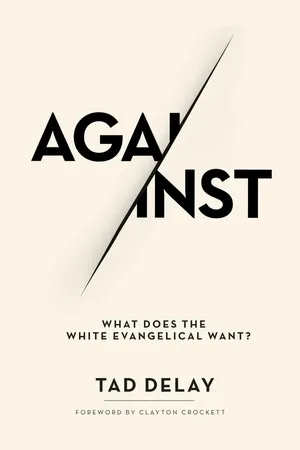
What does the white evangelical want? In our moment of crisis and rage, this question is everywhere. Scholars ask from where its desires emerged, pundits divine its political future, and the public asks how we lapsed into social chaos. For their part, white evangelicals feel misunderstood while failing to see the direction of their ambitions. We must interrogate its aims not only through its past or current trends but also through the various fantasies by which it rejects and enlivens reality.
Against traces five zones of opposition: future, knowledge, sexuality, reality, and society. If climate change is the greatest threat civilization has ever faced, then a faith aiding collapse must face analysis. If it swims in assured forgiveness, it feels no shame for its sins against humanity. If it wants a king, it threatens democracy. If it veils xenophobia, it shall be ever more cruel. In a critical and accessible history of odd ideas, DeLay chronicles the past and sketches its troubling future. It might die, but what's certain is that a faith built on nostalgia and supremacy won't moderate. We live in dangerous times, so let us consider its justifications, turmoil, appetite, and catastrophe.
Information
Topic
Theology & ReligionSubtopic
Psychoanalysis1
Against Future
Apocalypticism and Climate Collapse
“What the climate needs to avoid collapse is a contraction in humanity’s use of resources; what our economic model demands to avoid collapse is unfettered expansion. Only one of these sets of rules can be changed, and it’s not the laws of nature.”
—Naomi Klein
“In fantasy, the subject experiences himself as what he wants . . . in the place where he is truth without consciousness and without recourse. It is here that he creates himself in the thick absence called desire.”
—Jacques Lacan
The Optimist and the Pessimist
Halfway between the world wars, Albert Einstein dispatched a letter on behalf of a new project with the League of Nations. The International Institute of Intellectual Cooperation in Paris was founded in 1925 to foster intellectual and cultural exchange between scholars, artists, scientists, and teachers. Humanity’s march to extinction might be routed if the higher faculties of reason could generate cooperation. Perhaps a global coterie of genius might chasten the tribal impulses which careened into the Great War.
In the summer of 1932, Einstein pleaded for a public debate with an appeal to his reader’s idealism. He’d seen his correspondent’s awful account of human aggression, and Einstein felt such pessimism revealed a deep devotion to liberation.22 Only experts could decipher the perplexing vagaries rooted in complex psycho-social phenomena driving our self-destruction, he reasoned. Einstein figured a global government would resolve the drive for war, but we were doomed until archaic notions like sovereignty were exorcised from national consciousness. The ruling class already controlled the masses via the press, the church, and the schools. “How is it that these devices succeed so well in rousing men to such wild enthusiasm, even to sacrifice their lives?,” he asked. “Only one answer is possible. Because man has within him a lust for hatred and destruction.” His ultimate question was so very simple: “Is it possible to control man’s mental evolution so as to make him proof against the psychosis of hate and destructiveness?” He sent this open letter to the psychoanalyst who discovered the death drive.
Sigmund Freud’s response cheered on the physicist’s optimism while lamenting our self-destruction. On Freud’s wager, humanity enjoyed repetition. It was the whole reason his clinical practice was full of patients who had every opportunity to change and yet refused. The impulse to destroy was present in animalistic prehistory, cemented with property ownership, and ritualized with law and class divisions. Attachment to an object actually required bipolar affections such as love and hate. We couldn’t hold one without the conditions for the other, for love and hate (or progress and destruction) were two vectors of desire. Ridding society of violence would require we first rid ourselves of caring enough to fight. Destruction was not a mistake of evolution. It was practically the point.
While reading the exchange, I can’t help but wonder whether Freud secretly hoped Einstein would prove him wrong. Did he see Einstein as a naive physicist out of his element with social analysis? Or did Freud suspect his goal of “transforming neurotic misery into common unhappiness” might express itself in Einstein’s project? But the object was the prevention of war, not the excavation of the psyche. “The upshot of these observations,” the psychoanalyst concluded, “is that there is no likelihood of our being able to suppress humanity’s aggressive tendencies.”23
The pessimist proved right when anti-Semitism reached a murderous fever pitch and pressured his evacuation to England. Seven years after the exchange of letters, Freud was still lucid enough on his deathbed to understand the gravity of the German army’s invasion of Poland. One believed in an intellectually pacified future which never came. The other foresaw perpetual destruction that has not yet rid the earth of humanity. Neither yet knew of the apocalyptic possibilities of nuclear war or climate collapse around the temporal corner, and neither took seriously enough the religious commitment to realize such vivid apocalypse. They were worlds apart in their visions of the future.
Likewise, the historian Ernest Sandeen once observed, “Ever since its rise to notoriety in the 1920s, scholars have predicted the imminent demise of the movement. The Fundamentalists, to return the favor, have predicted the speedy end of the world. Neither prophecy has so far been fulfilled.”24 Which future do we expect? My argument in this chapter is not so complicated, for a pessimistic account of our dire situation is the only shot we have at an hopeful outcome. Climate collapse is the greatest threat our civilization has ever faced, but those who imagine themselves smart suppose our enemy is ignorance. If only the duped could see that the world truly is burning, we reason, they would vote on a carbon tax. Such naive optimism is dangerous. Reagan’s Secretary of the Interior, James G. Watt, once defended drilling oil and cutting more timber by telling Congress, “I don’t know how many future generations we can count on before the Lord returns.” It was rare honesty. Apocalyptic fatalism normally keeps its head down. Every day, you cross paths with multiple people who believe God will destroy the world before we reach the next century. What’s the point saving what God will surely destroy?
Apocalypse is a peculiar, deadly fantasy linked with climate denial, creating fertile ground for alliances so plainly exhibited between evangelicalism and Wall Street. Why does this alliance exist? What has Christ to do with the Dow? Goals are not identical, but there’s a shared ethos of future-denial. Capitalism has little incentive to think beyond the next financial quarterly earnings reports, while evangelicals deny the future in a more literal sense. The political theorist William E. Connolly called it an evangelical-capitalist resonance machine. The two parties share affinities—not goals—and they curate their alliance with polyvalent cues across multiple mediating apparatuses: the television in the home, the sermon in the pulpit, the literature consumed in private, the conversation between friends, the bumper sticker on the gas-guzzling truck, the meme spread across social media, the alternative education of the private or home school, the Bible study in the coffeehouse, and ultimately the political platform. Ideological apparatuses interpellate individuals into haphazardly constructed consciousness, foreign as they seem intuitive. Clandestine radicalization happens completely out in the open, and by the end of it the deregulation of the petroleum industry intertwines itself with heartfelt religion until there’s no daylight between the two. In effect, to be a good citizen is to destroy the world. If we wish to postpone the end of the world, we should understand the nature of this resonate machine, its fatalistic fantasies, and its commitment to destroy.
The Desire for the End is Not New
The world was supposed to end so many times already. Far from disillusionment, passing end dates often energize the disappointed faithful. Proliferation of end times thought intensified during the Industrial Revolution. In the northeastern United States, a following grew around the preacher William Miller (1782–1849). The oldest of sixteen children, Miller grew up on the border of Vermont and New York and eventually rejected his Baptist upbringing, preferring deism instead. Something changed during his military service, when he figured the deist God who wouldn’t interact with creation couldn’t procure an afterlife, so he drew himself back toward the personal God in the Scriptures. He worked a number of jobs while studying the Bible on his own time—self-radicalizing, one might say—until he discovered the world would end in “about the year 1843.” He traced his revelation to the same decade of the 1820s during which, over in the United Kingdom, the minister John Nelson Darby claimed to have discovered a rapture in which the faithful would rise to meet Christ in the skies before the Great Tribulation. Each initially hesitated several years before disseminating their revelations publicly. Each supposed there was no public appetite for such a message.
In the early 1830s, Miller committed himself to preaching full-time. It’s unclear how many fervent followers he had, but he estimated 50,000 to 100,000. He carried a list of more than seventy signatures from supportive ministers as he traveled thousands of miles back and forth across the northeastern United States and Canada. He purchased a tent to cover 3,000 listeners at a time to hear the prophecy. From the Book of Daniel 8:13–14,25 he narrowed Christ’s return to between March 1843 and March 1844.26 After April arrived, Miller felt deeply disappointed. However, some followers blamed the Gregorian calendar and drew a new prediction based on the Jewish calendar. Miller’s acolyte ...
Table of contents
- Title Page
- Foreword by Clayton Crockett
- Introduction
- Chapter 1: Against Future
- Chapter 2: Against Knowledge
- Chapter 3: Against Sexuality
- Chapter 4: Against Reality
- Chapter 5: Against Society
- Epilogue
- Acknowledgements
- Author Photo
- Bibliography
Trusted by 375,005 students
Access to over 1.5 million titles for a fair monthly price.
Study more efficiently using our study tools.
Frequently asked questions
Yes, you can cancel anytime from the Subscription tab in your account settings on the Perlego website. Your subscription will stay active until the end of your current billing period. Learn how to cancel your subscription
No, books cannot be downloaded as external files, such as PDFs, for use outside of Perlego. However, you can download books within the Perlego app for offline reading on mobile or tablet. Learn how to download books offline
Perlego offers two plans: Essential and Complete
- Essential is ideal for learners and professionals who enjoy exploring a wide range of subjects. Access the Essential Library with 800,000+ trusted titles and best-sellers across business, personal growth, and the humanities. Includes unlimited reading time and Standard Read Aloud voice.
- Complete: Perfect for advanced learners and researchers needing full, unrestricted access. Unlock 1.5M+ books across hundreds of subjects, including academic and specialized titles. The Complete Plan also includes advanced features like Premium Read Aloud and Research Assistant.
We are an online textbook subscription service, where you can get access to an entire online library for less than the price of a single book per month. With over 1.5 million books across 990+ topics, we’ve got you covered! Learn about our mission
Look out for the read-aloud symbol on your next book to see if you can listen to it. The read-aloud tool reads text aloud for you, highlighting the text as it is being read. You can pause it, speed it up and slow it down. Learn more about Read Aloud
Yes! You can use the Perlego app on both iOS and Android devices to read anytime, anywhere — even offline. Perfect for commutes or when you’re on the go.
Please note we cannot support devices running on iOS 13 and Android 7 or earlier. Learn more about using the app
Please note we cannot support devices running on iOS 13 and Android 7 or earlier. Learn more about using the app
Yes, you can access Against by Tad DeLay in PDF and/or ePUB format, as well as other popular books in Theology & Religion & Psychoanalysis. We have over 1.5 million books available in our catalogue for you to explore.