eBook - ePub
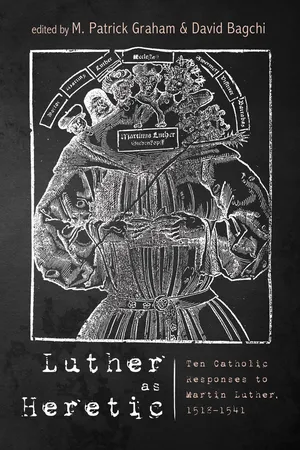
Luther as Heretic
Ten Catholic Responses to Martin Luther, 1518–1541
- 246 pages
- English
- ePUB (mobile friendly)
- Available on iOS & Android
eBook - ePub
Luther as Heretic
Ten Catholic Responses to Martin Luther, 1518–1541
About this book
The publication of Martin Luther's Ninety-Five Theses in 1517 immediately elicited responses from dozens of Roman Catholics in Germany and beyond. While Luther's works and those of his leading supporters have been available in English translation for many years, those of most of his Catholic opponents have not. In order to address this imbalance, win a fairer hearing for the Catholic opposition, and make it possible for students to understand both sides of the sixteenth-century religious debates, translators have drawn on the rich resources of the Kessler Reformation Collection at the Pitts Theology Library to present here introductions to and translations of ten Catholic pamphlets. The volume begins with an essay sketching the larger background for these publications. The editors' hope is that this book will prove useful for teaching and research and will foster a deeper understanding of the sixteenth-century theological discussions by allowing today's readers to hear voices that have been mostly silent in the English-speaking world for centuries.
Information
Topic
Theology & ReligionSubtopic
Christian Denominations1
Introduction
Reading the “Other Side” of the Reformation
Our knowledge of the Reformation suffers from a one-sidedness, a degree of uncertainty, while we are incomparably better acquainted with the reformers and their colleagues than with their opponents.1
These words were written in 1889 by a German Protestant historian, welcoming the appearance of a 500-page biography of one of Luther’s Catholic opponents. One hundred and thirty years later, it can safely be said that this proviso no longer applies.2 A succession of studies has both broadened and deepened our appreciation of the so-called “Catholic controversialists,” the collective name given to theologians who wrote against Luther and the other reformers. It is now widely acknowledged that their role was not purely a reactive one of negating the claims of Luther and other reformers with polemic, but that it embraced more positive strategies as well. For instance, it is clear that some Catholic writers used the printing press to reach and to teach the public, in order both to buttress their faith and to provide them with ready-made arguments against the blandishments of whatever wolf in sheep’s clothing they might encounter.3 Others tried to show that Luther’s teachings could be disproved on his own terms, on the basis of scripture alone, and did not merely confront him with reams of canon law and scholastic theology.4 In addition, we are now much more knowledgeable than before of the differences within the ranks of the Catholic controversialists, who did not present a unified or uniform front against their opponent in their understanding of the papacy, for example.5
In short, the Catholic controversialists can no longer be dismissed as knee-jerk reactionaries and supporters of the status quo, or as undifferentiated representatives of a moribund late-medieval scholasticism. Rather, they appear to us now as writers who were as thoughtful and committed as their Protestant counterparts. Of course, they do sometimes seem deficient both in reasoning and in reasonableness, to say nothing of Christian charity; but their pig-headedness in this respect is no worse than their opponents.’ Each saw in the other a threat to Christ’s church equal to or greater than the threat posed by the Ottoman Empire. No wonder they fought dirty.
There is of course much work still to be done to understand the Catholic controversialists fully, both as individuals and as a cohort. But at least they are now understood in their own terms and judged by their own criteria, as an important part of the full picture of the Reformation. The time when they were valued by Protestant historians merely as foils to enable Luther’s theological brilliance to shine more brightly, or by Roman Catholic historians for the degree of their loyalty to Tridentine orthodoxy, is long gone.
There is one respect, however, in which Walther’s words of 130 years ago still hold good, at least for monolingual anglophones. While the writings of sixteenth-century Protestants are readily available in English, in print and online, it is still difficult for those who lack a working knowledge of sixteenth-century Latin and German to access the writings of the Catholic controversialists, despite the availability of some superb translations.6 The present volume, using examples of Catholic controversial writing from the extensive Kessler Reformation Collection, therefore, meets a pressing need. Each translation, by an experienced translator, is prefaced by a detailed introduction, which sets both the writer and the writing in context. The purpose of this general introduction is to provide a wider perspective designed to contextualize and to characterize both the personalities involved and the nature of their literary response to Luther.
The Authors
In contrast with the evangelical pamphleteering of the day, publishing against the Reformation was no free-for-all, and Catholic writers generally did not take up the pen unless commanded to do so by their secular or ecclesiastical superiors. Evangelical propagandists saw in the need to challenge abuses and in their duty as baptized Christians to proclaim the gospel in season and out, sufficient reasons to publish a pamphlet or even a series of them. The only constraint was finding a printer prepared to handle the work. A famous example is that of Argula von Grumbach, who in her pamphlets called the authorities of the University of Ingolstadt out on the grounds that no one else was doing so. The requirement to defend God’s word and the demands of natural justice (the authorities had imprisoned and kept incommunicado a Lutheran student), she explained, overrode even the biblical injunction on women to keep silent.7
On the other hand, with few exceptions, Catholics published only if they had direct authorization to do so. Even the indulgence preacher Johann Tetzel, who had the most personal score of all to settle with Luther, wrote his Rebuttal not in a private capacity but as “inquisitor of heretical depravity” for Saxony and ultimately as part of the legal process against Luther.8 Duke George of Albertine Saxony used his authority as a prince, entrusted by God with the care of the souls of his duchy, to mobilize his bishops, his household, and the printing shops of Dresden and Leipzig to ban Luther’s works and to publish refutations of them. The success of his scheme can be seen from the fact that the presses in his lands were responsible for nearly half of all vernacular Catholic controversial theology in German-speaking lands between 1518 and 1555, a still more impressive statistic when one considers that the campaign ended in 1539, with George’s death.9 Many of the writings represented in this selection (by Alveldt, Bachmann, Cochlaeus, Emser, and Wulffer) were commissioned by Duke George, either directly or through his bishop, Adolf II (of Merseberg). While George was the most determined of the German princes to oppose the Reformation, he was not alone. The agency of Joachim, Margrave of Brandenburg, in commissioning Konrad Wimpina’s controversial works is made clear in the introduction to the document Against Martin Luther’s Confession at Augsburg, which is included in this collection.
There were important exceptions to this rule. Johann Eck first entered the lists against Luther in a private capacity when he circulated a manuscript of annotations on the Ninety-Five Theses among friends. Johannes Cochlaeus, who was to become a more prolific opponent of Luther than even Eck, and a far more influential one in the long term,10 wrote his early works independently. But both these exceptions serve to establish the rule: on the strength of his performance against Luther at the Leipzig Disputation, Eck was conscripted as an expert adviser to Pope Leo X over the official condemnation and was instrumental in first drafting and then promulgating the bull Exsurge Domine;11 Cochlaeus, having established a reputation as an energetic and effective freelance controversialist, was eventually appointed as Duke George’s court-chaplain in order to concentrate on his writing and so contribute more effectively to the duke’s campaign.12
This constraint goes some way to explaining who became controversialists and why. Those entrusted by the authorities with the responsible task of defending the church’s faith and practice had to be theologically competent and able to communicate effectively in writing. It is, therefore, not surprising that their backgrounds were predominantly clerical and/or monastic. The so-called “pamphlet war” in Germany, which ran from 1518 to 1525, involved over fifty writers on the Catholic side. Of those whose status can be determined, almost half (48 percent) were secular clergy. Of these, about two-thirds were lower clergy and included men such as Emser, Cochlaeus, and Wulffer who held court chaplaincies, and those, like Eck whose principal employment was as an academic. Th...
Table of contents
- Title Page
- Contributors
- Preface
- Abbreviations
- Timeline of Key Dates
- Chapter 1: Introduction
- Chapter 2: Johann Tetzel
- Chapter 3: Johann Eck
- Chapter 4: Hieronymus Emser
- Chapter 5: Augustin Alveldt
- Chapter 6: Wolfgang Wulffer
- Chapter 7: Augustin Alveldt
- Chapter 8: Johannes Cochlaeus
- Chapter 9: Konrad Wimpina and Others
- Chapter 10: Paul Bachmann
- Chapter 11: Johann Eck
Trusted by 375,005 students
Access to over 1.5 million titles for a fair monthly price.
Study more efficiently using our study tools.
Frequently asked questions
Yes, you can cancel anytime from the Subscription tab in your account settings on the Perlego website. Your subscription will stay active until the end of your current billing period. Learn how to cancel your subscription
No, books cannot be downloaded as external files, such as PDFs, for use outside of Perlego. However, you can download books within the Perlego app for offline reading on mobile or tablet. Learn how to download books offline
Perlego offers two plans: Essential and Complete
- Essential is ideal for learners and professionals who enjoy exploring a wide range of subjects. Access the Essential Library with 800,000+ trusted titles and best-sellers across business, personal growth, and the humanities. Includes unlimited reading time and Standard Read Aloud voice.
- Complete: Perfect for advanced learners and researchers needing full, unrestricted access. Unlock 1.5M+ books across hundreds of subjects, including academic and specialized titles. The Complete Plan also includes advanced features like Premium Read Aloud and Research Assistant.
We are an online textbook subscription service, where you can get access to an entire online library for less than the price of a single book per month. With over 1.5 million books across 990+ topics, we’ve got you covered! Learn about our mission
Look out for the read-aloud symbol on your next book to see if you can listen to it. The read-aloud tool reads text aloud for you, highlighting the text as it is being read. You can pause it, speed it up and slow it down. Learn more about Read Aloud
Yes! You can use the Perlego app on both iOS and Android devices to read anytime, anywhere — even offline. Perfect for commutes or when you’re on the go.
Please note we cannot support devices running on iOS 13 and Android 7 or earlier. Learn more about using the app
Please note we cannot support devices running on iOS 13 and Android 7 or earlier. Learn more about using the app
Yes, you can access Luther as Heretic by M. Patrick Graham,David Bagchi, M. Patrick Graham, David Bagchi in PDF and/or ePUB format, as well as other popular books in Theology & Religion & Christian Denominations. We have over 1.5 million books available in our catalogue for you to explore.