eBook - ePub
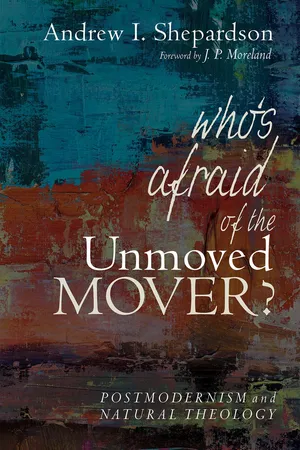
Who’s Afraid of the Unmoved Mover?
Postmodernism and Natural Theology
- 186 pages
- English
- ePUB (mobile friendly)
- Available on iOS & Android
eBook - ePub
About this book
Are postmodern philosophy and Christian theology compatible? A surprising number of Christian philosophers and theologians think so. However, these same thinkers argue that postmodern insights entail the rejection of natural theology, the ability to discover knowledge about the existence and nature of God in the natural world. Postmodernism, they claim, shows that appealing to nature to demonstrate or infer the existence of God is foolish because these appeals rely on modernity's outmoded grounds for knowledge. Moreover, natural theology and apologetics are often hindrances to authentic Christian faith. Notions like objectivity and rationality are forms of idolatry from which Christians should repent.
This book carefully examines the nature of truth, rationality, general revelation, and evangelism to show that the postmodern objections fail and that Christians ought to lovingly and faithfully use natural theology and apologetics to defend and commend the Christian faith to a world in need of the knowledge of God.
Information
Topic
Theology & ReligionSubtopic
Christian Theology1
Elucidation of the Problem and Definitions
Introduction
In terms of Christian theology, natural theology is understood as that branch of human inquiry which seeks to discover knowledge about the existence and nature of God apart from sources of revealed theology (i.e. the Bible, the person and work of Jesus Christ, the Holy Spirit, and various forms of prophecy). Knowledge of this kind is based on the validity or suggestive power of arguments made from observations of the natural world, human experience, and necessary truths. Various argument forms are employed including deduction, induction, and inferences to the best explanation. Closely related to natural theology is the practice of positive apologetics, where the arguments of natural theology and other aspects of Christian theology are defended rationally, with the claim, either explicit or implicit, that the doctrines and practices of Christianity correspond to reality, are internally consistent, and are existentially viable.1
The Evangelical philosophers James K. A. Smith, Myron B. Penner, and Carl A. Raschke claim that most forms of natural theology are dependent on modern conceptions of reason, truth, and language. Marshalling postmodernism’s critiques of foundationalist epistemology, the correspondence theory of truth, and referential semiotics, these authors argue that Evangelicals should reject natural theology. Appeals to common ground in nature to demonstrate or infer the existence of God will fail because these appeals are beholden to modernity’s outmoded grounds for knowledge. Moreover, because of their dependence on modernism, natural theology and apologetics are often hindrances to authentic Christian faith. According to these authors, notions like objectivity, neutrality, and rationality are various forms of idolatry, and any philosophical dependence on knowledge informed by these values will be a kind of idolatry.
I ask this key question: Do these postmodern Evangelical philosophers provide sound objections to natural theology? I will explicate the objections to natural theology made by Carl A. Raschke, James K. A. Smith, and Myron B. Penner and show that their objections fail by employing primarily analytic philosophical strategies and on occasion, biblical and systematic theology regarding the issues of truth, rationality, general revelation, and evangelism.
Postmodern Evangelical voices have been ascendant in theology and philosophy in the last fifteen years, and these three authors represent the more academic stream in the convergence of postmodern philosophy with Evangelical theology. Each of the authors shares the conviction that postmodernism and Evangelicalism share a number of important values. Though the initial plausibility of this conviction may be low for many Evangelicals, the authors provide a stunning cultural critique of Evangelicalism. The problem is that the cultural critique carries with it an epistemology that is fundamentally at odds with Evangelical assumptions regarding God-talk, evangelism, and the nature of religious truth because the epistemology denies that propositions about God are either true or false and undercuts a key evangelistic strategy: the use of natural theology for apologetics. I will support the intuition that our speech about God can relate to reality in meaningful and objective ways, buttressing the notion that religious truth, while having deep existential components, is not of a different kind than other truths about the universe.
The implications are important, though, especially for Evangelical theologies of mission and general revelation. As David Bebbington has argued, a key characteristic of Evangelicalism is conversionism, and if natural theology is biblically supported and culturally preferable, then it could be a valuable tool for Christian evangelists, preachers, teachers, and scholars. In the past generation, the scholarship of people like Francis Schaeffer and Josh McDowell has gained notoriety in using natural theology and apologetics in evangelistic endeavors. If the validity of the enterprise can be sustained in a world characterized by a postmodern zeitgeist, then Evangelical colleges and seminaries should provide training in philosophy and theology in general, and in natural theology and apologetics in particular.
Presuppositions
The thesis that the postmodern Evangelical rejection of natural theology fails involves some key assumptions, and my key assumptions are highly plausible for Evangelical theologians:
1. Propositions about the existence and nature of God are either true or false in relation to actual states of affairs in reality.2
2. Some features of Western logic, including some syllogistic argument forms and the laws of identity, non-contradiction, and the excluded middle, are reliable avenues toward adjudicating the truth or falsity of various truth claims. These are the benchmarks for a reasonable epistemology.
Method
In this work, detailed attention will be given to the works of Carl A. Raschke, James K. A. Smith, and Myron B. Penner. Carl A. Raschke provides a postmodern reinterpretation of a number of Evangelical and Reformation values including sola fide, sola scriptura, and the priesthood of all believers, applying these reinterpretations to a number of cultural developments in Evangelicalism, including natural theology and apologetics. Smith appropriates Derrida’s axiom that “there is nothing outside the text,” and Lyotard’s principle that postmodernism is “incredulity toward metanarratives,” in addition to his agreement with the Reformed objection to natural theology. In his The End of Apologetics, Penner provides the most focused and lengthy critique of natural theology considered in this thesis. He spells out in this work (and others) his rejection of objective, universal, and neutral reason that he claims is at the heart of Evangelical apologetics, and he offers a number of cultural critiques.
To date, few have attempted to address these authors’ key objections to natural theology, and because the authors’ work is copious and increasingly influential, a critique of their critique will help to reestablish natural theology as a relevant part of Evangelical philosophy of religion, systematics, and missiology for a new generation of scholars. While analytic thinkers like Douglas Groothuis, Richard B. Davis, W. Paul Franks, William Lane Craig, J. P. Moreland, and D. A. Carson have criticized the postmodern sympathies of some fellow Evangelicals, a detailed analysis of and response to postmodern attitudes toward the project of natural theology is yet to emerge. This work is original in that sense.
Below I will provide stipulative definitions of some key terms (Evangelical, postmodern, general revelation, natural theology, and apologetics). The second chapter will present vital background material which frames the intra-Evangelical debate about natural theology. Beginning with the Dutch Reformed tradition of Abraham Kuyper and the Princeton tradition exemplified by B. B. Warfield, and then discussing other key figures like Barth, Brunner, C. S. Lewis, Cornelius Van Til, Carl F. H. Henry, and William Lane Craig, that chapter will trace the development of Evangelical apologetics from the late nineteenth through the early twenty-first centuries to demonstrate how the terms of the current debate are set by older issues in Reformed theology and the practice of evangelism. The chapter will then summarize key works in postmodern philosophy and theology upon which Smith, Penner, and Raschke rely including those by Jacques Derrida, Jean-François Lyotard, Michel Foucault, Paul Ricoeur, Merold Westphal, and John D. Caputo.
The third and fourth chapters will set out in systematic form the key objections provided by Raschke, Smith, and Penner. The method for considering the authors’ various criticisms of natural theology and apologetics will be (1) to explicate their criticisms with reference to any specific employment of key postmodern philosophical voices, (2) to identify their key presuppositions, and (3) to situate their arguments in the works in which they appear and in their larger projects. After providing careful analysis of their criticisms (4), I will rebut their arguments by showing that they lack internal coherence, involve questionable presuppositions, and/or fail to account for key issues in Evangelical Christian theology (biblical and systematic) (5). The success of the rebuttal can be measured by showing the weaknesses of the postmodern philosophical and theological arguments and by showing how natural theology can take its rightful place in evangelism and systematics.3
The final chapter will offer a proposal for natural theology and apologetics after the failure of the postmodern Evangelical critique. Even though Evangelic...
Table of contents
- Title Page
- Foreword
- Acknowledgments
- Chapter 1: Elucidation of the Problem and Definitions
- Chapter 2: “Evangelical” Natural Theology and Postmodern Philosophy and Theology
- Chapter 3: Postmodern Evangelical Rejections of Natural Theology (Part 1)
- Chapter 4: Postmodern Evangelical Rejections of Natural Theology (Part 2)
- Chapter 5: Natural Theology After the Postmodern Critique
- Bibliography
Trusted by 375,005 students
Access to over 1.5 million titles for a fair monthly price.
Study more efficiently using our study tools.
Frequently asked questions
Yes, you can cancel anytime from the Subscription tab in your account settings on the Perlego website. Your subscription will stay active until the end of your current billing period. Learn how to cancel your subscription
No, books cannot be downloaded as external files, such as PDFs, for use outside of Perlego. However, you can download books within the Perlego app for offline reading on mobile or tablet. Learn how to download books offline
Perlego offers two plans: Essential and Complete
- Essential is ideal for learners and professionals who enjoy exploring a wide range of subjects. Access the Essential Library with 800,000+ trusted titles and best-sellers across business, personal growth, and the humanities. Includes unlimited reading time and Standard Read Aloud voice.
- Complete: Perfect for advanced learners and researchers needing full, unrestricted access. Unlock 1.5M+ books across hundreds of subjects, including academic and specialized titles. The Complete Plan also includes advanced features like Premium Read Aloud and Research Assistant.
We are an online textbook subscription service, where you can get access to an entire online library for less than the price of a single book per month. With over 1.5 million books across 990+ topics, we’ve got you covered! Learn about our mission
Look out for the read-aloud symbol on your next book to see if you can listen to it. The read-aloud tool reads text aloud for you, highlighting the text as it is being read. You can pause it, speed it up and slow it down. Learn more about Read Aloud
Yes! You can use the Perlego app on both iOS and Android devices to read anytime, anywhere — even offline. Perfect for commutes or when you’re on the go.
Please note we cannot support devices running on iOS 13 and Android 7 or earlier. Learn more about using the app
Please note we cannot support devices running on iOS 13 and Android 7 or earlier. Learn more about using the app
Yes, you can access Who’s Afraid of the Unmoved Mover? by Andrew I. Shepardson in PDF and/or ePUB format, as well as other popular books in Theology & Religion & Christian Theology. We have over 1.5 million books available in our catalogue for you to explore.