Storycraft
eBook - ePub

Storycraft

How to teach narrative writing

  1. 232 pages
  2. English
  3. ePUB (mobile friendly)
  4. Available on iOS & Android
eBook - ePub

Storycraft

How to teach narrative writing

About this book

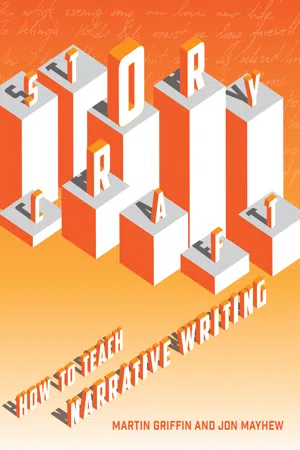
Martin Griffin and Jon Mayhew's Storycraft: How to teach narrative writing is an inspiring and practical resource to support secondary school teachers in developing their students' creative writing.

This book is not a style manual. Authors Martin Griffin and Jon Mayhew think there are plenty of those about. Instead, it picks apart the craft of narrative writing and equips teachers with activities designed to help their students overcome the difficulties they experience when tasked with creating something from nothing.

Written by two fiction writers and English teachers with over forty years' combined experience in education, Storycraft packs in expert guidance relating to idea generation and the nature of story and provides off-the-peg writing prompts that teachers can immediately adopt and adapt in the classroom.

The book breaks down the simple components that must be in place for a narrative to work the crafting of character, setting, shape and structure and shares fifty-one stimulating activities that will get students writing narratives regularly, more creatively and with greater confidence.

Martin and Jon also include helpful advice in a chapter dedicated to the process of editing in which they provide activities designed to help students diagnose and improve misfiring narratives, and they close the book with invaluable tips for GCSE exam preparation written directly for students and with an impending creative writing exam in mind.

Suitable for English teachers of students aged eleven to eighteen.

Frequently asked questions

Yes, you can cancel anytime from the Subscription tab in your account settings on the Perlego website. Your subscription will stay active until the end of your current billing period. Learn how to cancel your subscription.
At the moment all of our mobile-responsive ePub books are available to download via the app. Most of our PDFs are also available to download and we're working on making the final remaining ones downloadable now. Learn more here.
Perlego offers two plans: Essential and Complete
  • Essential is ideal for learners and professionals who enjoy exploring a wide range of subjects. Access the Essential Library with 800,000+ trusted titles and best-sellers across business, personal growth, and the humanities. Includes unlimited reading time and Standard Read Aloud voice.
  • Complete: Perfect for advanced learners and researchers needing full, unrestricted access. Unlock 1.4M+ books across hundreds of subjects, including academic and specialized titles. The Complete Plan also includes advanced features like Premium Read Aloud and Research Assistant.
Both plans are available with monthly, semester, or annual billing cycles.
We are an online textbook subscription service, where you can get access to an entire online library for less than the price of a single book per month. With over 1 million books across 1000+ topics, we’ve got you covered! Learn more here.
Look out for the read-aloud symbol on your next book to see if you can listen to it. The read-aloud tool reads text aloud for you, highlighting the text as it is being read. You can pause it, speed it up and slow it down. Learn more here.
Yes! You can use the Perlego app on both iOS or Android devices to read anytime, anywhere — even offline. Perfect for commutes or when you’re on the go.
Please note we cannot support devices running on iOS 13 and Android 7 or earlier. Learn more about using the app.
Yes, you can access Storycraft by Jon Mayhew,Martin Griffin in PDF and/or ePUB format, as well as other popular books in Pedagogía & Educación general. We have over one million books available in our catalogue for you to explore.

Information

CHAPTER 1

MANIFESTO FOR A CREATIVE CLASSROOM

If you search the internet for ‘the scientific method’ you get, at the time of writing, over 17 million hits, including Wikipedia pages, articles, definitions, images, beginner’s guides and introductions for various key stages.
If you search the internet for ‘the creative method’ you get fewer than 300,000 hits; that’s 1.76% of the pages dedicated to the scientific method. (The Creative Method, we discovered, is also the name of a Sydney-based design agency.)
Why the disparity? The characteristics of the scientific method have been established for nearly 500 years. You have a hypothesis which generates logical predictions. You then test these and gather evidence. The experiment must be replicable and peer approved. You arrive at a greater understanding having deconstructed something.
Scientific classrooms have the equipment and tools necessary to make these analyses. They have a lab assistant who wheels in trolleys of jars and test tubes from a stockroom full of materials. They have posters illustrating cross-section cutaways of hearts and eyes, drawings of light bouncing off surfaces, lists of parts and components.
But the creative method is about construction, not deconstruction. Moving from having nothing to having something you have crafted and built.
There is much discussion about how this process works, and every creative seems to be doing something very different. The picture is complicated by the fact that some writers and artists aren’t sure where their ideas come from and ascribe spiritual significance to them. Others claim to ‘hear voices’ or explain that all we have to do is ‘unearth the story’. Others speak of sudden flashes of inspiration.
All of this makes it harder to conceive of a ‘creative writing classroom’. Although it’s tempting to conjure up ideas of bright colours, informal seating, fun activities and eureka moments, these notions do nothing to encourage creative output. We’ve been teaching and writing for a combined forty years and when we sit at home to create we’re typing at a desk, alone. We’re responding to a brief having signed a contract for a book which specifies the length, audience, probable title and content. We’re on a deadline and we’ve got daily word count targets to reach.
Our manifesto for a creative classroom is an attempt to organise and formalise everything we’ve learned about the creative process. There are no weird or wacky suggestions here – nothing about sitting on a beanbag listening to free-form jazz and ‘writing what you feel’. Instead, creativity is about the same diligent and persistent hard work that brings success in every other subject and discipline. At its core is the concept of professionalism. As Steven Pressfield puts it in Turning Pro, ‘to defeat the self-sabotaging habits of procrastination, self-doubt, susceptibility to distraction, perfectionism and shallowness, we enlist the self-strengthening habits of order, regularity, discipline and a constant striving after excellence’.1

ADDRESSING MISCONCEPTIONS

Establishing ground rules will be important, particularly if students have some partially formed sense of what creativity is. They will need clear messages about the culture, expectations and parameters when they’re approaching a project in a new and unexpected way. Building a manifesto – a set of principles and ground rules – also requires us to spend some time surfacing and addressing some misconceptions about ‘learning to be creative’, all of which help to build a positive and purposeful working environment.
Here are ten principles we’ve found to be indispensable. We explore these ideas all the time, expressing them repeatedly in different ways. We’ve found that each one is good for busting a myth or misconception.
Principle 1: Writing successful narrative fiction is the result of a creative process that goes on for many weeks and months before the exam. This process can be taught, learned and engaged with over a long period of time.
Good for tackling: ‘The exam is random. There’s no reliable way to prepare. I’m going to go in there and wing it on the day, so these lessons are a waste of time.’
Principle 2: Becoming a good writer of narrative fiction means being professional: not waiting for inspiration to strike but working hard to hunt it down.
Good for tackling: ‘This will be easy. It’ll be a chance to kick back, relax, mess about and wait for an idea to come.’
Principle 3: Good stories are the result of stockpiling a huge number of ideas and sorting through the ordinary to find the unusual or interesting. Ideas arrive in pieces (micro-ideas) and stories have to be built from these pieces. Original is overrated. All story components have been used somewhere before, but that doesn’t stop you building something new with them.
Good for tackling: ‘I don’t have any ideas. I’ll never get any. All my ideas are rubbish. They’re not original.’
Principle 4: Good writers of narrative fiction read a lot of narrative fiction.
Good for tackling: ‘I can write well without reading. I’ve watched a ton of movies. I’m the exception to the rule.’
Principle 5: There are a thousand different ways to tell a good story. Creativity is an act of courage – of beginning your version of a story without knowing if it will be successful or if other people will like it.
Good for tackling: ‘How will I know when I’m “right”? I don’t want to be “wrong” and look stupid.’
Principle 6: There’s no such thing as writer’s block.
Good for tackling: ‘I’m blocked. I can’t do anything today.’
Principle 7: Quantity beats quality. We arrive at good writing on the other side of bad writing. You can’t edit a blank page.
Good for tackling: ‘I admit I’ve only done a paragraph, but it’s perfect. You’re going to love it. Quality beats quantity.’
Principle 8: Very few stories turn out as the writer hoped. The story in our head is always better than the one we produce on the page. These failures are a normal part of the creative process.
Good for tackling: ‘I’ll have an idea for a story, I’ll write it and the story will come out exactly as I’d hoped.’
Principle 9: Improvement comes from finding and making as many mistakes as possible, then learning from them. The more errors you make now, the fewer there are left to make in the exam.
Good for tackling: ‘Once I get the hang of this it’ll be easy. I’ll get gradually better each time I write. Progress will be smooth and inevitable.’
Principle 10: Creativity is not a gift given to some and not others. We all have the capacity.
Go...

Table of contents

  1. Cover
  2. Title Page
  3. Preface
  4. Acknowledgements
  5. Contents
  6. Introduction
  7. Chapter 1: Manifesto for a Creative Classroom
  8. Chapter 2: FORGE-ing Strategies
  9. Chapter 3: Crafting Characters
  10. Chapter 4: Crafting Settings
  11. Chapter 5: Crafting Shape and Structure
  12. Chapter 6: Editing
  13. Chapter 7: The Exam
  14. Conclusion
  15. The Storycraft Reading and Listening List: Twenty Places to Go Next
  16. Bibliography
  17. About the Authors
  18. Copyright