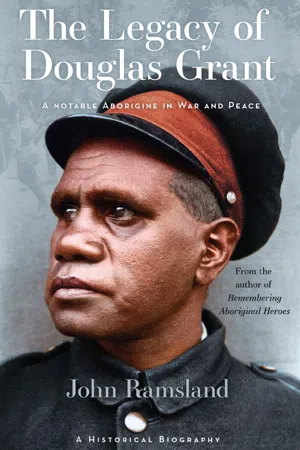
In The Legacy of Douglas Grant, John Ramsland vividly re-creates the famous Aborigine's life - now lost in the mists of history. Douglas was born to Indigenous parents and, as an infant, was the sole survivor of a cruel massacre in northern Queensland. As an adult, he was a charismatic speaker on Aboriginal rights, but spoke with a distinct Scottish burr. Why was this so?He was rescued by a kindly Scottish immigrant and brought up and well educated in the Scottish way in Sydney's leafy suburb of Annandale.Highly successful at school, he became a leading engineering draftsman at Mort's Dock Company in Balmain and, later, a woolclasser at "Belltrees" station near Scone in the Hunter Valley of NSW.With friends from "Belltrees", he joined the 1st AIF. His dangerous encounters on the Western Front and as a prisoner-of-war in Germany are pieced together by the author from many fragments.Douglas bravely faced unpleasant racism in post-war Australia, but never lost his keen sense of humour and scholarly interests.
- 200 pages
- English
- ePUB (mobile friendly)
- Available on iOS & Android
eBook - ePub
About this book
Information
Bullecourt 1
As part of the Battle of Arras, the 4th Australian Division, then serving in General Gough’s Fifth Army, … was ordered against the fortified village of Bullecourt on 11 April 1917. It took part of the Hindenburg Line without the assistance of tanks (which broke down) or artillery, but suffered grievously before it was withdrawn the next day.
A.K. Macdougal, 2015
Australia will demand to know the whole truth about Bullecourt and the equally lamentable affair of Fleurbaix [Fromelles] to which it bears a similar resemblance.
‘The First Battle of Bullecourt’, Sunday Times, 1 July 1917
Even though wounded, Douglas was one of the few who survived Bullecourt 1 – the First Battle of Bullecourt which took place on 10 and 11 April 1917. It was an experience of horror and devastation that he was never able to forget. After the war, it continued to haunt his dreams at night, even in his last years in the War Veterans Home on Bare Island, La Perouse.
The Australian battalions in France had already endured a terrible winter in 1916-1917 where opposing armies faced each other across a No Man’s Land of fields of frozen mud. The Germans had spent time in the lull of winter building a great defensive line a few kilometres behind the Front which the Allies called the Hindenburg Line. The Germans called it the Siegfriedstellung.
In early 1917, weather had improved slightly while the Germans staged an organised withdrawal to their famous new line. This gave the Allies a false, misguided hope of victory. They advanced up to the Hindenburg Line. General Douglas Haig, in command of the British Expedition Force (BEF) including the ANZACS, was desperate for a speedy victory, urged on by both the Prime Minister Lloyd George and his government. The French agreed to co-operate with a French offensive – the Grande Illusion – under the command of the General Robert Rivelle. The scheme was to break through at Arras with General Edmund Allenby and the British Third Army. For Allenby it was, at first, a successful offensive, its Canadian Corps seizing Vimy Ridge. And then it stalled.
General Sir Hubert Gough’s Fifth Army, in which the freshy arrived 1st Anzac Corps had been posted, were to join in the battle of Arras as a sideshow strategy, a diversionary. The Fifth Army were to launch a subsidiary attack on the heavily fortified village of Bullecourt. The idea was to divide the German defence.
The artillery was too far away engaged in other battles and thus, not yet available. Instead, Gough seized on the suggestions of tank commanders that they should lead the breakthrough with Mark 1 tanks instead of the usual preliminary bombardment. They intended that the foot soldiers, who were to follow, would be protected by the tanks in front of them. No preliminary bombardment was to be an essential part of the operation.
Gough did not bother to give the Australian infantry and the British tanks an opportunity to practise together in a careful dress rehearsal.
Favreuil village, where the 13th Battalion had been bivouacked on the outskirts of the much larger town of Bapaume, was eight miles behind the jumping-off point at a railway cutting about 1,200 yards from the heavily defended Hindenburg Line with deadly machine guns cleverly placed on three sides. Douglas was there with the battalion when they moved off in formation on an exhausting route march. They left Favreuil around midnight and were in position at the next railway cutting ready for the attack at 4.30 that morning.
The 14th and 15th Battalions of the AIF further on were already lying in No Man’s Land in a sunken part of the road seven hundred yards from the Hindenburg Line itself. All were in readiness, but the tanks had not yet arrived. They had technical problems to say the least. Some had gone astray in the dark and snow in which they found it impossible to navigate with any accuracy.
The village of Bullecourt bulged into No Man’s Land like a modern-day fortress, ringed with massive rolls of barbed wire with a well-planned network of trenches. General Gough issued the demand that Bullecourt was to be taken at all costs in an attack mounted to its west or left by a British division and by the right, it was to be stormed by the ANZAC division.
General William Birdwood, the Australian supremo, had previously pleaded for a postponement as the Bullecourt barbed wire seemed impenetrable and would result in a huge loss of life. But he was rebuffed by Gough and the British high command. He had begged passionately not to hazard his men needlessly. But Gough was stubbornly confident and was mistakenly convinced that the German army were about to withdraw from Bullecourt as British intelligence had seen burning. They had the mistaken belief that the enemy army was unravelling, falling apart.
Dawn was breaking. The men would be exposed in the open to the German artillery. A hasty decision to go ahead and attack had to be made. And then a contradiction. Under cover of a sudden, but fortunate snowstorm, the three thousand Australian soldiers were ordered to fall back in any order. Lieutenant Colonel Durant of the 13th ran out into the open field to shout to his company commanders: “Get back for your lives!”
Durant was an experienced officer from the Gallipoli campaign.
The 13th Battalion marched back down the eight-mile road from Ecoust to Favreuil. Exhausted from the route march, the men waited, shivering in the snow. Douglas felt stiff and frozen and his feet were sore. At 6pm orders were received to return hurriedly to the attacking point of the railway cutting as the attack was timed for 4.30am the following morning, April 11. The Australian soldiers had already spent nearly two sleepless nights. And by this stage, their condition in general was poor and deteriorating. So exhausted were they that they leant on each other as a mass of frozen bodies.
In the open field of the battle, terrible, well-organised German rifle and machine-gun fire enveloped the Australians as they advanced into what, for many, was a death trap. The terrific barrage was, to Douglas, like a high wind racing at them through a field of ripe wheat – and, like heavy wheat stalks, the men fell dead or wounded before the wind of lead.
Taking cover and lying close to one of his mates, Bert Knowles in “A” Company, 13th Battalion, Douglas murmured: “How cold it is on the fingers lying in this snow”.
“I think it’s bloody hot”, Bert replied.
Another man lying near them laughed a little hysterically, but Bert had a quiet smile on his face and Douglas grinned at the audacity of the man to have laughed so loudly in the middle of such horrific noisy slaughter.
Douglas began to wonder where it would all end as he knew that they were going forward despite having already lost half their strength in the relentless onslaught. They had no protection as promised since many of the tanks had lost their way or broken down. They had yet to go through two massive lines of barbed wire and enemy trenches as well as the fortified village of Bullecourt and then secure it by holding out for at least two days, all of which required keeping the rear effectively secured, which would continue to take many men out of the frontal attack. As well, there were no replacement troops behind them for several miles. They were on their own.
Douglas was brought back to reality by the urgent voice of Captain Harry Murray who had been recently awarded the Victoria Cross at Stormy or Cloudy Trench in the beginning of February that year: “Come on 13th! the 16th are getting hell”, he yelled.
But the German machine guns were having it all their own way and were well supplied with ammunition. It was almost dawn, but there was still some mist. The men did the next two hundred yards forward at a jogtrot. The machine guns wiped out fifty percent with a mere swish, so well placed were they.
Nevertheless, the Australian infantry managed to take the first German trench and, in a mighty effort, the survivors then took the second. They had already lost about sixty percent as casualties, including Douglas as he lay still, unconscious in the snow with shrapnel wounds – 825 metres had been temporarily gained on the Western Front with disastrous results.
Soon, however, the situation of the men still alive in the forward position became desperate as they were isolated and cut off at the back. About seventy-five to eighty percent of tho...
Table of contents
- Foreword
- A Scottish sojourn
- Finding Poppin Jerri
- Nurturer & the Nurtured
- Estaminet St Georges
- The Engraved Sovereign
- Bullecourt 1
- Prisoner-of-War
- Recognition behind barbed wire
- The Troubled 1920s
- Freedom of the Wallaby?
- Sanctuary! Sanctuary!
- Alone at Journey’s End
- Coda
- appendices
- BIBLIOGRAPHY & REFERENCES
Trusted by 375,005 students
Access to over 1.5 million titles for a fair monthly price.
Study more efficiently using our study tools.
Frequently asked questions
Yes, you can cancel anytime from the Subscription tab in your account settings on the Perlego website. Your subscription will stay active until the end of your current billing period. Learn how to cancel your subscription
No, books cannot be downloaded as external files, such as PDFs, for use outside of Perlego. However, you can download books within the Perlego app for offline reading on mobile or tablet. Learn how to download books offline
Perlego offers two plans: Essential and Complete
- Essential is ideal for learners and professionals who enjoy exploring a wide range of subjects. Access the Essential Library with 800,000+ trusted titles and best-sellers across business, personal growth, and the humanities. Includes unlimited reading time and Standard Read Aloud voice.
- Complete: Perfect for advanced learners and researchers needing full, unrestricted access. Unlock 1.5M+ books across hundreds of subjects, including academic and specialized titles. The Complete Plan also includes advanced features like Premium Read Aloud and Research Assistant.
We are an online textbook subscription service, where you can get access to an entire online library for less than the price of a single book per month. With over 1.5 million books across 990+ topics, we’ve got you covered! Learn about our mission
Look out for the read-aloud symbol on your next book to see if you can listen to it. The read-aloud tool reads text aloud for you, highlighting the text as it is being read. You can pause it, speed it up and slow it down. Learn more about Read Aloud
Yes! You can use the Perlego app on both iOS and Android devices to read anytime, anywhere — even offline. Perfect for commutes or when you’re on the go.
Please note we cannot support devices running on iOS 13 and Android 7 or earlier. Learn more about using the app
Please note we cannot support devices running on iOS 13 and Android 7 or earlier. Learn more about using the app
Yes, you can access The Legacy of Douglas Grant by John Ramsland in PDF and/or ePUB format, as well as other popular books in History & Historical Biographies. We have over 1.5 million books available in our catalogue for you to explore.