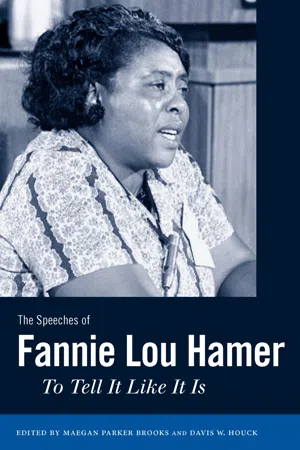
Most people who have heard of Fannie Lou Hamer (1917–1977) are aware of the impassioned testimony that this Mississippi sharecropper and civil rights activist delivered at the 1964 Democratic National Convention. Far fewer people are familiar with the speeches Hamer delivered at the 1968 and 1972 conventions, to say nothing of addresses she gave closer to home, or with Malcolm X in Harlem, or even at the founding of the National Women's Political Caucus. Until now, dozens of Hamer's speeches have been buried in archival collections and in the basements of movement veterans. After years of combing library archives, government documents, and private collections across the country, Maegan Parker Brooks and Davis W. Houck have selected twenty-one of Hamer's most important speeches and testimonies. As the first volume to exclusively showcase Hamer's talents as an orator, this book includes speeches from the better part of her fifteen-year activist career delivered in response to occasions as distinct as a Vietnam War Moratorium Rally in Berkeley, California, and a summons to testify in a Mississippi courtroom. Brooks and Houck have coupled these heretofore unpublished speeches and testimonies with brief critical descriptions that place Hamer's words in context. The editors also include the last full-length oral history interview Hamer granted, a recent oral history interview Brooks conducted with Hamer's daughter, as well as a bibliography of additional primary and secondary sources. The Speeches of Fannie Lou Hamer demonstrates that there is still much to learn about and from this valiant black freedom movement activist.
eBook - ePub
The Speeches of Fannie Lou Hamer
To Tell It Like It Is
- 288 pages
- English
- ePUB (mobile friendly)
- Available on iOS & Android
eBook - ePub
The Speeches of Fannie Lou Hamer
To Tell It Like It Is
About this book
Information
Federal Trial Testimony, Oxford, Mississippi, December 2, 1963
As her Continental Trailways bus arrived at Staley’s Café in Winona, Mississippi, on the morning of June 9, 1963, Fannie Lou Hamer could not have known her life was about to change dramatically. Nor did she likely know the extent to which local law enforcement officials had so brutally and swiftly suppressed any civil rights activity there long before her arrival.
Hamer, along with her traveling companions Annell Ponder, James West, June Johnson, Rosemary Freeman, and Euvester Simpson were traveling back to the Delta after a week-long voter education workshop in Charleston, South Carolina, led by the legendary teacher-activist Septima Clark. Unbeknownst to the road-weary travelers, Winona and Montgomery County officials were not eager to heed the 1961 Interstate Commerce Commission ruling, which effectively integrated interstate travel. In fact, in State Sovereignty Commission documents, local officials were feted for realizing “that each person has a responsibility in helping to resist those who would destroy our way of life by attempting to carrying [sic] out governmental department orders or decrees.” Such resistance entailed re-segregating the lunch counter and the restrooms at Staley’s in the fall of 1961.
Into this thicket of white intransigence Hamer and her friends walked. While several members of the party were badly beaten in the local jailhouse following their arrest, none was more savage than the beating ordered by the state highway patrolman and chief of police to be administered by two black prisoners—Sol Poe and Roosevelt Knox—on Fannie Lou Hamer. She would carry the beating with her until her death fourteen years later. It was a beating provoked, in her frequent retelling, by her civil rights activism back home in Ruleville. Largely because of the brutal beatings, and the seemingly irrefutable physical evidence therein, the Justice Department took an interest in the case—something the federal government was still slow to do in 1963.
The government brought suit against Earle Wayne Patridge, Thomas J. Herod, Jr., William Surrell, John L. Basinger, and Charles Thomas Perkins in U.S. District Court in the Northern District of Mississippi, Western Division. Its star witness was Fannie Lou Hamer, who testified at length in Oxford on December 2, 1963. Despite her steadfast and moving account of what happened on June 9, 10, and 11, and the damning evidence provided by her travel companions, the twelve-member all-white and all-male jury deliberated for a mere seventyfive minutes; on December 6, they found each defendant not guilty of violating the activists’ civil rights.
Whenever Fannie Lou Hamer spoke publicly after being bonded out of the Montgomery County Jail, the gruesome details of Winona were almost never spared; the “incident,” regardless of how many times she recounted it North and South, never failed to move both the speaker and her disbelieving audiences. Her accounts of the Winona beating also dramatically conveyed the larger sickness of white supremacy, as she carefully characterized her experience as symptomatic of a systemic illness rather than simply a small-town act of unpunished sadism.

Would you state your full name.
FLH. Mrs. Fannie Lou Hamer.
Q. Where do you live?
FLH. 626 East Lafayette Street, Ruleville, Mississippi.
Q. What does your family consist of, Mrs. Hamer?
FLH. Four.
Q. Who are the members of your family?
FLH. My husband and two daughters.
Q. Where were you born?
FLH. I was born in Webster County, Tomnolen, Mississippi.
Q. Where have you lived?
FLH. I’ve been in Sunflower County, not out of Sunflower County a year for forty-four years.
Q. Lived all your life in Mississippi.
FLH. That’s right.
Q. Now, are you associated at the present time with any organization that has among its purposes the encouragement of Negroes to vote in Mississippi?
FLH. Yes.
Q. What’s that organization?
FLH. I’m a field secretary for the Student Nonviolent Coordinating Committee.
Q. How long have you been connected with that organization?
FLH....
Table of contents
- Cover Page
- Title Page
- Copyright Page
- Dedication
- Contents
- Introduction
- “I Don’t Mind My Light Shining,”
- Federal Trial Testimony, Oxford, Mississippi, December 2, 1963
- Testimony Before a Select Panel on Mississippi and Civil Rights, Washington, D.C., June 8, 1964
- Testimony Before the Credentials Committee at the Democratic National Convention, Atlantic City, New Jersey, August 22, 1964
- “We’re On Our Way,” Speech Delivered at a Mass Meeting in Indianola,Mississippi, September 1964
- “I’m Sick and Tired of Being Sick and Tired,” Speech Delivered withMalcolm X at the Williams Institutional CME Church, Harlem, New York,December 20, 1964
- Testimony Before the Subcommittee on Elections of the Committee onHouse Administration, House of Representatives, Washington, D.C.,September 13, 1965
- “The Only Thing We Can Do Is to Work Together,” Speech Deliveredat a Chapter Meeting of the National Council of Negro Women inMississippi, 1967
- “What Have We to Hail?,” Speech Delivered in Kentucky, Summer 1968
- Speech on Behalf of the Alabama Delegation at the 1968 DemocraticNational Convention, Chicago, Illinois, August 27, 1968
- “To Tell It Like It Is,” Speech Delivered at the Holmes County, Mississippi,Freedom Democratic Party Municipal Elections Rally in Lexington,Mississippi, May 8, 1969
- Testimony Before the Democratic Reform Committee, Jackson, Mississippi,May 22, 1969
- “To Make Democracy a Reality,” Speech Delivered at the Vietnam WarMoratorium Rally, Berkeley, California, October 15, 1969
- “America Is a Sick Place, and Man Is on the Critical List,” Speech Deliveredat Loop College, Chicago, Illinois, May 27, 1970
- “Until I Am Free, You Are Not Free Either,” Speech Delivered at theUniversity of Wisconsin, Madison, Wisconsin, January 1971
- “Is It Too Late?,” Speech Delivered at Tougaloo College, Tougaloo,Mississippi, Summer 1971
- “Nobody’s Free Until Everybody’s Free,” Speech Delivered at the Founding ofthe National Women’s Political Caucus, Washington, D.C., July 10, 1971
- “If the Name of the Game Is Survive, Survive,” Speech Delivered in Ruleville,Mississippi, September 27, 1971
- Seconding Speech for the Nomination of Frances Farenthold, Delivered atthe 1972 Democratic National Convention, Miami Beach, Florida,July 13, 1972
- Interview with Fannie Lou Hamer by Dr. Neil McMillen, April 14, 1972, andJanuary 25, 1973, Ruleville, Mississippi; Oral History Program, University ofSouthern Mississippi
- “We Haven’t Arrived Yet,” Presentation and Responses to Questions at theUniversity of Wisconsin, Madison, Wisconsin, January 29, 1976
- Appendix
- Acknowledgments
- Suggestions for Further Reading and Research
- Index
Trusted by 375,005 students
Access to over 1.5 million titles for a fair monthly price.
Study more efficiently using our study tools.
Frequently asked questions
Yes, you can cancel anytime from the Subscription tab in your account settings on the Perlego website. Your subscription will stay active until the end of your current billing period. Learn how to cancel your subscription
No, books cannot be downloaded as external files, such as PDFs, for use outside of Perlego. However, you can download books within the Perlego app for offline reading on mobile or tablet. Learn how to download books offline
Perlego offers two plans: Essential and Complete
- Essential is ideal for learners and professionals who enjoy exploring a wide range of subjects. Access the Essential Library with 800,000+ trusted titles and best-sellers across business, personal growth, and the humanities. Includes unlimited reading time and Standard Read Aloud voice.
- Complete: Perfect for advanced learners and researchers needing full, unrestricted access. Unlock 1.5M+ books across hundreds of subjects, including academic and specialized titles. The Complete Plan also includes advanced features like Premium Read Aloud and Research Assistant.
We are an online textbook subscription service, where you can get access to an entire online library for less than the price of a single book per month. With over 1.5 million books across 990+ topics, we’ve got you covered! Learn about our mission
Look out for the read-aloud symbol on your next book to see if you can listen to it. The read-aloud tool reads text aloud for you, highlighting the text as it is being read. You can pause it, speed it up and slow it down. Learn more about Read Aloud
Yes! You can use the Perlego app on both iOS and Android devices to read anytime, anywhere — even offline. Perfect for commutes or when you’re on the go.
Please note we cannot support devices running on iOS 13 and Android 7 or earlier. Learn more about using the app
Please note we cannot support devices running on iOS 13 and Android 7 or earlier. Learn more about using the app
Yes, you can access The Speeches of Fannie Lou Hamer by Maegan Parker Brooks, Davis W. Houck, Maegan Parker Brooks,Davis W. Houck in PDF and/or ePUB format, as well as other popular books in History & North American History. We have over 1.5 million books available in our catalogue for you to explore.