eBook - ePub
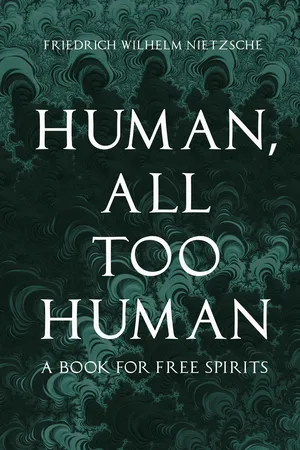
Human, All Too Human
A Book for Free Spirits
- 126 pages
- English
- ePUB (mobile friendly)
- Available on iOS & Android
eBook - ePub
About this book
"Human, All Too Human: A Book for Free Spirits" is a 1878 book by 19th-century philosopher Friedrich Nietzsche. It represents Nietzsche's first work in the aphoristic style that would become a dominant force in his writings, exploring a range of ideas in short sayings or paragraphs. This fascinating volume is not to be missed by those with an interest in philosophy and constitutes a must-read for fans and collectors of Nietzsche influential work. Contents include: "Of the First and Last Things", "History of the Moral Feelings", and "Religious Life". Friedrich Wilhelm Nietzsche (1844–1900) was a German critic, philosopher, composer, philologist, poet, and Latin and Greek scholar. Other notable works by this author include: "Thus Spoke Zarathustra" (1892), "The Antichrist" (1888), and "The Birth of Tragedy" (1872). Many vintage books such as this are becoming increasingly scarce and expensive. It is with this in mind that we are republishing this volume now in an affordable, modern, high-quality edition complete with the original text and artwork.
Information
HISTORY OF
THE MORAL FEELINGS.
THE MORAL FEELINGS.
35
Advantages of Psychological Observation.—That reflection regarding the human, all-too-human—or as the learned jargon is: psychological observation—is among the means whereby the burden of life can be made lighter, that practice in this art affords presence of mind in difficult situations and entertainment amid a wearisome environment, aye, that maxims may be culled in the thorniest and least pleasing paths of life and invigoration thereby obtained: this much was believed, was known—in former centuries. Why was this forgotten in our own century, during which, at least in Germany, yes in Europe, poverty as regards psychological observation would have been manifest in many ways had there been anyone to whom this poverty could have manifested itself. Not only in the novel, in the romance, in philosophical standpoints—these are the works of exceptional men; still more in the state of opinion regarding public events and personages; above all in general society, which says much about men but nothing whatever about man, there is totally lacking the art of psychological analysis and synthesis. But why is the richest and most harmless source of entertainment thus allowed to run to waste? Why is the greatest master of the psychological maxim no longer read?—for, with no exaggeration whatever be it said: the educated person in Europe who has read La Rochefoucauld and his intellectual and artistic affinities is very hard to find; still harder, the person who knows them and does not disparage them. Apparently, too, this unusual reader takes far less pleasure in them than the form adopted by these artists should afford him: for the subtlest mind cannot adequately appreciate the art of maxim-making unless it has had training in it, unless it has competed in it. Without such practical acquaintance, one is apt to look upon this making and forming as a much easier thing than it really is; one is not keenly enough alive to the felicity and the charm of success. Hence present day readers of maxims have but a moderate, tempered pleasure in them, scarcely, indeed, a true perception of their merit, so that their experiences are about the same as those of the average beholder of cameos: people who praise because they cannot appreciate, and are very ready to admire and still readier to turn away.
36
Objection.—Or is there a counter-proposition to the dictum that psychological observation is one of the means of consoling, lightening, charming existence? Have enough of the unpleasant effects of this art been experienced to justify the person striving for culture in turning his regard away from it? In all truth, a certain blind faith in the goodness of human nature, an implanted distaste for any disparagement of human concerns, a sort of shamefacedness at the nakedness of the soul, may be far more desirable things in the general happiness of a man, than this only occasionally advantageous quality of psychological sharpsightedness; and perhaps belief in the good, in virtuous men and actions, in a plenitude of disinterested benevolence has been more productive of good in the world of men in so far as it has made men less distrustful. If Plutarch's heroes are enthusiastically imitated and a reluctance is experienced to looking too critically into the motives of their actions, not the knowledge but the welfare of human society is promoted thereby: psychological error and above all obtuseness in regard to it, help human nature forward, whereas knowledge of the truth is more promoted by means of the stimulating strength of a hypothesis; as La Rochefoucauld in the first edition of his "Sentences and Moral Maxims" has expressed it: "What the world calls virtue is ordinarily but a phantom created by the passions, and to which we give a good name in order to do whatever we please with impunity." La Rochefoucauld and those other French masters of soul-searching (to the number of whom has lately been added a German, the author of "Psychological Observations") are like expert marksmen who again and again hit the black spot—but it is the black spot in human nature. Their art inspires amazement, but finally some spectator, inspired, not by the scientific spirit but by a humanitarian feeling, execrates an art that seems to implant in the soul a taste for belittling and impeaching mankind.
37
Nevertheless.—The matter therefore, as regards pro and con, stands thus: in the present state of philosophy an awakening of the moral observation is essential. The repulsive aspect of psychological dissection, with the knife and tweezers entailed by the process, can no longer be spared humanity. Such is the imperative duty of any science that investigates the origin and history of the so-called moral feelings and which, in its progress, is called upon to posit and to solve advanced social problems:—The older philosophy does not recognize the newer at all and, through paltry evasions, has always gone astray in the investigation of the origin and history of human estimates (Werthschätzungen). With what results may now be very clearly perceived, since it has been shown by many examples, how the errors of the greatest philosophers have their origin in a false explanation of certain human actions and feelings; how upon the foundation of an erroneous analysis (for example, of the so called disinterested actions), a false ethic is reared, to support which religion and like mythological monstrosities are called in, until finally the shades of these troubled spirits collapse in physics and in the comprehensive world point of view. But if it be established that superficiality of psychological observation has heretofore set the most dangerous snares for human judgment and deduction, and will continue to do so, all the greater need is there of that steady continuance of labor that never wearies putting stone upon stone, little stone upon little stone; all the greater need is there of a courage that is not ashamed of such humble labor and that will oppose persistence, to all contempt. It is, finally, also true that countless single observations concerning the human, all-too-human, have been first made and uttered in circles accustomed, not to furnish matter for scientific knowledge, but for intellectual pleasure-seeking; and the original home atmosphere—a very seductive atmosphere—of the moral maxim has almost inextricably interpenetrated the entire species, so that the scientific man involuntarily manifests a sort of mistrust of this species and of its seriousness. But it is sufficient to point to the consequences: for already it is becoming evident that events of the most portentous nature are developing in the domain of psychological observation. What is the leading conclusion arrived at by one of the subtlest and calmest of thinkers, the author of the work "Concerning the Origin of the Moral Feelings", as a result of his thorough and incisive analysis of human conduct? "The moral man," he says, "stands no nearer the knowable (metaphysical) world than the physical man."19 This dictum, grown hard and cutting beneath the hammer-blow of historical knowledge, can some day, perhaps, in some future or other, serve as the axe that will be laid to the root of the "metaphysical necessities" of men—whether more to the blessing than to the banning of universal well being who can say?—but in any event a dictum fraught with the most momentous consequences, fruitful and fearful at once, and confronting the world in the two faced way characteristic of all great facts.
38
To What Extent Useful.—Therefore, whether psychological observation is more an advantage than a disadvantage to mankind may always remain undetermined: but there is no doubt that it is necessary, because science can no longer dispense with it. Science, however, recognizes no considerations of ultimate goals or ends any more than nature does; but as the latter duly matures things of the highest fitness for certain ends without any intention of doing it, so will true science, doing with ideas what nature does with matter,20 promote the purposes and the welfare of humanity, (as occasion may afford, and in many ways) and attain fitness [to ends]—but likewise without having intended it.
He to whom the atmospheric conditions of such a prospect are too wintry, has too little fire in him: let him look about him, and he will become sensible of maladies requiring an icy air, and of people who are so "kneaded together" out of ardor and intellect that they can scarcely find anywhere an atmosphere too cold and cutting for them. Moreover: as too serious individuals and nations stand in need of trivial relaxations; as others, too volatile and excitable require onerous, weighty ordeals to render them entirely healthy: should not we, the more intellectual men of this age, which is swept more and more by conflagrations, catch up every cooling and extinguishing appliance we can find that we may always remain as self contained, steady and calm as we are now, and thereby perhaps serve this age as its mirror and self reflector, when the occasion arises?
39
The Fable of Discretionary Freedom.—The history of the feelings, on the basis of which we make everyone responsible, hence, the so-called moral feelings, is traceable in the following leading phases. At first single actions are termed good or bad without any reference to their motive, but solely because of the utilitarian or prejudicial consequences they have for the community. In time, however, the origin of these designations is forgotten [but] it is imagined that action in itself, without reference to its consequences, contains the property "good" or "bad": with the same error according to which language designates the stone itself as hard[ness] the tree itself as green[ness]—for the reason, therefore, that what is a consequence is comprehended as a cause. Accordingly, the good[ness] or bad[ness] is incorporated into the motive and [any] deed by itself is regarded as morally ambiguous. A step further is taken, and the predication good or bad is no longer made of the particular motives but of the entire nature of a man, out of which motive grows as grow the plants out of the soil. Thus man is successively made responsible for his [particular] acts, then for his [course of] conduct, then for his motives and finally for his nature. Now, at last, is it discovered that this nature, even, cannot be responsible, inasmuch as it is only and wholly a necessary consequence and is synthesised out of the elements and influence of past and present ...
Table of contents
- Friedrich Nietzsche
- PREFACE.
- OF THE FIRST AND LAST THINGS.
- HISTORY OF THE MORAL FEELINGS.
- THE RELIGIOUS LIFE.
Trusted by 375,005 students
Access to over 1.5 million titles for a fair monthly price.
Study more efficiently using our study tools.
Frequently asked questions
Yes, you can cancel anytime from the Subscription tab in your account settings on the Perlego website. Your subscription will stay active until the end of your current billing period. Learn how to cancel your subscription
No, books cannot be downloaded as external files, such as PDFs, for use outside of Perlego. However, you can download books within the Perlego app for offline reading on mobile or tablet. Learn how to download books offline
Perlego offers two plans: Essential and Complete
- Essential is ideal for learners and professionals who enjoy exploring a wide range of subjects. Access the Essential Library with 800,000+ trusted titles and best-sellers across business, personal growth, and the humanities. Includes unlimited reading time and Standard Read Aloud voice.
- Complete: Perfect for advanced learners and researchers needing full, unrestricted access. Unlock 1.5M+ books across hundreds of subjects, including academic and specialized titles. The Complete Plan also includes advanced features like Premium Read Aloud and Research Assistant.
We are an online textbook subscription service, where you can get access to an entire online library for less than the price of a single book per month. With over 1.5 million books across 990+ topics, we’ve got you covered! Learn about our mission
Look out for the read-aloud symbol on your next book to see if you can listen to it. The read-aloud tool reads text aloud for you, highlighting the text as it is being read. You can pause it, speed it up and slow it down. Learn more about Read Aloud
Yes! You can use the Perlego app on both iOS and Android devices to read anytime, anywhere — even offline. Perfect for commutes or when you’re on the go.
Please note we cannot support devices running on iOS 13 and Android 7 or earlier. Learn more about using the app
Please note we cannot support devices running on iOS 13 and Android 7 or earlier. Learn more about using the app
Yes, you can access Human, All Too Human by Friedrich Wilhelm Nietzsche, Alexander Harvey in PDF and/or ePUB format, as well as other popular books in Psychology & Ethics & Moral Philosophy. We have over 1.5 million books available in our catalogue for you to explore.