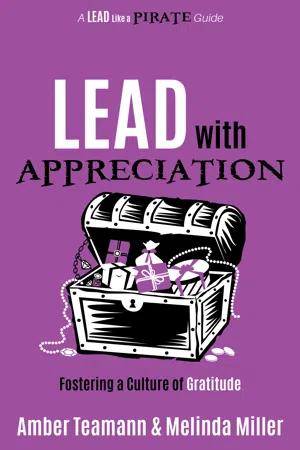
Positive recognition and appreciation can transform your school from a place where people have to work into one where they want to work and enjoy bringing their best every day. And that transformation starts with the leader! In this Lead Like a PIRATE Guide, Amber Teamann and Melinda Miller offer practical and doable strategies to revolutionize your campus culture.
- English
- ePUB (mobile friendly)
- Available on iOS & Android
eBook - ePub
About this book
Information
Topic
PedagogíaSubtopic
Educación general1
What’s Your Style?

There is tremendous value in getting to know the people you work with and the members of your team. Relationship building isn’t just a cliché; it can be the difference between a team that works together and a team that is together to work. Before you can appreciate your team, you need to get to know them! I (Amber) learned quickly in my first year that there is no rushing relationships. It was in December that I realized that even though I had been there six WHOLE months, I still hadn’t invested in real quality time with my people. I’d been in the building six months, but in actual conversations, experiences, or trust-building opportunities, it was just a handful with each teacher. I had not intentionally been going out of my way to get to know them on a personal level but simply interacting with them daily on a professional one.
New leaders, learn this from my mistake! When you are in a new position or role, it’s easy to get caught up in your excitement and energy. You’ve been waiting for this chance, and now you’re the leader! You’re in charge! You get to make decisions and make changes! Your position precedes your person each time you walk into a room. When you speak, you speak as the leader, as the one in evaluative control.
One of the things my current district utilizes is the Gallup’s Strengths Finder. The Clifton StrengthsFinder is an online assessment that helps individuals identify, understand, and maximize their strengths. This is incredibly powerful for me not only to know more about myself but also to learn more about the people I am surrounded by. The bulk of the staff I hadn’t hired, but through the Gallup lens, I was able to immediately get a feel for what they contributed to our team.
All people have a unique combination of talents, knowledge, and skills—strengths—that they use in their daily lives to do their work, achieve their goals, and interact with others. Gallup has found that when people understand and apply their strengths, the effect on their lives and work is transformational. “Gallup analysis reveals that people who use their strengths every day are three times more likely to report having an excellent quality of life, six times more likely to be engaged at work, 8% more productive, and 15% less likely to quit their jobs.” My number one Gallup strength is “activator.” An activator wants action, wants to jump right in and make things happen. I have learned to guard my impulsive “let’s” so others around me don’t feel the pressure to move as quickly as I do. I also surround myself with people who have different strengths. From our teacher leadership teams to my amazing AP and counselor, we make decisions as a team. While I ultimately have autonomy to make decisions, “because I said so” is a terrible leadership strategy. Making sure our relationships are as balanced as possible allows decisions to be made confidently, clearly, and to be easily communicated. These connections matter in every situation and hopefully convey to our campus that we are invested in making the RIGHT decision, not just the easiest or the most convenient one.
Why does this matter in a book about appreciation? It matters because you can’t rush relationships, and you can’t rush getting to know people. A team is only as strong as its weakest link, and part of your responsibility is to build up all the links. By recognizing each of your team members and knowing what makes them tick, you find where and how you can build them up. Employees who feel appreciated are going to do more than what is expected. Employee engagement is the appreciative acknowledgment of a person or a team’s efforts that exceed the expectations of their role or behaviors that benefit the success of the business. This can be done formally or informally as long as the employee feels valued. How they each feel valued, though, will vary. There are a variety of additional ways you get to know your people.
I’ve mentioned the Clifton’s Strengths Finder. Another tool I have used with my team is the Enneagram. The enneagram is a personality typing system that consists of nine different types. Everyone is considered to be one single type, although one can have traits belonging to other ones. We all know effective leadership depends on self-awareness and self-management. This requires a willingness to look inside oneself, to listen to feedback, and to respond to the needs of each situation. As a leader, both your strengths and your weaknesses have a huge impact on your staff and amongst your teams. If you have an opportunity to do ANY sort of personality quizzes or even take the easy enneagram quiz, you’ll have an opportunity to see a different way of looking at your team’s strengths and weaknesses. This will, again, allow you to best meet the needs of your people.
Disclaimer: Not all of your staff will feel appreciated by “gifts.” For the life of me, I (Melinda) could not figure out why my teachers did not feel appreciated or loved. I was working nights and weekends on treats and cute little Pinterest tokens of appreciation. Then my superintendent mentioned he had read The 5 Languages of Appreciation in the Workplace: Empowering Organizations by Encouraging People by Gary Chapman and Paul White. I immediately downloaded the book on Audible and started listening every morning while getting ready for work. It’s like the “love languages,” only it is appropriate for a work environment.
Here are the 5 Languages of Appreciation at Work:
- Acts of Service
- Tangible Gifts
- Quality Time
- Words of Affirmation
- Physical Touch (Appropriate for Workplace)
After finishing the book, I knew it would be valuable for me to know my teachers’ languages of appreciation at work. I purchased the survey for each staff member and sent it out before school started. I anxiously awaited their results. They completed the survey and then emailed me the results. There is a PowerPoint template that you use to enter all the results.
To say the results were surprising would be an understatement. My language of appreciation is “gifts.” Buy me all the things! My least language of appreciation is “words of affirmation.” Telling me “good job” or saying complimentary things to me about my work . . . in one ear out the other. Buy me things; I love you! I was not shocked by these results in my own survey; however, I felt awful. How shallow and insensitive is it to “need” material things to feel good about myself?
What made this even harder to swallow is that I am the only one on my staff whose primary language of appreciation is “gifts.” There’s the answer. The appreciation I was showing was not their primary language of appreciation. I’ll pause here for you to guess what my staff’s primary language of appreciation is . . . quality time! What do administrators have the least amount of? Quality time! Needless to say, I am re-evaluating what I do to show appreciation to my teachers.
What this boils down to is that there are a lot of ways to get to know your staff. You can choose whichever one you feel comfortable with, but we do think these are helpful ways to start as you lead. Our goal for this book is to help you find ways to appreciate, encourage, and empower others. The group that Melinda and I started on Facebook was the catalyst for this book. It was a group for administrators that allowed us to share creative and easy ways to show our appreciation for our staff. Its membership is now in the thousands, and we have learned so much from so many of you! We plan to share many of those ideas in this book, which is broken down through the calendar year with special attention paid to what we think of as the “Big Three.” Those would be October and February—which Melinda affectionately refers to as the “armpits of the school year”—and the holiday season of December. Although we’ll focus on those three months, any of our ideas can be used at any time during the year. Whether you come across a fantastic sale on cute sticky notes, are having a particularly low season, or just want to make some co-workers smile, using any of these ideas can help improve the climate of your campus, office, or team.
Conclusion
Regardless of your work love language, Gallup strengths, or enneagram number, we guarantee there are people on your team who don’t think or react in the same way you do. Our goal is to provide you with easy-to-implement ideas to meet as many needs on your team as possible. Even if you aren’t comfortable showing appreciation in this way, we believe you will be able to find an idea that will work for your leadership style. These efforts can be delegated, simplified, and expanded. Think of them as a starting place and then use your imagination! With employee appreciation, you’re not only boosting performance and engagement but your employees’ well-being and health.
Reflect on Your Climate
Leadership Treasure Hunt (Find This)
Have you taken a survey or personality-type test? Do you know what your work love language is?
Navigating the Seas (Think about This)
We typically give to others in the manner in which we like to receive. Now that you know what your natural inclination is, how can you purposefully and intentionally add other types of appreciation to your list?
Charting the Course (Take Action)
Have your staff complete a similar survey to learn the language of each employee on your team.

Share your thoughts and ideas!
#LeadWithAppreciation
2
Encouragement Matters
Pirate leaders infuse enthusiasm into their work. They bring it every day, and they are committed to being on. They are the champions and cheerleaders of their schools and champions and cheerleaders of those who work and learn there.Lead Like a PIRATE
Your crew is essential to the survival of your building and the success of your students.Lead Like a PIRATE
Educators are being asked to do more with increasingly fewer resources. Our plates are full, and people keep serving up ideas, initiatives, and strategies for how to do our jobs differently. Overworked and underpaid, most teachers spend their days trying to do what they signed up to do— grow learners, change lives, and make a difference. That has become more and more complicated with ever-changing curricula, home concerns, and dwindling public funding and support. A national debate on the appropriateness of public education has empowered everyone to have an opinion on what we do and how we do it. It can be exhausting. It is exhausting. As a leader, looking out across a team, a campus, or a district can be overwhelming. There are only so many hours in the day and only so many dollars in a budget. Melinda and I (Amber), however, have an idea about how to ease some of th...
Table of contents
- Cover
- Endorsements
- Title Page
- Copyright
- Dedication
- Contents
- Encourage and Appreciate like a PIRATE
- Foreword
- Our Stories
- Introduction
- 1. What’s Your Style?
- 2. Encouragement Matters
- ‘I Need to Listen More Than I Talk’
- 3. Learn to Delegate
- 4. Summer Prep
- Empowering Others to Lead
- 5. August and September
- 6. October and November: Honeymoon is over!
- It’s a Marathon, Not a Sprint
- 7. December
- 8. January and February
- Gratitude in Ten Minutes or Less
- 9. March and April
- 10. Teacher Appreciation
- Reach Out to Those around You!
- 11. Self-Care for Administrator
- Bibliography
- More Books from Dave Burgess Consulting, Inc.
- Lead with Appreciation at Your School!
- About the Authors
Trusted by 375,005 students
Access to over 1.5 million titles for a fair monthly price.
Study more efficiently using our study tools.
Frequently asked questions
Yes, you can cancel anytime from the Subscription tab in your account settings on the Perlego website. Your subscription will stay active until the end of your current billing period. Learn how to cancel your subscription
No, books cannot be downloaded as external files, such as PDFs, for use outside of Perlego. However, you can download books within the Perlego app for offline reading on mobile or tablet. Learn how to download books offline
Perlego offers two plans: Essential and Complete
- Essential is ideal for learners and professionals who enjoy exploring a wide range of subjects. Access the Essential Library with 800,000+ trusted titles and best-sellers across business, personal growth, and the humanities. Includes unlimited reading time and Standard Read Aloud voice.
- Complete: Perfect for advanced learners and researchers needing full, unrestricted access. Unlock 1.5M+ books across hundreds of subjects, including academic and specialized titles. The Complete Plan also includes advanced features like Premium Read Aloud and Research Assistant.
We are an online textbook subscription service, where you can get access to an entire online library for less than the price of a single book per month. With over 1.5 million books across 990+ topics, we’ve got you covered! Learn about our mission
Look out for the read-aloud symbol on your next book to see if you can listen to it. The read-aloud tool reads text aloud for you, highlighting the text as it is being read. You can pause it, speed it up and slow it down. Learn more about Read Aloud
Yes! You can use the Perlego app on both iOS and Android devices to read anytime, anywhere — even offline. Perfect for commutes or when you’re on the go.
Please note we cannot support devices running on iOS 13 and Android 7 or earlier. Learn more about using the app
Please note we cannot support devices running on iOS 13 and Android 7 or earlier. Learn more about using the app
Yes, you can access Lead with Appreciation by Amber Teamann,Melinda Miller in PDF and/or ePUB format, as well as other popular books in Pedagogía & Educación general. We have over 1.5 million books available in our catalogue for you to explore.