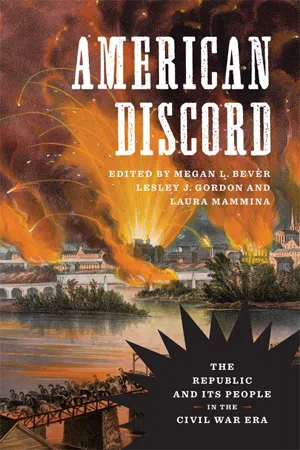
A panoramic collection of essays written by both established and emerging scholars, American Discord examines critical aspects of the Civil War era, including rhetoric and nationalism, politics and violence, gender, race, and religion. Beginning with an overview of the political culture of the 1860s, the collection reveals that most Americans entered the decade opposed to political compromise. Essays from Megan L. Bever, Glenn David Brasher, Lawrence A. Kreiser Jr., and Christian McWhirter discuss the rancorous political climate of the day and the sense of racial superiority woven into the political fabric of the era.Shifting focus to the actual war, Rachel K. Deale, Lindsay Rae Privette, Adam H. Petty, and A. Wilson Greene contribute essays on internal conflict, lack of compromise, and commitment to white supremacy. Here, contributors adopt a broad understanding of "battle, " considering environmental effects and the impact of the war after the battles were over. Essays by Laura Mammina and Charity Rakestraw and Kristopher A. Teters reveal that while the war blurred the boundaries, it ultimately prompted Americans to grasp for the familiar established hierarchies of gender and race.Examinations of chaos and internal division suggest that the political culture of Reconstruction was every bit as contentious as the war itself. Former Confederates decried the barbarity of their Yankee conquerors, while Republicans portrayed Democrats as backward rubes in need of civilizing. Essays by Kevin L. Hughes, Daniel J. Burge, T. Robert Hart, John F. Marszalek, and T. Michael Parrish highlight Americans' continued reliance on hyperbolic rhetoric. American Discord embraces a multifaceted view of the Civil War and its aftermath, attempting to capture the complicated human experiences of the men and women caught in the conflict. These essays acknowledge that ordinary people and their experiences matter, and the dynamics among family members, friends, and enemies have far-reaching consequences.
eBook - ePub
American Discord
The Republic and Its People in the Civil War Era
- 304 pages
- English
- ePUB (mobile friendly)
- Available on iOS & Android
eBook - ePub
American Discord
The Republic and Its People in the Civil War Era
About this book
Information
PART
I
ENEMIES MUST BE DEFINED
Party Politics and Political Culture
War itself requires no little hatred. There must be enemies, and those enemies must be defined, denounced, and defeated.
—George C. Rable, Damn Yankees! (2015), 2
That slavery roiled the religious and political waters should have caused no great surprise, but there were several ironies. Northerners portrayed the slave power as an aggressive force hell bent on stamping out civil and religious liberty—a mirror image of southern diatribes against Yankee political preachers. Extremism quite literally bred extremism.
—George C. Rable, God’s Almost Chosen Peoples (2010), 30
As George Rable observes in his most recent works, mid-nineteenth-century partisan rancor became intensely uncompromising in the wake of sectional conflict and war. These first four essays build on these themes as they explore American political rhetoric, noting the extremism both between and within the North and South. Northern Democrats and Republicans, as well as northerners and southerners, fought bitterly over white supremacy and black equality as well as over the war, the Union, and the future of the nation.
Perhaps none of the essays illustrates these themes more clearly than Megan L. Bever’s “Northern Temperance Reformers, Slavery, and the Civil War.” According to Bever, temperance reformers (much like their abolitionist acquaintances) grew tired of making moral compromises for the sake of political peace. This lack of interest in compromise continued throughout the war, as Lawrence A. Kreiser Jr. (“Newspaper Advertisements and American Political Culture”) and Christian McWhirter (“The White Horse or the Mule”) demonstrate. Gimmicks like advertisements and songs increased rather than allayed partisan hostilities, and portraying the opposition as idiotic proved essential to increasing enthusiasm for one’s own cause.
Behind the partisan rancor ran a conviction that compromising with the opposition was immoral. Temperance reformers are perhaps the most blatant example of this sentiment because they insisted that saving the Union must involve legislation to prohibit alcohol, thus preventing drunken ruin on a national scale. Yet perhaps more ominous is the way that these reformers understood the problem of slavery. Rather than opposing slavery wholeheartedly, teetotalers were often only concerned with abolition when it directly facilitated their own crusade against alcohol. Still, temperance reformers did not hold a monopoly on hyperbolic imagery. According to Kreiser, Democrats warned voters that Lincoln’s reelection would cause the United States to “sink into despotism” and would bring “universal anarchy and ultimate RUIN!” In their campaign music, Peace Democrats took the warnings even further, suggesting that Lincoln was in cahoots with the devil. Similar to Rable’s own observations, Americans connected their politics to a larger moral cause, thus enabling—and even necessitating—them to vilify the opposition.
As extreme as Democrats and Republicans’ penchant for consigning their political opponents to the pits of hell might seem, they saved their most virulent rhetoric for expressions of white supremacy. While McWhirter points out that after January 1863, popular songs in the North—particularly those authored by African Americans—celebrated Lincoln’s role as emancipator, Democrats ridiculed the president’s antislavery actions. Kreiser, likewise, argues that Democrats used blatantly racist imagery to play on fears of black equality and to stir up enthusiasm among voters. And Glenn David Brasher’s “Debating Black Manhood” illustrates that northern support for emancipation fell well short of a commitment to racial equality. Arming black men was controversial in the wartime North, and some in the northern press hesitated to fully celebrate black soldiers even after the 54th Massachusetts bravely stormed Fort Wagner. As Brasher makes clear, some Democratic papers at least initially covered the 54th’s performance at Fort Wagner sympathetically, but only because the Lincoln administration continued to pay black soldiers less than white soldiers, demonstrating that the North had not fully accepted black equality. Ultimately, these essays portray extreme partisan rancor as well as the wide variety of issues that animated white and black northerners and southerners. No one could quite agree which was most important—white supremacy versus black equality or individual rights versus federal power—or which national sin, slavery or intemperance, most urgently required addressing. The war had not raised these questions, but it also failed to resolve them.
Northern Temperance Reformers, Slavery, and the Civil War
MEGAN L. BEVER
In December 1860, the American Temperance Union (ATU) rejoiced at the election of Abraham Lincoln and Hannibal Hamlin, both of whom were “thorough temperance men.” From the perspective of John Marsh, the editor of the Journal of the American Temperance Union: And the New-York Prohibitionist (JATU), supporters of temperance from all over the United States—regardless of “politics or . . . local interest”—should “look up and be thankful that there is one placed at the helm who will, never, through the wine bottle, lose his reckoning and run our noble steamer into Dundrum Bay.” That Lincoln was a teetotaler was of upmost importance to the temperance community. They believed firmly that there was “not safety to any government,” nor was there “permanent prosperity to any people, but in the temperance principle.”1 For the United States to prosper, the entire nation needed to embrace total abstinence. In fact, many members of the New York–based ATU were convinced that temperance was the primary issue of the 1860 presidential election. When southern subscribers to the Journal balked at its endorsement of the Republican ticket, ATU president Marsh believed that southerners would quickly calm down and continue to “stand bravely for the temperance flag as the only flag of the Free.”2 After all, Lincoln, Hamlin, and the Republican Party offered them the best chance to achieve their main political goal, which, of course, was prohibition.
With the benefit of hindsight, it would seem that northern temperance reformers were wildly out of step with the major political debates that engrossed the American public during the 1860 presidential campaign. Contrary to Marsh’s optimism, southern temperance reformers insisted that the movement’s alignment with the Republican Party was absurd. While most Americans focused on debates over the expansion of slavery into the territories during the 1850s, the temperance community remained obsessed with ridding the United States of the liquor traffic. Even as the sectional crisis erupted into secession and war, northern temperance reformers remained preoccupied with the problem of drunkenness. For these reformers, saving the Union became inextricably linked to prohibition. Because of this, they monitored slavery’s demise closely. On one level, reformers firmly opposed slavery and believed that, like intemperance, it threatened national well-being. But in their view, emancipating the slaves was only the first step toward saving the Union. Reformers insi...
Table of contents
- Cover
- Title Page
- Copyright Page
- Contents
- Foreword
- Editors’ Introduction: The Mundane and the Sublime
- PART I: Enemies Must Be Defined: Party Politics and Political Culture
- PART II: Rippling Effects: Political and Military Conflicts
- PART III: A Thermidorean Reaction: Reconstruction and Counterrevolution
- Acknowledgments
- Contributors
- Index
Trusted by 375,005 students
Access to over 1.5 million titles for a fair monthly price.
Study more efficiently using our study tools.
Frequently asked questions
Yes, you can cancel anytime from the Subscription tab in your account settings on the Perlego website. Your subscription will stay active until the end of your current billing period. Learn how to cancel your subscription
No, books cannot be downloaded as external files, such as PDFs, for use outside of Perlego. However, you can download books within the Perlego app for offline reading on mobile or tablet. Learn how to download books offline
Perlego offers two plans: Essential and Complete
- Essential is ideal for learners and professionals who enjoy exploring a wide range of subjects. Access the Essential Library with 800,000+ trusted titles and best-sellers across business, personal growth, and the humanities. Includes unlimited reading time and Standard Read Aloud voice.
- Complete: Perfect for advanced learners and researchers needing full, unrestricted access. Unlock 1.5M+ books across hundreds of subjects, including academic and specialized titles. The Complete Plan also includes advanced features like Premium Read Aloud and Research Assistant.
We are an online textbook subscription service, where you can get access to an entire online library for less than the price of a single book per month. With over 1.5 million books across 990+ topics, we’ve got you covered! Learn about our mission
Look out for the read-aloud symbol on your next book to see if you can listen to it. The read-aloud tool reads text aloud for you, highlighting the text as it is being read. You can pause it, speed it up and slow it down. Learn more about Read Aloud
Yes! You can use the Perlego app on both iOS and Android devices to read anytime, anywhere — even offline. Perfect for commutes or when you’re on the go.
Please note we cannot support devices running on iOS 13 and Android 7 or earlier. Learn more about using the app
Please note we cannot support devices running on iOS 13 and Android 7 or earlier. Learn more about using the app
Yes, you can access American Discord by Lesley J. Gordon, Megan L. Bever, Laura Mammina, Lesley J. Gordon,Megan L. Bever,Laura Mammina in PDF and/or ePUB format, as well as other popular books in History & American Civil War History. We have over 1.5 million books available in our catalogue for you to explore.