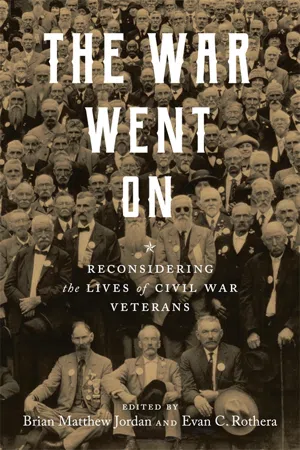
In recent years, Civil War veterans have emerged from historical obscurity. Inspired by recent interest in memory studies and energized by the ongoing neorevisionist turn, a vibrant new literature has given the lie to the once-obligatory lament that the postbellum lives of Civil War soldiers were irretrievable. Despite this flood of historical scholarship, fundamental questions about the essential character of Civil War veteranhood remain unanswered. Moreover, because work on veterans has often proceeded from a preoccupation with cultural memory, the Civil War's ex-soldiers have typically been analyzed as either symbols or producers of texts. In The War Went On: Reconsidering the Lives of Civil War Veterans, fifteen of the field's top scholars provide a more nuanced and intimate look at the lives and experiences of these former soldiers.Essays in this collection approach Civil War veterans from oblique angles, including theater, political, and disability history, as well as borderlands and memory studies. Contributors examine the lives of Union and Confederate veterans, African American veterans, former prisoners of war, amputees, and ex-guerrilla fighters. They also consider postwar political elections, veterans' business dealings, and even literary contests between onetime enemies and among former comrades.
eBook - ePub
The War Went On
Reconsidering the Lives of Civil War Veterans
- 344 pages
- English
- ePUB (mobile friendly)
- Available on iOS & Android
eBook - ePub
The War Went On
Reconsidering the Lives of Civil War Veterans
About this book
Information
I
REJECTING
HIBERNATION
HIBERNATION
“Let Us Everywhere Charge the Enemy Home”
Army of the Potomac Veterans and Public Partisanship, 1864–1880
ZACHERY A. FRY
IN MARCH 1866, a series of published resolutions from the Union veterans’ group the Soldiers’ and Sailors’ League fumed that Robert E. Lee must “answer to the charge of treason.” As the leader of rebel forces in the Virginia theater, Lee had committed “treachery to God for wantonly violating the obligations of his oath” and thus deserved “the reward of a traitor.” The veterans called attention to their own sacrifices during the war and, in calling for a harsh and unforgiving Reconstruction, demanded justice for their fallen comrades. Nearly a year after Appomattox, therefore, Union veterans continued to assail the defeated foe, the black-and-white letters of newspaper print having replaced salvoes of lead.1
Two broad innovations in Civil War literature have dominated the field in recent years. The first and perhaps most significant is the so-called dark turn. Historians of this school have increasingly emphasized the war’s destructive effects on its participants (both physical and psychological), on the national culture, and even on the country’s landscape itself.2 The second trend is a steady growth in the recognition of a “long Civil War” in which the actual military struggle between 1861 and 1865 was only the most dramatic and conventional phase.3 Using the political experiences of wartime and postwar Union veterans, this essay offers insights for both historiographical trends.
Historians have traditionally viewed Union veterans through an emphasis on social and political history, including the lengthy campaign for pensions and civil service positions.4 Recent works have changed tack to focus on the traumatic cultural effects the war itself had on the difficult readjustment to civilian life, in the process highlighting the chasm between veterans and ordinary civilians in the postwar North.5 Neither approach appreciates the central role returning Union soldiers played in the raging partisan issues of Reconstruction. Veterans used the process of political organization and mobilization to replicate their wartime service, in large part because their time in uniform had been characterized by a constant spirited debate over loyalty. While Democratic veterans convened to oppose radical measures that would revolutionize the vanquished South, Republican veterans and their allies quickly came to oppose anyone who would uproot the gains they had fought for and gained under Lincoln’s leadership. As years went on, both sides appealed to the soldier’s hallowed place in the national political culture to cast the veteran as the true guardian of civic virtue.6

THE FIRST UNION VETERANS to exert influence on national politics actually mobilized during the height of the war itself. By autumn 1864, thousands of men who had hung up the blue uniform rather than reenlist at the end of their terms of service participated in the presidential contest between Abraham Lincoln and former Army of the Potomac commander George McClellan. The crucial election witnessed Lincoln reaching broadly for northern support in a “National Union” Party that joined Republicans with like-minded pro-administration War Democrats. McClellan’s candidacy, decided after an awkward convention struggle dominated by the Democratic Party’s peace faction, left a weakened standard bearer hoping to capitalize on the vote of an army that had once revered him. By 1864, the Army of the Potomac had therefore become an arena for competing views of political loyalty. On one side were those who endorsed the Republican message and the administration’s policies as a wartime imperative.7 On the other side, maligned by many soldiers because of the Democratic Party’s peace activism, were those who stuck to a conservative message that valued the Constitution and individual liberty in a white man’s republic.8
Men returning from the front lines threw themselves into political activity across the North, Democrats and Republicans working in their wartime social circles to form paramilitary campaign clubs. Pro-Republican generals, some of them in the army still and others having left, mobilized former subordinates and enlisted men to prove to the nation that the Army of the Potomac had escaped the shadow of Little Mac. In New York, for example, Abner Doubleday, Dan Sickles, Daniel Butterfield, and other Republican-leaning figures formed the Veteran Union Club, specifically mirroring the more inclusive title of Lincoln’s National Union Party and meeting weekly at Cooper Union, where the rail-splitter himself had famously impressed eastern Republicans in 1860.9
Outside New York, Republican veterans relied more heavily on junior officers to do the heavy lifting of political mobilization. In Philadelphia, to oppose the McClellan Old Guard, former colonel Peter C. Ellmaker of the city’s 119th Pennsylvania took command of the “First Battalion” of the Union Campaign Club (UCC). Ellmaker had made a name for himself and his regiment by publicly opposing an autumn 1863 effort by Army of the Potomac commander George G. Meade to honor McClellan with an army-wide testimonial of support.10 By 1864, Ellmaker worked with fellow Pennsylvanians John F. Glenn of the “Birney Zouaves,” Thomas F. B. Tappan of the 4th Reserves, DeWitt Clinton Baxter of the “Fire Zouaves,” and Turner G. Morehead of the 106th Regiment.11 As many as thirty-five hundred veterans eventually united under the UCC banner, resolving in the inaugural meeting at Sansom Street Hall on September 12 to settle “finally and forever” the conflict’s root cause of slavery. Thanking the state’s Republicans for allowing absentee voting in the field, the UCC also made emotional appeals to voters of the Keystone State. Former lieutenant Lemuel Reeves of the 12th Corps resolved, for instance, that the harshest rebuke of “traitors at home” would have come from the thousands of fallen martyrs on Army of the Potomac battlefields.12 The UCC mimicked the old Wide Awakes of 1860 in organizing a series of torchlight parades to intimidate the opposition and inspire followers. Aligning with the city’s powerful Union League, Army of the Potomac veterans of every rank marched through the city bearing lanterns adorned with powerful political messaging. “Robert, I will not hurt you too much; I will fight you gentlemanly,” proclaimed one sarcastic transparency, while another (reported soon afterward in the Philadelphia Press) mocked McClellan’s early-war prediction of a “short, sharp, decisive” campaign against the rebels with the simple promise, “We intend to make it so.—1st Bat. Union Campaign Club.”13
Like their Republican counterparts, the president’s opponents formed similar ...
Table of contents
- Cover
- Title Page
- Copyright Page
- Dedication
- Contents
- Acknowledgments
- Introduction
- I. REJECTING HIBERNATION
- II. NARRATING THE PAST
- III. THE MULTIVOCALITY OF CIVIL WAR VETERANHOOD
- Contributors
- Index
Trusted by 375,005 students
Access to over 1.5 million titles for a fair monthly price.
Study more efficiently using our study tools.
Frequently asked questions
Yes, you can cancel anytime from the Subscription tab in your account settings on the Perlego website. Your subscription will stay active until the end of your current billing period. Learn how to cancel your subscription
No, books cannot be downloaded as external files, such as PDFs, for use outside of Perlego. However, you can download books within the Perlego app for offline reading on mobile or tablet. Learn how to download books offline
Perlego offers two plans: Essential and Complete
- Essential is ideal for learners and professionals who enjoy exploring a wide range of subjects. Access the Essential Library with 800,000+ trusted titles and best-sellers across business, personal growth, and the humanities. Includes unlimited reading time and Standard Read Aloud voice.
- Complete: Perfect for advanced learners and researchers needing full, unrestricted access. Unlock 1.5M+ books across hundreds of subjects, including academic and specialized titles. The Complete Plan also includes advanced features like Premium Read Aloud and Research Assistant.
We are an online textbook subscription service, where you can get access to an entire online library for less than the price of a single book per month. With over 1.5 million books across 990+ topics, we’ve got you covered! Learn about our mission
Look out for the read-aloud symbol on your next book to see if you can listen to it. The read-aloud tool reads text aloud for you, highlighting the text as it is being read. You can pause it, speed it up and slow it down. Learn more about Read Aloud
Yes! You can use the Perlego app on both iOS and Android devices to read anytime, anywhere — even offline. Perfect for commutes or when you’re on the go.
Please note we cannot support devices running on iOS 13 and Android 7 or earlier. Learn more about using the app
Please note we cannot support devices running on iOS 13 and Android 7 or earlier. Learn more about using the app
Yes, you can access The War Went On by Brian Matthew Jordan, Evan C. Rothera, Brian Matthew Jordan,Evan C. Rothera in PDF and/or ePUB format, as well as other popular books in History & American Civil War History. We have over 1.5 million books available in our catalogue for you to explore.