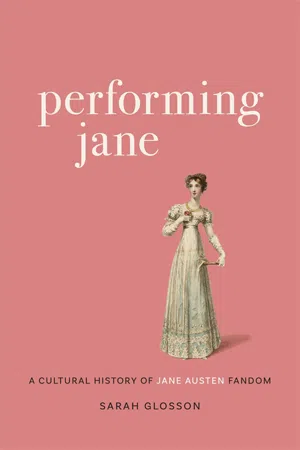
Jane Austen has resonated with readers across generations like no other writer. More than two hundred years after the publication of her most celebrated novel, Pride and Prejudice, people around the world continue to honor "dear Jane." In Performing Jane, Sarah Glosson explores this vibrant fandom, examining a long history of Austen fans engaging with her work, from wearing hand-sewn bonnets and period-appropriate corsets to creating spirited fanfiction and comical gifsets. Sophisticated and engaging, this study demonstrates that Austen fans of today have a great deal in common with those who loved the English novelist long before the term "fan" came into use. Performing Jane analyzes three ways fans engage with Austen and her work: collecting material related to the writer, whether in physical scrapbooks or on social-media platforms; creating and consuming imitative works, including fanfiction and modernized adaptations such as The Lizzie Bennet Diaries; and making pilgrimages to Steventon, Hampshire, Chawton Cottage, and even to annual meetings of Jane Austen societies. Key to Glosson's exploration of Austen fans is the notion that all of these activities, whether occurring in private or in public, are fundamentally performative. And in counterbalance to studies that center on fans with a tendency to transform and disrupt the original text, this study provides much-needed understanding of a fandom that predominantly reaffirms Austen's works. Because Austen's writing has bridged the realms of both literary and popular culture, this fandom serves as an excellent case study to understand the ways in which we draw distinctions between fandom and other forms of intensive engagement and, more importantly, to appreciate how fluid those distinctions can be. Performing Jane embraces a holistic view of the long history of Austen fandom, relying on archival research, literary and visual analyses, and ethnographic study. This groundbreaking book not only demonstrates the ways in which fan practices, today and in the past, are performative, but also provides fresh perspectives into fandom and contributes to our understanding of the ways readers engage with literature.
- 256 pages
- English
- ePUB (mobile friendly)
- Available on iOS & Android
eBook - ePub
About this book
Information
Subtopic
Modern Literary CriticismIndex
Social SciencesI
JANE AUSTEN AND TRANSATLANTIC LITERARY FANDOM 1816–1940
Prologue
In Louisa May Alcott’s Little Women (1868), the March sisters enjoy an entertainment derived from an activity rather like the writing of a fanzine, inspired by their admiration for Charles Dickens.
As spring came on, a new set of amusements became the fashion, and the lengthening days gave long afternoons for work and play of all sorts. . . . One of these was the “P.C.”; for, as secret societies were the fashion, it was thought proper to have one; and, as all of the girls admired Dickens, they called themselves the Pickwick Club. With a few interruptions, they had kept this up for a year, and met every Saturday evening. . . . Three chairs were arranged in a row before a table, on which was a lamp, also four white badges, with a big “P.C.” in different colors on each, and the weekly newspaper, called “The Pickwick Portfolio,” to which all contributed something; while Jo, who reveled in pens and ink, was the editor.1
Alcott followed this description with a comical and charming example of the “Pickwick Portfolio,” the sisters’ weekly newspaper complete with poems, jokes, sensational stories, and even advertisements. The real-life Alcott sisters, on whom the March girls were based, themselves formed a Pickwick Club, and examples of their actual “Pickwick Portfolio” survive today.2 It is from among these original newspaper entries, written between 1849 and 1853, that Alcott excerpted the selections found in Little Women.3 The fannish admiration of Dickens documented by the Alcott sisters and represented by the fictional March sisters was surely meant to be a familiar scene to readers in the mid-nineteenth century, not an outlandish one; these were young women engaging in good clean fun. Yet fans, their obsessions, and their behaviors have always been viewed by some as eccentric at best and deviant at worst. It is no accident, then, that Alcott characterizes the girls’ secret society as industrious—and therefore virtuous—amusement.
The chapters in part I provide examples, like that from Little Women, that demonstrate that literary fan practices analogous to those today were commonplace in mid-nineteenth-century America, when Austen’s novels began to take root there in the cultural imagination. Today’s Jane Austen fandom has origins traceable to the 1830s, long before the appearance of adaptations and spin-offs that would later help make the fandom much more prevalent. By 1940, when MGM’s film adaptation of Pride and Prejudice captivated audiences, the stage had already been set for expanding participatory interaction with Austen’s texts. In addition to tracing Austen fandom from the earliest reception of the novels through a moment of burgeoning spin-offs and adaptations at the turn of the twentieth century, the following three chapters reveal several characteristics of the fandom that were as notable in the nineteenth century as today, demonstrating remarkable continuity.
Early Austen fans used ideas about the novelist’s morality and the decency of her work to support their claims of respectability in the face of criticism leveled at them by a society ambivalent about novels and uncomfortable with unfettered fascination with them. For every fan of literature who emerged in the eighteenth and nineteenth centuries, a detractor found their enthusiasm and habits problematic or even immoral. To overcome this disapproval, literature lovers learned to perform virtue through their reading habits, rendering an obsession with literature safe and blameless by casting both their own activities and the object of their fascination as moral. By performing an affinity to Jane Austen, readers performed virtue. Whereas some fandoms today receive criticism for their obsessive behaviors, fans of literature benefit from an aura of respectability. Society might look askance at Trekkies (or Trekkers, as many prefer) or censure the exuberance of teen girls over K-Pop stars, but Janeites are spared for the most part or are at least tolerated thanks to the way Austen aligns with certain ideas about class, race, and gender. I suggest that the air of respectability Janeites enjoy today relative to other fandoms is visible in the nineteenth century through Austen fans’ performances of virtue.
Austen, like other literary figures of the time, inspired fans to feel a personal connection to “Jane,” a sensibility that the fandom retains today. The modes of literary fandom I describe here are not unlike those seen today, in which fans—through performative means—seek personal connections to texts and authors, pursue affective experiences related to their reading through play, and seek out a physical link through material objects and pilgrimage. Today fans can easily connect to a greater community online through social media and can readily travel great distances to come together in person. Although such connectivity and community were harder to achieve in the nineteenth century, personal correspondence and circulating print media provided a vibrant means for fans to participate in like-minded communities. The activities of fans described in part I are antecedents of those detailed later in the book.
In the first chapter, I offer brief context for eighteenth- and nineteenth-century transatlantic literary fandom, particularly highlighting the tendency, well documented by literary scholars and historians, of nineteenth-century fans to seek a personal connection with a beloved author or fictional world. In the second and third chapters, I detail evidence of a Jane Austen fandom that was in full swing by the time her first biography became available, in 1870, a moment that sparked even greater and more widespread admiration of Austen. In the 1830s through 1850s, Austen’s fame and fandom existed on a more modest scale than in later decades, but I suggest that allusions to Austen and discussions of her novels in early-nineteenth-century print media help shed light on the emergence of the fandom. Periodicals, so influential on the American cultural imagination, reveal views on Austen that influenced the characteristics of the fandom. Chapter 3 offers examples of three main modes of fan engagement—fanfiction, collecting memorabilia, and pilgrimage—from the early nineteenth through early twentieth centuries, bringing the history of Austen fandom up to another pivotal moment: MGM’s release of Pride and Prejudice on the silver screen in 1940. By this time, Austen’s appeal was ineluctable, and she had taken hold in the cultural imagination, particularly in America. I propose that the modes of fandom visible in the nineteenth century enabled and shaped the Austen fandom that would become so recognizable in the twentieth century and beyond.
1
A “Sense of Kindred” in Nineteenth-Century Transatlantic Literary Fandom
In the mid-twentieth century, American literary critic Lionel Trilling lamented a trend whereby Jane Austen was frequently removed from “the proper confines of literature” and instead was read and loved in a manner that Trilling felt might be considered “objectionable” or even “illicit” and which stemmed from a self-congratulatory and “extravagantly personal” form of admiration.1 Yet Austen was never solely within the “proper confines of literature” to begin with and has long inspired very personal forms of veneration among her fans. Precedents for loving Austen and her works in all sorts of ways have a long history in the nineteenth century. And Jane Austen was not alone: nineteenth-century readers loved literature and adored writers. This chapter provides brief historical context for the milieu into which early Jane Austen fandom emerged and highlights a feature prevalent in nineteenth-century fandom generally: a personal sense of connection fans felt—and sought—to their favorite authors and other celebrities.
There persists a notion that what we recognize as fandom today is a much more recent phenomenon driven by the advent of film and especially of television, with its appealingly serialized, often open-ended narrative format. While it may be true that the characteristics of fandom, as defined by fans as well as fan studies scholars, are more pronounced today and amplified by social media, they are certainly legible in fandom’s past. Fan studies scholar Matt Hills defines fans with regards to several key traits: fans are obsessed with a particular text; they retain detailed information about that text and can quote favored segments; they are highly articulate about their fandom; and they tend to interpret texts in “a variety of interesting and perhaps unexpected ways.”2 Perhaps most important, fans participate in communal activities and are not isolated or atomized readers/viewers. This communal aspect of fandom is further explained and indeed emphasized in the definition offered by Henry Jenkins, who characterizes fans as acting within an interpretive community ...
Table of contents
- Cover
- Title Page
- Copyright Page
- Dedication
- Contents
- Acknowledgments
- Introduction: Performing Jane
- PART I. JANE AUSTEN AND TRANSATLANTIC LITERARY FANDOM, 1816–1940
- PART II. FANS IN THE ARCHIVE, 1940–1995
- PART III. SENSE AND VISIBILITY: DIGITAL FANDOM AND ARCHONTIC WORKS IN THE INTERNET AGE
- PART IV: IMAGINING JANE: LITERARY PILGRIMAGE AND JANE AUSTEN FANDOM
- Coda: Effigies of Experience
- Notes
- Bibliography
- Index
Trusted by 375,005 students
Access to over 1.5 million titles for a fair monthly price.
Study more efficiently using our study tools.
Frequently asked questions
Yes, you can cancel anytime from the Subscription tab in your account settings on the Perlego website. Your subscription will stay active until the end of your current billing period. Learn how to cancel your subscription
No, books cannot be downloaded as external files, such as PDFs, for use outside of Perlego. However, you can download books within the Perlego app for offline reading on mobile or tablet. Learn how to download books offline
Perlego offers two plans: Essential and Complete
- Essential is ideal for learners and professionals who enjoy exploring a wide range of subjects. Access the Essential Library with 800,000+ trusted titles and best-sellers across business, personal growth, and the humanities. Includes unlimited reading time and Standard Read Aloud voice.
- Complete: Perfect for advanced learners and researchers needing full, unrestricted access. Unlock 1.5M+ books across hundreds of subjects, including academic and specialized titles. The Complete Plan also includes advanced features like Premium Read Aloud and Research Assistant.
We are an online textbook subscription service, where you can get access to an entire online library for less than the price of a single book per month. With over 1.5 million books across 990+ topics, we’ve got you covered! Learn about our mission
Look out for the read-aloud symbol on your next book to see if you can listen to it. The read-aloud tool reads text aloud for you, highlighting the text as it is being read. You can pause it, speed it up and slow it down. Learn more about Read Aloud
Yes! You can use the Perlego app on both iOS and Android devices to read anytime, anywhere — even offline. Perfect for commutes or when you’re on the go.
Please note we cannot support devices running on iOS 13 and Android 7 or earlier. Learn more about using the app
Please note we cannot support devices running on iOS 13 and Android 7 or earlier. Learn more about using the app
Yes, you can access Performing Jane by Sarah Glosson in PDF and/or ePUB format, as well as other popular books in Social Sciences & Modern Literary Criticism. We have over 1.5 million books available in our catalogue for you to explore.