The word "prohibition" tends to conjure up images of smoky basement speakeasies, dancing flappers, and hardened gangsters bootlegging whiskey. Such stereotypes, a prominent historian recently noted in the Washington Post, confirm that Americans' "common understanding of the prohibition era is based more on folklore than fact." Popular culture has given us a very strong, and very wrong, picture of what the period was like. Prohibition's Greatest Myths: The Distilled Truth about America's Anti-Alcohol Crusade aims to correct common misperceptions with ten essays by scholars who have spent their careers studying different aspects of the era. Each contributor unravels one myth, revealing the historical evidence that supports, complicates, or refutes our long-held beliefs about the Eighteenth Amendment. H. Paul Thompson Jr., Joe L. Coker, Lisa M. F. Andersen, and Ann Marie E. Szymanski examine the political and religious factors in early twentieth-century America that led to the push for prohibition, including the temperance movement, the influences of religious conservatism and liberalism, the legislation of individual behavior, and the lingering effects of World War I. From there, several contributors analyze how the laws of prohibition were enforced. Michael Lewis discredits the idea that alcohol consumption increased during the era, while Richard F. Hamm clarifies the connections between prohibition and organized crime, and Thomas R. Pegram demonstrates that issues other than the failure of prohibition contributed to the amendment's repeal. Finally, contributors turn to prohibition's legacy. Mark Lawrence Schrad, Garrett Peck, and Bob L. Beach discuss the reach of prohibition beyond the United States, the influence of anti-alcohol legislation on Americans' longterm drinking habits, and efforts to link prohibition with today's debates over the legalization of marijuana. Together, these essays debunk many of the myths surrounding "the Noble Experiment, " not only providing a more in-depth analysis of prohibition but also allowing readers to engage more meaningfully in contemporary debates about alcohol and drug policy.
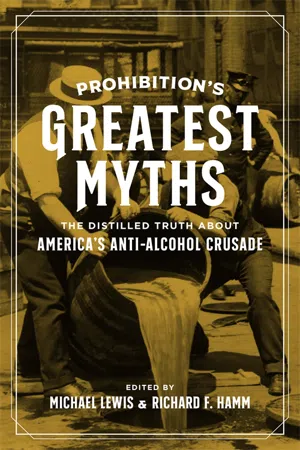
eBook - ePub
Prohibition's Greatest Myths
The Distilled Truth about America's Anti-Alcohol Crusade
- 176 pages
- English
- ePUB (mobile friendly)
- Available on iOS & Android
eBook - ePub
Prohibition's Greatest Myths
The Distilled Truth about America's Anti-Alcohol Crusade
About this book
Information
Subtopic
North American HistoryIndex
HistoryMYTH 1
TEMPERANCE ADVOCATES AND PROHIBITIONISTS SHARED THE SAME GOALS AND TACTICS
H. PAUL THOMPSON JR.
It seems as if every time I tell people that I research the temperance movement they make some comment about Al Capone, Carrie Nation, or the Woman’s Christian Temperance Union. I usually respond by saying, “No, I study the nineteenth-century temperance movement.” My response elicits blank stares. Apparently, the nineteenth-century antebellum-reform, or “Benevolent Empire” section, of everyone’s US history textbook leaves little to no impression on students. Popular memory about the temperance movement seems to begin somewhere around 1900 and moves quickly to the drama of national prohibition in the 1920s. Popular books and media attract our attention with titillating stories of rum running, organized crime, corrupt law-enforcement officers, and alcohol-related violence. Popular documentaries like Ken Burns’s Prohibition and books like the recent Last Call: The Rise and Fall of Prohibition often omit the less colorful parts of the century-long movement or fail to capture its nuances and complexities, perpetuating an overly simplified, one-dimensional image of the movement. This image often leaves one bewildered, at best, about how Americans could ever have banned such a historically ubiquitous and culturally normative article of trade and consumption as alcoholic beverages.
Popular culture has made it easy to buy into the myth that temperance reformers and prohibitionists were one and the same. While it is true that the rhetoric of early twentieth-century prohibitionists often conflated the two, it is also true that many temperance reformers rejected the goals and tactics of prohibitionists. Temperance was a large, multifaceted movement, and as such, temperance reformer was an umbrella term for a wide range of reformers working to limit or ban the consumption of alcoholic beverages. One subset of this group was prohibitionists, who, directed and coordinated by the Anti-Saloon League of America (ASL), guided from start to finish the passage of the Eighteenth Amendment and the Volstead Act, thereby creating national prohibition. Temperance began as an idea in the 1780s, and over the years it encompassed a variety of goals, rationales, and strategies, not to mention successive generations of leaders, rank-and-file reformers, and organizational structures. The movement evolved throughout the nineteenth century as activists continually debated their rationales, goals, and tactics. Temperance reformers were as divided among themselves—sometimes vehemently—as other reformers often were. Temperance played a critical role in advancing women’s rights and was implicated in a range of class, ethnic, religious, scientific, and political discourses. It was also a prominent theme in literature, entertainment, and popular culture.
The temperance movement was quintessentially American if for no other reasons than that it remained a “work in progress” for so many years, and because its adherents maintained a running debate about their goals and how best to achieve them. Prior to the beginning of national prohibition in January 1920, the rise of the ASL in the 1890s represented the single most profound watershed moment in the movement’s history. The ASL initiated and led the national campaign for the Eighteenth Amendment, and the dominance and success of its rhetoric and tactics represented such a significant break from longstanding temperance practices that it is more accurate to think of the 1890s as the end of the temperance movement and the beginning of the prohibition movement.1
This essay looks at the origins of temperance ideas and then discusses the movement’s nineteenth-century evolution from an organizational perspective to contrast its complexity with the narrow, laser-like focus of the ASL and the campaign for the Eighteenth Amendment.
ANTEBELLUM TEMPERANCE REFORM
Americans’ annual per capita alcohol consumption increased markedly during the late eighteenth and early nineteenth centuries. By 1830, annual per capita consumption of absolute alcohol had reached almost four gallons, more than twice what it was in the late twentieth century. One of the first persons to perceive this trend was Benjamin Rush, a respected Revolutionary Era medical doctor. In 1784 he published An Inquiry into the Effects of Spiritous Liquors on the Human Body and Mind, where he argued that distilled beverages like rum and whiskey were unhealthy and dangerous and that instead people should drink healthy beverages like beer, wine, and ciders (all of which were hard then). Rush’s work prepared the ground for the next generation of temperance advocates. By the second decade of the nineteenth century, thousands of local temperance societies had sprung up across the nation, many with the active support of local clergy. Sponsoring speakers, distributing literature, and pledge signing were their primary activities. They believed that through “moral suasion”—appeals to one’s reason—they would eventually persuade more and more Americans to abstain from both drunkenness and distilled beverages.2
Although several preachers published sermons attacking drunkenness and distilled drinks during these early years, none rivaled in influence those preached and published in the mid-1820s by Lyman Beecher, an important revivalist of the Second Great Awakening. Through these and other sermons, Beecher articulated the theological foundations for temperance and other reforms of the antebellum period. For revivalists like Beecher, benevolent reforms drew on the same theology they employed in their revivalist preaching. They emphasized the individual’s free will but also one’s accountability to God about how one used that will. Revivalists wanted nothing to distort one’s free will, or reasoning faculties, and thus compromise their ability to respond to the preacher’s call to repentance and conversion. Equally important was the widely held view at the time that America needed virtuous citizens if it was to become a successful, long-lasting republic. Beecher argued that there were three ways for one to develop those virtues: through a religious conversion experience, through obedience to righteous laws, or through the influence of positive social pressures. Reform societies, like temperance societies, were a means of creating positive social pressures leading to virtuous and patriotic citizens.3
Beecher’s Six Sermons on the Nature, Occasions, Signs, Evils, and Remedy of Intemperance (1827) became as influential in the temperance movement as his daughter’s Uncle Tom’s Cabin would become in the abolitionist movement. These sermons issued the first public call for three things that would characterize the movement for decades to come: (1) defining temperance as abstinence from all intoxicating beverages (not just distilled, or “ardent,” spirits); (2) a national organization to coordinate the movement; and (3) an intentional effort to educate public sentiment so that voters would eventually call for the outlawing of the traffic in intoxicating beverages. Beecher’s sermons sought to defeat the “enemy” of intemperance, namely, individuals’ self-destructive b...
Table of contents
- Cover
- Title Page
- Copyright Page
- Contents
- Preface
- MYTH 1: Temperance Advocates and Prohibitionists Shared the Same Goals and Tactics
- MYTH 2: Religious Conservatives Spearheaded the Prohibition Movement
- MYTH 3: The Prohibition Amendment and Supporting Laws Sought to Ban Individual Drinking
- MYTH 4: Prohibition in the United States Came About Primarily because of World War I
- MYTH 5: Alcohol Consumption Increased during the Prohibition Era
- MYTH 6: Prohibition Started Organized Crime
- MYTH 7: Repeal Happened because Prohibition Was a Failure
- MYTH 8: Prohibition Was Uniquely American
- MYTH 9: Prohibition Changed Little about American Drinking Habits
- MYTH 10: The Current Debates over Marijuana Legalization Are the Same as Those That Ended Prohibition
- Contributors
- Index
Trusted by 375,005 students
Access to over 1.5 million titles for a fair monthly price.
Study more efficiently using our study tools.
Frequently asked questions
Yes, you can cancel anytime from the Subscription tab in your account settings on the Perlego website. Your subscription will stay active until the end of your current billing period. Learn how to cancel your subscription
No, books cannot be downloaded as external files, such as PDFs, for use outside of Perlego. However, you can download books within the Perlego app for offline reading on mobile or tablet. Learn how to download books offline
Perlego offers two plans: Essential and Complete
- Essential is ideal for learners and professionals who enjoy exploring a wide range of subjects. Access the Essential Library with 800,000+ trusted titles and best-sellers across business, personal growth, and the humanities. Includes unlimited reading time and Standard Read Aloud voice.
- Complete: Perfect for advanced learners and researchers needing full, unrestricted access. Unlock 1.5M+ books across hundreds of subjects, including academic and specialized titles. The Complete Plan also includes advanced features like Premium Read Aloud and Research Assistant.
We are an online textbook subscription service, where you can get access to an entire online library for less than the price of a single book per month. With over 1.5 million books across 990+ topics, we’ve got you covered! Learn about our mission
Look out for the read-aloud symbol on your next book to see if you can listen to it. The read-aloud tool reads text aloud for you, highlighting the text as it is being read. You can pause it, speed it up and slow it down. Learn more about Read Aloud
Yes! You can use the Perlego app on both iOS and Android devices to read anytime, anywhere — even offline. Perfect for commutes or when you’re on the go.
Please note we cannot support devices running on iOS 13 and Android 7 or earlier. Learn more about using the app
Please note we cannot support devices running on iOS 13 and Android 7 or earlier. Learn more about using the app
Yes, you can access Prohibition's Greatest Myths by Michael Lewis, Richard Hamm in PDF and/or ePUB format, as well as other popular books in History & North American History. We have over 1.5 million books available in our catalogue for you to explore.