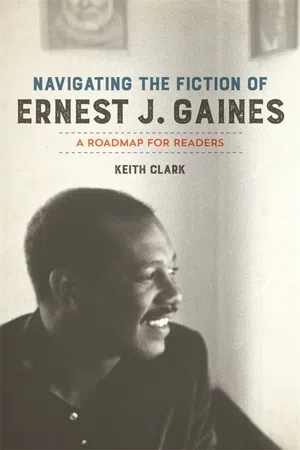
One of the South's most revered writers, Ernest J. Gaines attracts both popular and academic audiences. Gaines's unique literary style, depiction of the African American experience, and celebration of the rural South's oral tradition have brought him critical praise and numerous accolades, including a MacArthur Fellowship, a National Humanities Medal, and a National Book Critics Circle Award for his novel A Lesson before Dying. In this welcome guide to Gaines's fiction, Keith Clark offers insightful analyses of his novels and short stories. Clark's close readings elucidate Gaines's more acclaimed works—including The Autobiography of Miss Jane Pittman and A Gathering of Old Men —while also introducing lesser-known but masterfully crafted pieces, such as the story "Three Men" and the civil rights novel In My Father's House. Gaines's most recent work, The Tragedy of Brady Sims, receives here one of its first critical examinations. Clark shows how the themes of Gaines's literary oeuvre, produced over the past fifty years, dovetail with issues reverberating in twenty-first-century America: race and the criminal justice system; black masculinity; the environment; the enduring impact of slavery; black southern women's voices; and blacks' and whites' interpretation of history. In addition to textual discussions, the book includes an interview Clark conducted with Gaines at the writer's home in New Roads, Louisiana, in 2014, further illuminating the inner workings and personality of this eminent literary artist.
- 264 pages
- English
- ePUB (mobile friendly)
- Available on iOS & Android
eBook - ePub
About this book
Information
Index
Literature1
Sugarcane, Railroad Cars, Prisons, Peoples
Dominant Themes and Topics
Surveying the writings of black men since Richard Wright shows us that other issues, other meanings, other forms of power are at stake. The southernness of the black male writer seems peripheral to the fiction many of them have written.
—MICHAEL KREYLING, Inventing Southern Literature
Certainly, no one can dispute the southernness of Gaines’s works: the mythic pastoral past colliding with a modern, industrialized present; a Jim Crow regime that provided legal ballast to separate and unequal; white supremacist terrorism carried out by socially sanctioned hate groups (the Knights of the White Camelia, the Ku Klux Klan, and so forth); the omnipresent and intersecting color lines—not merely the implacable, death-defying one separating black and white, but also strictures separating “mulatto” from both “black” and “white” and the wars waged in the name of a spurious racial “purity”; the way that “progress” in the present moment is forever impeded by a southern ethos of “go slow” gradualism. To be sure, these themes are prevalent in works by the colossus of southern literature, the writer who casts an inescapable shadow over Gaines and every other southern writer regardless of race, gender, or period: William Faulkner. Still, as the distinguished southern literature critic Michael Kreyling observes, “Family and community, sense of place, the legacy of failure-poverty-defeat emit significantly different meanings in works by African-American southern men” (Inventing Southern Literature 77). With this distinction in mind, this chapter enumerates the foremost concerns and themes that constitute the fabric of Gaines’s fiction.
History, from the National to the Personal
Specific mention of Louisiana history might initially evoke such notorious figures as Huey “Kingfish” Long, nefarious ones like David Duke, or natural catastrophes lacking surnames—Katrina, Rita, Camille. However, no less explosive in the history of American racial jurisprudence was the infamous case that Brown v. Board abrogated, Plessy v. Ferguson, the basis of which was an 1892 Louisiana statute that forbade a railroad passenger from entering “a coach or compartment to which by race he does not belong” (qtd. in Litwack, Trouble in Mind 243). Homer Plessy, a “quadroon” light enough to pass, was recruited by activists to challenge the law. After purchasing a first-class ticket on the East Louisiana Railway and sitting in the “whites-only” car, Plessy was arrested when he refused to exit. The case eventually reached the United States Supreme Court in 1896, and by an eight-to-one margin, the Louisiana law barring Plessy from the whites-only car was upheld. Sanctioning “separate but equal” accommodations to legitimize racial segregation, the decision held that, “If one race be inferior to the other socially, the Constitution of the United States cannot put them upon the same plane” (242–43). Without question, this dreadful decision “mark[ed] the birth of Jim Crow and, in sad retrospect, the Supreme Court’s and highest law of the land’s endorsement of white supremacy and black subjugation as the national legal norm” (Baker, “Incarceration” 18). Indeed, this case would become the bulwark for Jim Crow and mark the continuation of such oppressive judicial measures as the Slave Codes and the Black Codes.
I reference Plessy v. Ferguson to elucidate the scope of racism in Louisiana and the state’s prominent role in our pestilential racial past. The specifics of Plessy also resonate in terms of Gaines’s life and work: the law had a dismal effect on the lives of southern blacks, especially rural denizens like Gaines’s family, in terms of economic opportunities, education, public accommodations, and voting. Legally barred from jobs that would pay what we in contemporary parlance call a “living wage,” Gaines’s family lived a sharecropping life which was little more than indentured servitude and peonage, a life that drove his mother and stepfather west and left his aunt and relatives to wrest what middling existence they could from the land. The tentacles of this case would reach down into an education system that severely stunted black children’s academic development; at best, they might receive a middle-school education as young Gaines did. The quasi-slavery into which he was born and lived, coupled with the juridical racial strictures which fortified it, might explain Gaines’s abiding interest in history: “So it’s present [antebellum southern history]; it’s always here. We still see the result of it among my own people. The effects and the legacy of slavery, it’s always there” (Conversations 255). The most obvious artistic rendering of this belief is his 1971 novel The Autobiography of Miss Jane Pittman. Through his meticulous and sweeping creation of the heroine’s life, he was “trying to go back, back, back into our experiences in this country, to find some kind of meaning to our present lives” (Mozart and Leadbelly 15).
Though Gaines never referenced Plessy specifically in interviews, he did cite another seismic episode in America’s litany of them, James Meredith’s integration of the University of Mississippi in 1962. Gaines stated that it “would change my life forever” (24). He abruptly cancelled a trip to Mexico and returned to Baton Rouge to reunite with friends, family, and community—all of whom heralded the Mississippian’s bravery as evidence of the impact that one vigilant and courageous young man could have. It is these cumulative historical events, I would surmise, that informed Gaines’s own unstinting interest not only in racially resonant historical inflection points and their impact on the community but, concomitantly, in how they can shape and motivate individuals on a much smaller, micro level. Throughout his canon, teachers and students, while not actors on the grand historical scale of ministers such as Martin Luther King and students such as Meredith, nevertheless perform noble acts on behalf of their families and communities.
Racial Tensions—In Black and White and Everything in Between
Though it might seem patently obvious that an African American southern writer would examine racial animus in his work, Gaines’s treatment of this topic nevertheless warrants delineation. He himself has been unreservedly clear on its omnipresence in his fellow regional writers’ fiction, regardless of their pigmentation: “I don’t know if you can write at all, seriously, without invoking race, especially Southerners. . . . It’s almost impossible for us to write seriously without bringing in race. From Twain’s Huckleberry Finn to all of Faulkner’s stuff, the best of that stuff, the best of, I would say, Southern literature would have involved race” (Conversations 254). Indeed, works such as Jane Pittman, which begins during the antebellum period and spans one hundred years, and Of Love and Dust (1967), set on a plantation in the late 1940s, by their very narrative situations are bound to depict racial disquietude. What distinguishes Gaines here from, say, black southern literary patriarch Wright, is that he complicates the standard black/white binary, populating his fictions with variations on these categories.
I would conjecture that there are two reasons for Gaines’s more kaleidoscopic racial worlds. First, Louisiana, unlike other southern states, has more global origins: as a former French territory that stretched to Canada and was a major hub for enslaved Africans being transported both to America and the Caribbean, it is a callaloo of diverse ethnicities, nationalities, and cultures—black and white Creole, Haitian, and Acadian (“Cajun”) to name a few. Add to this the profusion of New Orleans’s brothels in the antebellum period (run by “mulâtresses”), as well as concubinage: “‘kept women’—the famous New Orleans quadroon placées, mistresses of Louisiana’s white elite, and their children” (Brasseaux, French, Cajun, Creole, Houma 107–8). With these various ethnic and sexual enmeshments come inevitable hierarchies within the black community based on skin color: the inexorable “color line,” which includes a spectrum of hues, from blacks light enough to pass for white to the “blackest berries,” to allude to the folk saying that inverts the usual elevating of the lightest-skinned black person. Secondly, recall the teenaged Gaines’s relocation to Vallejo, where he lived among Japanese, Filipinos, Latinos, and poor whites. Hence, his impressionable teenage years were not marked by the searing physical and psychological racial violence Wright recalled in his autobiographical essay, “The Ethics of Living Jim Crow” (1938) and his nightmarish autobiography Black Boy (1945). Gaines’s exceedingly more catholic experiences—and this is not to suggest that Gaines did not suffer the stings of race-specific enmity in the ostensibly more “liberal” Golden State—along with growing up in a more multicultural southern state, may have provided a unique insight and a different prism through which to reimagine and re-present southern life.
Another noteworthy dimension of Gaines’s treatment of race relates specifically to the white southerners who populate his fictive universe. This topic has surfaced in some of the interviews he’s granted, this response standing out: “A lot of whites have accused me of making my whites devils and my blacks angels. I don’t agree with that at all. . . . I honestly think that I’m as fair with my white characters as most of, as probably all, of our white writers are with their black characters” (Conversations 176). Though one might grant a black southern writer of Gaines’s generation a great deal of latitude if he or she were to paint white characters with the broad brush of viciousness and hatemongering, Gaines’s portrayals belie such monochromatic characterizations. Indeed, just as he imagines the full scope of African American humanity—which includes such less-than-admirable features as greed, cowardice, and vengefulness—he also conceives whites in their comparable complexity and fullness. Though indeed some are unrepentant racists, he never reduces them to cardboard cutouts or racial straw men or women. One of the most tragic figures of any race in Gaines’s canon is Tee Bob Samson, the “pure” white son (he has a mulatto half-brother) of the owner of the plantation on which Miss Jane Pittman works. He falls deeply in love with Mary Agnes LeFabre, a Creole schoolteacher who, despite looking white, is an unacc...
Table of contents
- Cover
- Title Page
- Copyright Page
- Dedication
- Contents
- Acknowledgments
- Introduction
- 1. Sugarcane, Railroad Cars, Prisons, Peoples: Dominant Themes and Topics
- 2. Catherine Carmier
- 3. Of Love and Dust
- 4. Bloodline
- 5. The Autobiography of Miss Jane Pittman
- 6. In My Father’s House
- 7. A Gathering of Old Men
- 8. A Lesson before Dying
- 9. The Tragedy of Brady Sims
- Conclusion: A Secured Legacy
- Appendix: An Interview with Ernest J. Gaines
- Notes
- Works Consulted
- For Further Reading
- Index
Trusted by 375,005 students
Access to over 1.5 million titles for a fair monthly price.
Study more efficiently using our study tools.
Frequently asked questions
Yes, you can cancel anytime from the Subscription tab in your account settings on the Perlego website. Your subscription will stay active until the end of your current billing period. Learn how to cancel your subscription
No, books cannot be downloaded as external files, such as PDFs, for use outside of Perlego. However, you can download books within the Perlego app for offline reading on mobile or tablet. Learn how to download books offline
Perlego offers two plans: Essential and Complete
- Essential is ideal for learners and professionals who enjoy exploring a wide range of subjects. Access the Essential Library with 800,000+ trusted titles and best-sellers across business, personal growth, and the humanities. Includes unlimited reading time and Standard Read Aloud voice.
- Complete: Perfect for advanced learners and researchers needing full, unrestricted access. Unlock 1.5M+ books across hundreds of subjects, including academic and specialized titles. The Complete Plan also includes advanced features like Premium Read Aloud and Research Assistant.
We are an online textbook subscription service, where you can get access to an entire online library for less than the price of a single book per month. With over 1.5 million books across 990+ topics, we’ve got you covered! Learn about our mission
Look out for the read-aloud symbol on your next book to see if you can listen to it. The read-aloud tool reads text aloud for you, highlighting the text as it is being read. You can pause it, speed it up and slow it down. Learn more about Read Aloud
Yes! You can use the Perlego app on both iOS and Android devices to read anytime, anywhere — even offline. Perfect for commutes or when you’re on the go.
Please note we cannot support devices running on iOS 13 and Android 7 or earlier. Learn more about using the app
Please note we cannot support devices running on iOS 13 and Android 7 or earlier. Learn more about using the app
Yes, you can access Navigating the Fiction of Ernest J. Gaines by Keith Clark in PDF and/or ePUB format, as well as other popular books in Literature & Literary Criticism History & Theory. We have over 1.5 million books available in our catalogue for you to explore.