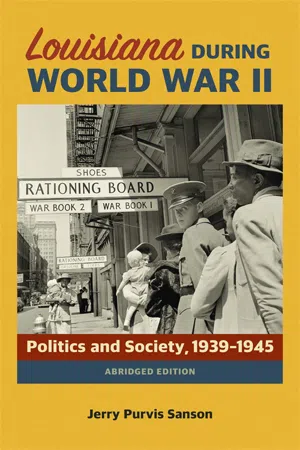
While the impact of World War II on America and other countries has been exhaustively chronicled, few historians have investigated the experiences of individual states during the tumultuous war years. In his study of Louisiana's home front from 1939 to 1945, Jerry Purvis Sanson examines changes in politics, education, agriculture, industry, and society that forever altered the Pelican State. The war era was a particularly important time in Louisiana's colorful political history. The gubernatorial victories of prominent anti–Huey Long candidates Sam Jones in 1940 and Jimmie Davis in 1944 reflected shifting sentiments toward politicians and heralded a changing of the guard in the statehouse. This created a system of active dual-faction politics that continued for the next decade. The war also transformed the state's economy: agricultural mechanization accelerated to compensate for labor shortages, and industries increased production to meet military demands. Louisiana's educational system modified its curriculum in response to the war, providing technical training and sponsoring scrap-metal collections and war-stamp sales drives. Sanson explores the war's effect on the everyday lives of Louisianians, showing how their actions at home provided them with a sense of personal participation in the titanic effort against the Axis powers. He also points out that, while many found their lives limited by war, two groups—African Americans and women— experienced increased opportunities as they moved from low-paying jobs to more lucrative positions vacated by white males who had departed for the service. Now condensed for easy and efficient access, Sanson's historical account provides a wide-ranging yet intimate look at how the war was brought home to the people of the Bayou State.
- 224 pages
- English
- ePUB (mobile friendly)
- Available on iOS & Android
eBook - ePub
About this book
Information
1
LOUISIANA IN 1939
A State in Chaos
LOUISIANA WAS A STATE IN CHAOS when Adolf Hitler rolled his tanks across the Polish border on September 1, 1939, starting the European Theater conflict of World War II. Revelations of a network of thievery in the administration of Governor Richard W. Leche roiled the state’s politics beginning in June of that year and showed no signs of abating. Each day’s news reported new abuses of the public trust, and official after official stood accused of corruption on a scale vast even by Louisiana standards.
The Leche administration represented the Longite faction of Louisiana’s Democratic Party, the ruling faction from 1928 until 1940. This faction was the creation of one man, Huey Pierce Long Jr., who transformed the state’s politics with his policies and the force of his personality. His efforts to help poor Louisianians using the power of state government led thousands of voters to support him without question. Other thousands, however, recoiled from his virtual dictatorship of the state and gravitated to an anti-Long Democratic faction that opposed his methods, if not always his goals, as he reshaped both the form and the substance of Louisiana politics.
The Regular Democratic Organization of New Orleans, the RDO, “Old Regulars,” or “Ring,” as the association was variously called, together with upstate planters, tightly controlled the state from the 1880s until 1928. Successful gubernatorial candidates generally won office by obtaining the support of the Old Regular/planter alliance. Huey Long, in contrast, spoke directly to the ordinary people, and with their support, he rose from an obscure Winn Parish boyhood to the Louisiana Railroad/Public Service Commission, the governor’s office, and the U.S. Senate.1
Long was born near the parish seat of Winnfield in 1893 and grew up in the aftermath of Populism in one of the movement’s strongholds in the state that provided the Populist candidate for governor in 1892. Winn Parish voters responded to a visit from Socialist presidential candidate Eugene Debs in 1912 by electing Socialists to some parish offices. This poor, agrarian, radical environment in which Huey Long matured influenced his political philosophy.2
Long’s political career began in 1918 with election to the Third (North Louisiana) District seat on the Railroad Commission. The commission regulated pipelines and utilities as well as railroad rates and practices and offered a platform from which an ambitious young politician could launch a successful career, and Long exploited the opportunity. Besides, the Louisiana Constitution stipulated no minimum age for commission members, and Long was only twenty-four years old, too young for most state offices. He positioned himself as the people’s champion on the commission, successfully challenged corporation practices, and brought some rates down. He believed that fulfillment of his campaign promises created an important distinction between him and other politicians: “I would describe a demagogue as a politician who don’t [sic] keep his promise. On that basis, I’m the first man to have power in Loozyanna who ain’t a demagogue.”3 Moreover, he could not afford to forget his promises to the voters. He planned to run for higher office, and he needed their continuing support.
He lost a race for governor in 1924 to Old Regular candidate Henry L. Fuqua, spent four years preparing for the next campaign, and competed against incumbent Oramel H. Simpson (Fuqua died in office in 1926 and Lieutenant Governor Simpson succeeded him) and Congressman Riley J. Wilson in 1928. His campaign set a new standard in Louisiana politics by including proposals to improve living conditions in the state: toll-free bridges, state-owned “free” school textbooks, construction of modern roads, improved state social services, and opposition to the Old Regulars and corporate rule. Simpson and Wilson maintained that Long represented a Communist attempt to take over the state, but their tactic failed. Long won the Democratic nomination when Wilson and the Old Regulars chose not to continue the struggle into the second Democratic primary.4 Winning the Democratic nomination was tantamount to election in those days of the Democratic Solid South. Louisiana did not elect a Republican governor between the end of Reconstruction in 1877 and 1980.
Long’s administration continued Louisiana’s lengthy tradition of powerful governors who aggregated influence through practice as well as through constitutional provision.5 Once in office, he fully developed the powers inherent in the governor’s control of such crucial matters as budget formulation, selection of legislative officers, patronage, and the granting of state contracts.
The new governor obtained control of important sources of patronage with which to reward loyal followers despite efforts by the old political establishment to neutralize him. He appointed friends to chair the highway commission, the board of health, and the conservation commission. He often served as his own floor leader in the legislature, rallying his troops and issuing orders on key bills. He pushed through a bond issue for sorely needed hard-surfaced roads, which upset conservatives whose political beliefs led them to recoil from public indebtedness. He financed his new “free” schoolbooks with increased severance taxes.6
Long hoped to establish his programs while his opponents were still in disarray after his election, but anti-Longite strength rebounded in March 1929 when the legislature met in special session to consider a tax Long proposed on refining oil in Louisiana. Instead of acting on his recommendation, his opponents rallied enough support in the House of Representatives to impeach him. He prevented his trial by persuading fifteen senators (one more than enough to block the two-thirds vote necessary to convict him) to sign a “round robin” pledge not to vote for his conviction because they believed that the impeachment charges were invalid.7
Long’s impeachment, though ultimately unsuccessful, increased his determination to obtain control of the state. He spent the remainder of his life acquiring enough political power to prevent other challenges to his power and his programs.8 While still consolidating his position in Louisiana following his impeachment scare, Long ran for the U.S. Senate, to which he was elected in 1930, and in which he took his seat in 1932.9 In between, he dominated a series of special legislative sessions that approved laws stripping the opposition of virtually all its remaining influence. The Old Regulars began defecting to him when business and political leaders in New Orleans realized that they had to cooperate in order to maintain state funding assistance for the city.10
Once in Washington, Long made his presence felt on the national level, demonstrating his ability to attract votes outside Louisiana by helping elect Hattie Caraway from Arkansas to the U.S. Senate in 1932. He supported New York Governor Franklin Roosevelt’s campaign for the presidency that year, but broke with him after concluding that the New Deal would not thoroughly redistribute wealth throughout the American economy, a reform that he believed necessary to alleviate suffering caused by the Great Depression. That opposition led him to create the Share Our Wealth movement, his alternative to the New Deal.11
Huey Long stood astride Louisiana politics by 1935 and was considering a likely campaign for the presidency when an assassin’s bullet cut him down in the state capitol while he was in Baton Rouge managing yet another special session of the legislature on September 8, 1935. His apparent assassin, Dr. Carl A. Weiss, evidently committed the murder because Long planned to gerrymander out of office Weiss’s father-in-law, state judge Benjamin Pavy. Long died two days after the attack.12
Huey Long’s funeral, on September 12, was a solemn ceremony befitting a prominent politician, but it left behind a leaderless faction possessing significant power. Longites controlled the governorship, with its array of powers. Their legacy included Huey’s memory, with which they could appeal for votes from people enjoying the state services he had provided, and they inherited an environment rife with opportunities for corruption. Long’s concentration of power and his domination of the legislature had almost obliterated the checks and balances of the democratic process. Writer Hamilton Basso observed Long’s heirs and accurately predicted how events would soon unfold: “From now on the boys who own the cow get the cream, every ounce of it, and the skimmed milk as well.” Huey Long himself had recognized the opportunities for graft created by his machine’s tight control of the state, observing that, “If those fellows ever try to use the powers I’ve given them without me to hold them down, they’ll land in the penitentiary.”13
A contemporary news magazine divided Long’s political heirs into two groups: “insiders” working behind the scenes to keep the machine running smoothly, and “outsiders”—a vote-getting political front. “Insiders” included people of influence such as Seymour Weiss, who administered the organization’s money and tax payments, and Conservation Commissioner Robert Maestri. “Outsiders” included Public Service Commissioner Wade O. Martin Sr., state Senator James A. “Jimmie” Noe, and state Representative Allen J. Ellender. Each of them possessed power and influence, but no one in either group had an undisputed claim to Long’s mantle. Instead, the day after Long died, they pledged to follow Governor Oscar K. “OK” Allen’s lead when he called a caucus to select a slate of candidates for the next year’s campaign for statewide offices.14
Longites eventually agreed on a ticket for the 1936 election headed by New Orleans Appeals Court judge Richard Leche for governor and Earl K. Long for lieutenant governor. Leche handily defeated an anti-Longite candidate, attorney Cleveland Dear of Alexandria, in an election that Perry Howard described as “the peak of the Long surge that had scattered the Bourbon Democrats into disarray.”15 Dear might have been in the most difficult position faced by any Louisiana gubernatorial candidate because Longites portrayed Huey Long as a martyr who gave his life in his fight for poor, deserving Louisianians. Anti-Longites discovered how difficult it is to campaign against a popular ghost.
The new administration established itself as the true heir of Huey Long by continuing public works and public assistance. But Longites in high positions also stole money from the state, the top leaders clothing themselves in the trappings of wealth. One student of this period of Louisiana politics observed, “Huey liked money but loved power; ‘Governor Dick’ [Leche], on the other hand, liked power but loved money.”16 Leche’s administration came to an ignominious end in 1939 largely because of action by disgruntled former Longite James A. “Jimmie” Noe.
Noe became bitter after Longites failed to nominate him for governor in the 1936 election. He began collecting affidavits from state employees reporting thefts in state government in 1937 and sending them to the U.S. Justice Department because he did not trust state courts subservient to the Long organization. Justice lawyers initially dismissed the affidavits as non-substantial, so Noe added photographers to his staff of researchers, but their early pictures failed to show a theft that unquestionably involved state property.17
A predawn telephone call to Noe’s Monroe home on June 7, 1939, informed him that a truck loaded with window frames was leaving a workshop located on the campus of Louisiana State University bound for the construction site of a house in Metairie owned by James McLachlan, an associate of Governor Leche. Noe quickly relayed his information to the city editor of the States newspaper in New Orleans, his friend F. Edward Hebert, who assigned reporter Meigs O. Frost and photographer Wilfred D’Aquin to accompany Ray Hufft, manager of Noe’s New Orleans radio station WNOE, to the construction site. The truck bore no identifying marks, and the rear license plate was smeared with mud, but photographs of the front license plate revealed numbers that States researchers traced to LSU. D’Aquin’s pictures and Frost’s narrative broke the story of the Louisiana Scandals.18
U.S. Treasury Department officials had also kept a watchful eye on the Longites since settlement of income tax claims against them in 1937. Rufus W. Fontenot, collector of internal revenue at New Orleans, convinced Elmer Irey of the Bureau of Internal Revenue in Washington to resume an ...
Table of contents
- Cover
- Title Page
- Copyright Page
- Dedication
- Contents
- Preface to the Abridged Edition
- Acknowledgments
- Introduction
- 1. Louisiana in 1939: A State in Chaos
- 2. Effective Bifactionalism
- 3. Bifactionalism and National Politics
- 4. Reaction to a World Aflame
- 5. Prep Schools for Boot Camp
- 6. Working the Fields
- 7. Goodbye to the Great Depression
- 8. War Bonds, Scrap Drives, and No Mardi Gras
- 9. The End of World War II
- Notes
- Bibliography
- Index
- Photographs
Trusted by 375,005 students
Access to over 1.5 million titles for a fair monthly price.
Study more efficiently using our study tools.
Frequently asked questions
Yes, you can cancel anytime from the Subscription tab in your account settings on the Perlego website. Your subscription will stay active until the end of your current billing period. Learn how to cancel your subscription
No, books cannot be downloaded as external files, such as PDFs, for use outside of Perlego. However, you can download books within the Perlego app for offline reading on mobile or tablet. Learn how to download books offline
Perlego offers two plans: Essential and Complete
- Essential is ideal for learners and professionals who enjoy exploring a wide range of subjects. Access the Essential Library with 800,000+ trusted titles and best-sellers across business, personal growth, and the humanities. Includes unlimited reading time and Standard Read Aloud voice.
- Complete: Perfect for advanced learners and researchers needing full, unrestricted access. Unlock 1.5M+ books across hundreds of subjects, including academic and specialized titles. The Complete Plan also includes advanced features like Premium Read Aloud and Research Assistant.
We are an online textbook subscription service, where you can get access to an entire online library for less than the price of a single book per month. With over 1.5 million books across 990+ topics, we’ve got you covered! Learn about our mission
Look out for the read-aloud symbol on your next book to see if you can listen to it. The read-aloud tool reads text aloud for you, highlighting the text as it is being read. You can pause it, speed it up and slow it down. Learn more about Read Aloud
Yes! You can use the Perlego app on both iOS and Android devices to read anytime, anywhere — even offline. Perfect for commutes or when you’re on the go.
Please note we cannot support devices running on iOS 13 and Android 7 or earlier. Learn more about using the app
Please note we cannot support devices running on iOS 13 and Android 7 or earlier. Learn more about using the app
Yes, you can access Louisiana during World War II by Jerry Purvis Sanson in PDF and/or ePUB format, as well as other popular books in History & World War II. We have over 1.5 million books available in our catalogue for you to explore.