The first complete history of US industry's most influential and controversial lobbyist
Founded in 1895, the National Association of Manufacturers—NAM—helped make manufacturing the basis of the US economy and a major source of jobs in the twentieth century. The Industrialists traces the history of the advocacy group from its origins to today, examining its role in shaping modern capitalism, while also highlighting the many tensions and contradictions within the organization that sometimes hampered its mission.
In this compelling book, Jennifer Delton argues that NAM—an organization best known for fighting unions, promoting "free enterprise," and defending corporate interests—was also surprisingly progressive. She shows how it encouraged companies to adopt innovations such as safety standards, workers' comp, and affirmative action, and worked with the US government and international organizations to promote the free exchange of goods and services across national borders. While NAM's modernizing and globalizing activities helped to make American industry the most profitable and productive in the world by midcentury, they also eventually led to deindustrialization, plant closings, and the decline of manufacturing jobs.
Taking readers from the Progressive Era and the New Deal to the Reagan Revolution and the Trump presidency, The Industrialists is the story of a powerful organization that fought US manufacturing's political battles, created its economic infrastructure, and expanded its global markets—only to contribute to the widespread collapse of US manufacturing by the close of the twentieth century.
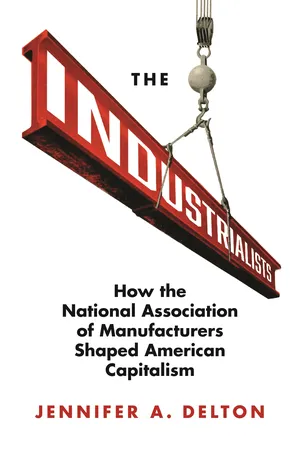
eBook - ePub
The Industrialists
How the National Association of Manufacturers Shaped American Capitalism
- English
- ePUB (mobile friendly)
- Available on iOS & Android
eBook - ePub
The Industrialists
How the National Association of Manufacturers Shaped American Capitalism
About this book
Information
Publisher
Princeton University PressYear
2020Print ISBN
9780691203348
9780691167862
eBook ISBN
9780691203324
Table of contents
- Cover Page
- Series Page
- Title Page
- Copyright Page
- Dedication
- Epigraphs
- Contents
- List of Illustrations
- Introduction
- Part I: Ascent, 1895–1940
- Part II: Dominance, 1940–1980
- Part III: Decline and Recovery, 1960–2004
- Epilogue
- Acknowledgments
- Selected Bibliography
- Index
Trusted by 375,005 students
Access to over 1.5 million titles for a fair monthly price.
Study more efficiently using our study tools.
Frequently asked questions
Yes, you can cancel anytime from the Subscription tab in your account settings on the Perlego website. Your subscription will stay active until the end of your current billing period. Learn how to cancel your subscription
No, books cannot be downloaded as external files, such as PDFs, for use outside of Perlego. However, you can download books within the Perlego app for offline reading on mobile or tablet. Learn how to download books offline
Perlego offers two plans: Essential and Complete
- Essential is ideal for learners and professionals who enjoy exploring a wide range of subjects. Access the Essential Library with 800,000+ trusted titles and best-sellers across business, personal growth, and the humanities. Includes unlimited reading time and Standard Read Aloud voice.
- Complete: Perfect for advanced learners and researchers needing full, unrestricted access. Unlock 1.5M+ books across hundreds of subjects, including academic and specialized titles. The Complete Plan also includes advanced features like Premium Read Aloud and Research Assistant.
We are an online textbook subscription service, where you can get access to an entire online library for less than the price of a single book per month. With over 1.5 million books across 990+ topics, we’ve got you covered! Learn about our mission
Look out for the read-aloud symbol on your next book to see if you can listen to it. The read-aloud tool reads text aloud for you, highlighting the text as it is being read. You can pause it, speed it up and slow it down. Learn more about Read Aloud
Yes! You can use the Perlego app on both iOS and Android devices to read anytime, anywhere — even offline. Perfect for commutes or when you’re on the go.
Please note we cannot support devices running on iOS 13 and Android 7 or earlier. Learn more about using the app
Please note we cannot support devices running on iOS 13 and Android 7 or earlier. Learn more about using the app
Yes, you can access The Industrialists by Jennifer A. Delton,Jennifer Delton in PDF and/or ePUB format, as well as other popular books in History & Business General. We have over 1.5 million books available in our catalogue for you to explore.