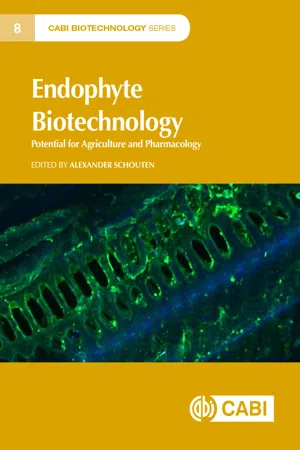
Endophytes are bacterial and fungal microorganisms that colonize plants without usually eliciting visible disease symptoms but establishing intricate and mutually beneficial interactions with their host plant. This can lead to an increase in plant vigour, growth, development, and changes in plant metabolism. Endophytes may assist in the development of more productive and sustainable agricultural practices or discoveries of novel pharmacologicals. These elusive organisms are often overlooked and their benefits underrated. Endophytes can support plants in a variety of ways to cope with biotic and abiotic stress factors, such as drought, heat, pest and diseases. They can produce particular metabolites, facilitate access to nutrients, change the plant's chemistry, physiology and responses, or by a combination of these factors. The biosynthetic pathways present in endophytes alone or in combinations with the plant's, can lead to novel chemicals, with yet undiscovered pharmacological characteristics. With state-of-the-art knowledge on their discovery and roles, this book describes the diversity of endophytes, their value, exploitation and future challenges.Key features: Provides an overview of the endophytes that are encountered in nature.Demonstrates the beneficial effects of endophytes together with their practical applications in agriculture.Explores how endophytes are valuable candidates for research on future drugs and biopesticides.This title is a valuable resource for students and researchers in plant science and plant pathology as well as those working in the pharmaceutical and pesticide industries.
- English
- ePUB (mobile friendly)
- Available on iOS & Android
eBook - ePub
About this book
Information
Topic
Scienze biologicheSubtopic
Biotecnologia 1 Introduction
Laboratory of Phytopathology, Wageningen University & Research, Wageningen, The Netherlands
* Corresponding author e-mail: [email protected]
1.1 Microbes: Ancient Allies in Sustaining Plant Life
Fossil records revealing the presence of arbuscular and fungal structures in 400-million-year-old plants indicate that intimate relationships between plants and microorganisms are very ancient (Remy et al., 1994; Taylor et al., 1995; Redecker et al., 2000; Taylor et al., 2005; Taylor and Krings, 2005; Krings et al., 2007; Labandeira and Prevec, 2014). Due to the sometimes devastating plant diseases in crops caused by microorganisms, such as late blight in potato, Panama disease in banana, rusts in cereals and brown spot in rice (Klinkowski, 1970; Marquardt, 2001), most microorganisms were initially mistrusted and plants were considered to be rather vulnerable to microbial invasion. Based on research over the past six decades, this view has gradually changed, and the current view is that in nature plants are not all that vulnerable to microbial diseases and can cope perfectly with both biotic and abiotic stress conditions. In this concept, the microbial community in the rhizosphere, phyllosphere and endosphere is even considered a true asset for plant survival (Rodriguez et al., 2008; Rodriguez and Redman, 2008), and may even be deliberately recruited and manipulated by the plant to maximize growth and development. Microbes can protect plants against biotic (pests and pathogens) and abiotic (extreme temperatures, drought, chemical contaminants) stress conditions and facilitate nutrient uptake. A typical and very practical illustration that particular microorganisms can benefit the plant is the presence of specific antibiotic-producing pseudomonads in wheat and barley, which significantly reduce root disease caused by the soilborne fungus Gaeumannomyces graminis var. tritici. Although this disease can be significantly detrimental in the first three to five growing seasons, by sustaining a strict monoculture approach, the bacterial population is capable of accumulating to effective antagonistic levels in the plant’s rhizosphere in several important growing areas, such as the Inland Pacific Northwest of the USA, The Netherlands and the UK. In this way, these crops have been successfully cultivated for many decades without showing significant detrimental effects caused by the pathogen (Gerlagh, 1968; Shipton, 1972; Baker and Cook, 1974; Gurusiddaiah et al., 1986; Cook, 2003; Weller et al., 2007). This counterintuitive monoculture approach proved to be crucial in suppressing the take-all disease because it could reappear when this growing strategy was interrupted, e.g. by fallow or crop rotation (Baker and Cook, 1974; Cook et al., 1995; Cook, 2007).
The ability to establish a beneficial association with particular microbes is most likely not an easy task, considering the vast numbers of microorganisms that can be found in both the rhizosphere and phyllosphere. It has been calculated that the rhizosphere, which is the thin zone of soil around the root in which the microbial life is affected through root exudates (Curl and Truelove, 1991), can harbour up to 1011 colony forming units (cfu) of prokaryotic cells (Shafer and Blum, 1991), comprising more than 30,000 different species (Mendes et al., 2011), and more than 107 cfu of fungi per gram of fresh root (Shafer and Blum, 1991). And for the rhizoplane itself, prokaryotic population densities of 107 cfu per gram of fresh material were calculated (Benizri et al., 2001; Bais et al., 2006). The microbial community structures within the rhizosphere environments are nevertheless tremendously inconsistent in place and time (Sasse et al., 2018). This inconsistency is regulated not only by abiotic factors, such as soil type and geographical location, but also by the plant species, its genotype and its developmental stage (Micallef et al., 2009a,b; Weinert et al., 2011; Inceoglu et al., 2013). Root cap, border and other root cells release an array of constituents such as insoluble mucilage and soluble (antibiotic) exudates as well as volatile organic carbons (Walker et al., 2003; Bais et al., 2006; Hartmann et al., 2009; Jones et al., 2009). Within root exudates, sugars, amino compounds, organic acids, fatty acids, sterols, growth factors, nucleotides, flavones, enzymes, together with an array of miscellaneous compounds, such as auxins, scopoletin, hydrocyanic acid and microbial growth stimulants and inhibitors, were detected (Curl and Truelove, 1991), thus illustrating the chemical complexity of the rhizosphere.
1.2 The Plant Endosphere as Habitat for Microorganisms
Primarily from the rhizosphere, a selected number of (beneficial) microorganisms are allowed access to the endosphere of the plant (Bulgarelli et al., 2013). This is nevertheless a rather oversimplified view, as some microorganisms are obligate endophytic and not only transferred horizontally but also vertically, i.e. through seeds, such as the grass endophytes, and are therefore not encountered in the bulk soil or rhizosphere (Schardl et al., 2004). Nevertheless, the microbial community within the endosphere is significantly less complex than that of the rhizosphere (Compant et al., 2010; Edwards et al., 2015; Vandenkoornhuyse et al., 2015). At first, only arbuscular mycorrhizae (AMs) and rhizobia (Denison and Kiers, 2011) were considered and extensively scrutinized (Parniske, 2008; Denison and Kiers, 2011). But it is now evident that virtually every plant can allow a much broader assortment of microorganisms, particularly bacteria and fungi, to reside in its endosphere without really exhibiting its presence (Rodriguez and Redman, 2008). As for arbuscular AMs and rhizobia, the endosphere is regarded as a protective environment and serving as an important carbon source for the microbe, whereas the benefit for the host plant is often more difficult to define. This is because these benefits may be more indirect and multifaceted, not only facilitating nutrient uptake (García-Garrido and Ocampo, 2002), as described for AMs and rhizobia, but also providing other means to increase plant vigour, growth and development (Sikora, 1992; Rodriguez and Redman, 2008; Aly et al., 2011; Bakker et al., 2013; Ludwig-Müller, 2015), which may only be determined by considering the environmental or ecological context (Schardl, 2001; Müller and Krauss, 2005; Rodriguez et al., 2008; Redman et al., 2011). In all, these endophytes can be mutualistic, serving the host plant in ways AMs and rhizobia may not.
Similar to AMs and rhizobia, it is believed that chemical queues released by the roots are involved in the recruiting of microorganisms from the bulk soil and subsequently manipulating the evolved microbial community, all aiming at allowing beneficial microorganisms to enter the rhizosphere and endosphere, while simultaneously repressing or repelling unwelcome, pathogenic or parasitic microorganisms. However, the occurrence of diseases indicates that the selection for beneficial microorganisms is error prone. As discussed in Chapter 2, this volume, this may not be without reason because the difference between a pathogenic and beneficial microorganism can in some cases be subtle. The underlying mechanisms for the change in microbial behaviour are still poorly understood. Nevertheless, biological, genetic and molecular studies suggest that both plant and endophytes are responsible. Knowledge on these issues is elemental when endophytes are to be exploited for agricultural practices.
1.3 Exploiting Endophytes
Endophytes can be exploited in several ways. Firstly, they can be used in agricultural practices to support plant vigour, growth and development, even making it possible to reduce the usage of fertilizers and pesticides and to grow plants under less ideal conditions, such as water deficiency, increased soil salinity and high temperatures. Secondly, endophytes are known to synthesize a plethora of chemical constituents. This is most likely because, over time, the intimate association between plants and endophytes led to complex chemical interactions, not only with the host plant but also with competitors. These constituents may benefit not only the plant but also humans. From many (medicinal) plants, endophytes are being characterized that are by themselves able to synthesize compounds relevant for pharmacological (Aly et al., 2011) and agronomical reasons.
1.4 Aim of This Book
The aim of this book is to give an overview on the current knowledge about endophytic fungi and bacteria, their diversity, their relationships with pests and pathogens, their distribution and activities inside the plant and their (potential) applications in developing more sustainable agricultural practices. Furthermore, the identification of chemical constituents synthesized by endophytes or by the endophyte–host plant association is discussed, as they can be most relevant for identifying novel compounds relevant for medicine, such as antibiotics and anticancer drugs, and for agriculture, such as biologically sound pesticides. It demonstrates that the current research on endophytes is highly technology-based on every level, relying on state-of-the-art molecular, biochemical, microscopical, computational and biological methods.
References
Aly, A.H., Debbab, A. and Proksch, P. (2011) Fungal endophytes: Unique plant inhabitants with great promises. Applied Microbiology and Biotechnology 90, 1829–1845. doi:10.1007/s00253-011-3270-y
Bais, H.P., Weir, T.L., Perry, L.G., Gilroy, S. and Vivanco, J.M. (2006) The role of root exudates in rhizosphere interactions with plants and other organisms. Annual Review of Plant Biology 57, 233–266. doi:10.1146/annurev.arplant.57.032905.105159
Baker, K.F. and Cook, R.J. (1974) Biological Control of Plant Pathogens. W.H. Freeman and Company, San Francisco, California.
Bakker, P.A.H.M., Berendsen, R.L., Doornbos, R.F., Wintermans, P.C. and Pieterse, C.M. (2013) The rhizosphere revisited: Root microbiomics. Frontiers in Plant Science 4, 165. doi:10.3389/fpls.2013.00165
Benizri, E., Baudoin, E. and Guckert, A. (2001) Root colonization by inoculated plant growth-promoting rhizobacteria. Biocontrol Science and Technology 11, 557–5...
Table of contents
- Cover
- Half Title
- CABI Biotechnology Series
- Title
- Copyright
- Contents
- Contributors
- Preface
- 1 Introduction
- 2 Endophytic Fungi: Definitions, Diversity, Distribution and Their Significance in Plant Life
- 3 Sources, Niches and Routes of Colonization by Beneficial Bacterial Endophytes
- 4 Analysing Seed Endophytes for Biotechnology
- 5 Mitigating Climate Impacts on Crop Production via Symbiosis
- 6 Endophytes as Novel Pest Control Agents: Myth or Reality?
- 7 Improved Adaptation of Temperate Grasses through Mutualism with Fungal Endophytes
- 8 Interactive Effects of Co-occurring Epichloid Endophytes, Rhizobia and Arbuscular Mycorrhizal Fungi Modulating Their Benefits to Grasses and Legumes
- 9 Saving Resources: The Exploitation of Endophytes by Plants for the Biosynthesis of Multi-functional Defence Compounds
- 10 Bioprospecting of Endophytes
- 11 Prospects for Biotechnological Exploitation of Endophytes Using Functional Metagenomics
- 12 Interplay Between Endophyte and Host Plant in the Synthesis and Modification of Metabolites
- Index
- Back
Trusted by 375,005 students
Access to over 1.5 million titles for a fair monthly price.
Study more efficiently using our study tools.
Frequently asked questions
Yes, you can cancel anytime from the Subscription tab in your account settings on the Perlego website. Your subscription will stay active until the end of your current billing period. Learn how to cancel your subscription
No, books cannot be downloaded as external files, such as PDFs, for use outside of Perlego. However, you can download books within the Perlego app for offline reading on mobile or tablet. Learn how to download books offline
We are an online textbook subscription service, where you can get access to an entire online library for less than the price of a single book per month. With over 1.5 million books across 990+ topics, we’ve got you covered! Learn about our mission
Look out for the read-aloud symbol on your next book to see if you can listen to it. The read-aloud tool reads text aloud for you, highlighting the text as it is being read. You can pause it, speed it up and slow it down. Learn more about Read Aloud
Yes! You can use the Perlego app on both iOS and Android devices to read anytime, anywhere — even offline. Perfect for commutes or when you’re on the go.
Please note we cannot support devices running on iOS 13 and Android 7 or earlier. Learn more about using the app
Please note we cannot support devices running on iOS 13 and Android 7 or earlier. Learn more about using the app
Yes, you can access Endophyte Biotechnology by Alexander Schouten in PDF and/or ePUB format, as well as other popular books in Scienze biologiche & Biotecnologia. We have over 1.5 million books available in our catalogue for you to explore.