eBook - ePub
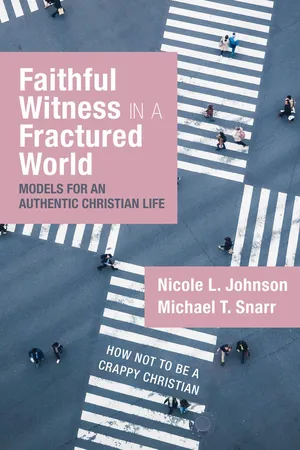
Faithful Witness in a Fractured World
Models for an Authentic Christian Life
- 132 pages
- English
- ePUB (mobile friendly)
- Available on iOS & Android
eBook - ePub
Faithful Witness in a Fractured World
Models for an Authentic Christian Life
About this book
Christians have always looked to models within the Christian faith to guide their lives. At a time when the church is more identifiable by ugly partisan politics--what we call "crappy Christianity"--than by compassionate neighbor love, this book highlights the lives and work of seven individuals who are pursuing their Christian calling in humility and profound love for and service to others, this book highlights the lives and work of seven individuals who are pursuing their Christian calling in humility and profound love for and service to others. Their commitments have led to vocations in working with homeless women, employing refugees, lobbying on Capitol Hill for environmental protection, healing trauma in urban communities, peacemaking in Israel-Palestine, advocating for immigrants, and walking alongside people in addiction recovery. Their individual and collective witness offer compelling examples of authentic Christian life, which is marked in part by active, embodied faith in pursuit of the common good; a broad and inclusive love for all people; rightly ordered political identities and loyalties; and a commitment to work toward holistic redemption of both people and the systems that constitute our life together. In contrast to much of contemporary American Christianity, these models of faith demonstrate that Christians should focus much more on what we are for rather than what we are against.
Information
Topic
Theology & ReligionSubtopic
Christian Ministry1
Meet Our Friends
Introduction
A decade ago, findings from a study by the Barna Group declared, “Christianity has an image problem.”6
No kidding. And it seems even worse now.
We noted in the introduction that this book is about people, and that by engaging the stories of some really good people living out their understanding of Christian faith, we might begin to see what Christianity can be for rather than what it thinks it should be against. In our view, too much of current mainstream Christianity in America is focused on what Christians think they should oppose or even hate. But we know that the biblical descriptions of Jesus are very much about what, or more accurately whom, he was for: poor and marginalized folks, sick people, children, outsiders, and other voiceless, powerless individuals and groups in first-century Palestine. And he wasn’t for them in some abstract theological way: he was literally with them in his ministry. Shane Claiborne echoes this when he says that the church desperately needs “lovers, people who are building deep, genuine relationships with fellow strugglers along the way, and who actually know the faces of the people behind the issues they are concerned about.”7
To this end, we invite the reader to meet some of our friends. In the next several pages, we travel to inner-city Pittsburgh where Christians are working to heal trauma victims, to the rural Midwest where a former drug addict is loving current addicts into a new life, and to war zones in the Middle East where a former horse trainer is defusing conflict one relationship at a time. We introduce you to a young woman who gave up a career in fashion in New York City to employ refugee women, and another working in Washington, DC, to bring together politicians from across party lines to address climate change. We’ve known some of these people for years, and others are relatively new to us, but each inspires us in significant ways with their humble and persistent service to broken or hurting people. These are the folks we look to when we feel inundated by the noise and bluster of crappy Christians. We share their stories hoping they’ll inspire you, too.
Tammy Beery: Inviting the Stranger In
Do not neglect to show hospitality to strangers, for by doing that some have entertained angels without knowing it.
~ Hebrews 13:2
I was a stranger and you welcomed me.
~ Matthew 25:35
“I’m Tammy Beery and I am nobody special.”
That’s how one of our models of Christian faith and service, when asked, introduced herself.
Most of us have seen homelessness firsthand. From the safety of our locked cars, we see a homeless person on a street corner and try to avoid making eye contact, driving by in quickly forgotten discomfort. Maybe we feel some sympathy—and a few of us might even respond in the form of some loose change or a spare granola bar—or we might just try to move on before we feel anything at all. Some Christians judge the homeless for the apparently poor personal decisions that landed them where they are. Even those who give are prone to only rolling their car windows down to the precautionary three inches—just enough space to pass out a couple of dollar bills and escape unscathed.
Tammy Beery took things further. A lot further.
Tammy’s story starts out like so many other Christians. She was raised in a loosely Christian household and was taught to believe in God. Shortly after getting married, she moved overseas with her husband, who was in the Air Force, and lived there for a few years. In search of community, she found a church but soon discovered some gut-level concerns about what she was learning there, and that led her to begin reading and trying to understand the Bible for herself.
As Tammy explains it, she “surrendered” to God and became a Christian in 1990. For well over two decades, she studied the Bible, went to Sunday school and church, and “did what Christians do,” but “without ever really connecting with people in need.” In the summer of 2014, she began to see more homeless people, especially homeless women, along her town’s main streets. They held signs that said things like “Will Work for Food” or “No Job, Need Money.” One day, in the car with her husband, Craig, she noticed a couple with a baby who were homeless. Tammy was struck by the way the woman was hiding behind her sign in shame. Craig declared that the man needed to get a job to support his family. Tammy asked Craig, a hiring manager for an engineering firm, if he would hire this man, given his unwashed clothes and hair and no shoes. No, admitted Craig. He certainly wouldn’t.
This conversation, along with the attitudes of people in her church, led Tammy to some new convictions about what it might mean to live out her Christian faith. As she read further into the Christian Scriptures, she began to see God’s active concern for the widow, the orphan, and the foreigner. This, in Tammy’s view, came to mean making room—literally—for the poorest in society. As Tammy puts it, God calls us “to be engaged and aware and empathetic with the suffering in our community.” She began learning about homelessness and came to understand the connections between homelessness and addiction and domestic violence. Despite the view held by many in her circles that drug addicts were simply not their problem, Tammy kept returning to the notion that God continually calls people to take care of those in need. Tammy’s compassion was multiplied as she heard the real-life stories of those who become addicts and eventually become homeless. As Tammy says, telling the girl who grows up with an addicted mother and comes of age mired in the world of drugs to “just get an education” to improve her situation isn’t enough: “We just have to get off our high horses and care!”
A vision began to develop in Tammy’s mind about what it would look like to live out this understanding of genuine, active concern for those facing homelessness due to drug addiction or other problems. She talked with a few local pastors and community leaders about her idea to provide shelter for homeless women. After multiple conversations with others in the community, a local judge who was working to develop alternatives to prison for drug offenders invited Tammy to present her ideas at a town hall meeting. Despite a near-panic attack at the thought of speaking publicly at the meeting, Tammy managed to share that vision with a group of pastors and other civic leaders. In particular, she noted the need for a “low-barrier” women’s shelter that would not require background checks for admittance or turn away women who showed up high or drunk, as the vast majority of shelters do. By October 2014, just a few months after Tammy’s initial convictions about serving the poorest in her community, Hope House, a low-barrier shelter for women, was up and running. Hope House provides overnight shelter for women and children who are the victims of domestic violence, drug abuse, and/or financial problems, and it operates from a Christ-centered perspective of care and concern for the “least” in society.
Tammy is relocating soon and has already begun to scope out spaces of need in her new community. She notes the difficulty of finding a church that is responding to God’s clear call to serve the vulnerable and poor in society. The sad reality is that churches that function this way can be difficult to find. Tammy expresses frustration with the view that she is somehow special or unique, some kind of “super Christian” for the work that she does (recall how she introduced herself above). In her view, she is doing nothing more than responding to the call that God places on all people who claim to follow the Christian faith. This is a theme we’ll come back to in the following chapters.
Ron Cordy: Leading Others to Recovery
Carry each other’s burdens, and in this way you will fulfill the law of Christ.
~ Galatians 6:2
Do not judge, so that you may not be judged. For with the judgment you make you will be judged, and the measure you give will be the measure you get.
~ Matthew 7:1–2
Ron Cordy doesn’t look like a “good” Christian. He doesn’t always sound like one either. He’s a big guy with a big voice and a rather gruff demeanor. He prefers to cut the sleeves off all his shirts. And he isn’t shy about using four-letter words.
As a kid, Ron liked the Methodist church he attended. He acknowledges that his faith in God developed there and that he learned about love in that community, but he struggled to feel truly connected. One instance in particular stands out for Ron as indicative of the issues that made him feel that sense of disconnection. One morning at church when Ron was just a little boy, he overheard some adults making fun of the way another guy in church was dressed. They had welcomed this young man to church that morning and as soon as he was out of earshot, they criticized his appearance, laughing about his long hair, shorts, and sandals. This happened to be a good guy Ron looked up to and saw as someone who was really trying to live an authentic Christian life. At that moment, Ron glanced up at the painting of Jesus hanging behind the altar and saw the image of a long-haired man in a robe and sandals. The hypocrisy of men who looked nothing like Jesus (and wore polyester suits, no less—it was the 1970s, after all) poking fun at a person who actually bore some resemblance to him, coupled with the deeper hypocrisy of Christians judging other Christians for something as insignificant as their appearance, hit Ron pretty squarely in the gut. Negative experiences like this one confused and clouded other, more positive things he was picking up from his church. As Ron explains, this was just one example of the many times he saw Christians acting very un-Christlike, and he eventually left church altogether.
In high school, Ron made the acquaintance of Allen, his art teacher. Allen sometimes talked about his dream of opening a coffee shop and an arts- and music-focused space that would provide opportunities for ministry in service to the poor. At the time, Allen was in a successful Christian band that toured locally, and Ron would work occasionally as part of the band’s road crew. Ron recalls thinking that Allen was wasting his time and talents by playing in a Christian band: “[I thought,] what an idiot, because I would be a rock star and I would make my own album covers . . . That’s what I would do with my talents. . . . I sure wouldn’t be [thinking about doing ministry with the poor and broken].”
Fast forward about a decade or so. Despite having a successful career, Ron began to live a lifestyle that eventually spiraled into alcohol and drug abuse. Things came to a critical juncture when he was arrested and convicted on felony charges for drug possession. Ron admits that, in retrospect, he is certain he would have met an early death if he had maintained the partying lifestyle, and he now looks back on that arrest as having saved his life. Rather than prison, his sentencing required mandatory recovery meetings for addiction. Flipping through a newspaper one afternoon, Ron saw a photo of Allen receiving a donation for his organization, Sugartree Ministries, and was astounded to learn that his former art teacher had realized his dream of opening a coffeehouse ministry. He visited Sugartree and discovered that they held a regular recovery meeting, so he began attending his mandated recovery meetings there. Eventually, as Ron began to overcome his own addictions, Sugartree asked him to oversee their recovery ministries, as well as the drop-in recovery house. For more than a decade now, Ron has facilitated the meetings, held twice each week, for people struggling with opioid, heroin, alcohol, and other addictions. He also sits on Sugartree’s advisory board. Although the recovery meetings and pastoral support offered by Sugartree are Christian-based, people with any or no belief system are welcome.
Ron has stayed clean and sober all these years. He is still a songwriter and musician and directs his artistic talents toward the work of helping others stay clean and sober. He says that the one thing he is called to do is to love people. He becomes frustrated with Christian legalism, which is the overemphasis on rules rather than love and compassion. Did we mention that Ron sometimes uses some colorful language? This is one example that Ron uses to make his point: too many Christians judge others for things like using swear words, but then turn around and fail to love their neighbors, which is far more central to the message of Jesus. As Ron puts it, “We forget the root of it all, which is that we were loved, so therefore we can love. We were saved, so therefore we can help in the salvation of someone else, and not just in their soul but in their life.” We’ll revisit Ron’s views of salvation and the church in the next chapters.
Tessa Reeves: Not “Business as Usual”
The foreigner residing among you must be treated as your native-born. Love them as yourse...
Table of contents
- Title Page
- Acknowledgments
- Introduction
- Chapter 1: Meet Our Friends
- Chapter 2: Embodied Faith
- Chapter 3: Depth of Faith, Breadth of Love
- Chapter 4: Identities and Loyalties
- Chapter 5: Redemption and Restoration
- Conclusion
- Bibliography
Trusted by 375,005 students
Access to over 1.5 million titles for a fair monthly price.
Study more efficiently using our study tools.
Frequently asked questions
Yes, you can cancel anytime from the Subscription tab in your account settings on the Perlego website. Your subscription will stay active until the end of your current billing period. Learn how to cancel your subscription
No, books cannot be downloaded as external files, such as PDFs, for use outside of Perlego. However, you can download books within the Perlego app for offline reading on mobile or tablet. Learn how to download books offline
Perlego offers two plans: Essential and Complete
- Essential is ideal for learners and professionals who enjoy exploring a wide range of subjects. Access the Essential Library with 800,000+ trusted titles and best-sellers across business, personal growth, and the humanities. Includes unlimited reading time and Standard Read Aloud voice.
- Complete: Perfect for advanced learners and researchers needing full, unrestricted access. Unlock 1.5M+ books across hundreds of subjects, including academic and specialized titles. The Complete Plan also includes advanced features like Premium Read Aloud and Research Assistant.
We are an online textbook subscription service, where you can get access to an entire online library for less than the price of a single book per month. With over 1.5 million books across 990+ topics, we’ve got you covered! Learn about our mission
Look out for the read-aloud symbol on your next book to see if you can listen to it. The read-aloud tool reads text aloud for you, highlighting the text as it is being read. You can pause it, speed it up and slow it down. Learn more about Read Aloud
Yes! You can use the Perlego app on both iOS and Android devices to read anytime, anywhere — even offline. Perfect for commutes or when you’re on the go.
Please note we cannot support devices running on iOS 13 and Android 7 or earlier. Learn more about using the app
Please note we cannot support devices running on iOS 13 and Android 7 or earlier. Learn more about using the app
Yes, you can access Faithful Witness in a Fractured World by Dr. Nicole L. Johnson,Michael T. Snarr in PDF and/or ePUB format, as well as other popular books in Theology & Religion & Christian Ministry. We have over 1.5 million books available in our catalogue for you to explore.