eBook - ePub
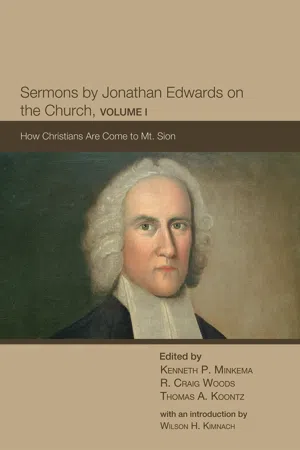
Sermons by Jonathan Edwards on the Church, Volume 1
How Christians Are Come to Mt. Sion
- 142 pages
- English
- ePUB (mobile friendly)
- Available on iOS & Android
eBook - ePub
Sermons by Jonathan Edwards on the Church, Volume 1
How Christians Are Come to Mt. Sion
About this book
In April 1740, Jonathan Edwards, minister of Northampton, Massachusetts, preached a discourse on Hebrews 12:22-24 comprising eight sermons. At this point, he had been the senior pastor of that town for just over a decade, and had seen his congregation through the historic Connecticut Valley Awakening of the mid-1730s, when several hundred souls were reportedly savingly converted. This first volume of Sermons by Jonathan Edwards on the Church contains the previously unpublished Hebrews discourse, "Christians Coming to Mt. Zion," preached on the very cusp of the transatlantic religious movement that would become known as "The Great Awakening," the New England phase of which began later that year. In addition to the complete and original text of Edwards' discourse, the volume includes two introductions that describe his preaching style and method and provide an historical context.
Information
Sermon 1
How Christians Are Come to Mt. Sion
Hebrews 12:22–24.
But ye are come unto Mt. Sion, and unto the city of the living God, the heavenly Jerusalem, and to an innumerable company of angels, to the general assembly and church of the firstborn, which are written in heaven, and to God the Judge of all, and to the spirits of just men made perfect, and to Jesus the mediator of the new covenant, and to the blood of sprinkling, that speaketh better things than that of Abel.
The Apostle had, in some of the preceding verses, been earnestly warning the Christian Hebrews or Jews, carefully to avoid the ways of sin. Vv. 13, etc., “And make straight paths for your feet, lest that which is lame be turned out of the way; but let it rather be healed. Follow peace with all men, and holiness, without which no man shall see the Lord: looking diligently lest any man fail of the grace of God; lest any root of bitterness springing up trouble you, and thereby many be defiled; lest there be any fornicator, or profane person, as Esau, who for one morsel of meat sold his birthright. For ye know how that afterward, when he would have inherited the blessing, he was rejected: for he found no place of repentance, though he sought it carefully with tears.”
And the great argument that the Apostle makes use of to enforce this counsel, is that they were not come to Mt. Sinai, as their fathers were of old, but to Mt. Sion, “the heavenly Jerusalem,” etc.; signifying that there is more at Mt. Sion to restrain us from sin, than there was at Mt. Sinai. There was a great deal to restrain from sin, that their fathers saw and heard when they came to Mt. Sinai. There was manifested the terrible majesty of God: for the mount burnt with fire, with blackness, and darkness and tempest, and the sound of the trumpet, and the voice of words giving forth the Ten Commands; which voice was so terrible, that the children of Israel entreated that the word should not be spoken any more: for they could not endure that which was commanded, and if so much as a beast touch the mountain it was to be stoned, or thrust through with a dart. And so terrible was the sight, that Moses himself said, “I exceedingly fear and quake,” as ‘tis said in the 18th, 19th, 20th [and] 21st verses. Here was a great deal to restrain and deter the children of Israel from sin, for they saw in what a dreadful manner the commands were given forth. They saw what a dreadful God it was that gave those commands, which might make ‘em sensible how terrible his wrath would be against the breakers of the commands.
But yet the Apostle intimates that their fathers had not so much to restrain them from sin, at that material, earthly mountain, Mt. Sinai, as they have who are come to the spiritual, heavenly Mt. Sion. And therefore the Apostle, after he had declared what Christians were come to at Mt. Sion, in the conclusion at the 25th [and] 26th verses, he says: “See that ye refuse not him that speaketh. For if they escaped not who refused him that spake on earth, much more shall not we escape, if we turn away from him that speaketh from heaven: whose voice then shook the earth: but now he hath promised, saying, Yet once more I shake not the earth only, but also heaven.”
In the three verses of the text, the state and circumstances of Christians is described under a twofold representation:
1. Of a place that they are come to. Here called Mt. Sion, “the city of the living God, the heavenly Jerusalem.”
2. The inhabitants, or persons, there resident: “to an innumerable company of angels, to the general assembly and church of the firstborn, to God the Judge of all, to the spirits of just men made perfect, and to Jesus the mediator of the new covenant.”
THE METHOD
in which I propose to discourse from these words, is to show, in order, in what sense Christians are said to be come to each of these: first, to show how Christians are come to Mt. Sion; second, how they are come to the city of the living God, the heavenly Jerusalem; third, how they are come to an innumerable company of angels; and so on, so that each particular may be taken as a distinct proposition, which I shall explain and improve. And therefore,
I. I would show how Christians may be said to be come to Mt. Sion.
In order to this, I would first show where the literal Mt. Sion was of old; and then show, in the second place, how Christians are come to Mt. Sion in a spiritual sense.
[First.] The literal Mt. Sion, or that which was of old called Mt. Sion, was a certain steep, rocky mountain or hill in the city of Jerusalem. The city of Jerusalem was not built upon a plain, but upon hills. It was compassed about with mountains on the outside; and not only so, but the city itself was built on hills, or mountains. There were several hills that it stood upon, and one of these was Mt. Sion, upon the top of which stood that part of the city of Jerusalem that is called the city of David. It was upon the top of this hill, that David’s house or palace stood. It was the strongest part of all the city of Jerusalem. It seems to have been but little else but an high, solid, steep rock of difficult ascent, and was a strong fortress; and therefore it was the last part of the city of Jerusalem that was taken out of the hands of the Jebusites, and used to be called “the stronghold” and “the fort.” We have an account of David’s taking of it, II Sam. 5:6 and onward: “And the king and his men went to Jerusalem unto the Jebusites, the inhabitants of the land: which spake unto David, saying, Except thou take away the blind and the lame, thou shalt not come in hither: thinking, David cannot come in hither. Nevertheless, David took the stronghold of Zion: the same is the city of David. And David said on that day, Whosoever getteth up to the gutter, and smiteth the Jebusites, and the lame and the blind, that are hated of David’s soul, he shall be chief and captain. Wherefore they said, The blind and the lame shall not come into the house. So David dwelt in the fort, and called it the city of David. And David built round about from Millo and inward.”
Because David took it out of the hand of the Jebusites, and because his palace stood there, therefore it was called “the city of David.” As ‘tis said in the 9th verse, “David dwelt in the fort, and called it the city of David.” And afterwards, David brought up the ark there into this Mt. Zion, or the city of David, and placed [it] in a tabernacle that he had pitched for it. We have a particular account of it in the next chapter [II Sam. 6].
So that after that, this Mt. Zion became the place of the sanctuary, the place of God’s more immediate residence, and the special symbol of his presence, above all other parts of the land of Canaan. When the children first came out of Egypt and settled in Canaan, the ark was placed in Shiloh; but then it was taken captive by the Philistines, and when it was returned out of the land of the Philistines, it was placed at Kirjath-jearim. And till now, God had never revealed what city he had chosen to place his name there, and therefore it is said that the ark wandered in a temple and in a tabernacle. But now God, having revealed to David that Jerusalem was the place that he had chosen, David went to fetch up the ark from Kirjath-jearim to Jerusalem; but because Uzza was smitten, it was left a while at the house of Obed-edom, and then afterwards was brought up to Jerusalem, and was carried up unto Zion, or city of David, and placed in the tabernacle that David had pitched for it there. II Sam. 6:12, etc., “And it was told king David, saying, The Lord hath blessed the house of Obed-edom, and all that pertaineth unto him, because of the ark of God. So David went and brought up the ark of God from the house of Obed-edom into the city of David with gladness.” After this, after the plague that there was for David’s sin in numbering the people, God revealed by the appearance of the angel, at the threshing floor of Araunah the Jebusite, that it was his will that a temple should, in his son’s days, be built to him there, where that threshing floor was; which was on Mt. Moriah, another hill in the city of Jerusalem, and the same hill where Abraham had formerly offered up Isaac his son.
And when the temple was built there, the ark was brought out of the city of David, which till then had been called Mt. Zion, and was brought into Mt. Moriah, and was placed there in the temple which Solomon had built. Which we have an account of, in the beginning of the 8th chapter of I Kings: “Then Solomon assembled the elders of Israel, and all the heads of the tribes, the chief of the fathers of the children of Israel, unto king Solomon in Jerusalem, that they might bring up the ark of the covenant of the Lord out of the city of David, which is Zion. And all the men of Israel assembled themselves unto king Solomon at the feast in the month Ethanim, which is the seventh month. And all the elders of Israel came, and the priests took up the ark.” When the ark was brought away from the city of David, which till then had been called Mt. Sion, it seems to have brought away the name of Zion with it; so that Mt. Moriah, or the mountain on which the temple stood, seems after that to have been called by that name. Thus we find the prophets speaking of “the mountain of the temple,” or “the mountain of the house of the Lord,” often call[ing] it Mt. Sion. In the city of David, while the ark continued there, and afterwards on the mountain of the temple, when the ark was removed thither, the priests dwelt and officiated. And there, on their festivals and solemn occasions, the silver trumpets were blown, which Moses commanded ‘em to make, and thither the congregation of the children of Israel used to be gathered together to worship God, as being the place that he had chosen. Agreeable to [the] 132nd Psalm, [vv.] 13–14: “For the Lord hath chosen Zion; he hath desired it for his habitation. This is my rest for ever: here will I dwell; for I have desired it”; and Ps. 78:67–69, “Moreover he refused the tabernacle of Joseph, and chose not the tribe of Ephraim: But chose the tribe of Judah, the mount Zion which he loved. And he built his sanctuary like high palaces, like the earth which he hath established for ever.”
I now proceed, in the
Second place, to show what is denoted by Christians being come to Mt. Sion.
Hereby seems to be signified, these several kinds of things they are brought to: viz., a joyful sound, a foundation, a fortress, a palace, a temple[,] and a throne.
1. That denotes the joyful sound that they hear. As I have already observed, the literal Mt. Sion of ol...
Table of contents
- Title Page
- List of Contributors
- Preface
- Edwards the Preacher
- Sermon 1: How Christians Are Come to Mt. Sion
- Sermon 2: How Christians Are Come to the Heavenly Jerusalem
- Sermon 3: How Christians Are Come to an Innumerable Company of Angels
- Sermon 4: How Christians Are Come to the General Assembly of the Church of the Firstborn Written in Heaven
- Sermon 5: How Christians Are Come to God the Judge of All
- Sermon 6: How Christians Are Come to the Spirits of Just Men Made Perfect
- Sermon 7: How Christians Are Come to Jesus the Mediator of the New Covenant
- Sermon 8: How Christians Are Come to the Blood of Sprinkling
Trusted by 375,005 students
Access to over 1.5 million titles for a fair monthly price.
Study more efficiently using our study tools.
Frequently asked questions
Yes, you can cancel anytime from the Subscription tab in your account settings on the Perlego website. Your subscription will stay active until the end of your current billing period. Learn how to cancel your subscription
No, books cannot be downloaded as external files, such as PDFs, for use outside of Perlego. However, you can download books within the Perlego app for offline reading on mobile or tablet. Learn how to download books offline
Perlego offers two plans: Essential and Complete
- Essential is ideal for learners and professionals who enjoy exploring a wide range of subjects. Access the Essential Library with 800,000+ trusted titles and best-sellers across business, personal growth, and the humanities. Includes unlimited reading time and Standard Read Aloud voice.
- Complete: Perfect for advanced learners and researchers needing full, unrestricted access. Unlock 1.5M+ books across hundreds of subjects, including academic and specialized titles. The Complete Plan also includes advanced features like Premium Read Aloud and Research Assistant.
We are an online textbook subscription service, where you can get access to an entire online library for less than the price of a single book per month. With over 1.5 million books across 990+ topics, we’ve got you covered! Learn about our mission
Look out for the read-aloud symbol on your next book to see if you can listen to it. The read-aloud tool reads text aloud for you, highlighting the text as it is being read. You can pause it, speed it up and slow it down. Learn more about Read Aloud
Yes! You can use the Perlego app on both iOS and Android devices to read anytime, anywhere — even offline. Perfect for commutes or when you’re on the go.
Please note we cannot support devices running on iOS 13 and Android 7 or earlier. Learn more about using the app
Please note we cannot support devices running on iOS 13 and Android 7 or earlier. Learn more about using the app
Yes, you can access Sermons by Jonathan Edwards on the Church, Volume 1 by Kenneth P. Minkema,R. Craig Woods,Thomas A. Koontz, Kenneth P. Minkema, R. Craig Woods in PDF and/or ePUB format, as well as other popular books in Théologie et religion & Critique et interprétation bibliques. We have over 1.5 million books available in our catalogue for you to explore.