- 338 pages
- English
- ePUB (mobile friendly)
- Available on iOS & Android
eBook - ePub
About this book
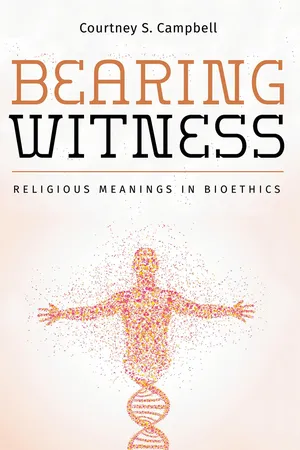
In Bearing Witness, Courtney S. Campbell draws on his experience as a teacher, scholar, and a bioethics consultant to propose an innovative interpretation of the significance of religious values and traditions for bioethics and health care. The book offers a distinctive exposition of a covenantal ethic of gift-response-responsibility-transformation that informs a quest for meaning in the profound choices that patients, families, and professionals face in creating, sustaining, and ending life. Campbell's account of "bearing witness" offers new understandings of formative ethical concepts, situates medicine as a calling and vocation rooted in concepts of healing, affirms professional commitments of presence for suffering and dying persons, and presents a prophetic critique of medical-assisted death. This book offers compelling critiques of secular models of medical professionalism and of individualistic assumptions that distort the physician-patient relationship. This innovative interpretation bears witness to the relevance of religious perspectives on an array of bioethical issues from new reproductive technologies to genetics to debates over end-of-life ethics and bears witness against the oddities of a market-oriented and consumerist vision of health care that is especially salient for an era of health-care reform.
Information
Topic
Teología y religiónSubtopic
Ética y filosofía moralPart One
Bearing Witness
1
Witnessing Meaning in Bioethics
I was sitting on the floor in a darkened hospital room, writing by the illumination of lights from the nurses’ station outside the room. New Age music emanated softly from a CD player on a chair. There was an unusual serenity and calmness present in that room, disrupted only by the ever-present beeping of the machines monitoring my mother’s physiological status as she lay motionless in the hospital bed. The beeps and the statistical output from the data they relayed informed her professional caregivers, my siblings, and myself that my mother was still alive, despite her present condition of unconsciousness subsequent to a severe intracranial hemorrhage. Every two hours a nurse would enter the room, record the vital signs data, check the status of the fluids sustaining my mother’s biological organism, and then leave us again to the shadows of the room, and of life itself.
I had felt quite helpless and very disempowered through this experience, sentiments in part attributable to what seemed to me to be a depersonalized medical staff trained to disclose as little information to myself and family members as was possible. An epistemic gulf lay between my experience of what was happening to my mother and the staff’s experience of managing care for another patient in the ICU. My siblings and I were empowered through an advance directive to act as proxy for medical decisions on my mother’s behalf. Short conversations between the staff and family members had addressed more or less successfully proxy consent for necessary interventions to reduce the swelling in the brain and the administration of medications. My siblings and I were acknowledged as not only stakeholders but also decision-makers in important aspects of our mother’s care and treatment; we were consulted in treatment decisions, rather than having treatment determined exclusively by specialists in neurology and cardiology.
Still, as I sat alone in that darkened room at the end of each day at what might be the end of a life, I experienced something missing from a discourse largely directed by matters of medical assessment, institutional protocol, and legal procedure. We had the requisite procedural documents, and had received information about my mother’s prognosis subsequent to the intracranial hemorrhage, as well as recommendations regarding the medical evaluation of risks and benefits of possible surgical interventions. However, we were ultimately up against one of the boundaries of human existence, an identity-defining and identity-expressing question about the meaning of mortality that cannot be readily reduced to the interplay of medical beneficence and legally-sanctioned consent processes, and no professional was willing to acknowledge this. I felt somewhat like the protagonist in Tolstoy’s classic novella, The Death of Ivan Ilyich, who grows increasingly frustrated and resentful as his physicians debate the biological causes of his condition and neglect what was the only question for Ilyich, “the real question of life or death.”1
As family and professional staff deliberated on several alternatives over the space of some weeks, including “wait and see” if my mother would regain consciousness, additional medical interventions to stabilize her regulating bodily systems, or perhaps discontinuation of treatment, a chasm of discursive dissonance opened up between the practical decision to be made and its existential meaning. If it came to a choice about invasive surgical procedures or discontinuing treatment (and it was yet too soon to know), what decision should be made? This is a question that medicine does not know how to answer, and neither does the culture as a whole.2 The silence on how persons ought to exercise the choices they have been empowered to make by legal statute and by bioethical reasoning is deafening. This question cannot be answered without incorporating some profound value convictions and assumptions about the purpose of life and the meanings of mortality.
What the hospital physicians referred to as my mother’s “stuporous” condition continued for weeks; some treatment decisions became necessary, and my siblings and I experienced disagreements amongst ourselves and with members of the medical staff. The familial disagreements occurred because we situated our mother’s current condition somewhat differently within the context of her prior life history, her spiritual and relational values, anticipated prospects for recovery and recuperation, and our own concerns about the burdens of anticipated caregiving on family members. Our disagreements with the physicians occurred because they did not have experience with my mother as a person outside the context of the hospital setting. She was, for them, yet another stroke victim who deserved the kind of care, treatment, and professional attention any stroke patient should receive. The medical and nursing staff members were professional, and carried out their responsibilities efficiently and with the technical skills of their diverse expertise. They were not, however, healers, and it seemed to me that it was precisely a commitment to healing that was missing in the circumstances.
Personally, if it came to it, I was inclined to have treatment discontinued rather than have a further surgical intervention undertaken. Although the specialists could not make a confident prognosis until (or if) my mother revived to consciousness, they had raised the prospect that, as things stood, in an unconsciousness stupor of this duration, the effects of the stroke on my mother’s physical, cognitive, and relational capacities were quite likely to be very significant. Even were surgery successful, they anticipated she would have some permanent paralysis, loss of mobility, compromised memory, and speaking difficulty. These impairments would not mean her condition would be incompatible with a life of some duration, but cumulatively they could entail a compromised quality of life for a woman who had been quite independent. I questioned whether this would be a life my mother would desire. This was a perspective that my brother and sister, the other proxies, did not share with me. At a deeper psychological level that I really didn’t wish to explore with myself, let alone my siblings, I envisioned that an impaired life for my mother would also entail an impaired relationship between my mother and I. Existentially, I had little doubt that my mother had fulfilled whatever calling or purpose brought meaning for her mortal life, and I felt it important to honor her convictions that her spiritual self would continue to exist, learn, and progress in an afterlife.
My concern here is not with assessing or justifying the rightness of the decisions made: my mother recovered without surgical intervention, a testimony to the resiliency of the body, and she lived semi-independently with impairments less severe than anticipated for over fourteen years. She and I experienced a different kind of relationship that required some adaptations, but I was certainly appreciative of this outcome. Physicians and proxies alike experienced their fallibility and their finitude. My central point is that the decisions and choices required in this setting were not solely matters of medical judgment: such decisions cannot even be made without incorporating some values, commitments, and convictions. We cannot live in the contemporary biomedical world by the formalistic procedures of medicine, institutions, and law alone. The chasm I experienced in the hospital between the practical necessity of making some decisions and the meanings of those decisions needed bridging. Perhaps it was not surprising that I remained troubled by how it was possible in the twenty-first century that what Tolstoy refers to as the “awesome act” of dying3 could be rationalized through the pedestrian procedures of family consults, consent documents, and advance directives.
The academic field of bioethics has been very adept and successful in critiquing reductionism in biomedical research and practice, in which the totality and mystery of a person is ultimately reduced to their genetic traits. Yet, bioethical methods engage in their own form of reductionism by making the disembodied will and choice the threshold determinant for moral reasoning: bioethics offers moral analysis shorn from substantive convictions about who we are, how we should live, why we suffer, or the meanings of mortality. In my own writings and methods in bioethics, I have wanted to explore connections between our actions, our reasons for them, and the profound questions of meaning and purpose that we live with and through. I simply do not find it plausible to engage in deliberation over the moral choices confronting, for example, the professional caregivers for a person whose body is harrowed by a disease without first situating the person within a narrative history and relational contexts comprised in part by her values and worldviews.
The study of religious experience, as well as many of the humanities disciplines, inescapably evokes an encounter with the ultimate questions of the human condition, such as our origins and identity, our nature and destiny as persons, the purpose(s) to our ordeals with pain, suffering, and diminishment, and our experience of mortality. Having the courage to explore these kinds of questions is itself a necessary feature for living an examined life, and that exploration can in turn generate profound philosophical and theological speculative insights. But I have found myself unwilling to leave such issues metaphorically “up in the air.” Our identities and ideas, our worldviews, and our questions matter to who we are and how we ought to live; the moral issues embedded in medical decision-making and in bioethical inquiry provide a very practical context within which diverse responses to these questions are enacted in ways that make enormous differences in the way that people live, die, and make sense and meaning of their experience. I have been “drawn into” bioethics because it displays a remarkable synergy of the theoretical and speculative with the practical and concrete. Ideas matter in bioethics.
Who Is Bioethics For? Cultures of Bioethics
No person has mortal immunity from the defining experiences of a human life, such as embodiment, parenting, relationships, disease, suffering, and dying. These are some of the givens of our existence, even if, as the pioneering bioethicist Paul R...
Table of contents
- Title Page
- Preface
- Acknowledgments
- Part One: Bearing Witness
- Part Two: Witnessing the Burdens
- Part Three: Bearing Mortality
- Part Four: The Public Witness
- Bibliography
Trusted by 375,005 students
Access to over 1.5 million titles for a fair monthly price.
Study more efficiently using our study tools.
Frequently asked questions
Yes, you can cancel anytime from the Subscription tab in your account settings on the Perlego website. Your subscription will stay active until the end of your current billing period. Learn how to cancel your subscription
No, books cannot be downloaded as external files, such as PDFs, for use outside of Perlego. However, you can download books within the Perlego app for offline reading on mobile or tablet. Learn how to download books offline
Perlego offers two plans: Essential and Complete
- Essential is ideal for learners and professionals who enjoy exploring a wide range of subjects. Access the Essential Library with 800,000+ trusted titles and best-sellers across business, personal growth, and the humanities. Includes unlimited reading time and Standard Read Aloud voice.
- Complete: Perfect for advanced learners and researchers needing full, unrestricted access. Unlock 1.5M+ books across hundreds of subjects, including academic and specialized titles. The Complete Plan also includes advanced features like Premium Read Aloud and Research Assistant.
We are an online textbook subscription service, where you can get access to an entire online library for less than the price of a single book per month. With over 1.5 million books across 990+ topics, we’ve got you covered! Learn about our mission
Look out for the read-aloud symbol on your next book to see if you can listen to it. The read-aloud tool reads text aloud for you, highlighting the text as it is being read. You can pause it, speed it up and slow it down. Learn more about Read Aloud
Yes! You can use the Perlego app on both iOS and Android devices to read anytime, anywhere — even offline. Perfect for commutes or when you’re on the go.
Please note we cannot support devices running on iOS 13 and Android 7 or earlier. Learn more about using the app
Please note we cannot support devices running on iOS 13 and Android 7 or earlier. Learn more about using the app
Yes, you can access Bearing Witness by Courtney S. Campbell in PDF and/or ePUB format, as well as other popular books in Teología y religión & Ética y filosofía moral. We have over 1.5 million books available in our catalogue for you to explore.