- 222 pages
- English
- ePUB (mobile friendly)
- Available on iOS & Android
eBook - ePub
A Theologian’s Guide to Heidegger
About this book
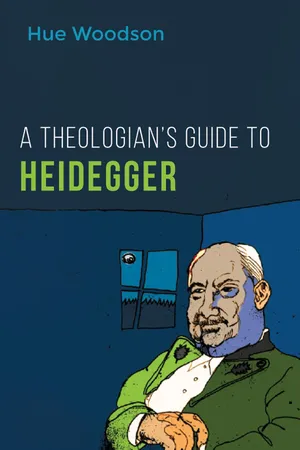
A Theologian's Guide to Heidegger provides a uniquely theological introduction to the philosophy of Martin Heidegger, by focusing on not just the relationship between Heidegger and theology, or even the nature of the discourse that must occur between theological concerns and Heidegger's philosophical errands, but by precisely exploring how theology can use Heidegger's philosophy as a means of outlining the scope and task of postmodern theology. To do this, especially with the postmodern theologian in mind, this book considers the general relationship between Heidegger and theology, how Heidegger can be read theologically, while justifying why Heidegger must be read this way and defining the role that Heidegger must take in postmodern theology. This includes a careful consideration of Heidegger's early theological roots from Freiburg to Marburg by examining the content of Heidegger's lesser-known theologically-minded seminars, lectures, and talks.
Information
Topic
PhilosophySubtopic
Philosophy History & TheoryCHAPTER 1: HEIDEGGER’S THEOLOGICAL ROOTS
Heidegger’s Theological Roots
While, from 1903 to 1906, when attending the State Gymnasium in Constance, and subsequently, from 1906 to 1909, when attending the State Berthold Gymnasium in Freiburg, Heidegger remained “with residence at the archdiocesan Gymnasium Seminary in preparation for archdiocesan priesthood.”105 By July 13, 1909, when he was awarded his high school baccalaureate “with the highest possible overall grade,” having studied a variety of academic subjects including religion, Latin, Hebrew, Greek, and philosophy, Heidegger selected theology on a “statement of intent regarding university studies.”106 As a student entering the University of Freiburg, Heidegger’s academic “theological roots,” as I refer to them, can be situated in his acceptance into Freiburg’s Department of Theology for the Winter 1909/1910 semester. At that time, Heidegger was still preparing for archdiocesan priesthood, “with residence at the archdiocesan Theological Seminary.”107
With the exception of a course on logic, during Heidegger’s first semester at Freiburg, as detailed in noteworthy accounts by Thomas Sheehan (1988) and John Van Buren (2002), Heidegger was enrolled in the following theology/religion courses with the following lecturers: “Encyclopedia of Theological Disciplines” (Rev. Julius Mayer108), “Introduction to the Sacred Scripture of the Old Testament” (Rev. Gottfried Hoberg), “Exegesis of Paul’s Letter to the Romans” (Rev. Simon Weber), “General History of the Church, Part One” (Rev. Georg Pfeilschifter), and “Theory of Religion” (Rev. Heinrich Straubinger).109
With the exception of a course on metaphysics, in Heidegger’s second semester at Freiburg in Summer 1910, he was enrolled in the following theology/religion courses with the following lecturers: “Messianic Prophesies” (with Hoberg), Hermeneutics, with the History of Exegesis (with Hoberg), “Introduction to the Sacred Scripture of the New Testament” (with Weber), “General History of the Church, Part Two” (with Pfeilschifter), and “Theory of Revelation and of the Church” (with Straubinger).110
With the exception of a survey course on the history of the German constitution, in his third semester at Freiburg in Winter 1910/1911, Heidegger was enrolled in the following theology/religion courses with the following lecturers: “Introduction to Catholic Dogmatics: The Doctrine of God” (Rev. Carl Braig), “Exegesis of the Holy Gospel According to John” (with Weber), “General Moral Theology, Part One through Three” (with Mayer), “The Doctrine of Property” (with Mayer), “Catholic Canon Law, Part One: Introduction, Sources, and Constitution” (Rev. Emil Göller), “General History of the Church, Part Three, The Age of the Enlightenment” (with Pfeilschifter), and “The History of Medieval Mysticism” (Rev. Joseph Sauer).111
With the exception of a course on the Renaissance, in his fourth semester at Freiburg in Summer 1911, Heidegger was enrolled in the following theology/religion courses with the following lecturers: “Theological Cosmology: The Creation, Preservation, and Governance of the World” (with Braig), “Special Moral Theology, Parts One and Two (with Mayer), and “The Christian Art of the Nineteenth Century and the Present” (with Sauer).112
As noted by Sheehan, throughout the Summer of 1911, Heidegger suffered from ill-health that posed “negative consequences for his ecclesiastical plans.”113 By Fall of 1911, Sheehan observes that “when [Heidegger] returned to Freiburg [for the upcoming Winter 1911 semester], Heidegger had moved out of the theological seminary [ . . . ] he had also transferred out of theology.”114 Essentially, at this point, Heidegger “abandon[ed] career plans for the priesthood.”115 It seems that this was mostly due to Heidegger’s “preference at this point [being] to study with Husserl,” who, at the time, was teaching at the University of Göttingen.116 Instead of doing so, Heidegger was accepted into Freiburg’s Department of Natural Sciences and Mathematics in Winter 1911/1912. Though Heidegger was enrolled mostly math and sciences courses for the semester, with the exception of two science courses and two philosophy courses, it has been detailed by both Sheehan and Van Buren that, during this semester, Heidegger audited a three theology/religion courses with the following lecturers: “Dogmatic Theology” (with Braig), “Gospel of John” (with Prof. Edward Schwartz), and “Hellenic Mystery Religions” (with Prof. Richard Reitzenstein). For the following Summer 1912, Winter 1912/1913, and Summer 1913, Heidegger was enrolled in mostly math courses, with a single science course and a handful of philosophy courses sprinkled throughout. On July 26, 1913, Heidegger had left the Department of Natural Sciences and Mathematics, was accepted to the Department of Philosophy, and was recommended by the Department of Philosophy “for the doctoral degree in philosophy summa cum laude,” based on his dissertation, submitted a month prior, “Theory of Judgment in Psychologism: Critical and Positive Contributions to Logic.”117 On August 20, 1913, Heidegger applied for a Von Schaezler Grant, in order, as cited by Van Buren, “to dedicate himself to the study of Christian philosophy and to pursue an academic career”—by September 29, 1913, he was awarded the grant for the 1913-1914 academic year with the expectation, as purported by Van Buren, that Heidegger “would remain true to the spirit of Thomistic philosophy.”118 Heidegger renewed the grant twice (on September 20, 1914 and on December 13, 1915), under the premise that, as Van Buren quotes, “his academic life’s work [would be] oriented to making the wealth of ideas inherited from Scholasticism applicable to the future intellectual struggle for the Christian ideal of life in Catholicism.”...
Table of contents
- Title Page
- PREFACE
- ACKNOWLEDGMENTS
- INTRODUCTION: HEIDEGGER AND THEOLOGY
- CHAPTER 1: HEIDEGGER’S THEOLOGICAL ROOTS
- CHAPTER 2: HERMENEUTICS BEFORE AND AFTER HEIDEGGER
- CHAPTER 3: THEOLOGIZING ON HEIDEGGER’S TERMS
- CONCLUSION: THEOLOGIZING PRIMORDIALITY THROUGH HEIDEGGER
- APPENDIX A: THE HEIDEGGER PROBLEM
- APPENDIX B: KARL BARTH
- BIBLIOGRAPHY
Trusted by 375,005 students
Access to over 1.5 million titles for a fair monthly price.
Study more efficiently using our study tools.
Frequently asked questions
Yes, you can cancel anytime from the Subscription tab in your account settings on the Perlego website. Your subscription will stay active until the end of your current billing period. Learn how to cancel your subscription
No, books cannot be downloaded as external files, such as PDFs, for use outside of Perlego. However, you can download books within the Perlego app for offline reading on mobile or tablet. Learn how to download books offline
Perlego offers two plans: Essential and Complete
- Essential is ideal for learners and professionals who enjoy exploring a wide range of subjects. Access the Essential Library with 800,000+ trusted titles and best-sellers across business, personal growth, and the humanities. Includes unlimited reading time and Standard Read Aloud voice.
- Complete: Perfect for advanced learners and researchers needing full, unrestricted access. Unlock 1.5M+ books across hundreds of subjects, including academic and specialized titles. The Complete Plan also includes advanced features like Premium Read Aloud and Research Assistant.
We are an online textbook subscription service, where you can get access to an entire online library for less than the price of a single book per month. With over 1.5 million books across 990+ topics, we’ve got you covered! Learn about our mission
Look out for the read-aloud symbol on your next book to see if you can listen to it. The read-aloud tool reads text aloud for you, highlighting the text as it is being read. You can pause it, speed it up and slow it down. Learn more about Read Aloud
Yes! You can use the Perlego app on both iOS and Android devices to read anytime, anywhere — even offline. Perfect for commutes or when you’re on the go.
Please note we cannot support devices running on iOS 13 and Android 7 or earlier. Learn more about using the app
Please note we cannot support devices running on iOS 13 and Android 7 or earlier. Learn more about using the app
Yes, you can access A Theologian’s Guide to Heidegger by Hue Woodson in PDF and/or ePUB format, as well as other popular books in Philosophy & Philosophy History & Theory. We have over 1.5 million books available in our catalogue for you to explore.