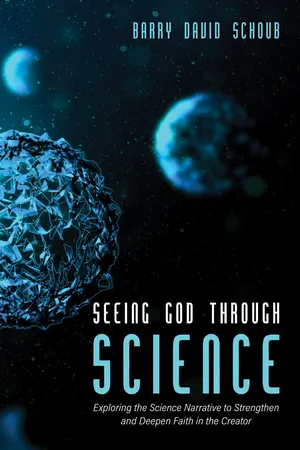
eBook - ePub
Seeing God Through Science
Exploring the Science Narrative to Strengthen and Deepen Faith in the Creator
- 178 pages
- English
- ePUB (mobile friendly)
- Available on iOS & Android
eBook - ePub
Seeing God Through Science
Exploring the Science Narrative to Strengthen and Deepen Faith in the Creator
About this book
It has been said that science and religion aren't friends. Indeed, science and scientists are preferably shunned in conservative religious circles. Seeing God through Science, however, emphatically dispels that notion. This book compellingly shows how science is, in point of fact, a potent support for religious faith. From the powerful, universal, biological drives of living organisms to the unimaginable vastness of the universe, science cogently frames the fundamental questions of meaning and purpose. Answers to these questions, however, lie outside science. It is solely through religious revelation that acceptable answers close the circle of enquiry into truth. In addition, examples from the sciences of genetics and cosmology illustrate the typical pattern of metascience, i.e. the process of science, which advances toward a frontier, only to generate further avenues of exploration, but never reaches a finality of knowledge. Thus, metascience steers enquiry to a supernatural reality, answerable only through religious revelation. This book shows how modern science is now entering a new phase, where what is unattainable by the science of nature constitutes a message to humankind that there exists a supernatural being who created, and controls, the universe. Modern science is now coming to prove God.
Information
Topic
Theology & ReligionSubtopic
Religion & Science1
The Search for Truth
The foundation of all foundations and the pillar of wisdom is to know that there is a primary being who brought into being all existence. All the beings of the heavens, the earth and what is between them came into existence only from the truth of His being.21
—Moses Maimonides (1135–1204)
“Knowing” God?
The most profound of all questions is “Does God exist?” If so, is that being the personal monotheistic God of the Bible? What can we know of God? It is indeed a religious imperative to “know” God—the first of the Ten Commandments given to humankind is an unequivocal identification of the personal God of the monotheistic religions. Exod 20:2, 3 and Deut 5:6, 7 state clearly “I am the God your Lord who brought you out of the land of Egypt, the house of bondage: You shall have no other gods besides Me.” On the other hand, the Scriptures also allude to humans being unable to know the essence of God. Moses, the greatest of all prophets in the Jewish tradition, begged God, “Oh, let me behold Your presence!” (Exod 33:18) but was privileged only to see God’s allegorical “back” from a cleft in the rock. “ . . . you cannot see My face, for man may not see Me and live” (Exod 33:20). The concealment from humankind of the Divine, and other supernatural phenomena, is illustrated in the well-known Talmudic apologue of the four sages who resolved to enter the Pardes (a spiritual dimension in proximity to God).22 After this exposure only one sage managed to emerge unscathed; of the remaining three, one died instantly, one become insane, and one become a heretic. Direct knowledge of God would conflict with the theological requirement for humans to have true freewill rather than living as a reward-and-punishment robot. Furthermore it would be logically incompetent for the created to have full knowledge of the creator. Logic dictates that a system cannot have knowledge from within.
The alternative approach of acquiring a knowledge of reality is to focus exclusively on science, an approach expressed as physicalism or materialism, which accepts that the material universe represents the totality of reality.23 With the burgeoning of scientific knowledge from the early twentieth century onwards came the verification principle enunciated by the thinkers of the Vienna Circle.24 They held that any statement is considered to be factual only if confirmed by sensory experience or mathematical calculation.25 Some two centuries earlier, David Hume had put it more bluntly, enunciating that something which wasn’t mathematically underwritten, abstract reasoning, or experimentally demonstrable, should be destroyed, as it was merely deception.26 Is the probing mind searching for answers to reality satisfied with this materialistic monism in the era of twenty-first-century science? The challenge of materialistic atheism and its relationship to science will be discussed more fully in chapter 7. From the theist’s standpoint, the challenge is to address the seemingly contrasting scriptural injunction to “know” God and the factuality that humankind is not empowered to know God’s “face” or anything of his essence. God remains hidden from humankind—“Deus Absconditus.”27 What then are the approaches to seeking “knowledge” of God, and how may the idea of non-predicate theism contribute to support belief in God?
The Classical Philosophical Arguments
The three classical philosophical arguments for the existence of God—the cosmological, the ontological, and the teleological—are generally not widely accepted today in their original forms. Elements of these ideas, however, do still have some resonance in contemporary philosophy, as well as in the concept of non-predicate theism. Cosmological arguments focus on the regress of causal relationships responsible for the existence of the world; the teleological on the examination and the inference drawn from the special features of the world; and the ontological argument reflects on the concept of God.
1. The Cosmological Arguments
Also known as the Kalam cosmological arguments (after the group of Middle Ages Islamic scholars called the Mutakallimun). This family of arguments is based on inferences drawn from a regress chain of causal relationships, coupled with the denial of this chain being infinite. The incomprehensibility of the concept of infinity is key to the cosmological argument. In other words, the interruption of the regress because of the non-acceptance of an infinite regress, means that there is a first cause—the uncaused cause, which, theologically, is identified to be God. Four types of regress chains were described by St. Thomas Aquinas (1225–1274),28 and comprise, respectively, the arguments from causation itself, the arguments from motion, the arguments from contingency, and the arguments from degrees. For each of these regress chains, the initiator of the chain, i.e., God, is defined as the first or uncaused cause, the unmoved mover, the necessary entity, or the pinnacle of perfection, respectively. A century earlier the Jewish philosopher and theologian, Moses Maimonides (1135–1204), had rationalised along similar lines that all events have causation and, therefore, need a prime mover who necessarily must be outside of the physical, as creation is a physical activity.29
Challenges and support for the cosmological arguments have come from classical and contemporary thinkers. Immanuel Kant (1724–1804) laid out several criticisms including the fact that, as it stands, the cosmological arguments fail to identify that the initiating author of the chain of causation is God or possibly even a committee of gods. There also remains, he asserted, the question of who or what caused God.30 Kant also questioned whether existence or “being” is a predicate. David Hume (1711–1776) went further, querying the idea of a necessary existence, which is what links the elements of the chain of causation.31 In other words, whenever we conceive of the existence of something, we can also conceive of its non-existence, and thus necessary existence has no meaning. In defen...
Table of contents
- Title Page
- Preface
- Acknowledgments
- Introduction
- Chapter 1: The Search for Truth
- Chapter 2: Science and Meta-Science
- Chapter 3: Design and Frontiers
- Chapter 4: The Human Organism and the Human Soul
- Chapter 5: Non-Predicate Theism
- Chapter 6: Divine Revelation
- Chapter 7: Addressing Atheism, Theism, and Science
- Chapter 8: Epilogue
- Bibliography
Trusted by 375,005 students
Access to over 1.5 million titles for a fair monthly price.
Study more efficiently using our study tools.
Frequently asked questions
Yes, you can cancel anytime from the Subscription tab in your account settings on the Perlego website. Your subscription will stay active until the end of your current billing period. Learn how to cancel your subscription
No, books cannot be downloaded as external files, such as PDFs, for use outside of Perlego. However, you can download books within the Perlego app for offline reading on mobile or tablet. Learn how to download books offline
Perlego offers two plans: Essential and Complete
- Essential is ideal for learners and professionals who enjoy exploring a wide range of subjects. Access the Essential Library with 800,000+ trusted titles and best-sellers across business, personal growth, and the humanities. Includes unlimited reading time and Standard Read Aloud voice.
- Complete: Perfect for advanced learners and researchers needing full, unrestricted access. Unlock 1.5M+ books across hundreds of subjects, including academic and specialized titles. The Complete Plan also includes advanced features like Premium Read Aloud and Research Assistant.
We are an online textbook subscription service, where you can get access to an entire online library for less than the price of a single book per month. With over 1.5 million books across 990+ topics, we’ve got you covered! Learn about our mission
Look out for the read-aloud symbol on your next book to see if you can listen to it. The read-aloud tool reads text aloud for you, highlighting the text as it is being read. You can pause it, speed it up and slow it down. Learn more about Read Aloud
Yes! You can use the Perlego app on both iOS and Android devices to read anytime, anywhere — even offline. Perfect for commutes or when you’re on the go.
Please note we cannot support devices running on iOS 13 and Android 7 or earlier. Learn more about using the app
Please note we cannot support devices running on iOS 13 and Android 7 or earlier. Learn more about using the app
Yes, you can access Seeing God Through Science by Barry David Schoub in PDF and/or ePUB format, as well as other popular books in Theology & Religion & Religion & Science. We have over 1.5 million books available in our catalogue for you to explore.