- 172 pages
- English
- ePUB (mobile friendly)
- Available on iOS & Android
eBook - ePub
About this book
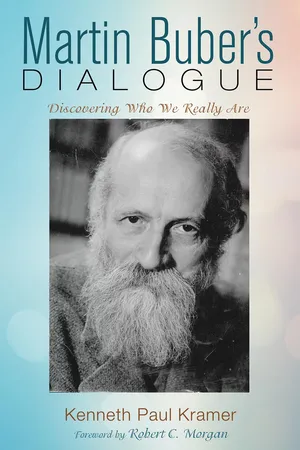
Martin Buber, one of the twentieth century's most distinguished and creative thinkers, famously argued that the fundamental fact of human existence is person with person, and that practicing genuine dialogue is necessary for anyone who wishes to become authentically human. This book seeks to unleash and reassemble the core elements for practicing dialogue--turning and addressing, and then listening and responding. Despite what many say, the innermost growth of the self does not come in relation to one's self. Rather, attaining one's authentic human existence (one's innate self-realization) emerges again and again through genuine dialogue, through "participatory consciousness." We become authentically human in and through our relationships with others. Here's the point--instead of having dialogues, human beings mutually become dialogue with others. Individual human beings in dialogue with one another become memorable mutualities found nowhere else, opening out into the world.
Information
Topic
PhilosophySubtopic
Ethics & Moral PhilosophyPART I
Readiness
| Chapter 1: Turning Clear Skies The Journey Turn, Turn, Turn Reflexion (Bending Back on Oneself) Breaking Through Thinking Tuning In Meditation to Mutuality Pivoting Around Practicing Turning › | Chapter 2: Addressing Back from Italy Accepting and Affirming Speaking Ever-New The Orange-Haired Mortician “A Great Man,” T. S. Eliot Said “There Are No Great Men,”Buber Said Making (The Other) Present Addressing Students Practicing Addressing |
1
Turning
Clear Skies
It was a day when the skies were clear. Squawking birds flew into a gentle wind current. From the hill on which the University sits, we could see sparkling blues of the Monterey Bay.
After exercising, showering, and dressing inside the gym locker room, I noticed a young man whom I had not seen before. He was tall and handsomely proportioned. His face was quiet, and he appeared self-contained, as if he was completely at ease with his current state of affairs. He too had finished dressing and was gathering his exercise equipment into his bag. We caught each other’s eyes at the same moment.
He was standing at one end of a row of lockers; I was sitting at the other end. Wanting to start a conversation, I turned toward him and asked, “What are you studying?”
Immediately, he set his bag down, and turned from the doorway to focus on me. Without being distracted by my limitations, he smiled and said, “I’m an exchange student from the Netherlands. I’m taking General Education classes.”
“Sweet deal,” I blurted, as a former professor who knew well the difference between General Education and major classes. “You’re lucky to get to do that here in California.”
He smiled, shaking his head in agreement at the obvious coup he was achieving—receiving transferable General Education credits at University of California, Santa Cruz in Santa Cruz.
“I hope you’re also able to take some courses in your major field.”
“Yes,” he said, “I’m also taking courses in technology.”
Standing tall, he talked in a mannered way. His thorough willingness to attentively listen and willingness to speak responsively captured my full attention.
“Your English is impeccable,” I said, congratulating him. “I admire both your speaking, your intonation, and your comprehensive grasp of the language.”
When I used the slang descriptor “spot on,” I interrupted myself to wonder out loud, “Did you understand my use of the slang ‘spot on’?”
“Yes,” he said, “I speak a lot with English speakers.”
Remembering that I had once known a Dutch girl who was also a transfer student, I asked, “Is Meeka a popular Dutch name?”
“I’ve heard it, yes.”
“She once knitted me a sweater,” I said as his eyes lit up.
Nodding his head with recognition, “Yes, my grandmother used to do that.”
He spoke proudly as he stood tall like the white calla lilies in my yard reaching to the sun. Again, I complimented him on his accent-free spoken English.
“And you’ve studied other languages, haven’t you?” I inquired.
“A little French and German,” he said.
“Ah,” I said, “can I ask you to translate the following German sentences? According to the philosopher Martin Buber, it’s one of the most important ones. It exactly describes what we are doing. ‘Alles wirkliche Leben ist Begegnung,’ which is from one of his major works.”
He shook his head with uncertainty. “Begegnung,” I repeated, “is the most significant word in that sentence. It is translated as ‘meeting,’ or ‘encounter,’ or ‘engagement.’ That’s what we are doing now.”
As I spoke, I extended my left hand first toward him, then I pulled it back toward me: forth and back, back and forth.
“Begegnung is the most important word in the German philosopher Martin Buber’s book, I and Thou. It represents his major thesis—that all real living, or actual life is engagement. That’s what is happening right now.”
He nodded his head in agreement.
“So thank you. By the way, I’m sorry I forgot to ask you: what’s your name?”
“Richard,” he said smiling as he extended his hand out to me.
“Thank you very much,” he said, and, picking up his bag, walked off to class.
The Journey
The span of this story, its itinerary in time and space, represents an assembly of expository commentary and illustrative episodes from notes and dialogical insights released while writing.
The possibility and reality of a dialogical relationship between myself and others—the happening itself—had already captured me in my youth. While spending time with my mother: either sipping Lipton’s tea at the kitchen table, or drying dishes, or walking, she—knowing nothing of Martin Buber—taught me dialogical principles by the way she lived, which would reawaken years later. This fundamental interhuman connection, the decisive transformation that takes place in and through authentic dialogue has never abandoned me.
Yet, when I began this journey, dragging my dented authenticity and leaking awareness, I was dogged by doubt. I wouldn’t be able to do it, I thought. Why even try? How could I ever write a book that would do justice to Buber’s brilliance on the one hand and captivate neophytes to his dialogical technology on the other?
Tracing themes of philosophy, anthropology, myth, ritual, and transcendence, I sought to follow Buber’s pioneering theory of “genuine dialogue.” I began to engineer the interplay of its fundamental practices. I set innovative references in appropriate historical contexts. Then, with personal interactions added, I began this journey with Buber’s dialogue.
How could I ever forget my excitement upon discovering the writings of Martin Buber, writings with power and wisdom for everyday living, writings about how his elevated individualism was shattered by meaningful encounters, openings to respond authentically to the claim and responsibility of each new event, trading selfhood for interrelatedness. Or, as my professor, Maurice Friedman, once wrote:
Coming to the conviction that the real heart of Buber’s philosophy—and of the “lived concrete” about which he was so concerned—is found not in conceptual or systematic thought but in . . . events and meetings[.]21
How indeed could one ever forget writings so fundamentally transformational? Especially when I came to discover that the word “dialogue,” in the context of relationship is what linguists call a “performative utterance”—a word that doesn’t simply mean communication or imply back-and-forth discourse, but actually enacts changes. Dialogue is two or more people actually talking and listening to one another with undivided attention, which causes shifts in behavior.
Looking ahead, aware of where I’ve been and not wanting to make similar mistakes, the scenes portrayed and discussed here are journeys of discovering the indispensable value of mutuality, of mutuality in speech.
Using words like a painter, Buber portrays the emotion and power of dialogue in images like: “vital reciprocity,” or “memorable common fruitfulness,” or a “dynamic elemental togetherness” these images challenge us to become “We.”
But where to start? What to include? What to leave out?
By looking back on Buber’s forward-leaning words, we see how his unique description of “genuine dialogue” enables and empowers us to hear each other’s voice in situation upon situation, and to respond by making decisions and taking a stand.
Walking along this path: I develop genuine relationships through authentic dialogue; I discover a new identity emerging through the voice of dialogue itself.
“Do you mean this is it? Is this all there is?” I hear myself wondering....
Table of contents
- Title Page
- Foreword
- Preface
- Acknowledgments
- Introduction
- Part I: Readiness
- Part II: Interactions
- Part III: Exemplifications
- Conclusion
- Works Cited
Trusted by 375,005 students
Access to over 1.5 million titles for a fair monthly price.
Study more efficiently using our study tools.
Frequently asked questions
Yes, you can cancel anytime from the Subscription tab in your account settings on the Perlego website. Your subscription will stay active until the end of your current billing period. Learn how to cancel your subscription
No, books cannot be downloaded as external files, such as PDFs, for use outside of Perlego. However, you can download books within the Perlego app for offline reading on mobile or tablet. Learn how to download books offline
Perlego offers two plans: Essential and Complete
- Essential is ideal for learners and professionals who enjoy exploring a wide range of subjects. Access the Essential Library with 800,000+ trusted titles and best-sellers across business, personal growth, and the humanities. Includes unlimited reading time and Standard Read Aloud voice.
- Complete: Perfect for advanced learners and researchers needing full, unrestricted access. Unlock 1.5M+ books across hundreds of subjects, including academic and specialized titles. The Complete Plan also includes advanced features like Premium Read Aloud and Research Assistant.
We are an online textbook subscription service, where you can get access to an entire online library for less than the price of a single book per month. With over 1.5 million books across 990+ topics, we’ve got you covered! Learn about our mission
Look out for the read-aloud symbol on your next book to see if you can listen to it. The read-aloud tool reads text aloud for you, highlighting the text as it is being read. You can pause it, speed it up and slow it down. Learn more about Read Aloud
Yes! You can use the Perlego app on both iOS and Android devices to read anytime, anywhere — even offline. Perfect for commutes or when you’re on the go.
Please note we cannot support devices running on iOS 13 and Android 7 or earlier. Learn more about using the app
Please note we cannot support devices running on iOS 13 and Android 7 or earlier. Learn more about using the app
Yes, you can access Martin Buber’s Dialogue by Kenneth Paul Kramer in PDF and/or ePUB format, as well as other popular books in Philosophy & Ethics & Moral Philosophy. We have over 1.5 million books available in our catalogue for you to explore.