eBook - ePub
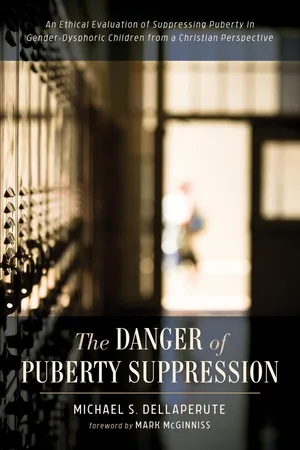
The Danger of Puberty Suppression
An Ethical Evaluation of Suppressing Puberty in Gender-Dysphoric Children from a Christian Perspective
- 122 pages
- English
- ePUB (mobile friendly)
- Available on iOS & Android
eBook - ePub
The Danger of Puberty Suppression
An Ethical Evaluation of Suppressing Puberty in Gender-Dysphoric Children from a Christian Perspective
About this book
What would you do if a child in your life rejected their natal gender? Would you blindly follow the counsel of a culture that advocates for hormone treatment at an early age in order to suppress puberty and facilitate gender transition? Before you commit to long-term use of a powerful, expensive, and experimental synthetic hormone treatment plan, would you be willing to take the time to examine the ethics surrounding a course of action that will permanently affect the life of the child? Several serious questions are presently being overlooked in the rush to treat gender dysphoric and TGNC children with puberty-suppressing hormones, such as: Are puberty-suppressing hormones medically necessary? Is there any evidence to prove that hormone treatment is helpful, and not harmful, to gender-dysphoric children? Does hormone treatment resolve gender dysphoria? Do other treatment options exist to address the underlying causes of gender dysphoria? Are parents, medical providers, and ministry professionals morally obligated to provide puberty suppressors for patients who self-diagnose? Does Scripture offer any insight into the treatment of gender dysphoric children? And finally, who really benefits from advocating for the early use of GnRH agonists? This book will answer these questions.
Information
Topic
PhilosophySubtopic
Ethics & Moral Philosophy1
What Happens When it is Your Child?
As a parent, you fear that there is something seriously wrong with your child, and you do not know what to do.
Your concern for the health and safety of your child first surfaced as they began to approach puberty. You watched a once happy and well-adjusted child grow increasingly anxious, despondent, and isolated with each passing season.1 In spite of your best efforts, your child flatly refused to participate in any gender-typical activities. Over time, you even discovered a cache of gender-atypical toys and clothing hidden in their room.2 When you finally confronted your child about their gender-nonconforming behaviors, they confessed a belief that their true inner self was not congruent with their natal gender. In short, they felt they were trapped in the wrong body, and they wanted you to help them fix their problem by transitioning to the opposite gender. Now, you have heard about other children making these kinds of claims. You have seen them on the news or read about them online. But this is your child. So what will you do?
Let’s assume you were like most parents. If so, then your initial response to your child would have included a mixture of disbelief and frustration.3 Eventually, you even dismissed their self-assessment as a passing phase.4 Maybe you even informed your child that they were assigned a gender at conception based on their chromosomes. It is basic biology, right? XX chromosomes mean that you are a female, and XY chromosomes mean that you are a male. As a result, you explained that gender transition was not a possibility. At best, while their body could conceivably be altered to resemble the opposite gender to some degree, this would require a long, painful, expensive, irreversible, and truly imperfect process that could never achieve gender change on the chromosomal level. That is just basic science. As a parent, you assumed your explanation would settle the matter. However, your refusal to affirm your child’s gender identity only seemed to accentuate their distress. So your child took the initiative to meet with a school counselor,5 and they become fixated with online transgender media sources.6 Soon your elementary school-aged child began to drop terms like "transphobic," "gender dysphoria," "discriminatory," and, of course, "puberty suppressors."
Within months, your child steadily grew more vocal about their convictions, insisting that family members, teachers, and classmates alike refer to them by a different name associated with their expressed gender. Your child also grew increasingly belligerent toward anyone who refused to support their decision uncritically. The conflict in your home finally came to a head when your child insisted on cross-dressing for a public function. Your refusal to support their behavior resulted in a heated argument. After allowing time for your child’s anger to subside, you entered their room only to find them huddled in a corner, sobbing, and cutting their arm with the sharp edge of a paper clip.7 That was the moment you wrapped your arms around your child and promised to get them help. But silently you wondered, “What does help look like? What is the right response to this situation? After all, they are still just a child. Should I pursue the kind of help that will ultimately alter their body so that it better aligns with their mind? Or should I seek the kind of help that focuses on correcting their thinking so that it more accurately aligns with their body? And, are these my only options?”
Later that evening you log on to an online forum that promises to provide answers for confused parents of Transgender and Gender Non-conforming (TGNC) children. In desperation, you describe your child’s condition to strangers on the internet. The reply comes within minutes: “If your child says they are trans, then they are trans. If your child says they need hormones, then it is your responsibility to help get them on hormones. The most important thing you can do is affirm your child.”8 When you question whether or not this is an appropriate course of action, the online experts quickly respond, “Would you rather have a dead son or a live daughter?”9 So here you stand, convinced that there is something seriously wrong with your child, but unsure about what steps to take next. How will you address a moral conflict that will affect your child for the rest of their life? Where will you turn to find help? Is this truly a case where choosing the lesser evil provides a satisfactory ethical solution to your moral dilemma?10
Hold that thought, and let’s consider this same situation from another angle. Instead of the parent, now you are the doctor or medical care provider.
A parent and their prepubescent child are waiting for you in the examination room. When you arrive, the parent assumes the role of advocate and proceeds to do most of the talking before you have a chance to assess your young patient. The parent informs you that their child is gender dysphoric. It is clear, both from the description they give and the terminology they implement, that they have done significant research on this subject and have already initiated social transition with their child. When finally questioned, the child confirms their parent’s narrative. The child insists that the anatomical features associated with their natal gender cause them significant emotional distress. They also identify an array of supporting symptoms that include anxiety, depression, and suicidal thoughts. The child appears convinced that the only solution to their problem is gender transition, and they express persistent dread over the onset of puberty.
At this point in the dialogue, the parent is distraught. They insist it is medically necessary to take every measure to protect their child from any self-destructive tendencies.11 They explain that these measures include the immediate prescription of puberty-suppressing hormones.12 The parent then presents you with written recommendations and printed testimonials they received after their child’s first meeting with a professional gender-affirming therapist.13 These testimonials describe puberty suppression as a safe, reliable, tested, and fully reversible treatment plan for children with gender dysphoria.14
Years of training cause you to hesitate before writing the prescription. You begin by explaining to both parties that, in your professional medical opinion, the child not only lacks the necessary competency to make a decision of this magnitude, but they have not been comprehensively examined. Furthermore, prescribing the requested drugs may result in serious consequences that the child will later regret if their distress desists.15 By the time you are finished, the parent is irate. They respond to your explanations with accusations of gatekeeping and discrimination.16 They demand treatment, and threaten you with legal action if you refuse. So what will you do? Will you act against your professional integrity and regard the self-diagnosis of a pre-pubescent patient and untrained parent as though it were authoritative?17 Or will you potentially place both your patient’s life and your medical practice at risk by conscientiously refusing to treat the child with puberty suppressors?18 Ethically, do you even have a choice in the matter? What is the right response to this complicated and emotionally charged situation?
Before we explore the answer to that question, keep in mind that the impact of puberty-suppressing hormones does not end at the home or doctor’s office. So let’s consider one final scenario. Instead of the parent or the doctor, let’s assume that you are now the ministry professional.
A family in your church has requested a meeting with you in order to discuss their concerns regarding the treatment of their child. During the appointment, they disclose that their child has been diagnosed with gender dysphoria. This diagnosis, initiated ...
Table of contents
- Title Page
- Foreword
- Chapter 1: What Happens When it is Your Child?
- Chapter 2: How Do You Speak the New Language of Gender?
- Chapter 3: What Happens in Puberty?
- Chapter 4: How is Puberty Suppressed?
- Chapter 5: What Happens to Gender-dysphoric Children after Puberty?
- Chapter 6: Why Were Puberty Suppressors Invented in the First Place?
- Chapter 7: What Causes Gender Dysphoria in Children?
- Chapter 8: What are the Treatment Options for Gender-dysphoric and TGNC Children?
- Chapter 9: Are Puberty-suppressing Hormones Unethical for Gender-dysphoric Children?
- Chapter 10: Is there a Biblical Alternative for Treating Gender Dysphoria?
- Chapter 11: Why Shouldn't You Give Your Gender-dysphoric Child Puberty Suppressors?
- Chapter 12: What Would You Say to a Child Who Really Wants Puberty Suppressors?
- Bibliography
Trusted by 375,005 students
Access to over 1.5 million titles for a fair monthly price.
Study more efficiently using our study tools.
Frequently asked questions
Yes, you can cancel anytime from the Subscription tab in your account settings on the Perlego website. Your subscription will stay active until the end of your current billing period. Learn how to cancel your subscription
No, books cannot be downloaded as external files, such as PDFs, for use outside of Perlego. However, you can download books within the Perlego app for offline reading on mobile or tablet. Learn how to download books offline
Perlego offers two plans: Essential and Complete
- Essential is ideal for learners and professionals who enjoy exploring a wide range of subjects. Access the Essential Library with 800,000+ trusted titles and best-sellers across business, personal growth, and the humanities. Includes unlimited reading time and Standard Read Aloud voice.
- Complete: Perfect for advanced learners and researchers needing full, unrestricted access. Unlock 1.5M+ books across hundreds of subjects, including academic and specialized titles. The Complete Plan also includes advanced features like Premium Read Aloud and Research Assistant.
We are an online textbook subscription service, where you can get access to an entire online library for less than the price of a single book per month. With over 1.5 million books across 990+ topics, we’ve got you covered! Learn about our mission
Look out for the read-aloud symbol on your next book to see if you can listen to it. The read-aloud tool reads text aloud for you, highlighting the text as it is being read. You can pause it, speed it up and slow it down. Learn more about Read Aloud
Yes! You can use the Perlego app on both iOS and Android devices to read anytime, anywhere — even offline. Perfect for commutes or when you’re on the go.
Please note we cannot support devices running on iOS 13 and Android 7 or earlier. Learn more about using the app
Please note we cannot support devices running on iOS 13 and Android 7 or earlier. Learn more about using the app
Yes, you can access The Danger of Puberty Suppression by Michael S. Dellaperute in PDF and/or ePUB format, as well as other popular books in Philosophy & Ethics & Moral Philosophy. We have over 1.5 million books available in our catalogue for you to explore.