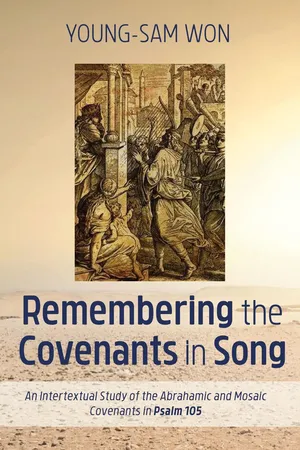
eBook - ePub
Remembering the Covenants in Song
An Intertextual Study of the Abrahamic and Mosaic Covenants in Psalm 105
- 282 pages
- English
- ePUB (mobile friendly)
- Available on iOS & Android
eBook - ePub
Remembering the Covenants in Song
An Intertextual Study of the Abrahamic and Mosaic Covenants in Psalm 105
About this book
In biblical and theological studies, fresh perspectives and novel approaches can breathe new life into familiar subjects. Remembering the Covenants in Song reconsiders the Abrahamic and Mosaic covenant relationship through the unique biblical and canonical lens of a postexilic song. In Psalm 105, the psalmist's intriguing intertextual engagement with both of Israel's great covenant traditions provides a rare glimpse into the covenant-understanding of a postexilic biblical writer interacting with the Torah.
Remembering the Covenants in Song entails an intertextual study of Psalm 105 that brings the psalmist's rhetorical design and covenant references into a dialogue with the Torah's seminal covenant texts. The examination of the psalmist's use of covenant references and allusions represents an innovative approach to assessing the rhetorical significance of intertextuality in biblical writings.
Information
Topic
Theology & ReligionSubtopic
Biblical Commentary1
Studying the Covenants
Then and Now
A Historical Survey of Covenant Studies: Following Two Streams
The history of covenant scholarship is not linear but complex. In broad strokes, the analogy of a river comes to mind—a river that splits into major tributaries that run in parallel at times and occasionally intersect as they meander independently through their respective fields. While the biblical covenants have long been a subject of scholarly interest in theological and biblical studies, the manner in which scholars have approached this topic has varied depending on which “stream” of scholarship they followed and at which point in history they produced their work. One can view the river as the main movement of biblical scholarship that followed the Reformation. This tradition of OT studies eventually bifurcates into two major tributaries of scholarly tradition. In the modern era, the epoch-making influence of higher criticism and a shift in focus toward the history of Israelite religion would define the major branch that forms mainstream OT scholarship and the evangelical stream of scholarship can be considered the tributary. This survey, while not exhaustive, highlights the major developments, movements, and trends that have come to characterize the modern study of OT covenants.1
Wellhausen and the Modern Era
In many ways, the modern approach to biblical scholarship came of age in the wake of Wellhausen’s epoch-making work Prolegomena to the History of Israelite Religion.2 The prominence of Wellhausen’s approach marked the point at which mainstream OT scholarship went from a theological endeavor to an emphasis on modern historicism. With the wide acceptance of Wellhausen’s work, the source-critical approach to OT texts would affect every aspect of biblical studies, including the modern approach to the biblical covenants.
According to Wellhausen’s view of Israelite religion, the earliest period of development reflected a primitive naturalistic religion that later evolved into the ethical religion of the prophets and finally culminated in the legalistic religion overseen by the Deuteronomic and Priestly schools.3 In the framework of Wellhausen’s history of Israelite religion, the covenants are literary fictions produced by the Deuteronomic and Priestly schools to support a particular narrative of Israel’s ancient history.4
In concert with the ascendance of source criticism was an emphasis on historicism in studying the OT, which seemed to better accommodate the Hebrew writings in their existential and historical setting.5 During this time, scholars gravitated toward four issues with regard to covenant in the OT:6 (1) the historicity of the journey to Sinai; (2) the meaning of the term berit; (3) the nature of early Israelite religion; amd (4) the silence of the eighth-century prophets regarding berit.7 The question of historicity in OT narratives and the dearth of covenant references in the eighth-century prophets bolstered the late dating of the covenant concept to the time of Josianic reform.8
According to Nicholson, this period from Wellhausen to the end of the nineteenth century is characterized by a general scholarly consensus regarding the late date of the covenants in the last stage of Israel’s religious development.9 Thus, the covenants were seen as juridical, legalistic documents reflective of Deuteronomic and Priestly concerns. Mainstream OT scholarship became less interested in the individual biblical covenants and more interested in the concept of covenant. The view that the biblical covenant texts were late examples of historical fiction meant the covenants were mainly of value as a means of understanding the various religious schools and tradents who were active in the exilic and postexilic periods. The theological significance of the covenants was no longer of importance as scholars began to study covenant from an evolutionary and rationalistic perspective.10
Beyond Wellhausen: Finding Consensus
In the early part of the twentieth century, mainstream OT scholarship experienced a noticeable shift from historical-critical emphases toward sociological and phenomenological approaches. During this period, Wellhausen’s view of covenant fell out of favor as several simultaneous developments brought the biblical covenant traditions back to the earliest period of Israel’s history. Max Weber’s Ancient Judaism, a seminal sociological study of ancient Israel’s religion and society, contributed to this major shift in thinking regarding covenant in Israel.11 Though it was Weber who first suggested that there were “amphictyonic” tendencies in Israel’s early rituals, Martin Noth ultimately popularized the view that the pre-monarchic tribes of Israel formed a confederation according to the analogy of Greek “amphictyonies.”12
Weber viewed t...
Table of contents
- Title Page
- Preface
- Abbreviations
- Introduction
- Chapter 1: Studying the Covenants
- Chapter 2: An Overview of Intertextuality
- Chapter 3: A Novel Approach to Biblical Intertextuality
- Chapter 4: A Song of Covenants
- Chapter 5: A Rhetorical Reading of Psalm 105
- Chapter 6: The Abrahamic Covenant
- Chapter 7: The Mosaic Covenant
- Chapter 8: An Analysis of the Covenant Intertextualities in Psalm 105
- Chapter 9: Conclusion
- Appendix A
- Appendix B
- Bibliography
Trusted by 375,005 students
Access to over 1.5 million titles for a fair monthly price.
Study more efficiently using our study tools.
Frequently asked questions
Yes, you can cancel anytime from the Subscription tab in your account settings on the Perlego website. Your subscription will stay active until the end of your current billing period. Learn how to cancel your subscription
No, books cannot be downloaded as external files, such as PDFs, for use outside of Perlego. However, you can download books within the Perlego app for offline reading on mobile or tablet. Learn how to download books offline
Perlego offers two plans: Essential and Complete
- Essential is ideal for learners and professionals who enjoy exploring a wide range of subjects. Access the Essential Library with 800,000+ trusted titles and best-sellers across business, personal growth, and the humanities. Includes unlimited reading time and Standard Read Aloud voice.
- Complete: Perfect for advanced learners and researchers needing full, unrestricted access. Unlock 1.5M+ books across hundreds of subjects, including academic and specialized titles. The Complete Plan also includes advanced features like Premium Read Aloud and Research Assistant.
We are an online textbook subscription service, where you can get access to an entire online library for less than the price of a single book per month. With over 1.5 million books across 990+ topics, we’ve got you covered! Learn about our mission
Look out for the read-aloud symbol on your next book to see if you can listen to it. The read-aloud tool reads text aloud for you, highlighting the text as it is being read. You can pause it, speed it up and slow it down. Learn more about Read Aloud
Yes! You can use the Perlego app on both iOS and Android devices to read anytime, anywhere — even offline. Perfect for commutes or when you’re on the go.
Please note we cannot support devices running on iOS 13 and Android 7 or earlier. Learn more about using the app
Please note we cannot support devices running on iOS 13 and Android 7 or earlier. Learn more about using the app
Yes, you can access Remembering the Covenants in Song by Young-Sam Won in PDF and/or ePUB format, as well as other popular books in Theology & Religion & Biblical Commentary. We have over 1.5 million books available in our catalogue for you to explore.