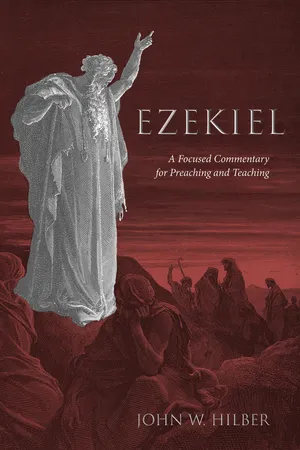
- 284 pages
- English
- ePUB (mobile friendly)
- Available on iOS & Android
eBook - ePub
About this book
The primary goal of this commentary is to focus attention on what mattered most to Ezekiel and to craft a direction and scope of application that the prophet himself would recognize were he to preach to God's people today. In addition to focusing on the most urgent interpretive issues of the text, another goal of this commentary is to explain in simple terms the reasons behind significant translation differences. Embedded in some verses in Ezekiel are particularly complicated or troubling biblical-theological issues. Special topical discussions address these at appropriate locations throughout the commentary.
Information
Topic
Teologia e religioneSubtopic
Commento della BibbiaThe Permanence of God’s Care
Ezekiel 38:1—39:29
Ezekiel’s Message
The Lord will defeat his enemies in order to give peace to his people forever.
Key Themes
• The Lord assures the ultimate defeat of all enemies of his people to assure their permanent security in blessing.
• God’s people will enjoy the favor of his glorious presence.
• In the end, no questions will remain regarding the integrity of God’s holiness and glory.
Context in Ezekiel
The placement of yet another oracle against foreign nations after Ezekiel’s message of Israel’s restoration (Ezek 33:1—37:28) might seem odd. Ezekiels’ oracles against the nations already preceded this part of Ezekiel (Ezek 25:1—32:32). But, as Cooper notes, Ezek 38–39 demonstrates “just how secure Israel will be in their land.”277 Without these chapters, Ezekiel’s prophecies about Israel’s suffering and restoration would revolve mainly around the crisis of the exile. But their inclusion provides a view into the distant future and a decisive victory.278 These chapters function, then, as an “end bracket,” complementing the similar use of oracles against the nations that precede Ezekiel’s announcements of salvation:
(A) The Lord will clear the way for restoration by removing Israel’s enemies (Ezek 25–32). (B) Jerusalem’s destruction clears the way for restoration (Ezek 33)—for leadership (Ezek 34), for flourishing in the land (Ezek 35:1—36:15), for spiritual renewal (Ezek 36:16–38), and for consummation of all covenant blessing (Ezek 37). (A’) The Lord will maintain Israel’s peace by destroying future enemies (Ezek 38–39).
Interpretive Highlights
38:2 Gog . . . chief prince: There is no consensus of opinion on the identity of “Gog,” since this individual is otherwise unattested.279 The other names in this context are reasonably secure, and that forms the best starting point for discussion. The name “Magog” is listed in Gen 10:2–3 (cf. 1 Chr 1:5), together with Meshek, Tubal, and Gomer with Beth Togarmah, who are both mentioned in Ezek 38:5. These are descendants from Noah’s son, Japhet. As early as Josephus, these have been identified as people inhabiting Asia Minor (modern-day Turkey) and the mountainous regions to the north.280 The name “Magog” could be a Hebrew form of the Sumerian/Akkadian equivalent, which means “land of Gog.” If so, Ezekiel is merely extracting the proper name from the regional designation, “land of Gog,” in order to make the addressee of the oracle personal (i.e., “Gog”).281 One common suggestion is that “Gog” is a form of the name of a famous, seventh-century king of western Asia Minor, Gyges of Lydia. The name would be chosen simply as a well-known representative of the rulers of this region.
The word translated “chief” in the phrase, “chief prince,” is the common word for “head, beginning, source, chief, leader” (rosh). It was translated by the Old Greek (followed by NASB) as a proper name, “Rosh.” By mere coincidence, this Hebrew word for “head” sounds similar to the word “Russia.” This similarity attracted the imagination of some interpreters and became popularized in the Scofield Reference Bible as the identification for the Hebrew word, rosh.282 This suggestion failed to convince later scholars even within the interpretive tradition of Scofield.283 In addition to the lack of any accepted linguistic method that could link rosh with the state of Russia, alternative identifications for rosh as a proper name have never gained wide acceptance; and the Hebrew word order naturally allows reading rosh in its normal sense of “head” or “chief.”284
38:4 hooks in your jaws: This metaphor stresses the sovereign control that the Lord exercises over this powerful war lord (cf. Ezek 29:4). Similar imagery describes God’s sovereign call on Assyria (Isa 7:17–18). The description of Gog’s army is filled with words that underscore the formidability of this enemy in size and equipment: “whole,” “fully,” “great,” “large and small.”
38:5 Persia, Cush and Put: The army of Gog represents foes from the north of Israel. Persia lies to the far east, while Cush (the region of modern-day Ethiopia) is to the southwest and Put (the region of modern-day Lybia) is as close to the west as the Mediterranean Sea barrier allows. Alternatively, the word translated “Persia” could refer to the region of Upper Egypt, in which case the emphasis is on the northern-southern axis of the coalition (viewing Lybia as part of the armies approaching from the south).285 Since Israel is bounded on the west by sea and on the east by desert, this “pincher” action leaves Israel surrounded. The point is that Gog marshals allies from every compass direction to attack Israel.
38:8 After many days . . . In future years: The first expression appears only in Josh 23:1 and refers to a long period of time (in Joshua’s case, on the order of a lifespan). The second expression (lit. “in latter years”) is a variant of a similar phrase, “in latter days,” used in Ezek 38:16.286 The phrase, “latter days,” is frequently used to refer to the remote future (e.g., Gen 49:1; Isa 2:2; Jer 23:20; Mic 4:1; Dan 10:14; and the Aramaic equivalent in Dan 2:28). With these two expressions, then, Ezekiel places the events of chapters 39 and 39 in the undisclosed future. Like in other prophetic contexts, the events of Ezek 38–39 have yet to unfold even in essential fulfillment; so a convergence at the end of the age (the “eschaton”) is an appropriate expectation (see below regarding Rev 20:8). The use of the phrase “in that day” (Ezek 38:14) further reinforces the eschatological (end times) framework for Ezekiel’s thought here. On the one hand, the phrase, “in that day,” can refer to any event when God intervenes for war (see comments at Ezek 7:7); however, it is common in prophetic language to refer to future events that are not realized until the final consummation of God’s kingdom (e.g., Isa 11:10; 27:1; Joel 3:18; Zech 3:10; 12:8–9; 14:9).
38:8 recovered from war: While the expected time of this oracle is undisclosed, the circumstances are repeated several times with different wording: Israel is back in the land and enjoying “safety.” The people’s sense of security is so certain that, practically speaking, they no longer feel the need for the ordinary precautions of building city walls or gates (Ezek 38:11; cf. Ezek 38:14; 39:26). Cook notes that the description could be figurative, since Ezek 36:35 describes the cities of Israel after restoration as well fortified.287 The portrait is one of full blessing under the covenant (see comments about covenant peace at Ezek 34:25 and blessing at Ezek 37:25–26). Ezekiel’s implication is that an attack under such conditions, against an unsuspecting people, is hideously evil.
38:10 thoughts will come into your mind: Ezekiel is mindful of the dual reality of divine sovereignty (Ezek 38:4) and human responsibility (cf. Gen 50:20; Exod 7:3; 8:15, 32; 9:34–35; 10:20, 27).
38:12 center of the land: Some commentators, in the tradition of the Old Greek and Latin versions, understand the word “center” (tabbur) as “navel” or “umbilical cord” [of the earth]. The ancients conceived of sacred places as nexus points connecting heaven and earth; and a people might imagine their city as the focal point of the universe.288 Block is probably correct, however, to doubt that this concept is expressed here in connection with tabbur. He notes that the word tabbur is used only here and in Judg 9:37, where its meaning is unclear—possibly an elevated plateau. Hebrew has an undisputed word for “umbilical cord” (shor) that Ezekiel himself uses in Ezek 16:4, and the prophet could easily have used it here if he intended “umbilical cord.” The meaning, “elevated plateau,” makes sense in this context as a secure location, even without walls.289
38:13 Sheba and Dedan: In anticipation of the plunder to be gained by Gog and his allies, nearby peoples eagerly await fruitful trading opportunities (cf. Ezek 27:20, 22 and discussion about com...
Table of contents
- Title Page
- Special Topics
- Preface and Acknowledgments
- Abbreviations
- Introduction
- The God of Glory Calls
- Embracing the Word
- Responsibility to Respond
- Failing to Live as Light
- Our Grievous Idols
- The Impotence of Materialism
- Rebellion in God’s Face
- Mercy for the Broken of Heart
- God’s Parting Judgment
- Hope Amidst Judgment
- A Word against False Hope
- Speaking Presumptuously in God’s Name
- Sin and Hindered Prayer
- No Righteousness by Association
- God’s Relentless Love
- The Sovereign Lord of Destinies
- The Individual Responsibility to Repent
- A Lament over Fallen Leaders
- Divine Pursuit of a Purified People
- Sovereign Determination of Judgment
- Exposing Sin in the Furnace of God’s Anger
- An Allegory of Political Prostitution
- A Real Cause for Mourning
- Judgment on a Vindictive Spirit
- The Sinking of Tyre’s Wealth
- The Corruption of Tyre’s Pride
- Leaning on Unreliable Allies
- A Great Fall
- No Privileged Status
- Two Kinds of Shepherds
- Reclaiming and Renewing the Land252
- Spiritual Transformation for God’s Honor
- A Whole Covenant Package
- The Permanence of God’s Care
- Return of God’s Glory
- Return to Order in Worship and the Land
- Bibliography
Trusted by 375,005 students
Access to over 1.5 million titles for a fair monthly price.
Study more efficiently using our study tools.
Frequently asked questions
Yes, you can cancel anytime from the Subscription tab in your account settings on the Perlego website. Your subscription will stay active until the end of your current billing period. Learn how to cancel your subscription
No, books cannot be downloaded as external files, such as PDFs, for use outside of Perlego. However, you can download books within the Perlego app for offline reading on mobile or tablet. Learn how to download books offline
Perlego offers two plans: Essential and Complete
- Essential is ideal for learners and professionals who enjoy exploring a wide range of subjects. Access the Essential Library with 800,000+ trusted titles and best-sellers across business, personal growth, and the humanities. Includes unlimited reading time and Standard Read Aloud voice.
- Complete: Perfect for advanced learners and researchers needing full, unrestricted access. Unlock 1.5M+ books across hundreds of subjects, including academic and specialized titles. The Complete Plan also includes advanced features like Premium Read Aloud and Research Assistant.
We are an online textbook subscription service, where you can get access to an entire online library for less than the price of a single book per month. With over 1.5 million books across 990+ topics, we’ve got you covered! Learn about our mission
Look out for the read-aloud symbol on your next book to see if you can listen to it. The read-aloud tool reads text aloud for you, highlighting the text as it is being read. You can pause it, speed it up and slow it down. Learn more about Read Aloud
Yes! You can use the Perlego app on both iOS and Android devices to read anytime, anywhere — even offline. Perfect for commutes or when you’re on the go.
Please note we cannot support devices running on iOS 13 and Android 7 or earlier. Learn more about using the app
Please note we cannot support devices running on iOS 13 and Android 7 or earlier. Learn more about using the app
Yes, you can access Ezekiel by John W. Hilber in PDF and/or ePUB format, as well as other popular books in Teologia e religione & Commento della Bibbia. We have over 1.5 million books available in our catalogue for you to explore.