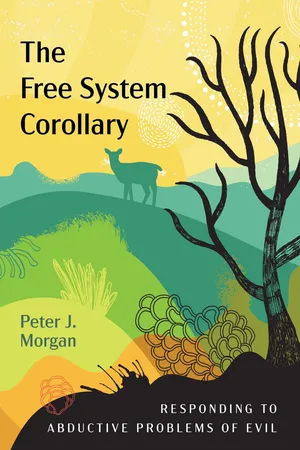
- 182 pages
- English
- ePUB (mobile friendly)
- Available on iOS & Android
eBook - ePub
About this book
Everyone has experienced pain. No one is immune from loss and suffering. With all of the evil in this world, how can anyone rationally believe in a good and loving God? People who believe in God experience intense evil, yet they still retain their faith, claiming that God helps them in times of need. Still others claim that this same evil is proof that God does not exist; that if God were real, he would limit the suffering. If you have ever thought that it seems that things should be a certain way, that you are inclined toward believing, or not believing, in God because of the existence of evil, you are part of the conversation of the abductive problem of evil.
This book does more than just explore what modern philosophers on both sides of the aisle have claimed about God and evil. It also illuminates an intricate world that is crafted for people having free will, for people who make moral choices. For it is within the realm of this intricate world that we may find the answers we seek.
Information
Topic
Teologia e religioneSubtopic
Teologia cristiana1
Introduction
Why the Problem of Evil?
In and of itself, the Problem of Evil (POE) is not new to the realm of philosophy and theology. However, the POE is no less important today for its historical presence. There are at least two reasons why this discussion continues to be had between theists1 and non-theists:2 (1) applicability and (2) ceaseless change.
The general question of the POE, “How can a wholly good God allow evil to take place?” is a question that is imminently applicable to theistic belief in a God that is supremely good. Horrors exist in the daily lives of people in communities around the world. The severe illness of a child, starvation, loss of family, and so many more examples of pain and suffering can be easily found. Factoring in the atrocities that occur during war, and the frequencies of wars, the amount of suffering that takes place is hard to ignore. Thus, the POE is timelessly applicable to any who would claim to believe in a wholly good God. However, it is not merely the applicability of the POE that continues to make it relevant for today. Theologians for centuries have given explanations for the great number of occurrences of evil in this world. The POE persists not only because of its applicability but new answers need to be given because of its capacity for ceaseless change.
Evidence for the ceaseless change of the POE can be found in the various arguments and discussions that have been had in the twentieth century and beginning of the twenty-first century, let alone the centuries prior. This is not to say that theistic answers to the POE were not adequate, but the POE is ever changing in that new perspectives on what constitutes evil have a tendency to change and/or become more nuanced. Therefore, with each theistic response to the POE it is possible for a refined statement/challenge of the POE to be formulated. This does not necessarily invalidate the answers previously given, but it does beg for additional/more complete responses.
For much of the history of the POE, a predominate (deductive) question was the logical compatibility of the existence of evil with an omnipotent, omniscient, and wholly good God (G). Today, the emphasis of the POE has shifted from logical compatibility to plausibility. A strong voice in non-theistic philosophical writings is Bruce Russell, and he encapsulates the current focus on the POE when he states, “Hence, any hypothesis that implies that this was not nearly certain would be improbable on what we know. And if a hypothesis is improbable on what we know, it cannot serve as an adequate defense of theism.”3 Here, Russell is referring to his argument that G has a moral obligation to stop at least one more instance of evil because it is in G’s power to do so, and doing so will not decrease the amount of good in the world. Russell is making an evidential argument. This evidential argument is inductive in nature in that it seeks to reveal a general truth about the existence of G from particular instances of suffering, but it is also abductive in that it argues for an inference to G’s nonexistence. This abduction is an inference to the best explanation on what is known of the situation of the POE, and while induction may do a lot of the foot work it is abduction that is the closing argument of non-theists such as Russell.
In making his abductive case, Russell asserts that any defense of theism will need to provide a plausible explanation for the POE that is superior to that of the non-theist. Russell states, “A defense requires that theism be conjoined with a hypothesis to explain the pattern of suffering there is and if that hypothesis is improbable on what we know, then the conjunction of theism and that hypothesis will also be improbable on that background knowledge.”4 The logical compatibility of the existence of G and evil is of minor concern for these kinds of non-theistic arguments; for theism to win the day an argument is needed that more abductively accounts for the amount of intense evil that is present in the world than non-theistic arguments.
A Daily Dose of Abduction
Non-theistic arguments from the POE, such as the one briefly introduced above, place a challenge before the theist to provide a more plausible explanation for the state of affairs that are present in this world. This is a challenge that should not be ignored by theists, for though inductive and deductive reasoning are used in daily life, it is abduction that plays a significant role in living life.
David Baggett describes abduction as an inference to the best explanation which is similar to induction in that a conclusion is not guaranteed but still warranted.5 Whereas inductive reasoning brings one to a generalized conclusion, abduction winnows the generality toward a specific explanation for an observed phenomenon, “in a way at once plausible, instinctive, and economical.”6 Baggett states, “The inference does not settle the matter, but produces new opportunities to subject the explanation to critical scrutiny to assess its effectiveness at providing further explanation of additional observations.”7 Abduction seeks a more personal/specific explanation for the states of affairs that are observed in this world than induction provides. Baggett additionally observes that Charles Sanders Peirce, who characterized abduction in the late nineteenth and early twentieth centuries, “noted that all of us tend to infer explanations; we hypothesize in efforts to explain various phenomena we encounter.”8 Not only does abduction seek for possible explanations that are more specific than induction but abduction is a common element of human existence.
Every day, millions of people commute to work. Regardless of their specific routines, each person believes that the process of boarding a train, driving a car, etc., will be as mundane as it has been for the overwhelming majority of previous days. Rarely, if ever, are thoughts given to the specific mortal dangers that lurk at every mile marker; if every other day has gone well then it is probable, since nothing else has changed, that this day will go well too. There are many potential explanations for this inductive feeling of security ranging from a belief in God’s protection to the superiority of one’s driving skills to the reliability of the make and model of one’s car. Whenever someone draws a conclusion as to the probable reason for their safe commute they are moving from induction to abduction. The commuter need not dwell on the explanation for safety for long for it to be an abductive thought. For example, even in the instant someone sees their car and briefly revels in purchasing a reliable vehicle that person has moved from the induction of belief in a safe commute toward an abductive justification for that belief. This same consideration of probability can be extended to virtually every aspect of routine life.9 This reality of human life makes abductive arguments from the POE worthy of attention.
For the reasons mentioned above, any argument on the POE that utilizes an abductive approach would be highly relatable to those living in a world in which evil exists. The significance of this observation for the theist resides in the non-theist’s confidence that no theistic defense can be more probable than that of the non-theist for explaining why there are the amounts and kinds of evils that exist in this world. While this author cannot speak as to the motivations/reasons for the non-theistic confidence of philosophers such as William Rowe, J. L. Mackie, Bruce Russell, and Paul Draper, there does appear to be a consistent tendency for the non-theist to use specific evidences (such as a fawn dying in a forest fire and the abuse/murder of a five-year-old girl) in support of their account of the POE. Theistic philosophers such as Alvin Plantinga, Peter van Inwagen, and Stephen Wykstra do provide compelling defenses, but they appear reluctant to apply their theistic defense toward the specific evidences used by non-theists. Given that non-theists are willing to evoke specific instances of natural and moral evil in their arguments, the reticence of the theists to do likewise can place them at a disadvantage in arguing for the plausibility of theism over against non-theism.
The significance of defenses, such as Plantinga’s Free Will Defense, that show the logical compatibility of G with intense evil should not be taken lightly. However, the evidential arguments from evil made by non-theists are insufficiently answered by theists if theistic defenses cannot be applied to specific cases of intense evil. Indeed, non-theists not only make their logical cases but they do so in a manner that can be and is applied to the real-life observations. Therefore, a theistic defense of the POE that can answer Russell’s aforementioned challenge of probability needs to address specific instances of intense evil. This is an important task, for if theism is unable to produce a defense that is not only logical but capable of addressing the same evidences used by non-theists in a more probable way, then theism is hard-pressed to show its truthfulness to a world that thinks in probabilistic terms on a daily basis. Fortunately, the work done by Plantinga, van Inwagen, and Wykstra provide a solid foundation for just such a defense.
The Work Ahead
The issue regarding the POE that has been briefly described above can be summarized by the question, “Can theism abductively account for specific instances of intense evil better than naturalism?”10 Therefore, this book will present a theistic defense which, on what is known, accounts for the amounts and kinds of intense evils that are in this world more fully than naturalism. This will be accomplished through building upon the Free Will Defense, the Expanded Free Will Defense, and Skeptical Theism by more fully considering what is needed in order for free will to operate properly and the implications that this has for the POE.
A Glimpse at Free Systems
In light of the challenges posed by the APOE above, considerations of the implications of systems of regularity for free creatures will provide valuable theodical suggestions,11 for addressing the APOE.12 In short, the free will that exists within humanity requires systems of regularity in which to operate. Within systems of regularity13 laws/rules (e.g., gravity) are a good in that they allow for consistent interaction between the free will of human agents and the physical world in which they live. Observing this regularity in relation to instances of intense evil will give rise to theodical suggestions that can correlate with existing defenses, such as the Free Will Defense, Expanded Free Will Defense, and Skeptical Theism. This Free System Corollary to Free Will Defenses is understood as follows:
Free System Corollary (FSC)df = Theodical suggestions, born from the conjunction of free will and the systems needed for free will to be actualized provide plausible explanations, that could be true for all we know, in response to specific instances of intense evil.
In other words, there are more factors involved in a given situation that are accessible to human knowledge than what appear on only an account of human free will. This is not to say that the FSC will open the human mind to all that is involved in a given si...
Table of contents
- Title Page
- Acknowledgments
- Abbreviations
- Chapter 1: Introduction
- Chapter 2: Considerations of the Good
- Chapter 3: Natural Law
- Chapter 4: The Free Will Defense
- Chapter 5: The Expanded Free Will Defense
- Chapter 6: Inculpable Nonbelief
- Chapter 7: Skeptical Theism
- Chapter 8: The Free System Corollary
- Chapter 9: Applying the Free System Corollary
- Chapter 10: Conclusion
- Bibliography
Trusted by 375,005 students
Access to over 1.5 million titles for a fair monthly price.
Study more efficiently using our study tools.
Frequently asked questions
Yes, you can cancel anytime from the Subscription tab in your account settings on the Perlego website. Your subscription will stay active until the end of your current billing period. Learn how to cancel your subscription
No, books cannot be downloaded as external files, such as PDFs, for use outside of Perlego. However, you can download books within the Perlego app for offline reading on mobile or tablet. Learn how to download books offline
We are an online textbook subscription service, where you can get access to an entire online library for less than the price of a single book per month. With over 1.5 million books across 990+ topics, we’ve got you covered! Learn about our mission
Look out for the read-aloud symbol on your next book to see if you can listen to it. The read-aloud tool reads text aloud for you, highlighting the text as it is being read. You can pause it, speed it up and slow it down. Learn more about Read Aloud
Yes! You can use the Perlego app on both iOS and Android devices to read anytime, anywhere — even offline. Perfect for commutes or when you’re on the go.
Please note we cannot support devices running on iOS 13 and Android 7 or earlier. Learn more about using the app
Please note we cannot support devices running on iOS 13 and Android 7 or earlier. Learn more about using the app
Yes, you can access The Free System Corollary by Peter J. Morgan in PDF and/or ePUB format, as well as other popular books in Teologia e religione & Teologia cristiana. We have over 1.5 million books available in our catalogue for you to explore.