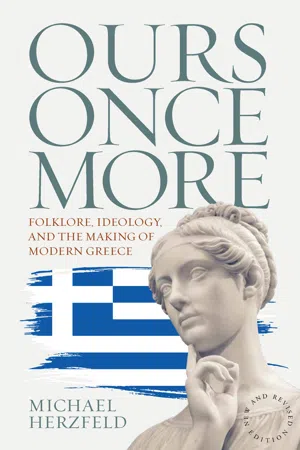
When this work – one that contributes to both the history and anthropology fields – first appeared in 1982, it was hailed as a landmark study of the role of folklore in nation-building. It has since been highly influential in reshaping the analysis of Greek and European cultural dynamics. In this expanded edition, a new introduction by the author and an epilogue by Sharon Macdonald document its importance for the emergence of serious anthropological interest in European culture and society and for current debates about Greece's often contested place in the complex politics of the European Union.
- 254 pages
- English
- ePUB (mobile friendly)
- Available on iOS & Android
eBook - ePub
About this book
Trusted by 375,005 students
Access to over 1.5 million titles for a fair monthly price.
Study more efficiently using our study tools.
Information
CHAPTER 1

Past Glories, Present Politics
“… the Europeans as mere debtors …”
Cultural Identity as Ideology
In 1821, the Greeks rose in revolt against the Ottoman Empire and declared themselves an independent nation. Their goal was far more ambitious than freedom alone, for they proclaimed the resurrection of an ancient vision in which liberty was but a single component. That vision was Hellas—the achievements of the ancient Greeks in knowledge, morality, and art, summed up in one evocative word. What was more, the new Greek revolutionaries went one step further than their forebears had ever managed to do: they proposed to embody their entire vision in a unified, independent polity. This unique nation-state would represent the ultimate achievement of the Hellenic ideal and, as such, would lead all Europe to the highest levels of culture yet known.
Europeans in other lands, though largely receptive to the attractions of Classical Greek culture, were not uniformly impressed by the modern Greeks’ claim to represent it. By what token could the latter-day Greeks portray themselves as the true descendants of the ancient Hellenes? Even if they were able to do so, had several centuries of unenlightened Ottoman rule not had any effect on their intellectual and moral condition? Were they still, in any sense that an educated European could grasp, the same as the Greeks of old?
In a strictly literal sense, of course, they were not. No culture remains totally unaltered with the passage of time; as generation succeeds generation, all kinds of changes occur, some abruptly, others imperceptibly but nevertheless with equal persistence. Thus, sameness must in reality be a matter of cultural similarity or continuity. These kinds of connection are unlike the absolute notion of sameness, however, in that they depend on the observer’s criteria of relevance—on a whole set of presuppositions, in other words, about what traits really constitute acceptable or interesting evidence for some sort of link. Clearly, then, a premise of cultural continuity cannot usefully be regarded as a question of pure fact. That it is often so regarded in practice is some indication of the substantial political interests that are vested in it. When cultural continuity is quite obviously a political issue—and in Greece it was never anything else, since it provided the theoretical justification for creating the nation-state in the first place—the observer’s personal politics are crucial in determining whether such continuity is admitted to exist.
This book is an attempt to show how Greek scholars constructed cultural continuity in defense of their national identity. It is not intended to suggest that they did so in defiance of the facts. Rather, they assembled what they considered to be the relevant cultural materials and used them to state their case. In the process, they also created a national discipline of folklore studies, providing intellectual reinforcement for the political process of nation building that was already well under way.1
In their attempt to project a particular view of the Hellenic ideal, moreover, the Greeks were acting no differently than the representatives of other, older European scholarly traditions. The selective character of their research was a well-established trait: Europeans of widely separated times and cultures had long been apt to reconstitute Classical Greece in the terms most familiar to them. The concept of Hellas was already a quicksand of shifting perceptions when the modern Greeks came to it in their turn, bringing with them their specialized nationalistic concerns. Even when Classical scholars could see how much “their” Greece differed from that of some other period or intellectual tradition, their deeper sense of perspective did not necessarily release them from their own time-bound and ethnocentric tastes.
A few examples of European scholarly attitudes will serve to make the point. The early medieval writers are said by one authority to have viewed the Greeks as “more simple-minded and devout, above all more romantic” than they were later to seem (Loomis 1906: 7–8). With the Renaissance, there came a greater respect for the Greeks’ intellectual achievements; the influx of Greek scholars to Italy after the sack of Constantinople in 1453 (see Geanakoplos 1962, 1966) produced a rapidly increasing familiarity with Classical philosophy and a general reverence for the wisdom of the ancient writers. As Classical scholarship began to expand and to become more specialized, however, and as philological knowledge was joined by the emergent discipline of archaeology, alternative ways of looking at the ancient world proliferated. By the nineteenth century, Classical scholars had come to pride themselves on a remarkable degree of academic perfectionism, but their views were clearly as much a matter of intellectual fashion as ever. A frankly critical American observer of nineteenth-century European scholarship decried not only the English scholars’ “limp Grecism,” as evidenced in the excessively “scented, wholesale sweetness of the modern aesthetic school in England,” but also the Germans’ use of Greek “as a stalking-horse for Teutonic psychology” and their grave concern with minutiae. Scholars of the two nations resembled each other, he thought, “in but a single trait—the conviction that they understand Greece” (Chapman 1915: 12–13). Nor was this acid commentator entirely free of any such conviction about himself, to judge from the tone of these remarks. And so, presumably, it will go on. New truths will yield to still newer truths about the same basic idea, the vision of Classical Greece—the source, in a commonly held view, of the very practice of historical writing itself.
Such changes in perception are of interest here for two reasons. First, they show that through all the divergent interpretations there runs a common theme: the idea of Hellas as the cultural exemplar of Europe.2 And, second, these same contrasts mark the progressive enhancement of that exemplar’s authority, not its dissolution (as we might expect) in the bickering of the ages. Whatever Greece is or was, the idea of Greece—like any symbol—could carry a wide range of possible meanings, and so it survived triumphantly. Similarly, the concept of European culture, so stable at the level of mere generality, has undergone many transformations through the centuries. “Europe,” like “Hellas,” was a generalized ideal, a symbol of cultural superiority that could and did survive innumerable changes in the moral and political order. It was to this European ideal, moreover, that Hellas was considered ancestral. Such is the malleable material of which ideologies are made.
Folklore and History
It is as an ideological phenomenon that we shall treat the twin concepts of Hellas and Europe here. They provided the motivating rationale for one of the most explosive political adventures of the nineteenth century, an adventure that claimed thousands of lives and brought many more under the control of a nation-state that had never before existed as a sovereign entity. This adventure was the Greek struggle for independence of 1821 to 1833. Its eventual success was by no means certain in the early stages. The Great Powers were reluctant to commit themselves to the Greek cause until, forced by public opinion at home, by the Greeks’ own successes, and by the fear of each other’s intentions, they began to take a more active part in bringing the Greek State into existence. That the Greeks did eventually prevail, despite the enormous Ottoman forces with which they had to contend as well as their destructive internal squabbles, is some measure of the evocative power of the name of Hellas among their European supporters. To be a European was, in ideological terms, to be a Hellene.
Yet the Hellas that European intellectuals wished to reconstitute on Greek soil was very different from the Greek culture that they actually encountered there, despite all the western-educated Greek intellectuals’ efforts to bridge the gap. Nowhere were the contradictions more apparent than in the earliest attempts to provide the new nation-state with an explicit foundation in political theory. In 1822 a national charter, the so-called Constitution of Epidaurus, was promulgated in a language so archaic that few Greeks could fully understand it. This language was symptomatic of the idealism with which the charter had been conceived: it promised a statist democracy in accordance with the principles that were thought to have guided a very different sort of polity, the Athenian city-state of the fifth century B.C. Although this impracticable blueprint was soon superseded by other constitutions, it expresses nicely the paradoxical situation in which the new Hellas found itself.
The paradox, though not openly expressed so baldly at first, was a matter of immediate concern to the founders of the new state and may be crudely paraphrased in these terms: how could a modern nation-state survive on the premise that its citizens were the same as the long-lost inhabitants of the land?3 Other, related questions followed in the stream of this first one. How, for example, could one be a “Hellene”—a term that had meant “pagan” in the early years of Christianity—while still a member of the Orthodox Christian faith? How could one be considered a Hellene when ordinary conversation was conducted in a language, Romeic, which was conceptually opposed to the ancient (“Hellenic”) tongue? What, more generally, were Greeks to make of all the cultural traits that, though a familiar part of their lives, were now under attack by their leaders as well as by foreigners as “barbarous” and “oriental” and therefore as the very antithesis of Greek? Such difficulties threatened the coherence of the national ideology at the moment of its supreme political triumph.
From 1821 on, the intellectuals had to deal with a large rural population in the realm of practical politics. The unlettered peasantry presented a potentially embarrassing contrast to the idealized image of Greece that the European supporters of Greek nationalism—the philhellenes, as they are so aptly named—had entertained for so long. How were the Greek rural folk to fit into the grand design? They had almost no documented history that might connect them, however tenuously, to their ancient predecessors.
The study of folklore provided the most comprehensive answer—hesitantly at first, then with growing confidence as the methods and orientation of this (for Greece) novel discipline became more and more systematic. The concept around which the early Greek folklorists organized their enterprise was precisely that of cultural continuity. This specialized version of the commonly entertained conception of Hellas as the exemplar of all Europe shared with the latter a similar liability to wide-ranging and ambiguous definition. In its successive reformulations, it responded to many of the ethnological fashions that sprang up abroad, though often in forms adapted to Greece’s special needs and preoccupations. Against the background of the Greeks’ dependence on European patronage, moreover, the role of folklore in fashioning an acceptable external image for the country had political significance right from the start. If it could be shown that the peasants, the largest demographic element, retained clear traces of their ancient heritage, the fundamental requirement of philhellenic ideology would be satisfied, and European support for the emergent nation-state could be based on a secure foundation of historical justification.
An Externally Directed Ideology
For these reasons, folklore was not merely an abstruse academic concern in the early years of Greek independence. It addressed what were perhaps the most sensitive aspects of national identity, and its political implications were widely recognized. Foreigners as well as Greeks, politicians as well as scholars helped launch Greek folklore research on the path along which it was to travel for decades to come. This rise of academic folklore was generated in the interplay between local and foreign interests in the legitimation of the new state.
The nationalist scholar and ideologue Adamantios Koraes (1748–1833), a correspondent of Thomas Jefferson and a close observer of pre- and post-revolutionary France, both exemplified and initiated that process. Koraes could be highly disparaging of the vernacular culture: he once dismissed the Cretan Renaissance verse-romance Erotokritos as “the ugly handmaid” of Greek letters, for example (1805). Despite such attitudes, he encouraged Greek scholars to take an interest in vernacular studies and expressed warm admiration for Claude Fauriel, the French historian and compiler of the first substantive collection of Greek folksongs to appear in print (Sainte-Beuve 1870: 202; cf. Llewellyn Smith 1965: 54). Some of the songs in Fauriel’s collection had apparently been supplied by Koraes himself, via the good offices of the Greek scholars Christodoulos Klonaris (1788–1849) and Nikolaos Piccolos (1792–1866) (Fauriel 1956: 2). Koraes’ own attitude toward folk literature can perhaps best be gauged through his linguistic ideas. In contrast to the neo-Atticists, who wanted to restore the Classical Greek of Plato and the Attic tragedians to daily use, he was willing to retain certain vernacular forms as well as to draw on European traditions of grammatical codification. Whether or not Koraes’ moderate stance was what enabled demotic Greek to survive the onslaught of extreme neo-Atticism (Babiniotis 1979: 4), his interest lay less in reviving the Classical glories as such than in locating in the modern Greeks a Hellenic essence that could be refashioned in the philhellenic idiom.
The development of folklore in Greece can be understood only against this background of an externally directed ideology, ever responsive to foreign comment and criticism. Perhaps the greatest period of activity in the history of Greek folklore began with the vehement denial of the Greeks’ claims to a Classical ancestry, articulated by the Tyrolean polemicist and scholar Jakob Philipp Fallmerayer. But, while due regard must be paid to such foreign stimuli, the achievements of the Greek folklorists are not thereby diminished. On the contrary, it was the Greeks’ willingness to join battle in the first place that allowed them to recover and preserve so vast a corpus of material; without their efforts, most of it would have vanished long ago. Nor is there any profit in laughing at their methods and theories, outlandish though many of them may now seem. These were partly a reflection of ethnological thinking abroad, partly a response to local political conditions and ideological trends. Above all, the Greek folklorists’ methods were intended to guide the earnest search for factual knowledge. These folklorists were actually dogged empiricists, no matter how ambiguous their evidence may seem today. There is nothing to be gained from looking at the early Greek folklorists as an assortment of charming eccentrics, even though the recent treatment of nineteenth-century philhellenes and nationalists (St. Clair 1972; Howarth 1976) may suggest some such course. To understand them, we must instead relate their ideas to the political, social, and moral universe in which they moved.
Toward a National Anthropology
How is such a task best approached? The Greek folklorists were attempting to explain a national culture that they considered to be both internally chaotic and corrupted by foreign influences of many kinds. Their notions about what it meant to be Greek acted as a filter through which only “relevant” data could pass. Indeed, these ideas were often translated into systems of classification. It is by treating such systems semiotically—that is, as a code that embodied and expressed the folklorists’ guiding assumptions—that we can most effectively work back to the assumptions themselves.
Every cultural commentary—be it folkloric, historical, or anthropological—is an attempt to convey to an audience of relative outsiders something that already has its own internal forms of explanation and rationale. In the present case, however, it is the commentators themselves whom we are studying. The Greek folklorists saw their nation’s culture as a unity in which they were themselves fully participating members. In order to examine their relationship to the peasantry whose lore they studied, we cannot afford to accept that assumption uncritically. On the contrary, it is just one of the many distinctive traits of their culture within a culture, of the habits of thought that set them apart from other Greeks. Their willingness and ability to think in terms of studying folklore are some measure of the distance that actually separated them from the rural people. In that sense, too, this book is essentially an “anthropology of anthropologists,”4 whatever its wider implications with regard to modern Greek culture as a whole.
These Greek scholars were anthropologists of a special kind. Most of what they did was in some way a response to the ideological needs of their emergent polity. Indeed, they made a distinctive and important contribution to the making of modern Greece, no less than did the military and political leaders in their respective areas of competence. Their methods and assumptions are thus crucial to our understanding not only of the ideological development of Greece in its first few decades of independence but of the complexities of modern Greek culture as we encounter it today. All too often, our insights are restricted by the boundaries of current academic disciplines. Village-level ethnographies and studies of particular artistic and literary movements are valuable and interesting, but they address comparatively small and isolated segments of the national culture. By examining the Greeks’ study of their own national culture, we can at least begin to gain some sense of how these various segments are connected in the national sense of identity.
Attractive though this framework of inquiry is, it does raise two serious difficulties that ought to be discussed before we go any further. The first of these concerns the extent to which the folklorists exerted the kind of influence that may have caused the folklore itself to conform increasingly to their preconceptions. The second problem is both more general and more immediate: how can we be sufficiently confident of our own sense of Greek folklore to be able to make a critical examination of the original collectors’ work?
The first question—that of the folklorists’ influence on cultural change—is hard to answer with any real accuracy. There is no doubt that the folklorists did have some effect on the content of school textbooks, which in turn contributed to the partial dissemination of learned culture (see especially Beaton 1980: 190). Moral censorship, too, seems to have had some effect; what the folklorists permitted themselves to include in their collections may have had greater chances of survival simply because of this semiofficial approval. Yet we should be careful not to overstate the case here; the real difficulty is that our major source of information about the folk culture is precisely the body of material collected over the years by the local scholars, and in fact there is some evidence (e.g., Herzfeld 1979) that the more disreputable forms have survived remarkably well in some areas. Some of the scholars’ linguistic emendations may have entered the folk repertoire as the spoken language moved increasingly toward standardization. Here again, however, it is not at all clear how radical the folklorists’ influence actually was, and I have been extremely cautious about assuming that they were responsible for any of these kinds of cultural change. It is not necessary t...
Table of contents
- Cover
- Title Page
- Copyright Page
- Contents
- Preface to the First Edition
- Introduction to the New Edition. Historicizing a History
- Prologue to the Greek Edition ~ Alki Kyriakidou-Nestoros
- Chapter 1. Past Glories, Present Politics
- Chapter 2. Extroversion and Introspection
- Chapter 3. National Character, National Consciousness
- Chapter 4. Attack and Reaction
- Chapter 5. The Creation of a Discipline
- Chapter 6. Expansion and Collapse
- Chapter 7. Conclusions and Emergences
- Epilogue to the New Edition. Laying the Foundations of the Anthropology of Europe: An Ethnography of Culture Theory ~ Sharon Macdonald
- Appendix A. Politis’ Folklore Taxonomy
- Appendix B. Basic Chronology
- Bibliography
- Index
Frequently asked questions
Yes, you can cancel anytime from the Subscription tab in your account settings on the Perlego website. Your subscription will stay active until the end of your current billing period. Learn how to cancel your subscription
No, books cannot be downloaded as external files, such as PDFs, for use outside of Perlego. However, you can download books within the Perlego app for offline reading on mobile or tablet. Learn how to download books offline
Perlego offers two plans: Essential and Complete
- Essential is ideal for learners and professionals who enjoy exploring a wide range of subjects. Access the Essential Library with 800,000+ trusted titles and best-sellers across business, personal growth, and the humanities. Includes unlimited reading time and Standard Read Aloud voice.
- Complete: Perfect for advanced learners and researchers needing full, unrestricted access. Unlock 1.5M+ books across hundreds of subjects, including academic and specialized titles. The Complete Plan also includes advanced features like Premium Read Aloud and Research Assistant.
We are an online textbook subscription service, where you can get access to an entire online library for less than the price of a single book per month. With over 1.5 million books across 990+ topics, we’ve got you covered! Learn about our mission
Look out for the read-aloud symbol on your next book to see if you can listen to it. The read-aloud tool reads text aloud for you, highlighting the text as it is being read. You can pause it, speed it up and slow it down. Learn more about Read Aloud
Yes! You can use the Perlego app on both iOS and Android devices to read anytime, anywhere — even offline. Perfect for commutes or when you’re on the go.
Please note we cannot support devices running on iOS 13 and Android 7 or earlier. Learn more about using the app
Please note we cannot support devices running on iOS 13 and Android 7 or earlier. Learn more about using the app
Yes, you can access Ours Once More by Michael Herzfeld in PDF and/or ePUB format, as well as other popular books in Social Sciences & Cultural & Social Anthropology. We have over 1.5 million books available in our catalogue for you to explore.