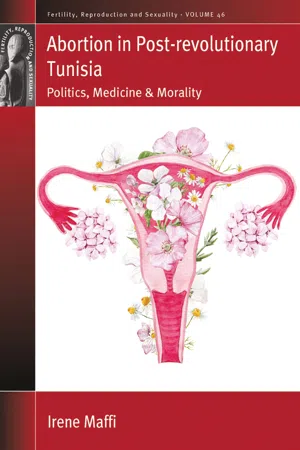
After the revolution of 2011, the electoral victory of the Islamist party 'Ennahdha' allowed previously silenced religious and conservative ideas about women's right to abortion to be expressed. This also allowed healthcare providers in the public sector to refuse abortion and contraceptive care. This book explores the changes and continuity in the local discourses and practices related to the body, sexuality, reproduction and gender relationships. It also investigates how the bureaucratic apparatus of government healthcare facilities affects the complex moral world of clinicians and patients.
- 182 pages
- English
- ePUB (mobile friendly)
- Available on iOS & Android
eBook - ePub
About this book
Trusted by 375,005 students
Access to over 1.5 million titles for a fair monthly price.
Study more efficiently using our study tools.
Information
Chapter 1
PUTTING ABORTION INTO QUESTION
DEBATES, ACTORS AND STAKES AFTER THE REVOLUTION
Secularists, Islamists and the Woman Question
Immediately after the revolution, the issue of women’s rights and their role in local society became a major topic of debate, opposing secular political forces and the newly reconstituted Islamist party Ennahdha (Gray 2012). The definition of the national identity and women’s position in the family and society were the battlefields on which adversaries fought to impose their own political agenda. While women were at the centre of the discussions, they were not the main actors on the political scene. Despite the law of gender parity1 – promulgated before the elections of October 2011 – requiring that political parties have ‘equal gender representation’ (Khalil 2014), the women elected represented only 27 per cent of the constituent assembly. The very high number of parties that allowed the election of only one representative in each electoral district and the fact that only 7 per cent of candidates were female did not grant effective parity (Chekir 2016: 371). Women were also largely absent from the transitional commissions established before the elections of 2011 and the following provisional government. Thus, after their active participation in the revolution, very few women were involved in the post-revolutionary political institutions and decision-making processes. Instead, they became an object of discussion,2 used to redefine the identity of post-revolutionary Tunisia as had already happened in two previous transitional periods: in 1956, when Tunisia became independent from France, and in 1987, when Bourguiba was deposed by Ben Ali. In both situations, women’s rights became a crucial concern for the state and civil society.3 Indeed, the CPS was promulgated in August 1956, three years before the constitution (1959), while Ben Ali officially declared his commitment to the CPS after the Islamic Tendency Movement (MTI, later Ennahdha) had proposed to modify it because it was deemed ‘a product of the West and Westernization, imposed on the country by one person’ (Ghanmi quoted in Labidi 2007: 19). In 2011, the official position of Ennahdha was that the CPS had become part of the Tunisian heritage, although it was still possible to improve it (Gray 2012).4 Ennahdha was in power from October 2011 to January 2014 but was replaced by a government of national union in the following months until the parliamentary elections took place in October 2014. Islamist attempts to replace the principle of men’s and women’s equality with that of complementarity and to criminalise abortion did not succeed thanks to the mobilisation of feminist groups, secular parties and other components of civil society. The complementarity issue in particular gave way to several demonstrations and protests, culminating on 13 August 2012 during the commemoration of the promulgation of the CPS. After repeated discussions within the constituent assembly, articles 21 and 45 of the new constitution promulgated in 2014 reaffirmed women’s and men’s equality of rights and duties.
In short, after the revolution, once again in the history of Tunisia, women were at the centre of the political and ideological debate, opposing the advocates of modernist secular discourses and those of Arab-Islamic authenticity. This opposition dates back at least to the second half of the nineteenth century, when a debate took place within the reformist movement over the role of women in society. Already in 1867, the Secretary of Bey Ahmed Kheireddine emphasised the importance of educating women in order to make them good wives and mothers and help in the regeneration of the country (Ben Youssef Zayzafoon 2005). In the late 1920s, positioning himself in the nationalist debate that developed in opposition to the French colonial presence, Bourguiba argued that Tunisian women should wear the veil because ‘veiling is a custom that has entered into our ethics centuries ago. It is now part of who we are’ (quoted in Ben Youssef Zayzafoon 2005: 101). Interestingly, while Bourguiba, despite being a secular and nationalist politician trained at the Sorbonne, defended the veil against the French, Tahar Haddad, the well-known reformist who had trained at the Zaytouna Mosque, argued for the unveiling of women. In Our Woman (1930), he wrote that the veil is an instrument of male oppression that relegates women to the role of passive individuals under men’s tutelage (Ben Youssef Zayzafoon 2005). Although after independence Bourguiba adopted a modernist view of the state and transformed many of Haddad’s ideas into social reforms, including the unveiling of women, he never adopted a secular interpretation of social institutions. He justified all his reforms by drawing on the Islamic tradition of ijtihad, which allows for interpreting and adapting the precepts and norms of the past to the present. The conflicting positions of Bourguiba and Haddad in the early 1930s also show that the debates over modernisation and authenticity/tradition cannot be reduced to the opposition between religious conservative forces and advocates of modernity.
This ambiguity is still present in post-revolutionary Tunisia, where, as already noted, secular, modernising politicians are recalcitrant to adopt reforms that guarantee full equality between men and women, often in the name of cultural authenticity, whereas religious figures are sometimes ready to justify reforms in the name of Islamic principles.
Similar oppositions between conservative religious actors and modernist secular forces have characterised the history of several countries in the Middle Eastern region since the time of independence (Kandiyoti 1991). In all these contexts, one of the main objects of contention was the role of women in local society because as markers of cultural specificity they played a central role in the construction of local nationalism and anticolonial discourses. Deniz Kandiyoti underlines that ‘women were used to symbolize the progressive aspirations of a secularist elite or a hankering for cultural authenticity expressed in Islamic terms’ (ibid.: 3). In Tunisia, like in many other Arab states, the ‘woman question’ was and still is very important in the process of nation building, although the social and political arrangements reached have been different and constantly readapted to the changing contexts (Abu Lughod 1998). Women and the family occupied and still occupy a central place in the search for legitimacy of the Middle Eastern states in that they are deemed the custodians of authentic cultural values and social integrity. The case of Erdogan’s Turkey (Dayi and Karakaya 2018) and that of post-revolutionary Tunisia indicate that women’s place and role in society are still used to legitimate the ideologies and actions of present political actors and define the boundaries of modern states (Kilani 2018).
Despite their central place in the public debate, in post- revolutionary Tunisia, women were largely excluded from state institutions, and their image was used by political forces to gain power and impose an ideological agenda. Compared to the previous periods in which the discussion around women’s role in society appeared, what was new in the post-revolutionary period was the public emergence of an Islamist women’s movement that had been repressed and silenced in previous decades (Gray 2012; Khalil 2014). Within the movement, there were divergent positions about the role women should play in post-revolutionary society that did not correspond to the monolithic image many secular feminists had. Moreover, in 2011, Islamist female associations’ objectives were very similar to those of secular feminists, such as the ‘common struggle against authoritarianism, preservation of the CPS, freedom in dress and religious worship, increased participation of women in political and public life’ (Khalil 2014: 198). However, the suspicious attitude of secular feminists was not unfounded, because contradictory positions emerged during the electoral campaigns of 2011: while the official programme of Ennahdha entailed references to the intangibility of the CPS, this point was not mentioned during public meetings and discourses of several of the party candidates. In addition, on 29 January 2011, women taking part in the first feminist demonstration after the end of Ben Ali’s regime were verbally and even physically attacked by individuals belonging to religious movements, asking them ‘to go back to their kitchen’ (Chekir 2016: 375). After the revolution, incidents of aggression in the streets against women who did not wear the hijab or who circulated at night multiplied, especially in poor urban areas, and several episodes were on the front page of local newspapers. In 2012, when religiously motivated individuals perpetrated violent assaults against the work of female artists, the transitional government of Ennahdha did not take any measures against them. Several artists have also been the victims of legal attacks, such as the filmmaker Nadia El Fani, who has been accused of ‘insulting the sacred, and violating moral values and religious precepts’ (Labidi 2014: 163).5 Moreover, new locally unknown Islamic precepts were circulated by some representatives of Ennahdha, such as Habib Ellouz, who in 2012 proposed introducing the practice of excision in Tunisia, defining it as ‘plastic surgery’ (Ben Dridi and Maffi 2018). Ellouz was influenced by Wajdi Ghanim, a well-known Egyptian Islamist preacher, who, after the revolution, was invited by several local associations, such as the Association for the Preservation of the Quran, to come to Tunisia. He preached in several mosques, inviting pious citizens to excise their female children. The mobilisation of civil society – mainly lawyers and feminist and secular associations – was enough to stop the attempt to introduce female excision in Tunisia, where the practice does not exist. The episode did, however, affect the opinion of some groups of Tunisian society. A friend and colleague told me that in 2012, her cleaning woman, who at the time had two very young children, started to talk about the possibility of having her girl excised in order to make her pure and beautiful. Another colleague, who is a professor at the High School for Health Science and Techniques of Tunis, told me that several of her students were convinced that excision was a religious prescription and should be introduced in Tunisia. Instead of immediately contesting the opinion of her students, she asked them to conduct research on excision, drawing on the medical literature, because she realised that most of them did not understand what the practice entails. Eventually, a group of students presented the results of the research and expressed deep indignation and outrage over female excision, thus ending the discussion of its introduction.
The Abortion Debate
Since the electoral victory of Ennahdha in October 2011, secular and leftist parties, modernist elites, feminist associations and other civil society associations such as LTDH (Ligue tunisienne des droits de l’homme, Tunisian League of Human Rights) and the women’s committee of the UGTT (Union Générale des Travaillleurs Tunisiens, General Union of Tunisian Workers) have carefully observed the drafting of the new constitution, several versions of which were discussed over the period of 2011 to 2013. Demonstrations, workshops, public statements and lobbying activities among representatives of the constituent assembly by civil society organisations strongly contributed to the defence of women’s rights. They had to oppose not only male Islamist politicians but also women’s organisations linked to Ennahdha that since 8 March 2013, on the occasion of the celebration of International Women’s Day, took large-scale action to call into question Tunisia’s international engagements in the domain of women’s rights and particularly those related to the Convention on the Elimination of All Forms of Discrimination against Women (CEDAW) (Chekir 2016).
While the final text of the constitution was welcomed by feminists with relief, some articles are ambiguous and leave the door open to conservative interpretations that might threaten women’s rights. For instance, Article 22 states that the ‘right to life is sacred.6 It is not possible to violate it unless in extreme cases established by the law’. The article might thus threaten the right to abortion if the foetus is recognised as a human life. This possibility is very concrete if we consider that, as mentioned earlier, in January 2013, a deputy of Ennahdha tried to criminalise abortion in the name of the foetus’ right to come into the world. In 2015, in an interview, Rached Ghannouchi, the political and spiritual leader of Ennahdha, declared not without ambiguity that
‘on principle abortion should not be permitted’ because ‘it is an assault against life’. He considers that a woman can avoid getting pregnant also using contraceptive methods. However, Ghannouchi is not definitive and distinguishes between abortion after a period of 4 or 5 months – which he considers as a murder – and an abortion performed ‘before the development of the foetus’, that he regards as ‘possible’. (Ben Hamadi 2015)
Even before the attempt of Najiba Berioul to change the law and the ambiguous position expressed by Ghannouchi and other Ennahdha representatives, the conservative turn taken by many healthcare providers in the late 2000s – which I have already mentioned – pushed the ATFD to organise a workshop on the ‘Right to abortion and access to abortion services in post-revolutionary Tunisia’ on 9 November 2012 during the 4th international campaign of the Coalition for Sexual and Bodily Rights in Muslim Countries (CSBR).7 The ATFD, one of the founding members of the CSBR that includes women from Arab and Muslim countries, has been active in the domain of sexuality, bodily rights and violence against women since its creation in the early 1980s (Le droit à l’avortement en Tunisie –1973 à 2013 2013: 3). The workshop of 2012 – which was the origin of the already quoted booklet Abortion rights in Tunisia –1973 to 2013 – was conducted by three ATFD members, who are committed to the defence of women’s sexual and reproductive rights: Amel Aouij, a professor of rights at the University of Tunis al-Manar and a bioethicist;8 Selma Hajri, a physician and the president of the NGO Groupe Tawhida Ben Cheikh; and Anne-Emmanuelle Hassairi, midwife and ONFP official.
Spreading Opposition to Abortion Care after the Revolution
Along with ATFD, another Tunisian NGO founded shortly after the revolution (which I will call the Reproductive Health Association [RHA]), has been particularly active in the domain of women’s health, organising training seminars, workshops and conferences for healthcare providers working in the field of SRH. Its activities have not been limited to advocacy campaigns and public demonstrations but have directly targeted those practitioners in charge of reproductive health services in the government health sector. The choice to work with medical personnel was motivated by the conservative attitudes shown by health professionals in government reproductive health clinics, emphasised by the ATFD (2013) and Selma Hajri et al. (2015). The reticence of healthcare providers concerns principally, but not exclusively, abortion care because emerging religious movements have condemned abortion, equating it with murder. A young midwife with whom I collaborated over several months in an ONFP clinic told me that she felt very badly when a taxi driver once asked her whether she worked in the ‘place where they kill the babies of unmarried women’. Indeed, she had worked for a while in the youth-friendly unit, the section of her clinic meant for unmarried citizens, and she was shocked to see ‘how many babies were killed’ (Najet, 4 April 2014). This midwife – who had become very religious shortly before the revolution9 – experienced an inner struggle until she decided that she could not offer abortion care anymore. According to the head midwife in charge of the clinic where she worked, for some months, Najet10 used to read verses of the Quran in front of her patients to persuade them not to end their pregnancy. The act of reading the Quran to convince women not to abort seems to have become common practice (at least after the revolution) because on different occasions three other midwives working in government facilities related similar episodes.11 The refusal by some health practitioners to offer abortion care was not the only manifestation of the post-revolutionary changing social environment. Women seeking abortion care were not the only victims of these new behaviours, as some abortion providers were the target of (symbolically) violent discourses and actions.
Another midwife, who provided abortion and contraceptive care in a hospital in the capital, told me that she had been the object of repeated verbal attacks by other members of the personnel because of her professional activities. She received a threatening letter in which the author condemned her for committing sin (providing abortion care), arguing that if the hospital were bombed by religious extremists, it would be her fault and that she would go to hell for what she had done. She also told me that she found some graffiti on the hospital walls threatening her because she offered abortion care. The same practitioner was also the victim of repeated verbal aggressions by a secretary at her hospital, who, after a long period of sick leave, had come back to her workplace with a face veil – which she did not wear earlier – and manifested an intolerant religious attitude (fieldnotes, September 2013).
An obstetrician-gynaecologist with whom I collaborated during my research and who worked in the government hospital in a city in central Tunisia told me that after the revolution the department had stopped offering abortion care because the head physician was a supporter of Ennahdha and explicitly said he was against abortion. In the spring of 2014, an official working at the ONFP told me that she had been involved in the recruitment of the new head midwife of a clinic in a southern governorate. She was very upset because the midwife who was eventually hired had publicly declared that she was against abortion, although she was going to be in charge of the paramedical personnel of a clinic offering abortion services as there is a law granting this right to Tunisian women.
These fragmentary stories12 confirm what the studies I cited previously show: a conservative turn nurtured by Islamist repertoires and interpretations contributed to important changes in the medical environment I have studied. These changes – that had already started in the mid-2000s – were triggered by the revolution of 2011, which liberated the citizens from the authoritarian power of Ben Ali’s regime, leaving the possibility for repressed forces, ideas and practices to surface and take root.
The fact that after the revolution ten ONFP cli...
Table of contents
- Cover
- Title Page
- Copyright Page
- Dedication
- Contents
- List of Figures and Tables
- Preface
- Acknowledgements
- Notes on Transliteration
- Introduction. Situating Abortion: Islam, the Arab Countries and the Tunisian Exception
- Chapter 1. Putting Abortion into Question: Debates, Actors and Stakes after the Revolution
- Chapter 2. Female Bodies, Contraception and Reproductive Norms
- Chapter 3. Reproductive Governance, Moral Regimes and Unwanted Pregnancies
- Chapter 4. Imagining Early Pregnancy: Ontologies of the Foetus and the Moral Perception of Abortion
- Conclusion
- Glossary
- References
- Index
Frequently asked questions
Yes, you can cancel anytime from the Subscription tab in your account settings on the Perlego website. Your subscription will stay active until the end of your current billing period. Learn how to cancel your subscription
No, books cannot be downloaded as external files, such as PDFs, for use outside of Perlego. However, you can download books within the Perlego app for offline reading on mobile or tablet. Learn how to download books offline
Perlego offers two plans: Essential and Complete
- Essential is ideal for learners and professionals who enjoy exploring a wide range of subjects. Access the Essential Library with 800,000+ trusted titles and best-sellers across business, personal growth, and the humanities. Includes unlimited reading time and Standard Read Aloud voice.
- Complete: Perfect for advanced learners and researchers needing full, unrestricted access. Unlock 1.5M+ books across hundreds of subjects, including academic and specialized titles. The Complete Plan also includes advanced features like Premium Read Aloud and Research Assistant.
We are an online textbook subscription service, where you can get access to an entire online library for less than the price of a single book per month. With over 1.5 million books across 990+ topics, we’ve got you covered! Learn about our mission
Look out for the read-aloud symbol on your next book to see if you can listen to it. The read-aloud tool reads text aloud for you, highlighting the text as it is being read. You can pause it, speed it up and slow it down. Learn more about Read Aloud
Yes! You can use the Perlego app on both iOS and Android devices to read anytime, anywhere — even offline. Perfect for commutes or when you’re on the go.
Please note we cannot support devices running on iOS 13 and Android 7 or earlier. Learn more about using the app
Please note we cannot support devices running on iOS 13 and Android 7 or earlier. Learn more about using the app
Yes, you can access Abortion in Post-revolutionary Tunisia by Irene Maffi in PDF and/or ePUB format, as well as other popular books in Social Sciences & Cultural & Social Anthropology. We have over 1.5 million books available in our catalogue for you to explore.