This collection discusses the innovative and experimental architecture of Israel during its first three decades following the nation's establishment in 1948. Written by leading researchers, the volume highlights new perspectives on the topic, discussing the inception, modernization and habitation of historic and lesser-researched areas alike in its interrogation. Inbal Ben-Asher Gitler and Anat Geva show how Israeli nation building, in its cultural, political and historical contexts, constituted an exceptional experiment in modern architecture. Examples include modern experiments in mass housing design; public architecture such as exhibition spaces, youth villages and synagogues; a necessary consideration of climate in modern architectural experiments; and the exportation of Israeli modern architecture to other countries.
Frequently asked questions
Yes, you can cancel anytime from the Subscription tab in your account settings on the Perlego website. Your subscription will stay active until the end of your current billing period. Learn how to cancel your subscription.
At the moment all of our mobile-responsive ePub books are available to download via the app. Most of our PDFs are also available to download and we're working on making the final remaining ones downloadable now. Learn more here.
Perlego offers two plans: Essential and Complete
Essential is ideal for learners and professionals who enjoy exploring a wide range of subjects. Access the Essential Library with 800,000+ trusted titles and best-sellers across business, personal growth, and the humanities. Includes unlimited reading time and Standard Read Aloud voice.
Complete: Perfect for advanced learners and researchers needing full, unrestricted access. Unlock 1.4M+ books across hundreds of subjects, including academic and specialized titles. The Complete Plan also includes advanced features like Premium Read Aloud and Research Assistant.
Both plans are available with monthly, semester, or annual billing cycles.
We are an online textbook subscription service, where you can get access to an entire online library for less than the price of a single book per month. With over 1 million books across 1000+ topics, we’ve got you covered! Learn more here.
Look out for the read-aloud symbol on your next book to see if you can listen to it. The read-aloud tool reads text aloud for you, highlighting the text as it is being read. You can pause it, speed it up and slow it down. Learn more here.
Yes! You can use the Perlego app on both iOS or Android devices to read anytime, anywhere — even offline. Perfect for commutes or when you’re on the go. Please note we cannot support devices running on iOS 13 and Android 7 or earlier. Learn more about using the app.
Yes, you can access Israel as a Modern Architectural Experimental Lab, 1948–1978 by Inbal Ben-Asher Gitler, Anat Geva, Inbal Ben-Asher Gitler,Anat Geva, Mohammad Gharipour,Christiane Gruber in PDF and/or ePUB format, as well as other popular books in Architecture & Architecture General. We have over one million books available in our catalogue for you to explore.
A Museum in Between: The Israel Museum, Jerusalem, 19651
Eliyahu Keller
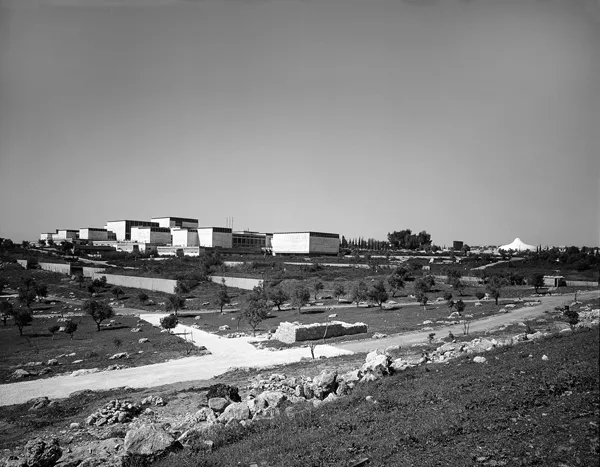
Ever since its establishment in 1965, the Israel Museum in Jerusalem has been considered one of the most important architectural works in the nation’s history [Figure 1].2 Studies have explored both its modernist roots and vernacular inspiration and pointed out its political implications and meaning.3 Different views of the museum’s design have swung from formal, historical, and ideological analyses, all of which have examined it through an isolating lens. Whether as a standalone architectural object, or within the political complexities that characterize Israeli architecture, the museum’s place within a larger architectural discourse has been somewhat overlooked. This chapter will situate the museum as a representative of conceptual shifts, and as an expression of concepts that exceed the physical boundaries of its site.
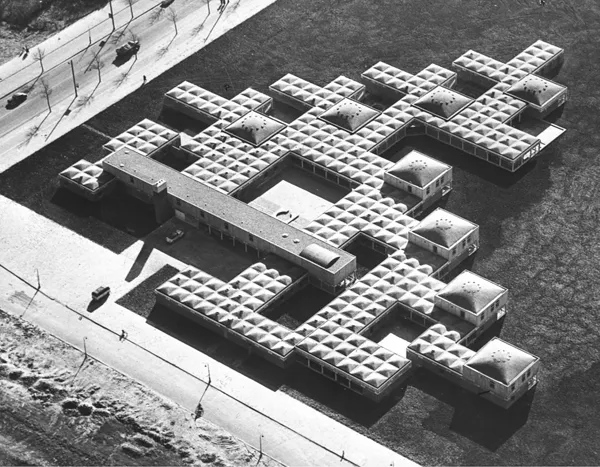
Building upon recent historical research carried out by the architect and architectural historian Eran Neuman,4 this chapter adds an additional layer to the museum’s tale. It analyses its role within a wider cultural and historical context beyond Israeli borders. The analysis includes a comparison of the museum with another modernist icon: the Amsterdam Orphanage, designed by the Dutch architect Aldo van Eyck [Figure 2]. Several reasons call for this comparison: their historical contemporaneity, their designers’ critique of modernism, their formal similarities, and their related conceptual and historical roots and inspirations. Through this lens – and following Van Eyck’s ‘twinphenomena’ theory, which focused on a wholeness that is sustained by the differences in between the distinct parts – the Israel Museum and Amsterdam Orphanage become discrete, yet comparable expressions of post-war modernism.5 The chapter focuses first on the museum’s history and the people involved in its design, and then compares it to the orphanage.
The Background of the Museum, Its Architect and Interior Designer
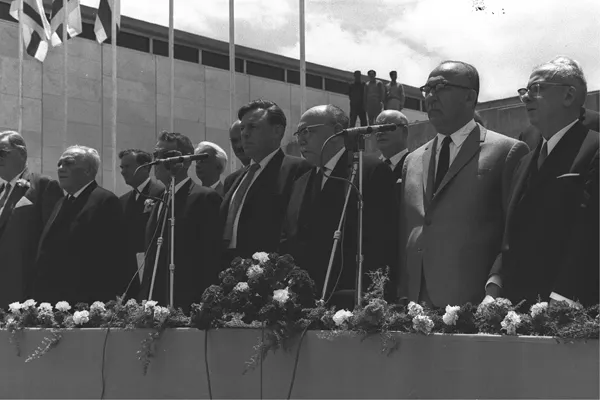
Seventeen years after Israel’s independence and only two years before the Six-Day War reshaped the country’s future, Theodore Kollek took to the stage to inaugurate the Israel Museum [Figure 3].6 The event was decorated with a row of banners, donors, and public figures, and framed by a view of the recently completed parliament building and the National Library. In his speech, Kollek, the future Mayor of Jerusalem, drew a clear connection between the establishment of the nation and its newest national institution:
I cannot avoid the conclusion that it is Jerusalem and the Land of the Bible that impelled forty-three museums and famous collectors […] to lend us some of their greatest treasures […] They knew that their works of art would be on display only a mile from a frontier. They also knew that we are engaged in a great task of nation building. They were happy to take part in sharing our perils and our high purpose.7
As Kollek’s words expose, the Israel Museum was viewed as an emblem of the link between architecture and politics, a connection allegedly shaping the entire history of Israeli architecture.8 Designed by the architect Alfred (Al) Mansfeld and the designer Dora Gad, the museum is an example of the nexus of ideology, architecture, and the making of a sense of place.9 Kollek, speaking of the museum’s erection within Israel’s process of nation building, makes the motivation for its constitution clear. The national institution was created to serve as a cultural symbol of the Jewish State and the fate of its gathered people, rather than simply a building to contain art. The history of this institution and the biographies of its designers reveal a complex story.
Thirty years after the establishment of Israel, the architectural historian Gilbert Herbert stated that ‘perhaps the most significant architecture of a new country is that of its institutions […] [T]heir importance is more symbolic than pragmatic’.10 Indeed, the Israel Museum falls within this category. The conceptual cornerstone for its construction lies, however, in a historical process that precedes the establishment of the state. Martin Weyl, one of the museum’s former directors, provides a glance into this process in an article celebrating the building’s 30th anniversary.11 His depiction, however biased, provides the historical framework that triggered the museum’s establishment. He quotes Israel’s first prime minister, David Ben-Gurion:
Despite the daily preoccupations with defense and security, economic and social development, and housing the newcomers, it has been resolved to spend part of our resources, energy and talent in what is destined to become the most impressive cultural center in the country.12
This speech, given at the Israeli parliament in 1960, represents both the importance and challenges that characterized the project. As the German architect, Philipp Misselwitz, notes, the museum was indeed ‘one of the most significant national institutions in Israel’, but also one ‘which, at the time, had neither funds nor content to match its ambition’.13
Ben-Gurion’s words mark the final steps towards the fulfilment of an endeavour initiated by several Jewish European artists, the most prominent of whom was Boris Schatz, the founder of the Bezal’el School of Arts and Crafts in Jerusalem. Schatz had presented his plans for an academy and a museum to Theodor Herzl, the spiritual father of Zionism, and to the Seventh Zionist Congress.14 Despite his crowd’s limited concern ‘with the issue of national culture, and even less with the question of art’, his plan was carried out and the school was formed in 1925.15 Schatz later secured support for the establishment of the Bezal’el Museum, an inseparable part of the adjacent school.
Weyl mentions Schatz’s ‘search for a new national style’, which ‘made it essential to collect local flora and fauna, archaeology, [and] folk art’, and with which the ground for the museum was laid.16 The site chosen was a complex of Ottoman villas in today’s city centre of Jerusalem. For Schatz, Weyl notes, the act of bringing Jewish art into his museum was one of ‘pure Zionism’; it was an ideological and political museology.17 As the collection grew, the building too needed expansion, as well as a new name: the National Museum of Eretz Israel. As the number of Jewish immigrants from Europe grew, the collection kept expanding; its interests spanned from Judaica to modern art. The museum began to serve its cultural and Zionist purpose in full capacity, becoming the architectural and institutional analogue to the Israeli State. Whereas Israel was conceived as a haven for Jewish people, its National Museum became a sanctuary for the cultural and artistic collections belonging to and created by Jews from around the world. The National Museum was to art what the nation was to its people.
Kollek, serving as a delegate at the Israeli Embassy in Washington, DC in the 1950s, was first to realize the need for the establishment of an iconic structure as a national museum. His mission ended a decade later after funds were allocated from both the Israeli and American governments.18 Towards the end of the decade a site adjacent to the Israeli parliament and the Hebrew University – the Hill of Tranquility – was chosen. After much bureaucratic preparation a limited architectural competition was announced, to which Al Mansfeld and Dora Gad had applied and won.19
Mansfeld’s story also begins with a movement from Europe towards Mandatory Palestine. Growing up in Russia, and moving to Germany as a child, his life in 1920s Germany was greatly affected by the changing surroundings. In his personal account, Mansfeld describes the images of German castles and churches colliding with those of an evolving metropolis. Like many others surrounded by these contemporary changes,20 Mansfeld and his brother ‘listened patiently while watching the cars d...
Table of contents
Cover Page
Title Page
Copyright
Contents
Introduction
Section I: Modern Experiments in Rural and Urban Design
Section II: Public Architecture as a Testing Ground