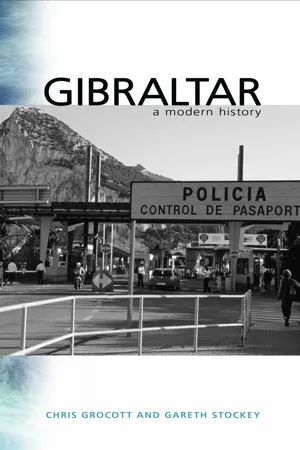
A timely and up-to-date history of a place and people embroiled in an enduring international dispute.
- English
- ePUB (mobile friendly)
- Available on iOS & Android
eBook - ePub
About this book
Trusted by 375,005 students
Access to over 1.5 million titles for a fair monthly price.
Study more efficiently using our study tools.
Information
1
Gibraltar as British Fortress, 1704–1783
Introduction
Without doubt, the period in the history of Gibraltar that has drawn the greatest attention from scholars from numerous countries, and across the past three centuries, has been the hundred years after the Spanish loss of the territory in 1704.1 There are a number of reasons for this. Many British writers were quickly enthused after 1704 by tales of martial success and bravery, as ‘their’ fortress successfully repulsed three sieges in the eighteenth century. Subsequent generations of British schoolchildren, and millions more English-language readers around the expanding Anglophone world, were taught to regard Gibraltar as the ultimate symbol of British courage, ingenuity, steadfastness and plucky resolve.2 The success and longevity of this popular image, combined with a propensity for English-language works on Gibraltar to be written by military and naval personnel, might thus account for a clear tendency to focus on this particular period. It is in this century, after all, that Gibraltar’s military history is best evidenced, and where the tale might appear to be one of unbroken success against overwhelming odds.
Spanish writers have been no less enthusiastic in focusing on this period, but for rather different reasons. It was in the eighteenth century that Spain ‘lost’ Gibraltar to Britain, when the terms of that cession were codified in Article X of the Treaty of Utrecht (1713), and when Spain was in its best position to reverse the outcome of Utrecht, whether through diplomacy or by force of arms.3 What reason, then, to focus on subsequent periods, when Spain has been unable or unwilling to do anything about its ‘Gibraltar problem’, when the proud (if unsuccessful) efforts of the eighteenth-century Spanish kings offer better reading? A second reason for the Spanish focus on the eighteenth century is the perceived British ‘breaches’ of the Treaty of Utrecht in the years after 1713. Given the centrality of that treaty, even to this day, to the respective Spanish and British claims to sovereignty of Gibraltar, its observance, or lack thereof, is clearly a subject of interest.4
The purpose of this chapter is not to disentangle the many competing narratives over this period in Gibraltar’s history, much less to weigh up their respective merits and flaws. Instead, amid the complexity and contingency of war, sieges, diplomatic manoeuvring, legalistic interpretation and confrontation, and three hundred years of polemic, we can identify three key developments in the century under review. First, the capture of Gibraltar in 1704, and its cession to Britain in 1713, created a distinctly new place, and one which provided the foundation for what we now know as ‘Gibraltar’. Secondly, the geographical confines of this ‘new’ Gibraltar, coupled with ongoing hostility with neighbouring Spain throughout the eighteenth century, dramatically altered Gibraltar’s purpose. Put simply, British Gibraltar in the eighteenth century was, to use Finlayson’s phrase, a place where ‘the fortress came first’.5 Thirdly, and crucial to present-day debates on the subject, this period marked the origins of a new people in the territory. None of these three developments was clearly predictable in 1704; and arguably, from certain standpoints, none of the three was desirable. It is the task of this chapter to outline how, by the end of the eighteenth century, the first two developments became unquestionable, and the third inevitable.
The Significance of 1704
On 4 August 1704, after a four-day assault, the Spanish authorities of the town and fortress of Gibraltar surrendered to an attacking force led by Prince George of Hesse-Darmstadt. The assault was just one part of a much wider European conflict to settle the question of who should succeed to the throne of Spain, following the death of Carlos II in 1700. Accordingly the war has been termed the War of Spanish Succession. Among the two thousand or so members of the attacking force could be found English, Dutch, Spanish and Catalan servicemen. When Prince George took possession of Gibraltar, he did so in the name of Archduke Charles of Austria, who was claiming the title of Carlos III of Spain. It was the Hapsburg standard of Charles that was raised in August 1704, in place of that of the Bourbon claimant, Philip of Anjou (or Philip V), and the document of surrender left no doubt that the territory had been surrendered to the Hapsburg claimant. The first three governors of the territory after 1704 – the first being Prince George himself – were appointed by the Archduke Charles and governed in his name. A series of powerful legends and images that have appeared in accounts of Gibraltar’s history since 1704 can therefore be dismissed as such. Gibraltar did not become ‘British’ as a result of the assault of 1704 – indeed, Britain would not exist as a nation-state until the Act of Union in 1707 – and tales of the Union Flag being raised upon the Rock after the battle must be regarded as apocryphal. By force of arms, control of the territory had passed from one putative Spanish king to another.
The events of 1704 certainly make for good reading, and doubtless they helped to lay the foundations of subsequent British sentiment regarding Gibraltar’s retention. At first sight, the speed of victory in the assault of 1704 was remarkable, and the successful defence of Gibraltar against a siege of combined French and Spanish forces that same winter (1704–5) admirable. Twice more in the eighteenth century Gibraltar would withstand prolonged sieges by Spanish, or Franco-Spanish, forces. The first took place in 1727 as part of a wider Anglo-Spanish war, and lasted for four months. The second – subsequently termed the ‘Great Siege’ by the British – took place between 1779 and 1783 as part of the War of American Independence, and lasted three years, seven months and twelve days. As we shall see, the failure of the latter only increased the popular perception in Britain, as time went on, that the original capture in 1704 had been remarkable. In truth, however, the events of 1704 tell us little about the creation of a ‘new’, British Gibraltar. To be sure, there is some evidence to suggest that English (then British) policy makers, both in London and on the spot in Gibraltar, were working to strengthen their hold on the territory in the immediate aftermath of 1704. Hills, for example, notes the steady decline in ceremonial gun salutes for Spanish feast days and monarchs’ birthdays, and a steady rise in those for similar British occasions.6 Of much greater significance is that the English Queen Anne declared Gibraltar a ‘Free Port’ in 1706. The economic and social consequences of this act will be discussed in more detail below, but we might note here the significance of an English monarch making decisions about a nominally ‘Spanish’ territory at this early stage. Nonetheless, despite certain signs of increased English/ British influence in the territory after 1704, it is unlikely that such developments took place as part of a preconceived plan to cement Queen Anne’s rule over Gibraltar. And while an increasingly vocal lobby was amassing in Britain, demanding that the territory be ‘retained’, such demands presupposed that the anti-Bourbon coalition would emerge victorious from the war, or at least in a position to dictate favourable terms – neither of which could be predicted with any certainty in these years. In addition, Britain had many other items on its ‘shopping list’ in the build-up to the eventual peace negotiations. Any claim to Gibraltar would have to be offset against other potential prizes, not to mention the diplomatic goals of Britain’s allies, and the opposing Bourbon alliance. In short, as interesting as the events of 1704 and its aftermath were, it was the peace of 1713 which laid the foundations for a ‘new’, British Gibraltar, and the ongoing dispute over its sovereignty ever since.
A ‘new’ Gibraltar – Place and Purpose
Article X of the Treaty of Utrecht (1713) passed sovereignty of Gibraltar from Spain to Britain ‘forever’. Both the terms of the treaty itself, and Spain’s continued unwillingness to accept the loss of Gibraltar had profound implications for this new British possession.
In the first instance, the treaty confirmed the territorial realities that had been seen ‘on the spot’ since August 1704; namely that ‘the full and entire propriety of the Town and Castle of Gibraltar, together with the port, harbour and fortifications thereunto belonging’ be ceded by the Spanish kingdom. This constituted most of the territory that is now referred to as ‘Gibraltar’, though as we shall see, even then the limits of this new territory were disputed. What was indisputable was that the narrow peninsula that made up this new British possession was politically severed from a much larger hinterland in the surrounding region of Spain. Writing decades later, the Spanish historian López de Ayala left vivid descriptions of the ‘greater Gibraltar’ that had existed before 1704:
The extensive district of Gibraltar continued to flourish, its productions, chiefly in wines and cattle, increasing with the population; its numerous valleys were better adapted for pasture than tillage, and corn was often imported for consumption; on the other hand, its hills produced fine wines in great abundance, which were held in estimation in Italy, France and England... the vast quantity of wild olive trees... indicates a soil well adapted to so valuable a production in this fertile district.7
In place of this ‘greater Gibraltar’, Britain held a much smaller and economically unpromising territory. The Spanish region surrounding the Rock – the Campo de Gibraltar – was largely isolated from its previous urban centre for almost a century, as we shall see in chapter 4.
It did not take long for disputes to break out over the territorial settlement of Article X. British reading of the treaty was less than literal, especially for those governors charged with preparing the defence of Gibraltar. A working assumption quickly developed, for example, that the ‘fortifications’ ceded under Utrecht included positions necessary for the defence of the fortress. Accordingly, less than six months after the signing of the treaty, Gibraltar’s acting-governor, Colonel Ralph Congreve, had ordered his troops to occupy defensive positions on both sides of the isthmus to the north of the Rock: at Devil’s Tower on the eastern side and at a windmill on the western. The Spanish position, both then and since, was that the treaty did not cede any territory beyond the walls of the fortress itself, and consequently protests were made at both a local and a national level. A compromise was eventually reached, whereby both sides agreed not to station troops as far as these two positions, though both were free to pursue deserters to those points. In effect, this was the first move towards the modus vivendi of a ‘neutral ground’ between the two lines. Nevertheless, the question of sovereignty over the isthmus has remained a principal bone of contention between Britain and Spain to the present day.
Scholars, diplomats and lawyers have argued ever since over the territorial meaning of Utrecht.8 After 1713 matters were not helped by further British insistence that the terms of the treaty permitted British troops to occupy land to a distance of a cannon shot from the fortress walls. Potentially, this would allow the territorial boundaries of ‘Gibraltar’ to expand with each improvement in artillery technology; patently ridiculous to today’s reader, in the modern age of intercontinental ballistic missiles, but perhaps less so in the early eighteenth-century. This British ‘reading’ of Utrecht was nonetheless maintained until well into the twentieth century, and justified a series of contentious encroachments beyond the original limits of Gibraltar as understood in 1713. The question of territorial waters has been similarly problematic, while matters have been further complicated since the early twentieth century by the question of airspace, and the physical expansion of Gibraltar by means of extensive land reclamation in the bay. In effect, these encroachments could only take place, whatever one’s reading of the original treaty, through the principle of ‘might is right’. Had any of the Spanish attempts to recover Gibraltar in the eighteenth century been successful, nobody would be arguing over the terms of a treaty from centuries ago. As we shall see in chapter 4, there was no question of Spain posing a serious challenge to Britain’s hold of Gibraltar in the nineteenth century, and as we shall see in chapter 5, a range of new arguments could be deployed to defend the status quo by the second half of the twentieth century.
The territorial boundaries of a new Gibraltar were thus set by the terms of Utrecht in 1713, albeit open to periodic, and limited, encroachment beyond the land originally occupied. Gibraltar the place was to move in a different political direction by virtue of its occupation by Britain, with different laws and administration certainly, but concurrently, or so might be expected, with different cultural and social values from those of its Spanish neighbour to the north. At the same time, the political and economic partition that created Gibraltar the place had dramatic implications for the purpose of this new British possession.
During the War of Spanish Succession, Gibraltar’s purpose was purely military. Prince George had immediately ordered the repair and strengthening of its defences after the assault, and as with so many governors after him, had called for reinforcements to be sent. This proved to be wise, since a Franco-Spanish force of several thousand was laying siege to Gibraltar within weeks; a siege that lasted several months, but which the allied defenders ultimately repulsed. Prince George saw Gibraltar not only as a defensible fortress in itself, but as a potential base from which to launch a major allied offensive into the Spanish interior. In the event, he could not convince the allied military hierarchy in this regard, particularly the English, who had been charged with meeting Gibraltar’s need for supplies and reinforcement. The fear of English/ British encroachment through Gibraltar remained powerful for successive Spanish governments after 1704, however.
When the war ended in 1713, there was little prospect that British Gibraltar’s purpose would alter. Spanish unhappiness over the loss of Gibraltar was palpable. It was evidenced not only through immediate diplomatic exchanges between Madrid and London, but also at a local level through the stationing of significant Spanish forces in the ‘Campo’. At all times, therefore, British military planners, and indeed commanders on the Rock itself, were forced to be mindful of the possibility of attack. The new possession demanded a substantial garrison, and, if Britain was serious about retaining Gibraltar, continued improvements to the fortifications. This was not cheap, and as we shall see, the cost of retaining the Rock was a constant source of dismay for those who advocated a new arrangement with Spain. Wider pressures thus ensured that Gibraltar, in these early years of its occupation by Britain, could be little other...
Table of contents
- Cover
- Title Page
- Copyright
- Contents
- Acknowledgements
- Map
- Introduction
- 1: Gibraltar as British Fortress, 1704–1783
- 2: Trading Outpost and Naval Base, 1783–1906
- 3: Emergence of a Civilian Community, c.1865–1954
- 4: Relations with Spain, 1704–1969
- 5: Gibraltar and the Gibraltarians, 1954 to the present
- Conclusion
- Notes
- Bibliographical note
- Appendix: Article X of the Treaty of Utrecht (1713)
Frequently asked questions
Yes, you can cancel anytime from the Subscription tab in your account settings on the Perlego website. Your subscription will stay active until the end of your current billing period. Learn how to cancel your subscription
No, books cannot be downloaded as external files, such as PDFs, for use outside of Perlego. However, you can download books within the Perlego app for offline reading on mobile or tablet. Learn how to download books offline
Perlego offers two plans: Essential and Complete
- Essential is ideal for learners and professionals who enjoy exploring a wide range of subjects. Access the Essential Library with 800,000+ trusted titles and best-sellers across business, personal growth, and the humanities. Includes unlimited reading time and Standard Read Aloud voice.
- Complete: Perfect for advanced learners and researchers needing full, unrestricted access. Unlock 1.5M+ books across hundreds of subjects, including academic and specialized titles. The Complete Plan also includes advanced features like Premium Read Aloud and Research Assistant.
We are an online textbook subscription service, where you can get access to an entire online library for less than the price of a single book per month. With over 1.5 million books across 990+ topics, we’ve got you covered! Learn about our mission
Look out for the read-aloud symbol on your next book to see if you can listen to it. The read-aloud tool reads text aloud for you, highlighting the text as it is being read. You can pause it, speed it up and slow it down. Learn more about Read Aloud
Yes! You can use the Perlego app on both iOS and Android devices to read anytime, anywhere — even offline. Perfect for commutes or when you’re on the go.
Please note we cannot support devices running on iOS 13 and Android 7 or earlier. Learn more about using the app
Please note we cannot support devices running on iOS 13 and Android 7 or earlier. Learn more about using the app
Yes, you can access Gibraltar by Gareth Stockey,Chris Grocott in PDF and/or ePUB format, as well as other popular books in History & European History. We have over 1.5 million books available in our catalogue for you to explore.