Until now, no book has covered all of Cold War air combat in the words of the men who waged it. In I Always Wanted to Fly, retired United States Air Force Colonel Wolfgang W. E. Samuel has gathered first-person memories from heroes of the cockpits and airstrips.
Battling in dogfights when jets were novelties, saving lives in grueling airlifts, or flying dangerous reconnaissance missions deep into Soviet and Chinese airspace, these flyers waged America's longest and most secretively conducted air war.
Many of the pilots Samuel interviewed invoke the same sentiment when asked why they risked their lives in the air—"I always wanted to fly." While young, they were inspired by barnstormers, by World War I fighter legends, by the legendary Charles Lindbergh, and often just by seeing airplanes flying overhead. With the advent of World War II, many of these dreamers found themselves in cockpits soon after high school. Of those who survived World War II, many chose to continue following their dream, flying the Berlin Airlift, stopping the North Korean army during the "forgotten war" in Korea, and fighting in the Vietnam War.
Told in personal narratives and reminiscences, I Always Wanted to Fly renders views from pilots' seats and flight decks during every air combat flashpoint from 1945–1968. Drawn from long exposure to the immense stress of warfare, the stories these warriors share are both heroic and historic.
The author, a veteran of many secret reconnaissance missions, evokes individuals and scenes with authority and grace. He provides clear, concise historical context for each airman's memories. In I Always Wanted to Fly he has produced both a thrilling and inspirational acknowledgment of personal heroism and a valuable addition to our documentation of the Cold War.
- 384 pages
- English
- ePUB (mobile friendly)
- Available on iOS & Android
eBook - ePub
About this book
Information
Publisher
University Press of MississippiYear
2009Print ISBN
9781617031700
9781578063994
eBook ISBN
9781628469127
Part 1
The Berlin Airlift, 1948
You must remember that the military people [in Washington] were thinking about this in terms of military decisions. And, militarily speaking, we were in no position to hold our own against the Russians in Germany. They had twenty divisions. Including the British and French, we could only muster three.
Lucius D. Clay
We frequently flew two to three missions a day. Our greatest enemy was fatigue and boredom, flying day after day, night after night, often in grueling weather conditions.
Sam Myers, Berlin Airlift pilot
On July 16, 1945, President Harry S. Truman decided to take a look around Berlin when Stalin did not show as scheduled for the Potsdam Conference because of his slight heart attack, a carefully kept secret at the time. “I took advantage of this unscheduled delay,” wrote President Truman in his memoir. “About halfway to the city we found the entire American 2nd Armored Division deployed along one side of the highway for my inspection. In an open half-track, I passed down the long line of men and vehicles, which comprised what was at that time the largest armored division in the world. Men and tanks were arrayed down the highway in front of me as far as the eye could see. The line was so long it took twenty-two minutes to ride from the beginning to the end of it” (1:341).
In 1948 there was no 2nd Armored Division to check Soviet ambitions. There was no meaningful American combat power west of the Elbe River. American ground forces in Germany were constabulatory and occupational in nature, neither equipped nor organized to fight the three hundred thousand–man Red Army to the east. American air-power was equally weak. Nothing remained of the once mighty Eighth Air Force. Air Force commander Lieutenant General Curtis E. LeMay characterized the situation: “At a cursory glance it looked like USAFE would be stupid to get mixed up in anything bigger than a cat-fight at a pet show. We had one Fighter group, and some transports, and some radar people, and that was about the story” (LeMay 411).
In a mad disarmament scramble soon after World War II, the U.S. armed forces declined from 12 million men to a mere 1.5 million. Those remaining on active duty in 1947 were not the hardened combat veterans of 1945. Military spending dropped from ninety billion dollars to eleven billion dollars. Although many people saw the need for rebuilding the U.S. military, it was not a popular political issue. Under the decisive leadership of President Truman, however, supported by a remarkably capable team of men including Dean Acheson, Clark Clifford, George Kennan, and General George Marshall, the nation soon reorganized its military and put in place a viable postwar foreign policy. The National Security Act of 1947 passed Congress in July, establishing a much-needed Department of Defense, headed by the secretary of defense with three civilian service secretaries. President Truman’s foreign policy was surprisingly proactive and showed signs of success. The Truman Doctrine was enunciated as a direct response to Soviet pressure on Greece and Turkey. Aid was made available to these and other nations to resist communist encroachment. And what eventually became known as the Marshall Plan was set in motion in June 1947, when Secretary of State Marshall outlined a European recovery program in a speech at Harvard University.
But a new U.S. defense organization and aid to nations in need could not stop determined aggression by a militarily powerful foe. In February 1948 Czechoslovakia came under Soviet control through a communist-inspired coup. The political and military stage was set for an attempt to bring a vulnerable Berlin under Soviet control as well. With Berlin, Stalin could reasonably expect much of Western Europe to follow and fall under the Red Army’s “protective” umbrella. American military weakness was readily apparent, and communist political movements in France and Italy were strong and seemingly on the verge of ascending to power. Soviet planners must have reasoned that the British and Americans might be able to supply their own garrisons in Berlin by air but would not be able to supply Berlin’s civilian population. An airlift supplying even the minimum needs of a city of more than two million inhabitants was too big a task to even contemplate. The Soviets knew for sure that they could not do it. A similar attempt by the Luftwaffe to supply the much smaller 6th Army at Stalingrad had failed miserably. Another strong factor in Stalin’s favor appeared to be the suffering of the vanquished German population, which was cold, hungry, and living mostly in ruins and makeshift buildings, with threadbare clothing and without hope for a better future. Stalin knew that such suffering, combined with the absence of hope, made people pliable tools for exploitation. The stage clearly was set for a Soviet blockade of Berlin.
In the spring of 1948 Stalin must have thought that the moment was almost right to oust the Allies from Berlin, although winter would have been a better time to begin such an undertaking. The American and British initiative to revive West Germany’s stagnant economy by introducing a new currency forced Stalin’s hand. On the positive side of the ledger, both the United States and Britain, although militarily weak, had experienced and resolute political and military leaders at their helms. The principal players in the unfolding Berlin drama were:
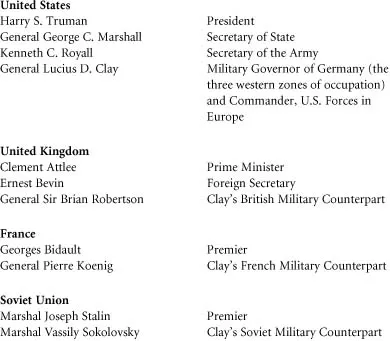
To some, the Berlin Airlift may appear to be an interesting but minor operation, overshadowed by subsequent Cold War events. It was anything but. The stakes were exceedingly high for the West—a continued Allied presence in Berlin, the survival of its people, and the political survival of Western Europe in the face of open aggression should the Soviets succeed. Events began to look a lot like 1937. Because of the West’s military weakness, some senior politicians and some senior military officers as well publicly expressed their fears that American and British military measures would cause the Soviets to react militarily. Would it not be better to let them have Berlin? was a question asked aloud in high places in Washington. Truman, Bevin, and Clay remained unimpressed, however, and were determined not to take their counsel from the barrel of a gun. From January 1948 onward, events moved rapidly toward confrontation.
January 1948—Soviet soldiers stopped a British military train en route to Hamburg from Berlin, holding the train for eleven hours. Soviet harassment of Allied military train traffic became a recurring experience.
February 1948—The communists staged a coup d’état in Czechoslovakia, adding that nation to the growing list of Soviet satellites.
March 1948—Senator Henry Cabot Lodge wrote to General Clay, “Is it safe for Americans to remain in Berlin?” Clay optimistically replied, “I believe American personnel are as secure here as they would be at home” (Smith 466). The members of the ongoing Six-Power Conference in London (the United States, United Kingdom, France, and the Benelux countries) preliminarily agreed to the formation of a West German government and for its association in the European Recovery Program (the Marshall Plan). The Western shift away from viewing Germany as an enemy had begun. On March 20 Marshal Sokolovsky walked out of the Allied Control Council in Berlin, short-circuiting the council’s attempt to formulate quadripartite policy for Germany. On March 31 the Soviets—abrogating earlier agreements—announced a new set of traffic regulations for Berlin. There were to be no freight shipments from Berlin to the West without Soviet approval, and all military passengers and their baggage would be inspected. Generals Clay and Robertson responded by using airlift resources under their control to start what later became known as the Baby Airlift. The EATS pilots would be the first to fly supplies into an increasingly beleaguered Berlin.
April 1948—The U.S. Army prepared contingency plans to evacuate Berlin. On April 2 Army Secretary Royall suggested the evacuation of American dependents from Berlin. And on April 10, in a teleconference with General Clay, General of the Army Omar N. Bradley expressed his belief that Berlin was untenable and that the United States should withdraw to minimize the loss of prestige. Clay viewed such proposals as alarmist and politically ruinous: “If we had started moving our dependents out we would never have had the people of Berlin stand firm” (Smith 474). Clay responded to Bradley that the United States should stay in Berlin unless driven out by force.
May 1948—British Foreign Secretary Bevin, remembering Munich, urged a steady course to the British Parliament. In a foreign policy address to the House of Commons he declared, “We are in Berlin as of right and it is our intention to stay there.” (Smith 477).
June 1948—On June 10 the Soviets attempted to remove locomotives and rolling stock from the American sector of Berlin. Clay posted guards, and the Soviets backed off. The following day the Soviets halted rail traffic into Berlin for two days. On June 16 the Soviets, anticipating Western currency reform, walked out of the quadripartite government of Berlin, the Kommandatura. Both the Allied Control Council and the Kommandatura were now defunct: no medium remained for the Soviets and the Western powers to interact. Berlin was about to be split both economically and politically. On June 20 the three Western occupying powers announced currency reform for western Germany. The deutsche mark replaced the hopelessly inflated reichsmark. Currency reform now divided Germany economically and forced the Soviets’ hand. On June 22 Marshal Sokolovsky announced that as of June 26 the new Soviet-issued reichsmark would be the only valid currency in Berlin. In response, the Western allies promptly introduced the deutsche mark in the western sectors. Firmly convinced that the Soviets were bluffing, General Clay directed his military deputy at Headquarters, U.S. Army Europe, Lieutenant General Clarence Huebner, to put together a regimental combat team of about six thousand men, including armor, artillery, and bridging equipment, to proceed on the autobahn from Helmstedt to Berlin. General LeMay, Clay’s air commander, was directed to provide air support. When acquainted with Clay’s proposal, however, President Truman rejected the idea outright, and usually supportive British friends also were not enchanted with Clay’s approach. The idea was finally dropped in July for lack of political support (Smith 495).
On June 24 the Soviets cut the last rail links to Berlin as well as electricity to the city’s western sectors. Within two days, highways and canals to Berlin were blocked. British Secretary Bevin was annoyed with developments and sought a practical solution. He asked Robertson if Berlin could be supplied by air and received a qualified “yes” for an answer. On June 25 Robertson acquainted Clay with the airlift proposal that Air Commodore Reginald “Rex” Waite, one of Robertson’s staff officers, had worked out and that he had previously presented to Bevin. In Robertson’s presence, Clay called LeMay at his headquarters in Wiesbaden. In Mission with LeMay, the General recalled the conversation:
So, I had only been on the job for six or seven months when there came that all-important telephone call from General Lucius B. Clay . . . could we haul some coal up to Berlin?
“Sure. We can haul anything. How much coal do you want us to haul?”
“All you can haul.” (LeMay 415)
Clay recalled telling LeMay, “I want you to take every airplane you have and make it available for the movement of coal and food to Berlin.” Furthermore, according to Clay, “I never asked permission or approval to begin the airlift. I asked permission to go in on the ground with the combat team, because if we were stopped we’d have to start shooting. . . . But we didn’t have to start fighting to get through in the air, so I never asked permission” (Smith 500, 502–3).
On June 26 the Berlin Airlift formally began, and the first C-47 aircraft delivered its cargo to Berlin’s Tempelhof Airport. In Britain, Secretary Bevin told the press, “His Majesty’s Government intends to stay in Berlin come what may.” In a message to General Marshall, Bevin requested the immediate dispatch of American B-29 bombers to be based in Britain (Smith 507). And on June 28 President Truman ordered a full-scale airlift to supply West Berlin. Two squadrons of B-29s, thought to be nuclear capable (they were not), were dispatched to Germany. One squadron was already at Fürstenfeldbruck Air Base near Munich on an unrelated training exercise. Other groups of B-29s were ordered to bases in England, including the bomb group that had dropped the two atomic bombs on Japan. Finally, Undersecretary of State Robert A. Lovett again mentioned the possibility of withdrawal from Berlin to President Truman, who replied, “We stay in Berlin, period” (Smith 508).
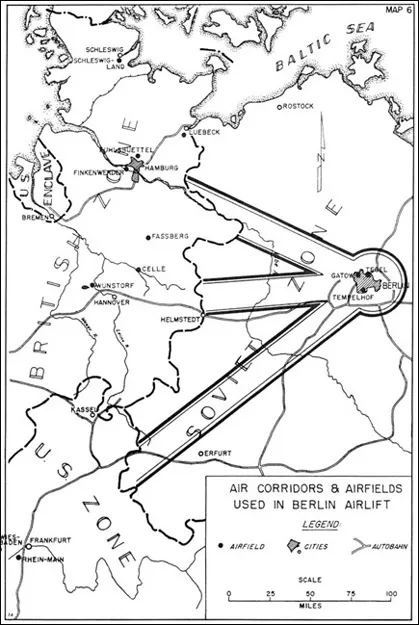
Air corridors and airfields used during the 1948–49 Berlin Airlift. Frederiksen 141.
July 1948—High-level doubt about the airlift persisted in Washington. Assistant Secretary of the Air Force for Matériel Cornelius V. Whitney told the National Security Council that “the Air Staff was firmly convinced that the airlift was doomed to failure.” Lovett continued to dismiss the airlift as unsatisfactory and a temporary expedient, and Secretary Royall predicted its demise that coming winter. Truman’s response to his doubting staff was to expand the airlift as quickly as possible and to commit the required number of C-54 transports to ensure success. In London, Secretary Bevin ran into similar pessimism when General Robertson, who had proposed the airlift as an option, suddenly began to doubt its efficacy. Bevin’s expressed view was that he would rather hold Berlin to the bitter end and be driven out by force than give way voluntarily (Smith 514).
May 1949—Truman, Bevin, and Clay’s unshakable commitment not to surrender Berlin to Soviet blackmail resonated with the air crews who had to make the airlift work. The crews flew their hearts out and made the naysayers eat their words, and on May 12, 1949, the Soviets formally ended the blockade. Three days later, General Clay, who was greatly respected and admired by Germans, returned to the United States and retired from the army. General Clay not only saved Berlin with his vision and steadfastness but in the process of doing so successfully transitioned Germany from an occupied enemy country to one that would one day rejoin the free nations of the world.
August 1949—On August 24 the North Atlantic Treaty went into effect, and the North Atlantic Treaty Organization (NATO) was born. NATO’s creation was a direct result of the Soviet-imposed blockade of Berlin and would in time contribute to the demise of the Soviet Union.
September 1949—The Federal Republic of Germany was established. Operation Vittles, the American name for the Berlin Airlift (the British called it Operation Plain Fare) officially ended on September 30.
The airlift’s achievements are described in many publications. One of the most authoritative, Berlin Airlift A USAFE Summary, states that American and British aircraft flew 2.3 million tons of cargo into Berlin on 277,569 flights and that American aircraft sustained seventy major accidents. General Clay summed up the airlift’s accomplishments: “If we had withdrawn from Berlin, which we would have had to do without the airlift, I don’t think we could have stayed in Europe. I doubt if there would have been a Marshall Plan. I doubt if there would have been a NATO. How can you prove these things? I don’t know. But I’m convinced that if we had left Berlin, we would never have had the confidence of the West Germans, or of any of the Western Europeans. I think that if we had pulled out and the Russians had moved in, we would have lost confidence in ourselves. If they had succeeded in that, it would have started a whole chain of events. The airlift prevented them from doing that” (Smith 505).
The C-47 and C-54 flyers who made the airlift a success were a hodgepodge of men with varied skills and experience levels. The only thing they had in common was that they were pilots or flight engineers. The lucky ones received C-54 training in Montana’s blue-sky country; the others learned in the often treacherous German skies. For at least six months of the year, Central European flying meant battling freezing rain, fog, violent thunderstorms, and frequent marginal visibility. Landings at Tempelhof Airport with a maximum load onto short runways were more closely comparable to aircraft-carrier landings than to those on the up to ten thousand feet of concrete common at American air bases. The airlift was a “come as you are” operation, with no plans or procedures for handling the massive flow of diverse aircraft types into the restricted geography of West Berlin. In the early days, some people referred to the airlift as a cowboy operation, reflecting the chaos in the sky. The pilots had to learn to fly in narrow air corridors in all kinds of weather, making straight-in-one-try-only approaches into fog-shrouded fields. There were no sophisticated landing aids, just a world of ball and needle—compass, altimeter, attitude and airspeed indicators. That there were not more accidents is a tribute to the adaptive skills of the American and British flyers. Skills or not, they could not have done the job without ground control approach (GCA) radar, rudimentary radars by contemporary standards. The men who stared into the flickering green tubes hour after hour, as well as the pilots who had to put their trust in the GCA controllers’ judgment, made GCA landings in zero visibility the system of the future.
The airplanes used in the airlift were severely punished in the “heavy load– frequent landing” environment. Maintenance focused on keeping the props turning. Fatigue combined with boredom became a real problem for many, as echoed in the stories that follow. The Berlin Airlift flyers conquered their unique challenges with skill and imagination. They did not disappoint the leadership that put its trust in them, nor the American and British people, or the people of Berlin.
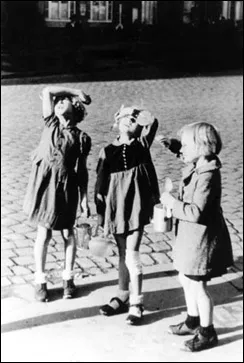
German schoolgirls in Celle, soup pails in hand, watch a coal-laden C-54 on its way to Berlin, 1949. C. Vaughn.
Chapter 1
Men of the Airlift
One of the greatest feats of flying in history.
Stephen E. Ambrose, historian and author
There wasn’t one pilot who thought it wasn’t going to work. Maybe there were some higher up in command who thought we weren’t going to cut it, but the pilots thought what they were doing was going to succeed.
Joe Laufer, Berlin Airlift pilot
Colonel Howard S. “Sam” Myers Jr.
Sam became interested in flying early in life. His father was a World War I navy aviator who flew a twin-engine Curtis NC-4 seaplane on antisubmarine patrol out of Queenstown, Ireland. “They would see the submarine out there, pick up a bomb from the cockpit, and lean over the side,” said Sam, with pride in his voice as he spoke of his father’s experiences during World War I. “When they got to the release point, they dropped it.” His father’s stories fascinated Sam, and there was little doubt in his mind that once he grew up he would fly airplanes. “I was born in Boston, Massachusetts, in 1923, but I grew up in Virginia Beach, Virginia. In 1943, at age nineteen, I was called to active duty. I graduated from twin-engine school at Lubbock, Texas, the following year. Then I was sent to Tarrant Field, now Carswell Air Reserve Base, for B-24 transition training and then on to March Field, in Riverside, California, where I made my home after retiring from the air force. I was getting my crew ready to go to the Pacific. But in August of ’45 they dropped the A-bomb. The war ended, and everything came to a halt. I opted to stay in the air force and was transferred to Bremen, Germany. I arrived in Bremen in August 1946 and was assigned to EATS, the European Air Transport Service, flying C-47 and C-45 aircraft. EATS was formed to provide the European theater commander with airlift for his far-flung troops from the United Kingdom to Turkey. I flew embassy runs and diplomatic missions throughout Europe, northern Africa, and the Middle East and made ammunition runs for the Gree...
Table of contents
- Cover Page
- Title Page
- Copyright Page
- Contents
- Foreword
- Preface and Acknowledgments
- Part 1: The Berlin Airlift, 1948
- Part 2: Korea, 1950
- Part 3: Strategic Reconnaissance
- Part 4: Vietnam, 1965
- The Magic of Flying: Concluding Thoughts
- Glossary
- Bibliography
- Interviews, Letters, and Tapes
- Index
Trusted by 375,005 students
Access to over 1.5 million titles for a fair monthly price.
Study more efficiently using our study tools.
Frequently asked questions
Yes, you can cancel anytime from the Subscription tab in your account settings on the Perlego website. Your subscription will stay active until the end of your current billing period. Learn how to cancel your subscription
No, books cannot be downloaded as external files, such as PDFs, for use outside of Perlego. However, you can download books within the Perlego app for offline reading on mobile or tablet. Learn how to download books offline
Perlego offers two plans: Essential and Complete
- Essential is ideal for learners and professionals who enjoy exploring a wide range of subjects. Access the Essential Library with 800,000+ trusted titles and best-sellers across business, personal growth, and the humanities. Includes unlimited reading time and Standard Read Aloud voice.
- Complete: Perfect for advanced learners and researchers needing full, unrestricted access. Unlock 1.5M+ books across hundreds of subjects, including academic and specialized titles. The Complete Plan also includes advanced features like Premium Read Aloud and Research Assistant.
We are an online textbook subscription service, where you can get access to an entire online library for less than the price of a single book per month. With over 1.5 million books across 990+ topics, we’ve got you covered! Learn about our mission
Look out for the read-aloud symbol on your next book to see if you can listen to it. The read-aloud tool reads text aloud for you, highlighting the text as it is being read. You can pause it, speed it up and slow it down. Learn more about Read Aloud
Yes! You can use the Perlego app on both iOS and Android devices to read anytime, anywhere — even offline. Perfect for commutes or when you’re on the go.
Please note we cannot support devices running on iOS 13 and Android 7 or earlier. Learn more about using the app
Please note we cannot support devices running on iOS 13 and Android 7 or earlier. Learn more about using the app
Yes, you can access I Always Wanted to Fly by Wolfgang W. E. Samuel in PDF and/or ePUB format, as well as other popular books in History & Military Biographies. We have over 1.5 million books available in our catalogue for you to explore.