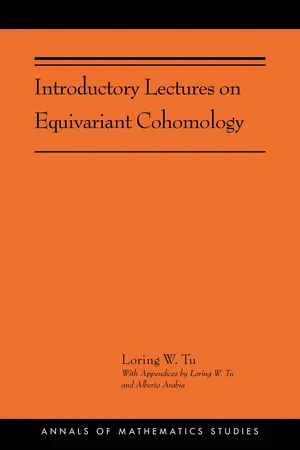
This book gives a clear introductory account of equivariant cohomology, a central topic in algebraic topology. Equivariant cohomology is concerned with the algebraic topology of spaces with a group action, or in other words, with symmetries of spaces. First defined in the 1950s, it has been introduced into K-theory and algebraic geometry, but it is in algebraic topology that the concepts are the most transparent and the proofs are the simplest. One of the most useful applications of equivariant cohomology is the equivariant localization theorem of Atiyah-Bott and Berline-Vergne, which converts the integral of an equivariant differential form into a finite sum over the fixed point set of the group action, providing a powerful tool for computing integrals over a manifold. Because integrals and symmetries are ubiquitous, equivariant cohomology has found applications in diverse areas of mathematics and physics.
Assuming readers have taken one semester of manifold theory and a year of algebraic topology, Loring Tu begins with the topological construction of equivariant cohomology, then develops the theory for smooth manifolds with the aid of differential forms. To keep the exposition simple, the equivariant localization theorem is proven only for a circle action. An appendix gives a proof of the equivariant de Rham theorem, demonstrating that equivariant cohomology can be computed using equivariant differential forms. Examples and calculations illustrate new concepts. Exercises include hints or solutions, making this book suitable for self-study.
- 338 pages
- English
- PDF
- Available on iOS & Android
eBook - PDF
Introductory Lectures on Equivariant Cohomology
About this book
Information
Publisher
Princeton University PressYear
2020Print ISBN
9780691191751
9780691191744
eBook ISBN
9780691197487
Table of contents
- Cover
- Title
- Copyright
- Dedication
- Contents
- List of Figures
- Preface
- Acknowledgments
- I Equivariant Cohomology in the Continuous Category
- II Differential Geometry of a Principal Bundle
- III The Cartan Model
- IV Borel Localization
- V The Equivariant Localization Formula
- Appendices
- Hints and Solutions to Selected End-of-Section Problems
- List of Notations
- Bibliography
- Index
Trusted by 375,005 students
Access to over 1.5 million titles for a fair monthly price.
Study more efficiently using our study tools.
Frequently asked questions
Yes, you can cancel anytime from the Subscription tab in your account settings on the Perlego website. Your subscription will stay active until the end of your current billing period. Learn how to cancel your subscription
No, books cannot be downloaded as external files, such as PDFs, for use outside of Perlego. However, you can download books within the Perlego app for offline reading on mobile or tablet. Learn how to download books offline
Perlego offers two plans: Essential and Complete
- Essential is ideal for learners and professionals who enjoy exploring a wide range of subjects. Access the Essential Library with 800,000+ trusted titles and best-sellers across business, personal growth, and the humanities. Includes unlimited reading time and Standard Read Aloud voice.
- Complete: Perfect for advanced learners and researchers needing full, unrestricted access. Unlock 1.5M+ books across hundreds of subjects, including academic and specialized titles. The Complete Plan also includes advanced features like Premium Read Aloud and Research Assistant.
We are an online textbook subscription service, where you can get access to an entire online library for less than the price of a single book per month. With over 1.5 million books across 990+ topics, we’ve got you covered! Learn about our mission
Look out for the read-aloud symbol on your next book to see if you can listen to it. The read-aloud tool reads text aloud for you, highlighting the text as it is being read. You can pause it, speed it up and slow it down. Learn more about Read Aloud
Yes! You can use the Perlego app on both iOS and Android devices to read anytime, anywhere — even offline. Perfect for commutes or when you’re on the go.
Please note we cannot support devices running on iOS 13 and Android 7 or earlier. Learn more about using the app
Please note we cannot support devices running on iOS 13 and Android 7 or earlier. Learn more about using the app
Yes, you can access Introductory Lectures on Equivariant Cohomology by Loring W. Tu in PDF and/or ePUB format, as well as other popular books in Mathematics & Algebra. We have over 1.5 million books available in our catalogue for you to explore.