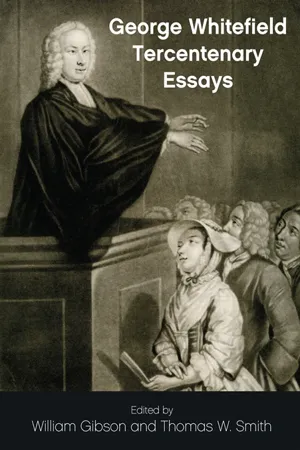
This special issue of The Journal of Religious History, Literature and Culture comprises some of the papers delivered at the 'George Whitefield after Three Hundred Years' International Conference held in June 2014 at Pembroke College, Oxford, commemorating the tercentenary of George Whitefield's birth in 1714.
The Revd George Whitefield (1714–70) was a very important early Methodist leader, clergyman and writer, who has not attracted as much scholarly attention as John and Charles Wesley. This interdisciplinary volume contains articles on 'George Whitefield and the Secession Movement's Reaction to the Cambuslang Revival' by Kenneth B. E. Roxburgh; 'George Whitefield and Anti-Methodist Allegations of Popery, c.1738–c.1750' by Simon Lewis; 'Latitudinarian responses to Whitefield, c.1740–1790' by G. M. Ditchfield; 'Preachers, prints and portraits: Methodists and image in Georgian Britain' by Peter S. Forsaith, with eight attractive images; 'George Whitefield's Journals: A Publishing Phenomenon' by Digby James; and 'George Whitefield's Reception in Twentieth-Century German-Speaking Theology' by Maximilian J. Hölzl.
- 144 pages
- English
- ePUB (mobile friendly)
- Available on iOS & Android
eBook - ePub
About this book
Information
Topic
Theology & ReligionSubtopic
History of ReligionLATITUDINARIAN RESPONSES TO WHITEFIELD, c. 1740–901
Several recent publications on the Georgian Church, prominent among them Professor Gibson’s study sub-titled ‘Unity and Accord’, have emphasised the flexibility, the acceptance of a substantial measure of diversity of opinion and practice, and a spirit of goodwill within an institution which remained fundamental to eighteenth-century society.2 It is a powerful argument, and if one needed an example in its support which is particularly relevant to this article, it would be the harmonious mastership of the famously evangelical Magdalene College, Cambridge, exercised by the heterodox Peter Peckard between 1781 and 1797. Yet even within this optimistic scheme, the followers of George Whitefield and the Latitudinarian element within the Church of England have the appearance of opposites, regarding each other with a suspicion which frequently translated into outright antagonism. This should not occasion surprise. The contrast between the Calvinist doctrines and the histrionic, theatrical, and allegedly manipulative manner in which Whitefield and his followers preached them, and the calm rationality of the Latitudinarian Churchmen of the middle and later eighteenth century could hardly have been more marked. That there were fundamental differences between Whitefield and his followers on the one hand, and the successors to Archbishop John Tillotson on the other, over such central issues as grace, justification and works, is well known. Yet although Latitudinarian responses to Whitefield were frequently characterised by suspicion, this article will suggest that this was by no means universally, or consistently, so. Latitudinarians, too, feared that the Reformation had not gone far enough, and that its existing achievements were in danger; they, too, insisted upon the sufficiency of scripture and its primacy over the authority of the Church Fathers and human formularies as the essential guide to belief and action. They shared some of the anti-Catholic sentiments of Calvinistic Methodists, and suspicions of popery led them to criticise any moves towards what they took to be ‘sacerdotalism’ in the Church of England. The hostility which early Methodism encountered from the Anglican hierarchy, moreover, nurtured a common suspicion of prelacy. With their suspicions of the post-1760 regime in Church and state, moreover, many Latitudinarians found themselves to be in broad agreement with Whitefield’s pro-colonial utterances as Britain’s relations with its North American colonies deteriorated in the 1760s.
Of course, Latitudinarians were not alone in their attacks on the solifidianism of Calvinistic Evangelicals. High Churchmen, too, emphasised the importance of works. For example, in one of his last works, Of justification by faith and works. A dialogue between a Methodist and a Churchman, William Law condemned Calvinist teaching of faith without works, and the double decree of election and reprobation.3 George Horne’s sermon at Oxford in 1761, entitled Works wrought through faith a condition of our justification, attacked both Whitefield and Wesley as dangerous, deluded antinomians and heretics, although Horne reserved his sharpest shafts for Calvinistic Methodism, fearing that ‘Antinomianism is again to be rampant among us’ and attributing its reappearance to the ‘latest and lowest of the modern sectaries’ who derived their doctrines ‘at second or third hand from the lake of Geneva’.4 And indeed the charge of antinomianism was frequently used by critics of early Methodism in an indiscriminate, blunderbuss-like, manner against Wesley, as well as Whitefield, although the latter was by far the most vulnerable to the allegation, especially as most of the early evangelical clergymen were Calvinists (albeit of the ‘moderate’, rather than the ‘high’ or ‘hyper’ kind) and became for that reason a more frequent target.5 But between High Churchmen and Evangelicalism there was also some affinity, in terms of individual asceticism and piety, the need for self-disciplined and regular devotions, and a detestation of the type of post-1714 materialist Whiggish domination of the Church hierarchy personified by Benjamin Hoadly. Furthermore, as John Walsh has shown, there were many examples of personal and family movements between the two.6 But such was hardly the case – at least in these terms – between Latitudinarians and Evangelicalism, and explanations of the Revival which centred upon a complacent and neglectful Latitudinarian mentality in the established Church carried for many years a near-orthodox status, not least among evangelical historians.
I
Nonetheless, Latitudinarian responses to Whitefield were characterised by hostility or at least by critical scrutiny, in doctrinal, disciplinary and pastoral terms. The term ‘Latitudinarian’ itself, in evangelical eyes, could carry derogatory implications. When defining a ‘catholic spirit’ of eirenicism which involved no compromise of one’s own theological convictions while remaining open to contrary arguments, John Wesley carefully distinguished between it and Latitudinarianism. He identified a ‘speculative Latitudinarianism’ which he saw as ‘an Indifference to all Opinions. This is the Spawn of Hell, not the Offspring of Heaven’. At the same time he identified a ‘practical Latitudinarianism’, which amounted to ‘Indifference as to publick Worship, or as to the outward Manner of performing it’.7 Both were to be deplored. And when Whitefield in his Letter to the Reverend Dr Durell in 1768 referred to ‘Dead Formalists’, it is likely that Latitudinarians as well as High Church Oxonians were among his targets.8 The Latitudinarian emphasis upon practical religion, the cultivation of a moral sense of duty – what Peter Nockles neatly summed up as ‘Tillotsonian moralism’ – and the promotion of virtuous manners were regularly dismissed by Evangelicals as ‘mere morality’.9
Most, although of course not all, Latitudinarian clergymen and laity were very much more inclined towards Arminianism than Calvinism. But whereas Wesley, as an evangelical Arminian, countered Calvinist predestination and election by the quest for holiness, the necessity of mission, and the free response of all to the preaching of the Gospel, Latitudinarian Arminians responded to Calvinism by rationalism, assertions of the freedom of the human will and the rights of the individual conscience, and by seeking to set a moral example, a frequently expressed preference for the adjective ‘virtuous’, rather than ‘holy’, as the guiding principle of everyday life, together with a broad tolerance of diverse (Protestant) opinions.10 The Latitudinarian tradition was non-dogmatist, or, so far as was consistent with the public safety, even anti-dogmatist, and was suspicious of ‘heart religion’. When Richard Hurd wrote admiringly of Archbishop Thomas Secker’s sermons in 1766 that they were ‘remarkable for their soft and gentle insinuation, for a prudent application to different tempers and characters, for the prevention and anticipation of popular prejudices, and for a certain conciliating calmness, propriety, and decency of language’,11 he was drawing an obvious contrast in particular with the ‘heart religion’, the importance of the experiential, and the oratorical flamboyance of Whitefield. Similarly, in 1764 Archbishop Robert Hay Drummond of York responded to the anguished complaints from the High Churchman Edward Rishton of Almondbury about the advances of Methodist antinomianism in his neighbourhood by advising that he knew ‘no better way to resist the artifices of the deceivers than by plain instruction in the genuine doctrines of Christianity, and constant attention to the parochial duty’.12 And when in the same year Drummond issued his much-quoted put-down to Whitefield’s admirer Richard Conyers, after the latter’s visitation sermon at Malton – ‘Were you to inculcate the morality of Socrates, it would do more good than canting about the new birth’ – he referred unmistakably to what became known as Whitefield’s ‘signature sermon’, The nature and necessity of our new birth in Christ Jesus, first published in 1737. The rebuke was all the more telling, since in 1767 Conyers undertook preaching tours in Yorkshire in support of Whitefield and of his patroness the Countess of Huntingdon.13 The public nature of the rebuke, moreover, ‘in the street in conversation with several farmers’, amounted to a breach of eighteenth-century notions of ‘politeness’. It is difficult to imagine Frederick Cornwallis, Archbishop of Canterbury from 1768 to 1783, for whom ‘politeness’ was a leading personal characteristic (and much appreciated by his clergy), administering so patently blunt a rebuke.14
A sense of Latitudinarian priorities may be detected, too, in William Paley’s sermon, ‘On the doctrine of conversion’, with its denial that the sole distinction within humanity was that between the converted and the unconverted. Paley stressed the importance of the preaching of improvement as well as conversion, ‘There are two topics of exhortation, which together comprise the whole Christian life, and one or other of which belongs to every man living, and these two topics are conversion and improvement; when conversion is not wanted, improvement is.’15 Accordingly, Paley insisted that
There are very many Christians, who neither have in any part of their lives been without influencing principles, nor have at any time been involved in the habit and course of a particular known sin, or have allowed themselves in such course and practice […] The conversion, therefore, above described, cannot apply to, or be required of, such Christians. To these we must preach, not conversion, but improvement.16
Jonas Hanway, who, although possessing ‘the sense of urgency and zeal characteristic of Evangelicalism’, remained a Latitudinarian in mentality,17 deplored the antinomian implications of Whitefield’s teaching of the ‘new birth’.18 And on hearing Whitefield preach at Tottenham Court, he was favourably impressed by the prayers and hymn-singing, but amused, and soon horrified, by the manner in which Whitefield delivered his sermon:
As he went on I became serious, then astonished, and at length confounded, and consequently you may think, in a most proper disposition to enter the list of the brotherhood. But my confusion arose from a m...
Table of contents
- Cover
- Title
- Contents
- Illustrations
- Contributors
- Editorial
- ARTICLES George Whitefield and the Secession Movement’s Reaction to the Cambuslang Revival: Kenneth B. E. Roxburgh
- A ‘Papal Emissary’? George Whitefield and Anti-Methodist Allegations of Popery, c.1738–c.1750: Simon Lewis
- Latitudinarian Responses to Whitefield, c.1740–90: G. M. Ditchfield
- Preachers, Prints and Portraits: Methodists and Image in Georgian Britain: Peter S. Forsaith
- George Whitefield’s Journals: A Publishing Phenomenon: Digby James
- George Whitefield’s Reception in Twentieth-Century German Theology Maximilian: J. Hölzl
- Copyright
Trusted by 375,005 students
Access to over 1.5 million titles for a fair monthly price.
Study more efficiently using our study tools.
Frequently asked questions
Yes, you can cancel anytime from the Subscription tab in your account settings on the Perlego website. Your subscription will stay active until the end of your current billing period. Learn how to cancel your subscription
No, books cannot be downloaded as external files, such as PDFs, for use outside of Perlego. However, you can download books within the Perlego app for offline reading on mobile or tablet. Learn how to download books offline
Perlego offers two plans: Essential and Complete
- Essential is ideal for learners and professionals who enjoy exploring a wide range of subjects. Access the Essential Library with 800,000+ trusted titles and best-sellers across business, personal growth, and the humanities. Includes unlimited reading time and Standard Read Aloud voice.
- Complete: Perfect for advanced learners and researchers needing full, unrestricted access. Unlock 1.5M+ books across hundreds of subjects, including academic and specialized titles. The Complete Plan also includes advanced features like Premium Read Aloud and Research Assistant.
We are an online textbook subscription service, where you can get access to an entire online library for less than the price of a single book per month. With over 1.5 million books across 990+ topics, we’ve got you covered! Learn about our mission
Look out for the read-aloud symbol on your next book to see if you can listen to it. The read-aloud tool reads text aloud for you, highlighting the text as it is being read. You can pause it, speed it up and slow it down. Learn more about Read Aloud
Yes! You can use the Perlego app on both iOS and Android devices to read anytime, anywhere — even offline. Perfect for commutes or when you’re on the go.
Please note we cannot support devices running on iOS 13 and Android 7 or earlier. Learn more about using the app
Please note we cannot support devices running on iOS 13 and Android 7 or earlier. Learn more about using the app
Yes, you can access George Whitefield Tercentenary Essays by in PDF and/or ePUB format, as well as other popular books in Theology & Religion & History of Religion. We have over 1.5 million books available in our catalogue for you to explore.