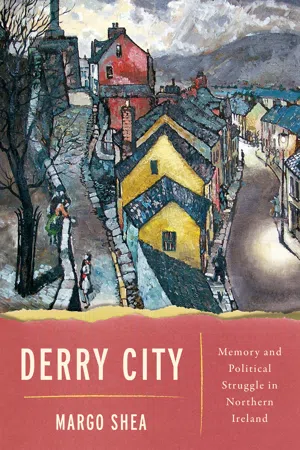
Derry is the second largest city in Northern Ireland and has had a Catholic majority since 1850. It was witness to some of the most important events of the civil rights movement and the Troubles. Derry City examines Catholic Derry from the turn of the twentieth century to the end of the 1960s and the start of the Troubles. Plotting the relationships between community memory and historic change, Margo Shea provides a rich and nuanced account of the cultural, political, and social history of Derry using archival research, oral histories, landscape analysis, and public discourse. Looking through the lens of the memories Catholics cultivated and nurtured as well as those they contested, she illuminates Derry's Catholics' understandings of themselves and their Irish cultural and political identities through the decades that saw Home Rule, Partition, and four significant political redistricting schemes designed to maintain unionist political majorities in the largely Catholic and nationalist city. Shea weaves local history sources, community folklore, and political discourse together to demonstrate how people maintain their agency in the midst of political and cultural conflict. As a result, the book invites a reconsideration of the genesis of the Troubles and reframes discussions of the "problem" of Irish memory. It will be of interest to anyone interested in Derry and to students and scholars of memory, modern and contemporary British and Irish history, public history, the history of colonization, and popular cultural history.
- 333 pages
- English
- ePUB (mobile friendly)
- Available on iOS & Android
eBook - ePub
About this book
Information
NOTES
Acknowledgments
1. Paul Gillespie, “Can Powersharing Lead to Place of Through-otherness?,” Irish Times, May 12, 2007.
2. Ibid.
3. Ibid.
Introduction
1. Barney McMonagle, introduction to No Go: A Photographic Record of Free Derry, ed. Adrian Kerr (Derry: Guildhall Press, 1997), 1.
2. Ibid.
3. Diana Taylor, The Archive and the Repertoire: Performing Cultural Memory in the Americas (Durham, NC: Duke University Press, 2003), 2.
4. Neil Farren, written statement, “Cameron Report, May 1, 1969,” Public Records of Northern Ireland (PRONI), File GOV/2/1/116.
5. For more on memory work, see Annette Kuhn, Family Secrets: Acts of Memory and Imagination (New York: Verso, 1995), 157–60.
6. For a political history of Northern nationalists, see Enda Staunton, The Nationalists of Northern Ireland (Dublin: Columba Press, 2001).
7. Tom Maguire, “Curating Hatred: The Joe McWilliams’s Controversy at the Ulster Museum,” special issue, “Hate and Heritage,” Journal of Hate Studies 13, no. 1 (2017): 61.
8. John Lees, “Rioting Reopens Old Wounds in Northern Ireland,” New York Times, October 8, 1968, 3.
9. Brian Keenan, introduction to Beyond Hate: Living with Our Deepest Differences, ed. Eamon Deane and Carol Ritner (Derry: Guildhall Press, 1994), xvi.
10. This argument veers away from the dominant one that the two major ethno-religious communities in Northern Ireland have utilized competing understandings of the past expressed through separate heritages to justify their actions and beliefs. For this perspective, see Elizabeth Crooke, “The Politics of Community Heritage: Motivations, Authority and Control,” International Journal of Heritage Studies 16, no. 1-2 (2010): 17
11. Henry Glassie, Passing the Time in Ballymenone (Philadelphia: University of Pennsylvania Press, 1982), 161.
12. “St. Patrick’s Day in Derry,” Belfast News Letter, March 6, 1884.
13. For more on this, see Ian McBride, The Siege of Derry in Ulster Protestant Mythology (Dublin: Four Courts Press, 1997).
14. “Catholic Registration,” Derry Journal, February 16, 1876, 2.
15. Lees, “Rioting Reopens Old Wounds in Northern Ireland.” Protestants have historically struggled to understand why 400 years of putting down roots, building communities, and working hard with the soil or in industry does not constitute belonging in Ireland. They have refuted the notion that political, economic, and cultural ties to Great Britain diminish or negate one’s attachments to Ireland. In their experience, the movements that began in the 1830s that equated Irishness with Catholicism and a Gaelic past marginalized their community and trivialized their deep connections to Ireland and their profound contributions to it. For more on Protestant experience in Northern Ireland, see Susan McKay, Northern Protestants: An Unsettled People (Belfast: Blackstaff Press, 2000), and Lee Smithey, Unionists, Loyalists and Conflict Transformation in Northern Ireland (Oxford: Oxford University Press, 2011).
16. “Creative destruction” is a term coined by Joseph Schumpeter, who utilized Marxian theory to describe the ways capitalist economic development arises out of the destruction of some prior economic order. See Joseph Schumpeter, Capitalism, Socialism, and Democracy (New York: Harper, 1942).
17. Richard English, Irish Freedom: The History of Nationalism in Ireland (New York: Macmillan, 2006), 368.
18. See Marianne Elliott, The Catholics of Ulster: A History (New York: Basic Books, 2001), see, esp., chap. 11, “Catholics in Northern Ireland 1920–2000.” More recently, Christopher Norton has picked up this trope to describe Northern Catholics in Norton, The Politics of Constitutional Nationalism in Northern Ireland, 1932–1970: Between Grievance and Reconciliation (New York: Manchester University Press, 2014).
19. This argument has been made most eloquently by Roy Foster. See Foster, The Irish Story: Telling Tales and Making It Up in Ireland (New York: Oxford University Press, 2002), xi.
20. George Bernard Shaw, “Preface for Politicians,” in John Bull’s Other Island (London: Constable and Co., 1907), 33.
21. This notion of a “hidden Ireland” was first raised with Daniel Corkery’s 1924 book of the same title. In it, he constructed a Gaelic Irish worldview, which he argued had been preserved within poetic and bardic traditions for 2,000 years. His assertion that it persisted, while remaining invisible in Anglo-Irish histories, has yielded much work on the perpetuations of Gaelic Irish culture and also on the need to interrogate the silences and avoidances that arise within Irish history. Daniel Corkery, The Hidden Ireland: A Study of Gaelic Munster in the Eighteenth Century (Dublin: Gill & Son, 1924).
22. Joep Leerssen, Hidden Ireland, Public Sphere (Galway: Arlen House for the Centre of Irish Studies, 2002), 14–15.
23. Tom Garvin, The Evolution of Irish Nationalist Politics (Ann Arbor: University of Michigan Press, 1981).
24. Mary Daly, “David Beers Quinn and Ireland,” Oral Address to the Hakluyt Society, Warburg Institute, London, March 13, 2003. http://www.hakluyt.com/hak-soc-tributes-daly.htm.
25. R. F. Foster, Modern Ireland, 1600–1972 (New York: Penguin, 1988), 3.
26. Nancy Curtin, “‘Varieties of Irishness’: Historical Revisionism, Irish Style,” Journal of British Studies 35, no. 2 (1996): 211.
27. Ibid.
28. John Regan, Myth and the Irish State (Kildare: Irish Academic Press, 2013), 7.
29. See Steven Ellis, “Historiographical Debate: Representations of the Past in Ireland: Whose Past and Whose Present?,” Irish Historical Studies 27, no. 108...
Table of contents
- Halftitle
- Title
- Copyrights
- Contents
- List of Figures
- Acknowledgments
- Maps
- Introduction
- One Situating the Past in Derry
- Two From under the Heel of the Minority: Challenging Protestant Memory and Power in Pre-Border Derry, 1896–1922
- Three Against the Wishes of the Inhabitants: Memory as Mooring in “Castaway” Derry, 1922–1945
- Four Tickling the Lion’s Tale, 1945–1962
- Five Sulphur in the Air, 1963–1968
- Six Old Derry’s Last Stand, 1969
- Conclusion
- Notes
- Bibliography
- Index
Trusted by 375,005 students
Access to over 1.5 million titles for a fair monthly price.
Study more efficiently using our study tools.
Frequently asked questions
Yes, you can cancel anytime from the Subscription tab in your account settings on the Perlego website. Your subscription will stay active until the end of your current billing period. Learn how to cancel your subscription
No, books cannot be downloaded as external files, such as PDFs, for use outside of Perlego. However, you can download books within the Perlego app for offline reading on mobile or tablet. Learn how to download books offline
Perlego offers two plans: Essential and Complete
- Essential is ideal for learners and professionals who enjoy exploring a wide range of subjects. Access the Essential Library with 800,000+ trusted titles and best-sellers across business, personal growth, and the humanities. Includes unlimited reading time and Standard Read Aloud voice.
- Complete: Perfect for advanced learners and researchers needing full, unrestricted access. Unlock 1.5M+ books across hundreds of subjects, including academic and specialized titles. The Complete Plan also includes advanced features like Premium Read Aloud and Research Assistant.
We are an online textbook subscription service, where you can get access to an entire online library for less than the price of a single book per month. With over 1.5 million books across 990+ topics, we’ve got you covered! Learn about our mission
Look out for the read-aloud symbol on your next book to see if you can listen to it. The read-aloud tool reads text aloud for you, highlighting the text as it is being read. You can pause it, speed it up and slow it down. Learn more about Read Aloud
Yes! You can use the Perlego app on both iOS and Android devices to read anytime, anywhere — even offline. Perfect for commutes or when you’re on the go.
Please note we cannot support devices running on iOS 13 and Android 7 or earlier. Learn more about using the app
Please note we cannot support devices running on iOS 13 and Android 7 or earlier. Learn more about using the app
Yes, you can access Derry City by Margo Shea in PDF and/or ePUB format, as well as other popular books in History & Irish History. We have over 1.5 million books available in our catalogue for you to explore.