![]()
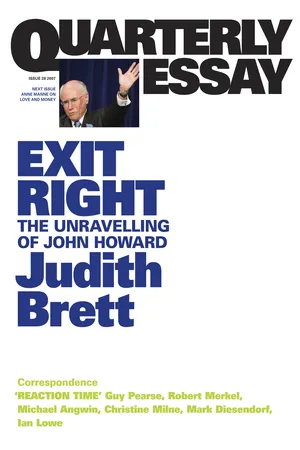
EXIT
RIGHT
The Unravelling
of John Howard
Judith Brett
The unravelling of John Howard began on the day in early December 2006 when Kevin Rudd was elected leader of the Opposition. Over the ensuing eleven months, Howard relied on all the strengths of his conviction-based leadership, all the arguments he had put to the electorate for the past eleven years, and all the political gambits available to an incumbent fighting for his political life. But they had stopped working. It is when a leader’s grip on political power starts to slip, when his threats and bribes miss their mark, when he starts to make uncharacteristic mistakes and when what had once been strengths reveal their limitations, that we can see most clearly the inner workings of that leadership. This essay is about John Howard’s leadership, seen through the prism of its failings.
In 2004, when he turned sixty-five, Howard promised to remain prime minister for as long as the Liberal Party and the voters wanted him to. And he repeated the promise in July 2006 when Peter Costello, considering a challenge, argued for a smooth transition. “The question of who leads the Liberal Party is a matter for the Liberal party-room,” Howard told the ABC’s PM. Again and again when the question of his retirement plans was raised, Howard reiterated, over and over, that he would continue as leader “for as long as my party wants me to, and it is in the best interests of the party that I do so. That’s always been the case and it can’t be otherwise.”
There was always a deep disingenuousness in Howard’s position. At face value, and this is how he wanted it to be taken, it disavowed personal ambition and put him at the service of the party and the nation. But it was also defiant, saying that if you want me to leave, you will have to throw me out. Howard, of course, pointed to the benefits of experience and a wise head. But whatever he said or promised, he could not escape the fact that he was getting old. And with Rudd rather than Beazley as his opposite number, he looked it.
At a deeper level, the problem with Howard’s position on the leadership succession was not just its defiance in the face of challengers, but its apparent denial of the reality of his age. Howard had turned sixty-eight on 26 July 2007. When the next election came round in 2010, he would be seventy-one. What could he say to the electorate about his intentions? Elect me and I promise to stay on till I’m seventy-one, and then I may even run again, like my hero Robert Menzies, who stayed on till he was seventy-two! Or elect me and at some unspecified date before the next election I will retire and pass the leadership on to my loyal and patient deputy, who already looks worn out from all those hard years in Treasury. Or elect me and someone else entirely might become prime minister after I retire, for after all, the leadership is not really mine to pass on; as I’ve said over and over, it is the party that decides. At least if one voted for Kevin Rudd, one knew that he intended to lead the country for the full term. In this scenario, a vote for Rudd would be the vote for certainty.
The more I thought about it, the more convinced I became that Howard’s age was his Achilles heel. I could not see how it would not be a problem for his campaign, the elephant in the room of every press interview and policy announcement, the question that would not go away because Howard’s answers to it were so inherently implausible. I could not see how it would not tip the undecided votes Rudd’s way.
And so in March I rang Chris Feik and suggested that I write the December Quarterly Essay, based on the premise that Howard would lose the election. I would write the story of Howard’s election year as the one in which he headed for the defeat which all my political intuitions told me was inevitable.
Another reason for my conviction that Howard would lose the election was my interpretation of his 2004 victory. When Mark Latham first became Labor leader in December 2003, he enjoyed a groundswell of popular support. A breath of fresh air after Beazley and Crean, he had energy and new ideas and seemed to offer new political possibilities. In those first months he enjoyed approval ratings in the 60s and Labor led the Coalition on the two-party preferred vote by an election-winning ten points. As we got closer to the election, this support fell away and Latham’s personal flaws started to become more apparent: his pleasure in the politics of envy and the barely concealed aggression he displayed in a bone-crushing handshake with Howard in full view of the cameras. But come election day, 47.2 per cent of the preferred vote still went to Labor.
Thinking about the likely outcome of the 2007 election, I drew two conclusions from Latham’s period as leader. First, that the early support for Latham had little to do with Latham himself and was in fact evidence of many people’s desire for an alternative to Howard. And secondly, that there was no reason for the 47.2 per cent of the vote that went to the ALP in 2004, even with the unelectable Latham as leader, to shift. This was a baseline of Labor’s electoral support, which is often forgotten in the winner-takes-all government conferred by election victory. After every election and for a good time in between, the media commentary is full of claims about “the Australian people,” “the Australian electorate,” “the voters,” and the way they have rejected the loser and embraced the winner. Such collective nouns obscure the fact that almost half of the electorate voted for the other side, and that they are still there, accepting the legitimacy of the election outcome but withholding their approval for much that the government does. After all, they didn’t vote for it and as likely as not they won’t next time.
Already lined up against Howard as we headed into the 2007 election was almost half the electorate who never believed in Howard the leader of the Australian people but always saw him primarily as a partisan figure of conflict and division. There were the left-liberals who were appalled by the way he gave permission to Pauline Hanson to air her racist views, evaded responsibility for the “children overboard” affair and for the scandalous behaviour of the Australian Wheat Board, by the harshness and hypocrisy of his asylum-seeker policies, by his stacking of public bodies with right-wing warriors, by his government’s unrelenting hostility to the ABC, by his bullying of public servants, and so on. Many trade unionists and working-class voters never trusted him not to govern as Liberal governments always do, in the interests of small and big business. And many Australians of ethnic background distrusted his backward-looking, British-centric version of Australian nationalism. These people were all still there. And so too, as the rising vote for Labor in blue-ribbon, middle-class Liberal seats shows, were defecting Liberal liberals with moral qualms.
On my reading, Labor’s loss in 2004 was like the Coalition’s in 1993, when an inexperienced John Hewson was out-politicked by Paul Keating and the antipathy to Keating had to wait another three years for its expression. To be sure, the depth of feeling might not have been quite as strong as against Keating, but I believed that much of the support for Howard was reluctant – he was the best of a bad choice – and if the choice improved, the vote would shift. When Rudd replaced Beazley as Labor leader, the choice improved dramatically.
After he lost the 2004 election on 9 October, Mark Latham’s taste for politics evaporated quickly. It was clear he did not have the stamina or the emotional steadiness for leadership and he resigned in January both from the leadership and from his seat of Werriwa. Labor returned to Beazley, who had done well for Labor in 1998, when the party won the two-party- preferred vote against Howard but lost in the marginals. But over the next two years it became clear that Beazley was not taken seriously by enough voters to threaten Howard’s hold on the government. Too many people were not listening to him. He was indecisive, and in contrast to Howard he looked tired and uninterested. The government was able to sail through the scandal about the Australian Wheat Board’s payment of bribes to Saddam Hussein’s regime on the claim that it did not know, and Labor looked all set for defeat again in 2007. In October 2006 Kevin Rudd published a long essay in The Monthly, “Faith in Politics,” in which he set out a moral basis for a social-democratic politics and displayed himself as a man of conviction, intelligence and wide reading. From Queensland, Rudd had been in parliament since 1998, after working both as an Australian diplomat and for Goss’s Queensland Labor government as director-general of Cabinet. Talk of a challenge started to circulate, and to head it off Beazley declared a spill. This was Beazley’s last political misjudgment. Rudd won the leadership 49 to 39, Julia Gillard was elected as deputy, and Howard’s annus horribilis was about to begin.
![]()
STRONG LEADERSHIP
After leading the Coalition back into government in 1996, Howard dominated the Liberal Party and the Coalition government. His longstanding political goals and values shaped the government’s, and his convictions and prejudices limited its room to move. Opposing the republic, supporting the traditional family, sidelining multiculturalism and Aboriginal reconciliation, reforming industrial relations, denying climate change, Howard led the way. Crucial decisions for the nation’s future were made by him alone, such as the decision not to ratify the Kyoto Protocol, or for Australia to join the US Joint Strike Fighter program. Australia’s alliance with the United States became inseparable from his personal friendship with US President George W. Bush. And Howard explained a late shift in the government’s position on the need for a symbolic act of reconciliation in autobiographical terms. “The challenge I have faced around indigenous identity politics is in part an artefact of who I am and the time in which I grew up,” he said in a speech to the Sydney Institute on 11 October 2007. Now that he, Howard, had a deeper understanding of indigenous issues, government policy could move on.
The Coalition’s four election victories since 1996 were largely attributed to his political skills: in particular his gamble with the GST in 1998, which brought conviction back to his flagging leadership; and the hardball, high-risk politics of the Tampa in 2001. So throughout 2007, as the Coalition trailed Labor in the opinion polls by an average of ten points, the spotlight was on John Howard and his capacities yet again to lead the Coalition to victory. Was he past it, too old and out of touch? Should he have resigned in favour of Costello? Would he pull a rabbit from the hat at the last minute – tax cuts, or a national security scare? Would his well-honed campaign skills enable him to defeat the inexperienced Rudd at the final post?
Elections are high-wire acts, with the contest for political leadership played out in full public view. For political junkies the moral and psycho- logical drama is gripping: the interplay of self-serving dissembling on the one hand, and glaring moments of unavoidable truth on the other; watching people hold their nerve and restrain their glee as they stare defeat or victory in the face; wondering how and why they do it, and what the costs are. For everyone, election campaigns turn complex and often dull policy debates into something they understand: a personal competition in which we all get a vote on the outcome.
Much about our leader-focused politics is inevitable. Politics needs leaders, people of determination and ambition who will devote themselves to public life. And our Westminster system organises the choice of leadership as a competition between two opposing teams that fight for the right to govern with words instead of swords. Armed conflict provides the linguistic stock-in-trade for political commentators: strategy, campaign, terrain, territory, discipline, command, attack, defence. I have used it myself, in my argument about the way Howard “captured” vernacular nationalism from Labor, and will again in this essay. It is unavoidable and it conveys much of what political leadership is about. But not all. We might choose our leaders through hard-fought verbal conflict, but the capacity to defeat an opponent is not all we want from a leader. We also want good policy, solutions to urgent problems, and the foresight to prevent future ones. And we want compassion, and the capacity to resolve conflicts rather than escalate them. The personal qualities for such tasks are very different from those required to win an election and sometimes the desire to win can overwhelm the other things a leader might do.
A liberal political system builds checks and balances on the leader’s power into the political system: two houses of parliament, the public service, an open and diverse media, an independent judiciary, even the parties themselves, each of which tries to keep its leader faithful to its traditions and core values. James Walter and Paul Strangio, in their recent essay No, Prime Minister, argue that systemic institutional changes in train since the Whitlam government partly explain the concentration of power in the person of prime minister we saw in Howard. But they also argue that Howard’s own leadership style exacerbated the process. They conceive of Howard’s dominance as “the unhappy convergence of the systemic and the singular,” in which institutional changes in our system of governance were compounded by Howard’s combative and controlling style of leadership, itself “given added licence by the post-9/11 climate of crisis.”
The essay by Walter and Strangio can be read as a companion to this one, giving more attention to the institutional backdrop to Howard’s prime ministership, but sharing the same framework for understanding his style of leadership. Both draw on the thinking of our mutual late friend and colleague Graham Little to reveal the psychological contours of Howard’s leadership style and its characteristic emotional palette.
Graham Little developed a theory of extraordinary power and sophistication for understanding political leadership. He took as his starting point the work of the psychoanalyst Wilfred Bion, who in his classic work Experiences in Groups (1961) describes three group formations, each of which demands a different type of leader. He calls them the dependency group, the flight–fight group and the pairing group. Little matched these with three types of political leaders: Group, Strong and Inspiring.
The dependency group is organised around shared need, and wants the leader to look after it. People are seen as belonging together: the emphasis is on the emotions and experiences that bind – on trust, loyalty, self-effacement, tradition. People are dependent, and maturity is the capacity to show concern for those more needy than oneself. For Little, the leaders of such groups pay attention to the many ways people need and depend on each other, specialising in the politics of sympathy and compassion and taking care not to put themselves too far ahead of those they lead.
Where the dependency group is formed around shared need, Bion’s second group, the flight–flight group, is formed for survival in the face of common threats. It faces outward, ready for action, and the emphasis is on maintaining the internal cohesion and sense of shared purpose needed to fight an external enemy. The fight–flight group’s leader is the Strong Leader, hard-working, tough and alert, proof against the temptations of pathos that might weaken the chances for the group’s survival. He demands total loyalty from the group, using his strength not just to combat the enemy but to stare down any internal opposition. And he expects people to be independent, carrying their supplies on their own sturdy backs.
Bion’s third group is the pairing group. It is the hardest to grasp. Bion’s fight–flight and dependency groups, Little’s Strong and Group Leaders, map easily onto familiar cultural forms – hard and soft, masculine and feminine, protective and nurturing, independent and dependent, what Margaret Thatcher called the dry and the wet. Pairing is different. As Bion describes it, a group will sometimes fall into the configuration of a pair, a two-some, in earnest, equal conversation. The group feels itself to be creative and senses the possibility of new things. Hope stirs and there’s excitement in the air. This provides the context for Little’s Inspiring Leader, who is able to break through the habitual stand-off between strength and compassion and suggest that perhaps we can find political solutions to encompass both. This is a less coherent leadership style than the other two, a sort of mid-way point, but it captures the way some leaders can break through with the promise and hope of solutions.
Little’s model has two great strengths. The first is that it is dynamic. Each leadership type has a particular emotional and psychological configuration, but each also casts the shadow of the emotional and psychological possibilities it excludes. The shadow is a necessary consequence of that type’s particular strengths, but it also makes each type inherently unstable. Each is subject to characteristic misjudgments, mistakes of both over- and under-reaching, and each can create a longing in his or her followers for something different: more decisiveness; more compassion and humility; more openness to new ideas; less divisiveness, and so on, propelling momentum for change.
As well, each leadership type exists in constant tension with the other two, warding off the alternatives. In Mar...