A new understanding of political philosophy from one of its leading thinkers
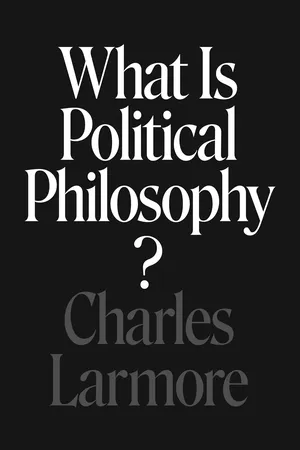
What is political philosophy? What are its fundamental problems? And how should it be distinguished from moral philosophy? In this book, Charles Larmore redefines the distinctive aims of political philosophy, reformulating in this light the basis of a liberal understanding of politics.
Because political life is characterized by deep and enduring conflict between rival interests and differing moral ideals, the core problems of political philosophy are the regulation of conflict and the conditions under which the members of society may thus be made subject to political authority. We cannot assume that reason will lead to unanimity about these matters because individuals hold different moral convictions. Larmore therefore analyzes the concept of reasonable disagreement and investigates the ways we can adjudicate conflicts among people who reasonably disagree about the nature of the human good and the proper basis of political society. Challenging both the classical liberalism of Locke, Kant, and Mill, and more recent theories of political realism proposed by Bernard Williams and others, Larmore argues for a version of political liberalism that is centered on political legitimacy rather than on social justice, and that aims to be well suited to our times rather than universally valid.
Forceful and thorough yet concise, What Is Political Philosophy? proposes a new definition of political philosophy and demonstrates the profound implications of that definition. The result is a compelling and distinctive intervention from a major political philosopher.
- English
- ePUB (mobile friendly)
- Available on iOS & Android
eBook - ePub
What Is Political Philosophy?
About this book
Information
Publisher
Princeton University PressYear
2020Print ISBN
9780691241562
9780691179148
eBook ISBN
9780691200873
Topic
PhilosophySubtopic
Philosophical Essays1
The Relation between Political and Moral Philosophy
THE QUESTION IN the title of this book receives much less attention than it deserves. Too often the domain of political philosophy is defined by a series of classic texts (running from Aristotle’s Politics, through Hobbes’s Leviathan, to Rawls’s A Theory of Justice) along with a conventional list of the topics to be addressed—the acceptable limits of state action, the basis of political obligation, the virtues of citizenship, and the nature of social justice. Precisely this last topic, however, shows why the question “What is political philosophy?” ought to have a greater urgency. For justice is a topic that also belongs to moral philosophy. How, therefore, are moral philosophy and political philosophy to be distinguished? Both take as their subject the principles by which we should live together in society. How exactly do they differ? If justice—to invoke a traditional tag as indisputable as it is uninformative—means giving everyone his or her due (suum cuique), then what is it to fill in the import of this phrase as a moral philosopher and to do so instead from the standpoint of political philosophy?
These questions are not motivated by a general love of intellectual hygiene. I do not assume that the various areas of philosophy need always to be cleanly demarcated from one another in order to avoid contamination by alien concerns and influences. Rather, disciplines arise in response to problems, and the boundaries between them, when justified, reflect the extent to which they deal with different problems or handle what might seem to be similar problems from fundamentally different perspectives. Now political philosophy—to invoke what may also look like a vacuous definition—consists in systematic reflection about the nature and purposes of political life. The relation it has to moral philosophy depends therefore on how political philosophers, in tackling this subject, should position themselves with respect to the sphere of morality. There have been, broadly speaking, two competing conceptions.
1. Two Rival Conceptions
According to what has no doubt been the dominant view, political and moral philosophy do not differ essentially in their aims. Moral philosophy is supposedly the more general discipline, dealing as it does with the good and the right in all their manifold aspects. Political philosophy is held to form part of this larger enterprise, working out the class of moral principles that should govern, not our individual relationships to others, but rather the structure of society as a whole. One of its primary themes must therefore be social justice, and justice regarded as a moral ideal, conceived in abstraction from the realities of politics. Its aim is to specify the relations in which we ought ideally to stand to one another as members of society, possessed of the appropriate rights and responsibilities. Only once this basis is secured should political philosophy move on to take into account existing beliefs, motivations, and social conditions. The ideal must then be adjusted to reality, particularly given the limitations, both empirical and moral, on what may be achieved through the coercive power of the law. None of this changes, however, the standpoint from which political philosophy is to begin and from which it must judge these very concessions, namely the moral ideal of the good society. Political philosophy is thus understood as being at bottom applied moral philosophy.
On the contrary view, political philosophy should instead be understood as an autonomous discipline, setting out not from the truths of morality, but instead from the defining problems of the political realm, which are the exercise of power and the need for authority. People disagree and their disagreements extend from their material interests and desire for honor and status to their very ideas of the right and the good, so that society is possible only through the establishment of authoritative rules, binding on all and backed by the threat or use of force. As moral beings, we figure out how one ought to act, judge whether others have acted as they should, praise or blame them accordingly, and feel guilt or shame when we have ourselves acted wrongly. But as political beings, we must determine what kinds of action should be subject to coercion—that is, required or prohibited through the use or threat of force—and therefore what disagreements among us, not least those of a moral character having to do with what is right and wrong, should be settled in an enforceable way. Our focus must then be, not on how things ought ideally to be, but on how they can legitimately be made to be, given that people who must live together have opposing notions of the ideal. To be sure, political philosophy so conceived has a normative aim, seeking to lay out the basic principles by which society should be structured. But it carries out this project by asking in the first instance what principles, including principles of justice, ought to have the force of law. Though these principles may well be ones that can be established by purely moral reasoning, that is not in this context their justification. For political philosophy, their validity has to be judged by how successfully they handle the distinctive problems of the political realm, which are conflict, disagreement, power, and authority.
I mentioned at the outset what appears to be a rather empty definition of political philosophy: systematic reflection about the nature and purposes of political life. But perhaps it is not such a platitude after all. For the difference between the conceptions just outlined seems to turn on which of the two terms receives the greater weight. Should political philosophy look first and foremost to the purposes that ideally political association ought to pursue? Or should it set out instead from the nature, that is, the reality, of political association, which is that interests conflict, people disagree, and without the institution of law and the exercise of state power no common existence is likely to be possible? Depending on the point of departure adopted, political philosophy becomes a very different sort of undertaking. Either it forms a branch of moral philosophy, concerned with what ideally the good society should be like, or it operates by principles of its own, propelled in no small part by the fact that moral ideals themselves prove politically divisive. The difference, I insist again, is not that the second approach is any less normative by virtue of setting out from the permanent features of political life. For it understands these givens as constituting the problems that political philosophy must solve in order to establish how social life ought to be basically organized. However, the principles on which it must rely are held to be essentially political in character, defining the legitimate use of coercive power.
The contrast between these two conceptions is not unfamiliar. Sometimes philosophers endorse what is effectively the one and decry the other. Yet these professions of faith are seldom accompanied by much argumentation or by an attempt to analyze the supposed errors in the contrary view. Two recent exceptions have been G. A. Cohen and Bernard Williams, advocates of opposite sides in the debate, who expounded their positions at length (though without, unfortunately, ever mentioning the other). “We do not learn what justice fundamentally is,” Cohen declared in explaining how he conceived of political philosophy, “by focusing on what it is permissible to coerce,” for “justice transcends the facts of the world.”1 Williams, by contrast, maintained that “political philosophy is not just applied moral philosophy, which is what in our culture it is often taken to be. . . . Political philosophy must use distinctively political concepts, such as power, and its normative relative, legitimation.”2
As I examine in this chapter and the next the nature of political philosophy, I will give particular attention to the pertinent views of these two philosophers. For they have brought out key features of the rival conceptions at issue—conceptions that Williams himself termed, rather to his own advantage, “moralism” and “realism.” No one has laid out so succinctly as Williams the substance of the realist position, even though there are many today, as I detail in the following chapter, who similarly invoke the name of “realism” in rejecting much of contemporary, particularly liberal, political philosophy as a flight from the reality of politics, which they regard as the omnipresence of conflict and the need for authority. (This view, rather than simply the idea that political philosophy should be modest and pursue realizable ideals, is, I should note, the core of what I too will mean by “political realism” in this book.) And though there are certainly other statements of the “moralist” or—more neutrally put—“ethics-centered” standpoint, the argument Cohen advances for his claim that the fundamental principles of political philosophy cannot depend on what it is permissible to coerce is of singular value. While it is aimed primarily at John Rawls’s theory of justice, its significance is far broader: it shows what we would ultimately have to believe in order to reject as irrelevant the key considerations in favor of the realist outlook.
As the introduction has already indicated, my own sympathies lie more with this second, “realist” understanding. Political and moral philosophy ought to be seen as two very different enterprises in much the way it claims. However, I also believe that this, as it were, more political conception of political philosophy has to be formulated with greater care than it is usually accorded. For a crucial point to note is that Cohen and Williams like many others regard the choice between the two conceptions as stark and inescapable. Political philosophy, they presume, cannot in the end avoid taking one or the other of the two opposing paths. I think that this is a mistake. Political philosophy must indeed focus primarily on the characteristic problems of political life, which include widespread disagreement about morality, and for just that reason it demands a significant autonomy from moral philosophy. Yet it cannot determine how these problems are to be rightly settled except by reference to moral principles fixing the proper use of force and presumed to have a validity independent of the exercise of political power they serve to justify. There is thus a limit to the autonomy political philosophy can enjoy.
In the present chapter, I lay out the essential differences between these two rival conceptions of political philosophy and then explain—by a line of argument that is largely my own—why the realist view is closer to the truth. My aim here is principally critical, however. It is to show why it is wrong to regard political philosophy as applied moral philosophy. It should not, that is, proceed by way of elaborating a vision of how ideally society should be structured in order then to determine how this ideal can be accommodated to the realities of the political realm. These realities, the basic problems they give rise to and the sort of solution they require, constitute the correct starting point. Though I will of necessity have a certain amount to say about the alternative, “realist” conception, I have reserved to the subsequent chapter a more comprehensive treatment. There I will show how it should be better formulated than usual and thus in more detail how, in my view, the nature of political philosophy should properly be conceived.
2. Philosophy and History
In order to explain why political philosophy is not simply one province among many within the larger realm of moral philosophy, I must begin with some remarks about the nature of philosophy in general. I broach this topic with mixed feelings. Often definitions of philosophy come to little more than the expression of particular preoccupations and commitments, themselves disputable on philosophical grounds, but disguised as an impartial demarcation between what is “really” philosophy and what is not. Think of the idea that philosophy concerns itself with the conditions of possibility for experience, or that it consists in conceptual analysis. I am myself, to be sure, engaged in saying how one ought really to do political philosophy. Yet my intention is not to suggest that the positions I oppose fail to qualify as “philosophy,” but instead that they fail to get it right about the “political.” Still, the way I see the general goal and method of philosophical reflection plays a substantial role in the particular view of political philosophy I propose. That is why the following remarks are necessary, even if they perhaps also go to show that talk about the nature of philosophy inevitably ends up being philosophically controversial. I shall begin at least on neutral ground.
Philosophy, I believe, following Wilfrid Sellars, is the effort “to understand how things in the broadest possible sense of the term hang together in the broadest possible sense of the term.”3 It seeks to clarify the basic practices and goals inherent in our various ways of dealing with the world. Its ambition is therefore to be maximally reflective: philosophy differs from other kinds of inquiry in that it aims to spell out and critically evaluate the fundamental and often implicit assumptions on which they, as well as our experience as a whole, happen to rely. Even when it concentrates on some limited area, as in the philosophy of art or indeed in political philosophy, the concern is with the constitutive features of this particular domain.
This definition is, of course, extremely broad. It tells us little about the direction in which such reflection should go, and different philosophers will proceed differently, in accord with their various views and interests. However, I want to mention one way the practice of philosophy cannot help but take on concrete form, since it forms an essential part of the justification I shall present of the proper task of political philosophy. It is a dimension whose significance philosophers themselves often overlook, so here I am clearly turning toward the philosophically controversial.
In striving to comprehend how things hang together, either overall or in some specific domain, philosophical reflection has to find some footing. It needs to draw upon existing knowledge and past experience, if it is to have any grasp of the problems it must handle and of the avenues it should pursue. The same point holds when the philosopher turns to challenge some widespread assumption, arguing that it is actually unfounded or less fruitful than commonly presumed. The resources for criticism have to come from what can count as settled about the matter under review. Philosophy is therefore always situated, shaped by its historical context, even as it aspires to make sense of some subject in as comprehensive, all-encompassing a way as possible. This historicity is easily discerned in the philosophical works of the past, and it inheres no less in the endeavors of the present, whether or not philosophers choose to acknowledge the fact. How could it be otherwise, given that reflection, however broad its scope, needs somewhere to stand if it is to see anything at all?
In this respect, then, philosophy is not so different from other kinds of inquiry. They too bear the mark of their time and place, both in the problems they tackle and in the solutions they devise. The modern natural sciences are no exception. Though they develop through the testing of hypotheses against evidence, hypotheses and evidence alike reflect the theories of the day, the experimental procedures available, and the course of previous inquiry.
Now just as a rootedness in history does not entail that the sciences fail to give us knowledge of nature as it really is, so it does not stand in the way of philosophy attaining a vantage point from which a deeper understanding of mind and world becomes possible. Some philosophers, it is true, have drawn such skeptical conclusions about both the sciences and philosophy itself. Some too have supposed that in order to be as reflective as possible, philosophy must stand back from the particularities of its place in history, in order to discover what Reason itself, addressing us simply as rational beings independent of historical context, requires us to think and do. These views, though frequently espoused, rest on a misconception. The contingencies of history are not essentially obstacles to be overcome, either in the sciences or in philosophy. They are the very means by which we learn about the world and ourselves as well as about how to learn about them, permitting beings like ourselves, who live in time, to lay hold of truth, which is necessarily timeless. Only through the accumulated experience of generations can we come to make out even the most basic features, not only of the world, but of human experience itself.4
Philosophy does differ from the sciences in its systematic devotion to examining the assumptions that implicitly shape our various activities, including the sciences and philosophical reflection itself. But this project does not demand setting aside what history has taught us about the matter under scrutiny—any more than the sciences are failing to p...
Table of contents
- Cover Page
- Title Page
- Copyright Page
- Contents
- Acknowledgments
- Introduction
- 1. The Relation between Political and Moral Philosophy
- 2. The Truth in Political Realism
- 3. Political Liberalism and Legitimacy
- Conclusion
- Index
Trusted by 375,005 students
Access to over 1.5 million titles for a fair monthly price.
Study more efficiently using our study tools.
Frequently asked questions
Yes, you can cancel anytime from the Subscription tab in your account settings on the Perlego website. Your subscription will stay active until the end of your current billing period. Learn how to cancel your subscription
No, books cannot be downloaded as external files, such as PDFs, for use outside of Perlego. However, you can download books within the Perlego app for offline reading on mobile or tablet. Learn how to download books offline
Perlego offers two plans: Essential and Complete
- Essential is ideal for learners and professionals who enjoy exploring a wide range of subjects. Access the Essential Library with 800,000+ trusted titles and best-sellers across business, personal growth, and the humanities. Includes unlimited reading time and Standard Read Aloud voice.
- Complete: Perfect for advanced learners and researchers needing full, unrestricted access. Unlock 1.5M+ books across hundreds of subjects, including academic and specialized titles. The Complete Plan also includes advanced features like Premium Read Aloud and Research Assistant.
We are an online textbook subscription service, where you can get access to an entire online library for less than the price of a single book per month. With over 1.5 million books across 990+ topics, we’ve got you covered! Learn about our mission
Look out for the read-aloud symbol on your next book to see if you can listen to it. The read-aloud tool reads text aloud for you, highlighting the text as it is being read. You can pause it, speed it up and slow it down. Learn more about Read Aloud
Yes! You can use the Perlego app on both iOS and Android devices to read anytime, anywhere — even offline. Perfect for commutes or when you’re on the go.
Please note we cannot support devices running on iOS 13 and Android 7 or earlier. Learn more about using the app
Please note we cannot support devices running on iOS 13 and Android 7 or earlier. Learn more about using the app
Yes, you can access What Is Political Philosophy? by Charles Larmore in PDF and/or ePUB format, as well as other popular books in Philosophy & Philosophical Essays. We have over 1.5 million books available in our catalogue for you to explore.