- 178 pages
- English
- ePUB (mobile friendly)
- Available on iOS & Android
eBook - ePub
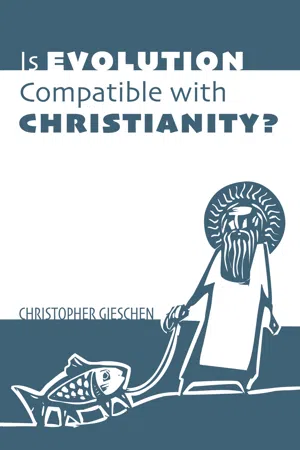
Is Evolution Compatible with Christianity?
About this book
All of these statements are false: Christians are science-deniers when it comes to evolution. Real science actually lines up more with evolution than creation as found in Genesis. Fossils are evidence for evolution. The Genesis account is fully compatible with evolution.
These questions need answers! What exactly is the difference between evolution right and evolution wrong? Is it possible to bend Genesis to fit evolution? How can one defend belief in a six-day creation from the onslaughts of the evolutionists? How about any questions you have?
This book is a must for any Christian about to enter a public high school or university. Accepting evolution as true is the basis for three of the ten reasons Christians give up saving faith. It is time for you to arm yourself with the truth and stand your ground logically, philosophically, scientifically, and most important biblically! Ready? Let's go!
Information
Topic
Teologia e religioneSubtopic
ReligioneChapter 1
In the Beginning
How I Got Started
“You never learn that the gravest issues may depend upon the smallest things.”
—Sherlock Holmes, “The Adventure of the Speckled Band”
As Holmes explains to Watson, the smallest incidents or facts can have huge significance when it comes to solving a case. In other words, to Holmes, there really is no such thing as a useless fact. He seems to be admonishing Watson about being too stubborn when he complains that Watson “never” learns this truth. Yet anyone who has read Sherlock Holmes may recall several instances when Watson actually does try to carry on investigations the “Holmes” way, looking at all the facts, no matter how big or small.
It is the same with the creation versus evolution issue. To begin examining the topic, it is important to understand that there are three factors influencing a person’s worldview: (1) religion, (2) upbringing, and (3) life experiences. Each area is a significant factor for whether a person becomes a believer of either creation or evolution. But, as the Holmes quote suggests, each of these areas may be impacted by a few seemingly small occurrences. This holds true for how I became a biblical creationist. There were many small events in my life that led me to hold creation as true. But first, let me talk about Joe.
Let’s say Joe decides to be a Christian missionary. How does he come to that decision? Mainly, Joe’s religion specifically tells him to do so. Jesus’ instructions were written down by his followers and passed down to Joe via the Bible. For example, Joe can cite Matthew 28:19–20, where Jesus said, “Go therefore and make disciples of all nations, baptizing them in the name of the Father and of the Son and of the Holy Spirit, teaching them to observe all that I have commanded you. And behold, I am with you always, to the end of the age.” Note that Jesus instructs his followers to spread the gospel to the rest of the world. Christians like Joe are to obey all that Jesus has commanded. Each person is to spread the gospel to others, who then become followers of Jesus, who then tell others, who then become followers . . . and you get the idea.
Are there other Bible passages Joe could point to that tell him to go and do mission work? Indeed, there are. Acts 22:15 says, “For you will be a witness for him to everyone of what you have seen and heard.” Another is 1 Peter 3:15: “But in your hearts honor Christ the Lord as holy, always being prepared to make a defense to anyone who asks you for a reason for the hope that is in you; yet do it with gentleness and respect.” We can see that Joe’s religion is a compelling factor in his decision to become a missionary.
The second influence on Joe’s decision to be a Christian missionary is his upbringing. Both of Joe’s parents are Christians who spoke about Jesus in their home. They talked about mission work during family devotions, and his parents often financially supported missionaries. Joe’s mother told him how a person had once shared the gospel with her when she was younger and led her to the Savior. Joe’s parents raised him to see the world’s treasures as blessings to be used for God’s kingdom instead of being wasted on his own pleasures or wants.
As you can see, the way Joe was raised plays a part in his worldview formation. It also is true that the Holy Spirit plays a large role in this, but to Joe, it is his parents that have a significant role here. It is important to note that Joe’s parents not only talk the walk but also actually walk the walk. Proper modeling goes a long way to fostering proper worldview growth.
Finally, life experiences can have a huge impact on a person’s worldview. Joe’s story is no different. His church sponsored missionaries, who came and talked about their work for the Lord in foreign lands. This increased Joe’s interest in seeing how other cultures lived. He also read accounts of people who sometimes risked their very lives to bring the good news to others. These brave ones inspired Joe. During college, he was given the chance to work as an intern for a Bible society one summer and even spoke directly to a few missionaries who had returned home to visit relatives in the United States.
Life experiences are most critical in the later years prior to adulthood. This is why many churches wisely include a variety of experiences for their teens to help shape their worldviews. True enough that most will not become missionaries for Jesus like Joe. However, many will be impacted to become a Christian who shares his/her faith easily with others.
These three factors greatly influenced Joe in his decision to enter the mission field. As you can see, some of the causes were seemingly small, but others were more direct in their impact. But each was used to shape Joe into the person he came to be. My story is no different, but I will start with one particular memory of my upbringing.
From my earliest days, I can remember my parents taking me to worship at a Lutheran church. Paying attention and not disturbing others during the service was very much instilled in my brothers and me via my mother, as my father was busy serving as an organist at another church in downtown Chicago. All it took was a pinch on the leg and the offender rapidly snapped to attention. I never could figure out how she did it while looking straight ahead. As you can see, those little pinches (upbringing) reminded me to take what was going on in church seriously!
My Christian faith, under the guiding hand of the Holy Spirit, grew due to several factors. I recall having theological discussions with my dad over Sunday dinner or during our drives back from my grandparents’ house. Dad was patient, letting me ask question after question, and he explained God’s truth in ways I could understand.
Another influential person in the development of my belief system was my religion professor at Concordia Teachers College in River Forest, Illinois (now Concordia University Chicago). I will never forget his opening question to our class, most of whom considered themselves to be Christians: “Why are you a Christian?” Most attributed our choice in religion to our parents who dragged us to church when we were young, or that we were Christians because our parents were. His response brought us up short: “Then I am afraid that none of you are saved.” After our shock and outrage died down, he challenged us further: “Care to show me from the Bible where it states that you are saved by your parents’ faith or by them dragging you church?” His question made me recall the time when the Jews argued with Jesus about this very idea. They said they were saved because Abraham was their father (John 8:31–38). Needless to say, we were not successful in using the Jews’ argument either.
This same professor also helped me deal with a time in my life when I questioned my faith. I asked him how I could be sure Christianity is the correct religion. After all, there are so many religions in the world, how can I be sure that it is the one that will save my soul? He encouraged me to do some research and find out for myself. Therefore, keeping one foot firmly planted on the rock, I dipped my other toes into a sea of other religions. I basically found that all other religions are full of dos and don’ts with no real guarantees. Christianity is the only belief system that involves God doing everything for a person, including sending his only Son, Jesus, to die for his lost creation and rise again. No other belief system has a god who would (or could) do such a thing.
But to bring us back to the topic of this book, I’ll share how life experiences led me to where I am now. One Christmas, I received a dinosaur play set. It included several prehistoric-looking trees and plants as well as a big plastic rock for the creatures to climb. Interestingly, it also contained six “cave people” in various poses, yet there were no prehistoric mammals. Obviously at the time, I did not see the “error” that any evolutionist would. Today, one can still find those types of play sets with cavemen and dinosaurs, but now Ice Age mammals are thrown in. One wonders why the evolutionists do not publicly bemoan the toy industry supporting creationist “nonsense” of men and dinosaurs existing at the same time. One also wonders whether the toy industry even realizes it is supporting biblical truth found in Genesis. But this play set began my love of things prehistoric.
After earning my teaching degree I was hired by a Lutheran high school to teach biology and english. It was there where I became exposed to the creation and evolution debate. I do have an early teaching memory of a parent questioning me during a “back to school night” session. She wondered if I taught evolution in my biology classroom. I answered that I did, and that I also stressed to my students that what the Bible says about creation is true. At that time, I did not realize just how ineffective my teaching style was in training future apologists.
While attending science conferences, I came to see that many of my public school colleagues often wondered how I compartmentalized my brain in holding two seemingly contradictory beliefs as being true: evolution and creation. For many teachers and scientists, there is not even one sliver of compromise or relationship between the two. In their minds, one cannot exist if the other does. To many, the Bible is just a bunch of myths borrowed from various pagan religions that were twisted to the Hebrew concepts of monotheism. People who hold such a belief sometimes get upset when I say that I look at them as both/and, not either/or as being true. What I mean by either/or is that some Christians deny everything about evolution because it’s not mentioned anywhere in the Bible. I fully understand this, but it is misguided due to not having a correct definition of evolution. The problem with evolution’s definition is that it has now become so generic. Some say it means we all came from one ancestral cell, which is not a scientific fact at all (Evolution Wrong). But others, including myself, say it means that we have variations within specific species, such as the different breeds of dogs or cows. This is absolutely true in every sense, and is what we call microevolution (Evolution Right).
So in a very limited sense, I do believe in evolution, but not how the evolutionists would like me to believe it. I also hold fast to the word of God as found in Genesis all the way to Revelation. When God said he created the world by his word, this is exactly what happened. He most certainly did not use evolution to create the world. Had he done so, he would have said so. Later on, we shall explore the errors made when trying to merge biblical truth with secular science.
Another event that led me to become a creation apologist occurred at a National Association of Biology Teachers conference in the early 1980s. This conference took place around the time when a small group in California known as the Institute for Creation Research (ICR) was voicing the first serious and scientific objections against evolution. I was amazed to see such vitriol and passion in some of the knee-jerk reactions against that early creationist group. At one of the sessions I attended, I asked the presenter if it were possible to present both sides and let the students make up their own minds. He responded testily, “Of course not! Do we let them decide if two plus two equals four?”
I wish I had known how to respond to him at the time. Had I known then what I know now, I would have told him that comparing evolution to math is comparing apples to oranges. I can prove that two plus two is four. No one can scientifically prove particles became people.
After that conference, a craving for knowledge that upheld creation took over my mind. My wife gave me my first creationist book, Evolution: Possible or Impossible by Dr. James F. Coppedge. The subtitle intrigued me even more: Molecular Biology and the Laws of Chance in Nontechnical Language. This book opened up a whole new world of statistics and scientific facts that confirmed the impossibility of evolution creating life. Details of the cell’s intricacies—namely those concerning DNA, RNA, and protein synthesis—were explained. The author’s premise was that there is no possible way information-rich molecules could have put themselves together. The odds against it are just too great. Nevertheless, famous evolutionists, such as Stephen Jay Gould, speak about “fortuitous events,” which can circumvent such bleak odds.1 Coppedge’s book turns the chance events that Gould says make evolution possible into simple flights of fancy. After reading what Coppedge has to say, it’s easier to believe in fairy tales than the ideas of organic evolution, which supposedly explains where the first cell came from.
Coppedge’s book foreshadowed the excellent work of Stephen C. Meyer, who wrote Signature in the Cell. To make an excellent but thick book short, it is DNA that is the signat...
Table of contents
- Title Page
- Acknowledgments
- Chapter 1: In the Beginning
- Chapter 2: Does Neutral Ground Exist?
- Chapter 3: Definitions or What Does This Mean?
- Chapter 4: Christianity
- Chapter 5: Is Theistic Evolution a Valid Compromise?
- Chapter 6: Philosophy 101
- Chapter 7: Darwin Right and Darwin Wrong
- Chapter 8: Time is of the Essence
- Chapter 9: Fossils as Evidence for Which Side?
- Chapter 10: Textbook Evolution Evidence Explained
- Chapter 11: The Origins of Everything
- Chapter 12: Stephen Meyer Weighs in and You Should Too
- Chapter 13: Has Alien Life Evolved?
- Chapter 14: The Word of God and This Issue
- Chapter 15: Four Websites Worth Your Time
- Appendix: Study Questions and Answers
- Bibliography
Trusted by 375,005 students
Access to over 1.5 million titles for a fair monthly price.
Study more efficiently using our study tools.
Frequently asked questions
Yes, you can cancel anytime from the Subscription tab in your account settings on the Perlego website. Your subscription will stay active until the end of your current billing period. Learn how to cancel your subscription
No, books cannot be downloaded as external files, such as PDFs, for use outside of Perlego. However, you can download books within the Perlego app for offline reading on mobile or tablet. Learn how to download books offline
Perlego offers two plans: Essential and Complete
- Essential is ideal for learners and professionals who enjoy exploring a wide range of subjects. Access the Essential Library with 800,000+ trusted titles and best-sellers across business, personal growth, and the humanities. Includes unlimited reading time and Standard Read Aloud voice.
- Complete: Perfect for advanced learners and researchers needing full, unrestricted access. Unlock 1.5M+ books across hundreds of subjects, including academic and specialized titles. The Complete Plan also includes advanced features like Premium Read Aloud and Research Assistant.
We are an online textbook subscription service, where you can get access to an entire online library for less than the price of a single book per month. With over 1.5 million books across 990+ topics, we’ve got you covered! Learn about our mission
Look out for the read-aloud symbol on your next book to see if you can listen to it. The read-aloud tool reads text aloud for you, highlighting the text as it is being read. You can pause it, speed it up and slow it down. Learn more about Read Aloud
Yes! You can use the Perlego app on both iOS and Android devices to read anytime, anywhere — even offline. Perfect for commutes or when you’re on the go.
Please note we cannot support devices running on iOS 13 and Android 7 or earlier. Learn more about using the app
Please note we cannot support devices running on iOS 13 and Android 7 or earlier. Learn more about using the app
Yes, you can access Is Evolution Compatible with Christianity? by Christopher Gieschen in PDF and/or ePUB format, as well as other popular books in Teologia e religione & Religione. We have over 1.5 million books available in our catalogue for you to explore.