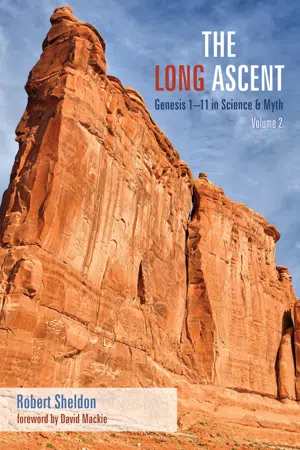
- 376 pages
- English
- ePUB (mobile friendly)
- Available on iOS & Android
eBook - ePub
About this book
The first eleven chapters of Genesis (Adam, Eve, Noah) are to the twenty-first century what the virgin birth was to the nineteenth century: an impossibility. A technical scientific exegesis of Genesis 1-11, however, reveals not only the lost rivers of Eden and the garden's location, but the date of the flood, the length of the Genesis days, and the importance of comets in the creation of the world. These were hidden in the Hebrew text, now illuminated by modern cosmology, archaeology. and biology. The internet-friendly linguistic tools described in this book make it possible to resolve the location, the extent, and the destruction of Eden and Noah's flood. Ancient Egyptian, Greek, Norse, Sumerian, and Sanskrit mythology are all found to support this new interpretation of Genesis. Combining science, myth, and the Genesis accounts paints a vivid picture of the genetic causes and consequences of the greatest flood of the human race. It also draws attention to the acute peril our present civilization faces as it follows the same path as its long-forgotten, antediluvian ancestors. Discover why Genesis has never been so possible, so relevant as it is today.
Information
Preface to Volume 11
This book would never have been begun if it were not for my father, a graduate of Maryville College and Princeton Seminary, a Presbyterian missionary to South Korea, and a preacher all his life. When he had a stroke, and could no longer preach, I went to visit him. Not only was it difficult for him to talk, it was impossible for him to read. I found myself monologuing about my seminary research, and what I wanted to tell the world about science and the Bible. I told him I would write a book, and started the first chapter. But his condition deteriorated more quickly than I had hoped. I raced to his bedside on hearing the news but he died before I had a chance to read it to him. I grieved for a year and found that I could write nothing. But the following summer three brushes with death befell me.
During a family trip to the Gulf of Mexico, a storm caused riptides that drowned five people. I came close to being the sixth but my son was able to reach me in the surf seconds before I lost consciousness. A few weeks later I was taking my daughter to get her driver’s license. While she was getting experience driving the Interstate, she lost control of the Camry, skidded over the median, and struck an oncoming Suburban doing 70mph, rolling it into the shoulder. A few weeks after that, we were pulling our pop-up trailer over Independence Pass in the Colorado Rockies. As we were approaching a switchback, the brakes overheated and faded away. Smoke came pouring out of the wheel wells. The next week, in a reflective mood, I asked my wife, “Do you think God is trying to tell me something?” She gave me an exasperated look and replied, “What do you want to do before you die?”
My interest in the relationship between science and religion began when my father encouraged me to pursue science, asking me to explain how science could be reconciled with the Bible. While I was in high school, he listened to a seminar by Henry Morris and bought me Morris’s book The Genesis Flood.2 I read it cover to cover, and learned a lot of geology. It appeared to me then, and even now when I reread the book, that it was not primarily a science book, but a theology book. Like most theology books, it was deductive and not inductive, always sure of the answer before presenting the evidence. I put the book away, wishing there were a better way to reconcile the Bible with science.
I went off to college at a leading Christian evangelical liberal arts institution that strove to be “scientific.” We were taught that “all truth was God’s truth” and that in the final analysis, there could be no conflict between science and the Bible. Our biology courses were taught from a theistic evolutionary perspective, and we were encouraged to read and present articles from the Journal of the American Scientific Affiliation. A small brouhaha occurred when the two geology profs were forced into early retirement, perhaps for being too open to Henry Morris’s sentiments. But whenever a “conflict” between science and the Bible arose, I always knew the answer before the evidence was presented. When I went off to graduate school, I put my BS degree behind me, thinking that there must be a better way to reconcile science with the Bible.
Physics grad school was not easy for a liberal arts graduate. After three semesters, I was burnt out from successive all-nighters and comprehensive exams. My father encouraged me to consider seminary so, taking a leave-of-absence, I applied to Princeton and two other schools. The only one that accepted me for the January term was Westminster Theological Seminary (WTS). To my surprise, I found Greek and Hebrew exegesis far more exciting than I had expected. But the most unexpected discovery was the classmate who became my wife. Upon our graduation, I had to make the difficult decision whether to pursue academic theology or finish the physics degree.
I chose physics, and with my new bride’s encouragement completed my PhD five years later. My father was proud of my degrees, though he always regretted that I had chosen physics over theology. My career prospered and soon I had appointments at the University of Bern, Boston University and then the University of Alabama in Huntsville. There I worked very hard on NASA programs involving space plasma experiments. But then the word went round that I was a “creationist.” Soon my colleagues were distancing themselves from me, and I was disinvited to team meetings. The honors course I taught entitled “Physics, Philosophy and Fundamentalism,”3 was the straw that broke the camel’s back. Under the cover of many pretexts, the president sent me my pink slip. At the same time, a tenure-track position opened at my alma mater, which I saw as providential.
Alas, the environment had changed in the 22 years since I had graduated. Now even ASA was considered too conservative an organization. A new course entitled “Origins” was team taught by a biologist, a physicist, and a theologian. The biologist taught evolution, the physicist taught the inflationary Big Bang, and the theologian taught that Genesis was a Mesopotamian temple dedication ritual. I found myself in complete disagreement with all the viewpoints taught in the course. Around that time, World Magazine published a spread on a new approach spearheaded by Phillip Johnson, William Dembski and Michael Behe.4 These men were saying things I had discovered while teaching the honors course: Evolutionary mechanisms are too weak to achieve the effects claimed. For the second time, I left the faculty of a college thinking that there must be a better way to integrate “faith and learning.”
After I had spent a few years consulting for NASA and blogging about science and the Bible, my wife became concerned that my theological training was fading–I was certainly very rusty in Greek and Hebrew. I applied to WTS graduate school, and was eventually accepted into the New Testament program, with a requirement of two semesters of study. It was 850 miles away, but my wife insisted I go. With fear and trepidation, I immersed myself in Hebrew exegesis, writing several papers on Genesis and Mark that became the core of this book. My thesis and my interest in science and the Bible, however, were not well received. So, for the second time, I left the seminary thinking that there must be a better way to express the universal truths of science and Scripture.
I went back to consulting for NASA, working on nuclear rockets for a manned Mars mission. The work was exciting and took me back into the world of science. Then came that fateful recent summer and my wife’s question. I thought a minute and said, “I want to finish the book I was going to give my Dad.” She said, “Great. I’ll send you to Westminster library to do the research,” and she did exactly that. And what could I say? I didn’t want to die.
It took a week or two to work through the Genesis flood material. Then on a hunch, I looked up Norse myths. What I found nearly knocked my socks off. I had been trying so hard to bring science and the Bible to the altar, and all along Myth was holding the wedding band. I began to realize that I was not the first person to attempt this task; Genesis stands in a long line of stories about origins, stories about floods, stories about man’s elevation above the animals. And now as I brought the tools of archeology, paleontology, and geochronology to bear, I was finding that the story told by science had been told before, had been told often, and had been told more accurately. Science reported little about the climate in Eden, but Genesis and Gilgamesh told me about the weather; Greek taught me the agriculture, Norse described the irrigation system, and Egyptian whispered about the roads. And last, in the voice of one exiled to a foreign land, Sanskrit sang of its haunting beauties.
This trilogy is my attempt to convey all these voices. We need not fear science or myth, as if they are competing stories to Genesis. Rather they are complementary harmonies, telling us the important things we need to know—where we came from, why we do not now live in paradise, and ultimately, how we can return.
Feb 18, 2016
1 Sheldon. The Long Ascent.
2 Whitcomb and Morris. The Genesis Flood.
3 Sheldon. “Course notes”.
4 Perry. “Courtly Combatant” World Magazine.
Preface to Volume 2
Nearly three years have gone by since Volume 1 went to the publishers, with many new developments. The resolution of the EMODNET (European Marine Observation & Data Net-work) bathymetry has more than quadrupled, revealing greater detail of the Med bed.5 New discoveries and genetic analysis of Neanderthal remains has filled out our understanding of what preceded humanity, as well as confirmed our interpretation that Neanderthals did not speak. Papers on linguistics and genetics have continued to explore migrations and relationships of the Neolithic peoples that filled the Earth in Genesis 9–11. All these developments have reinforced the tentative chronology we inferred for Genesis 1 & 2.
The biggest surprise in the last three years of research was finding that the idea of “pre-Adamites” was historic, going back at least to Isaac la Peyrère’s PreAdamitae in 1643.6 And while many of these earlier works contain elements of our chronology, including the separation of Genesis 1 and 2,7 the identification of Paleolithic man with pre-adamites,8 and the interpretation of Noah’s flood as local,9 yet not one of these approach...
Table of contents
- Title Page
- Foreword
- Preface to Volume 1
- Preface to Volume 2
- Acknowledgments
- Chapter 1: Asgard
- Chapter 2: Paradise
- Chapter 3: Ragnarök
- Chapter 4: Sumer
- Chapter 5: Duat
- Chapter 6: Midgard
- Bibliography
Trusted by 375,005 students
Access to over 1.5 million titles for a fair monthly price.
Study more efficiently using our study tools.
Frequently asked questions
Yes, you can cancel anytime from the Subscription tab in your account settings on the Perlego website. Your subscription will stay active until the end of your current billing period. Learn how to cancel your subscription
No, books cannot be downloaded as external files, such as PDFs, for use outside of Perlego. However, you can download books within the Perlego app for offline reading on mobile or tablet. Learn how to download books offline
Perlego offers two plans: Essential and Complete
- Essential is ideal for learners and professionals who enjoy exploring a wide range of subjects. Access the Essential Library with 800,000+ trusted titles and best-sellers across business, personal growth, and the humanities. Includes unlimited reading time and Standard Read Aloud voice.
- Complete: Perfect for advanced learners and researchers needing full, unrestricted access. Unlock 1.5M+ books across hundreds of subjects, including academic and specialized titles. The Complete Plan also includes advanced features like Premium Read Aloud and Research Assistant.
We are an online textbook subscription service, where you can get access to an entire online library for less than the price of a single book per month. With over 1.5 million books across 990+ topics, we’ve got you covered! Learn about our mission
Look out for the read-aloud symbol on your next book to see if you can listen to it. The read-aloud tool reads text aloud for you, highlighting the text as it is being read. You can pause it, speed it up and slow it down. Learn more about Read Aloud
Yes! You can use the Perlego app on both iOS and Android devices to read anytime, anywhere — even offline. Perfect for commutes or when you’re on the go.
Please note we cannot support devices running on iOS 13 and Android 7 or earlier. Learn more about using the app
Please note we cannot support devices running on iOS 13 and Android 7 or earlier. Learn more about using the app
Yes, you can access The Long Ascent, Volume 2 by Robert Sheldon in PDF and/or ePUB format, as well as other popular books in Teologia e religione & Critica e interpretazione biblica. We have over 1.5 million books available in our catalogue for you to explore.