'Rousing, hopeful and important reading' - Caroline Criado Perez, author of
Invisible Women
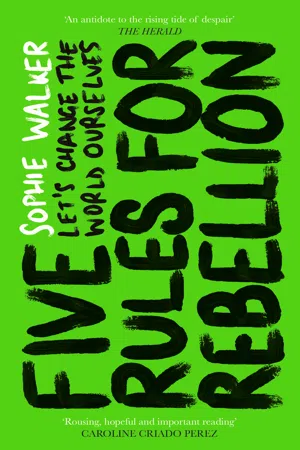
Had enough? Feeling hopeless? Don't give up - join the rebellion.
Activist, journalist, founding leader of the Women's Equality Party and 'modern-day suffragette' (
Evening Standard) Sophie Walker presents an inspiring, five-step journey to incorporating activism into our lives.
Featuring stories of new and seasoned activists - including Amika George and Jack Monroe - campaigning on a range of issues from reproductive rights and poverty to the environment and access to education - the book shows us how to see activism not as a series of pitched battles but as a positive, lifelong learning experience.
Escape the numbing effects of despair, learn to channel anger, arm yourself with hope, practise perseverance and connect with others compassionately.
Five Rules for Rebellion explains how we can convert our confusion and impatience into a powerful force for change.
'Thoroughly engaging, empowering and inspiring ... blows invigorating air into the weary world of politics and makes you want to get out there NOW and do something about it' - Ailbhe Smyth, co-director of Together For Yes and convenor of Coalition to Repeal the 8th Amendment
- 224 pages
- English
- ePUB (mobile friendly)
- Available on iOS & Android
eBook - ePub
About this book
Information
Rule
1
1
DEFEAT DESPAIR
‘You are never stronger than when you land on the other side of despair.’
– Zadie Smith
‘It’s all a mess. Nobody listens. Me? Nothing I can do. I keep my head down. Live my own life.’
It’s a Sunday morning and Tom, aged 28, is buying materials for some weekend DIY. There’s a steady stream of people entering and exiting this big suburban store that sells a wide range of home improvement kit and hardware. Outside, the car park is busy with vehicles of all shapes and sizes into which couples, families and weekend workmen load boxes and bags. Inside, the aisles and check-outs are busy with purposeful men and women holding handwritten lists of materials and carrying everything from tins of paint to doorknobs.
But ask them about how they feel about fixing the wider world, and their air of purpose visibly slips.
‘Pffft!’ Michael, 56, blows out his cheeks, exasperated. I’ve 20asked him how he feels about the state of world and whether he might be able to fix that as well as he fixes upholstery. ‘I wouldn’t know where to start,’ he replies. ‘And there’s no point. Nothing makes a difference, much.’
Sarah, carrying carpet cleaner, agrees. ‘Politicians don’t care. They’re not interested in anyone except themselves,’ the 62 year old tells me. ‘I’m worried about what kind of world my grandchildren are going to live in, but I don’t see that there’s much I can do about it except try to look after them myself as best I can.’
Sarah, Michael and Tom’s loss of faith is typical of current public attitudes. In 2019 the Ipsos MORI Veracity Index found that politicians were the least-trusted profession surveyed, displacing advertising executives, who most frequently occupied the bottom place. Just 14 per cent of the public said they trusted politicians in general to tell the truth. Separately, research by Young Women’s Trust found that 72 per cent of young women aged 18–24 in the UK had less confidence in elected representatives than the previous year. And a poll by PR consultancy firm Edelman found that 60 per cent of Britons believed their views were not represented by British politics.
Americans’ trust in US institutions is also in a poor state. A 2018 poll by NPR, PBS NewsHour and Marist showed that Americans have limited confidence in public schools, courts and banks, and even less confidence in big business and politics. Just 8 per cent of those polled had confidence in Congress. Ten per cent trusted the Republican Party and 13 per cent trusted the Democratic Party.21
This crisis of democracy is not limited to the West, and it’s not new – political trust among current generations has been declining since the 1960s and 70s. In 1974, Takeo Miki became Prime Minister of Japan at a point when the country faced a global post-war recession, unprecedented levels of inflation and a political system rendered ineffective by a lack of collective responsibility. His own ruling Liberal Democratic party was out of policy ideas and dominated by scandals, in-fighting and personal rivalries. At his first press conference, Miki said: ‘We face the most difficult situation in the post-war years. The mission of the moment is to restore the people’s confidence in politics.’
Fast forward to 2002: Dutch Prime Minister Jan Peter Balkenende was so desperate for a spell to renew public confidence in politics that he based his election campaign imagery on his likeness to Daniel Radcliffe, the actor who portrayed J.K. Rowling’s wizard hero Harry Potter. Trust in the national parliament, which had so far held up against a decline in other countries, fell sharply in the Netherlands from 2001, despite the country’s high rankings for prosperity and standard of living. Analysis of the fall suggests a rising feeling among voters that the government felt distant and patronising, that there wasn’t a chance to make their voices heard in crucial decisions. Globalisation, migration and EU enlargement, against the dissenting voices of anti-Islam and anti-immigrant politicians such as Pim Fortuyn (whose assassination temporarily increased the popularity of his LPF party), all contributed to a rising sense of risk and uncertainty to which voters felt the political establishment was unequal. By 2010, after four coalition cabinets collapsed, Balkenende resigned, having spent his 22time as prime minister primarily focused on political in-fighting. ‘Without trust, any attempt to agree on matters of substance is doomed to failure,’ he said.
As Balkenende was stepping down, the new UK Prime Minister David Cameron was pledging to rebuild public trust in politics with the slogan ‘We can’t go on like this’ central to his messaging. He had already declared in his party leadership victory speech of 2005 that he was fed up with the ‘name calling, backbiting, point scoring, finger pointing’ of Westminster and promised, in a tweet that has now been posted by activists on public billboards across the nation as a post-EU-referendum reproach: ‘Britain faces a simple and inescapable choice – stability and strong Government with me, or chaos with [opposition Labour leader] Ed Miliband.’
The swell of distrust has been growing for a long time. Our politicians and political institutions can’t say they didn’t see it coming. And you don’t have to look very far for more reasons why people think leaders and institutions are incapable of action or innovation.
According to a Credit Suisse survey in 2017, 1 per cent of the population own half the world’s wealth. The world’s 3.5 billion poorest adults each have assets of less than $10,000. Meanwhile, global greenhouse gas emissions have reached record highs, and the Intergovernmental Panel on Climate Change has warned we may only have until 2030 to avert catastrophic climate change. In the Western hemisphere, a decade’s worth of austerity budgets – the decision by so many governments to make taxpayers and those dependent on welfare pay for mismanagement of the banks that brought about 23the financial crisis – has left the most vulnerable on their knees and prey to chancers pretending to be men of the people. Self-styled ‘strong men’, like US President Donald Trump, Brazilian President Jair Bolsonaro, Hungarian Prime Minister Viktor Orbán and UK politician Nigel Farage, are all hiding their establishment links and spinning tales about immigrants as the real culprits to blame for a widely felt loss of dignity and dependable work.
We’re living at a time when populists and politicians are so desperately short of ideas that they have resorted to the oldest strategy in the book: divide and rule. It’s a favourite of those with no imagination and a thirst for power. Frighten people and turn them against one another and, with a bit of luck, they won’t notice how lacking in true solutions you are. Politics is calcifying because it is dominated by people who look and sound the same: professionalised to death by people who come to it as a paying job rather than to do public service, or who seek a soapbox from which to broadcast their own opinions rather than fresh ideas on behalf of the voting public. The only invention now is the reinvention of angry white men pretending to be prophets of the people, howling about ‘identity politics’ in what is the most dangerous identity politics of all: the rage of those with power and privilege against any suggestion that it might be time to make room for people who look and sound different.
It is tempting at times like this to look away, to look inward, to protect private spaces and immediate family, as Sarah said at the top of the chapter. It’s tempting also to decide that things aren’t that bad – to emulate the approach of climate change 24deniers when it comes to this global political meltdown and tell ourselves that it’s just cyclical, it will pass and, really, it’s not so serious. Turkish writer Ece Temelkuran, in her book How to Lose a Country, describes a London event in 2016, two months after a failed coup in her home country, at which a woman in the audience asked her with pity what help Britain could offer.
Temelkuran writes: ‘I pause for a second to unpack the invisible baggage of the question: the fact that she is seeing me as a needy victim; her confidence in her own country’s immunity from the political malaise that ruined mine … This is a moment in time when many still believe that Donald Trump cannot be elected, some genuinely hope that the Brexit referendum won’t actually mean Britain leaving the European Union, and the majority of Europeans assume that the new leaders of hate are only a passing infatuation.’ After a beat, Temelkuran responds to the audience member: ‘Whatever happened to Turkey is coming towards you. This political insanity is a global phenomenon. So actually, what can I do for you?’
Despair manifests in many different ways. Pretending things are fine while pushing away a worried or sinking feeling is a response that many of us have been trained in. It’s often the response to a lifetime of experience that teaches many of us that asking for attention and respect is a dangerous act, that we are not good enough or worthy enough, that we need to work harder and be better to earn significance. It’s the same impulse that can also manifest as fierce love and loyalty towards a charismatic snake oil salesman who promises that he sees you and is outraged on your behalf at the way you’ve been treated. 25
Despair is seeing the extent of the storm, understanding its ferocity and deciding that your best chance of survival is to hunker down and hope it passes. If you are one of the people in the storm bunker, remember that the people whipping up the tornado are really committed and really busy, and they are not going away. They will relentlessly create a stronger and stronger force for destruction until everything is levelled.
Over the months of writing this book, I have seen and felt the pressure building. News came that Rita Bosaho, Spain’s first black female MP, had lost her seat in a general election in which 10 per cent of the Spanish vote was won by the far-right Vox party. Vox attempts to frighten voters into distrusting one another by centring migration as everyone’s biggest problem; it also suggests that key to a stable society is rolling back women’s rights. Vox wants to scrap legislation to halt violence against women on the grounds that it discriminates against men. The party dehumanises feminists by routinely calling them ‘feminazis’.
Bosaho was born in Equatorial Guinea, which has one of the world’s worst human rights records. Two of her uncles, as well as other relatives, were killed by the regime that took over when the country gained independence from Spain in 1968. She has lived in Spain since she was four and was working as a nurse’s aide at a hospital in Alicante until the financial crisis, when government cuts, combined with a major public spending corruption scandal, prompted her to join the anti-austerity movement and, in turn, Podemos, the left-wing movement that set out to end corruption and achieve social justice.
Speaking to me a few weeks after her election loss, via a journalist friend and translator, Bosaho explains that, while she 26never needed to be convinced of the importance of activism, she was surprised to find that the crisis created a movement in which her voice could really be heard.
‘I was born in a country that has never known what human rights are: a dictatorship. For that reason, I’ve never had to have a Eureka moment [as regards activism]. But the Indignados movement [a peaceful protest led by ordinary Spaniards who organised sit-ins in city squares against government austerity measures] […] was like a snowball effect, with more and more people joining in. You could participate in a town square and for the first time your voice could be heard and become important. That had never been possible before in Spain.’
Podemos attracted her because it didn’t have the structure of a classic political party, even though she later felt constrained by the structural difficulty of delivering change from within a system designed to encourage stability over revolution. She explains:
‘I sometimes get down about the dynamics of how political parties work. At the start everyone wants to change everything, but all of a sudden you are in a political party and that party has to behave within certain structures, and you can’t operate in the same way as you do on the street.’
But in the end, Bosaho says: ‘I will be an activist until I die. I’ll carry on fighting. What motivates me are the roots of my race: over and above being a feminist, I am a black woman. Because of the almost total invisibility of anyone of colour in Spain, my biggest cause is against racism.’
Bosaho may no longer have a seat in Spain’s Congress, but her trajectory shows the determination of ordinary people for 27change. She shows that despair can be overcome – even when progress is not linear. She shows that people do want more than the broken systems they are told to put up with; and they want life to be meaningful and purposeful and rewarding; and they are driven by exasperation at what’s on offer instead.
Back at the DIY superstore on my day of informal public polling, I eventually exit towards the car park, where I notice a charity stand has been set up just along from the stacked piles of logs that were rapidly diminishing thanks to the weekend’s forecast of a cold snap. Blowing on her fingers in between asking customers to pause for a chat is Milly, a 24-year-old volunteer. She is here to talk to people about the work of an international aid organisation.
‘I feel in equal measure dismayed and hopeful,’ she tells me. ‘We have a lot of barriers, and there’s an increasing sense of division that’s really vitriolic in the way it’s expressed. Everything feels like conflict.’
She continues: ‘It’s an indictment of where we are that this organisation has to pick up the slack where international governments don’t. But I do find hope from the way in which some people rally around this organisation. They don’t take the word of states and governments. They do defy the status quo.’
On a cold and drear day, Milly’s summing up gives a warm glow. Her words speak of belief in potential action from a group of people who stated that they had given up; she had uncovered the contradiction within all those people repairing and nourishing their homes while despairing over their country. This is the nub of truth from which any activism begins: when 28you recognise how daunted you are by the world, you are simultaneously recognising that you do want better. Within your despair lies the path out of it. Or, as George Eliot wrote in Middlemarch: ‘What we call our despair is often only the painful eagerness of unfed hope.’
We should take heart from the words of a woman who had to take a man’s name in order to make her voice heard.
Within Eliot’s words is another truth that offers us a strategy for casting off despair. Much of the world we live in is structured to foster despair. It’s built by the winners, to keep everyone else subdued by feelings of intimidation that they may not even recognise. If despair is structural, so must our response to it be. We can take heart from those who have recognised this before us. The history of activism – and of societal change − is dominated by women building alternative routes, groups and networks when their needs and experiences were ignored or dismissed by those in positions of power. The needs of our communities have long been shored up by local activists striving for practical change and broader solutions when political parties’ policies fail.
There are millions of global examples of what former UK Prime Minister David Cameron termed ‘Big Society’. This was a campaign that attracted some good campaigning minds but ultimately reeked of political hypocrisy, set as it was against a background of austerity cuts that forced community groups to pick up a very heavy burden as local services were deprived of vital funds. In the end it became a byword for the work of low-paid and unpaid and undervalued people whose lives had not merited investment yet who picked up the pieces of their 29broken communities and, with hope, empathy and collaboration, tried to create new solutions.
Their work is where we will start to find the answers to the enormous questions posed by automation, migration and the changing nature of work; our global connectivity and the way we trade; and the conflict and poverty that scars our world even as we are told we’ve never had it so good. On-the-ground activism redraws politics into something much more immediate, real and rooted in people’s day-to-day lives. Mass action movements challenge political certainties. The failed visions and narrow-minded investment of governments and institutions have fuelled great pain but also channelled protestors’ impatience into finding alternative answers.
Traditional economic and democratic thinking has been tested to destruction. In this context, activism is not just an alternative, it’s essential.
Jack Monroe’s activism began as survival in the most desperate of circumstances; she lost her job and began a downward spiral into poverty as the we...
Table of contents
- Title Page
- Contents
- Dedication
- About the Author
- Introduction
- RULE 1: Defeat Despair
- RULE 2: Channel Rage
- RULE 3: Wield Hope as Power
- RULE 4: Collaborate with Compassion
- RULE 5: Practise Perseverance
- Now Do It
- Stay Inspired
- Further Reading for Rebels
- Acknowledgements
- Copyright
Trusted by 375,005 students
Access to over 1.5 million titles for a fair monthly price.
Study more efficiently using our study tools.
Frequently asked questions
Yes, you can cancel anytime from the Subscription tab in your account settings on the Perlego website. Your subscription will stay active until the end of your current billing period. Learn how to cancel your subscription
No, books cannot be downloaded as external files, such as PDFs, for use outside of Perlego. However, you can download books within the Perlego app for offline reading on mobile or tablet. Learn how to download books offline
Perlego offers two plans: Essential and Complete
- Essential is ideal for learners and professionals who enjoy exploring a wide range of subjects. Access the Essential Library with 800,000+ trusted titles and best-sellers across business, personal growth, and the humanities. Includes unlimited reading time and Standard Read Aloud voice.
- Complete: Perfect for advanced learners and researchers needing full, unrestricted access. Unlock 1.5M+ books across hundreds of subjects, including academic and specialized titles. The Complete Plan also includes advanced features like Premium Read Aloud and Research Assistant.
We are an online textbook subscription service, where you can get access to an entire online library for less than the price of a single book per month. With over 1.5 million books across 990+ topics, we’ve got you covered! Learn about our mission
Look out for the read-aloud symbol on your next book to see if you can listen to it. The read-aloud tool reads text aloud for you, highlighting the text as it is being read. You can pause it, speed it up and slow it down. Learn more about Read Aloud
Yes! You can use the Perlego app on both iOS and Android devices to read anytime, anywhere — even offline. Perfect for commutes or when you’re on the go.
Please note we cannot support devices running on iOS 13 and Android 7 or earlier. Learn more about using the app
Please note we cannot support devices running on iOS 13 and Android 7 or earlier. Learn more about using the app
Yes, you can access Five Rules for Rebellion by Sophie Walker in PDF and/or ePUB format, as well as other popular books in Politics & International Relations & Political Advocacy. We have over 1.5 million books available in our catalogue for you to explore.