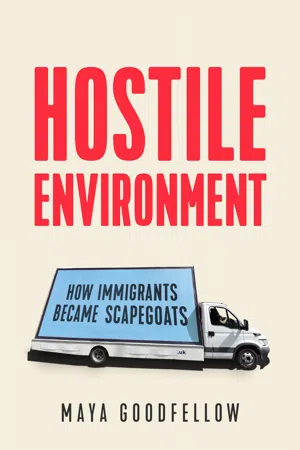
Longlisted for the 2019 Jhalak Prize. From the 1960s the UK's immigration policy - introduced by both Labour and Tory governments - has been a toxic combination of racism and xenophobia. Maya Goodfellow tracks this history through to the present day, looking at both legislation and rhetoric, to show that distinct forms of racism and dehumanisation have produced a confused and draconian immigration system. She examines the arguments made against immigration in order to dismantle and challenge them. Through interviews with people trying to navigate the system, legal experts, politicians and campaigners, Goodfellow shows the devastating human costs of anti-immigration politics and argues for an alternative.
This new edition includes an additional chapter, which explores the impacts of the 2019 election and the ongoing immigration enforcement during the coronavirus pandemic.
- 272 pages
- English
- ePUB (mobile friendly)
- Available on iOS & Android
eBook - ePub
About this book
Information
1
The Cost of It All
What decadence this belonging rubbish was, what time the rich must have if they could sit around and weave great worries out of such threadbare things.Sunjeev Sahota, The Year of the Runaways
An industrial estate on the edge of central Birmingham might not sound like the place to find out about the difficulties of migrating to the UK. But in a building nestled behind a car park and overlooking the network of canals that branch off to the nearby town of Smethwick, a group of around thirty people met up on a cold, rainy October evening to talk about their problems with the immigration system. Overstretched lawyers and immigration specialists were on hand to offer advice. As is typical of a winter’s day in the UK, the darkness of evening descended far too early, and rain bounced off the pavement as we all made our way into the building, but the room was warm and buzzing with activity when I arrived. People were introducing themselves and getting to know each other while tucking into complimentary homemade samosas taken from a deep bowl that sat next to tea and coffee laid out on one side of the room.
Coming from all over the world, some of the people there that night had struggled alone to navigate disorientating immigration rules while others had to find a way through for their whole family. In the room were children of various ages – from curious babies to bored seven- or eight-year-olds. Some had been born in the country, others had migrated with their parents. But for all of them their future in the UK was uncertain. What united these people was the time, effort and money – often money they didn’t have – they were spending to try to stay in this country. About fifteen minutes after I arrived, people took their seats, forming a circle in the middle of the room. As the meeting began, almost immediately their anger and worry spilled out of them. They shared stories of being fleeced by lawyers, going into courtrooms where the people they’d paid to represent them didn’t even know the most basic details of their case, and explained the desperation they felt when their claims were repeatedly rejected.
For all the focus on the supposed importance of defending our national borders from outsiders and tales of immigration bringing problems to the UK, too few debates are concerned with how difficult it can be to be a migrant in this country.
One of the people I met in Birmingham was Diana.1 She came from Zimbabwe as a visitor and began studying before going on to marry an EU citizen. But her marriage quickly deteriorated: ‘I had to come out of the relationship because of domestic violence.’ She says she left her partner to save her life. She knew nothing about the asylum process, but in 2013 she was told she could apply for refugee status. Diana quickly learned how many people are out there who are ‘ready to mislead you’. One of her lawyers didn’t give her the right information about applying for asylum, which meant that, when she went to court, she didn’t present relevant facts that might have helped her case. Other lawyers she paid barely gave her any time and didn’t go through her case properly. At each appeal, she was refused the right to stay in the country.
Understanding all the intricacies of what happened to Diana, and all the other people I talk to, takes time and requires countless follow-up questions. It’s unclear how anyone manages to make sense of and navigate the disorientating process she describes. But she is still determined to secure refugee status, and she puts her lack of success at least partly down to poor representation. Still, she isn’t giving up. ‘One of the things I’ve found and that has encouraged me to be who I am today is you learn the hard way: ignorance is expensive – and ignorance is not bliss at all.’
Diana isn’t alone. She and Kelly, another person I speak to, live in different cities and have had completely different lives, but their experiences of the immigration regime are remarkably similar. Calling the UK home since she was nine years old, Kelly came here after her dad brought the whole family – Kelly, her sister and her mother – from West Africa on a diplomatic visa. Ten years later, when Kelly was in the middle of her first year of university, he abruptly left the country and she was told she didn’t have the right to stay in the UK. With her mum and sister, Kelly applied for a family visa, but when that was rejected, she decided to apply for the right to stay in the country alone.
‘I went through three lawyers,’ she says. The first one didn’t understand her case and after he submitted her application, the Home Office said there was no cogent argument in the papers, so they had nothing to consider. That cost her over £1,000. ‘At the time I didn’t understand the case, so I was dependent on him to explain,’ Kelly remembers, shaking her head. ‘There was no communication … so … I was chasing him every second and then when the Home Office refused it there was not much done.’
Kelly waited three years for her appeals to be processed. With no right to work and unable to access state support, she had to resort to living between friends’ houses and she nearly became homeless. ‘It’s ridiculous to be honest because you’re not allowed to work, so where do you expect me to get the money from?’ she asks. ‘I think the cost is just to frustrate people to just give up and go back.’ She asked multiple agencies for financial support and legal help. She was a ‘novice’ and had no idea ‘what was going on’. It’s not chance that makes Kelly’s and Diana’s experiences so similar. As well as exorbitant fees for visas and applications, support for immigration and asylum cases is almost non-existent unless you happen to have the money to pay for it, and when you’re not allowed to work, for many people, funding legal representation is an impossible task. Even for those lucky enough to be able to afford it, there’s no guarantee that the advice you get is going to be reliable.
‘In the late 90s when New Labour came in, it was a sort of a golden age for legal aid … because there were a lot of asylum claims at that time the government was really throwing money at solicitors’ firms to get them to open immigration departments … to get solicitors trained up in immigration law so they could take on all these asylum claims,’ former immigration barrister Frances Webber remembers. The legal aid she talks about is money the state gives to people who need it to pay for advice or representation. It was available for people regardless of where they were born, so it could be used for people trying to regularise their status or claim British citizenship. But within about three years, New Labour started cutting back. ‘It was like this great tidal wave of money was then retreating, retreating, retreating,’ Webber says.
In 2007, the government introduced a flat fee for legal aid asylum cases, which meant lawyers were paid a fixed amount regardless of how many hours they worked on a case. ‘If you did go over a certain number and if you could justify that … then you would get paid by the hour,’ Webber explains, but getting to that stage was very complicated and difficult. These changes incentivised a factory-style process: encouraging ‘rubbish firms who do no work or do very little work’ and penalising those who took ‘great care’. Firms were expected to subsidise work on asylum cases with money they received from more straightforward legal aid cases. Then the Coalition government cut legal aid in 2013, including the money available for most immigration and asylum cases.2 ‘When we talk about legal aid cuts and we talk about other aspects of austerity,’ journalist Rebecca Omonira-Oyekanmi says, ‘we don’t also talk about immigration.’
New Labour had cracked down on fraudulent lawyers but, as costs spiralled and legal aid was hacked away, the chaos left people once again exposed to predatory lawyers. What has essentially been solidified is a two-tier justice system.
Reliable help is now extremely hard to come by. Two of the biggest not-for-profit immigration and asylum centres, Refugee and Migrant Justice (RMJ, formerly the Refugee Legal Centre) and the Immigration Advisory Service, closed in 2010 and 2011 respectively. Between them, they represented around 20,000 clients and employed hundreds of staff. The reason for their failure was massive cash issues; RMJ said this was brought on by changes to legal aid, which meant bills wouldn’t be paid until a case was finished. When they went under, they were owed £2 million by the Legal Services Commission, which ran the legal aid scheme in England and Wales from 2000 until 2013.3 ‘You just don’t have the bodies helping people, so you are going to see more rejections,’ explains Alison Moore, director of Refugee Women Connect, an asylum organisation in Liverpool, which caters specifically for women. ‘It’s not an area where you shouldn’t have a legal representative with you.’
But the issue is also the cost. ‘Initially they were very modest,’ Webber says of immigration fees. They were increased by a small amount when the Home Office claimed they weren’t covering administrative costs. But then they skyrocketed to the levels they are now, and they’re still soaring. In 2016–17, fees for settlement, residence and nationality increased by 25 per cent. They’re constantly changing, but at the time of writing, if you want to become a permanent resident of the UK, it will cost you £2,389.4 That’s on top of £50 for a ‘Life in the UK’ test, which you have to take when you apply to become a British citizen or for permanent residency and, if you’re required to take one, £150 for an English exam.
Playwright Inua Ellams had discretionary leave to remain and so had to refresh his status every three years, costing £900 each time.5 Being able to stay in this country, he tells me, is ‘expensive – it’s thousands upon thousands upon thousands of pounds’. It’s even gotten to the stage where the Home Office is charging £5.48 every time you require a response by email.6 This inevitably impacts poorer migrants disproportionately, people who might not be able to pay to get the reply they need, which risks subsequently preventing them from successfully resolving their claim.
Having cash is not an automatic guarantor to frictionless movement, but money lubricates the whole system. As of 2010, if you have £2 million or more to invest in the British economy, you can apply for an ‘investor’ visa – and if successful, come to the country for three years and four months and bring immediate family members. The right to settle after two years has a £10 million price tag, and £5 million buys the same entitlement after three years.7 For everyone else, the cost of it all can shape their whole lives.
While successive governments have extolled the virtues of family life, immigration controls have kept people apart. Since July 2010, migrants from outside the European Economic Area and their spouses in the UK have been separated by borders and the associated price tags. Under Theresa May’s plans to ‘get numbers down’, a UK citizen or settled resident (someone who has the right to stay in the UK with no time restrictions) had to earn £18,600 per year before tax if they wanted their non-EU partner to join them. The cost rose by £3,800 if that included bringing a child, and an extra £2,400 for every additional child.8
For decades, non-EU spouses and family members have been treated with suspicion when all they wanted was to join their loved ones: couples are quizzed over the most intimate details of their relationship and asked questions often based on racist stereotypes; children’s teeth and wrists are X-rayed to try to ascertain their age; and older relatives have been left continents apart from their closest family simply because they have a relative in the country they’re in – even if that person isn’t available, able or willing to look after them. It’s virtually impossible for elderly non-Europeans, whether grandparents, aunts and uncles or siblings, to come to live in the UK.9 And it’s not always easy to visit either.
It’s these strict, costly rules that left five-year-old Andrea Gada’s family desperate. Walking home from school with her father and brother on a winter’s day in Eastbourne, Andrea was hit and killed by a car. When her grandparents and aunt applied to come from Zimbabwe for her funeral, they were denied a visa. According to their local MP, then Liberal Democrat Stephen Lloyd, they were deemed ‘too poor’ to be granted a temporary visa to come to the funeral in the UK. The Home Office offered a more technical verdict: they hadn’t previously left Zimbabwe, couldn’t show they had regular incomes and therefore were considered at risk of absconding.
The three grieving relatives – Mona Lisa Faith and Grace and Stanley Bwanya – were desperate to be at Andrea’s funeral. They tried every solution possible, from offering to wear electronic tags to saying they would report regularly to a police station while they were in the UK. Recognising how unfair the rules were, people rallied around their cause. Lloyd guaranteed that, if they were allowed to enter the UK, he would personally make sure they left the country after the funeral, and members of the community raised £5,000 to help cover travel costs. But the government rejected the application for a second time. Then slowly their case began to make headlines. The attention resulted in a petition asking the government to reverse their decision. Over 120,000 people signed it. Finally, the Home Office relented. Without public pressure and media attention, this could have been just one more story among countless others in which people are kept apart by uncaring and inflexible immigration policies. ‘Anyone who has ever struggled with poverty’, wrote essayist James Baldwin, ‘knows how extremely expensive it is to be poor.’10
Worryingly and somewhat inevitably, the few organisations that exist to help people struggling with their status are overstretched, laden with more responsibilities than they can manage and struggling to survive. But they are vital. ‘It’s become almost impossible for people with most kinds of immigration issues to get any advice,’ says Benjamin, who gives assistance to destitute migrants. ‘And it’s become much more difficult for people who’ve got that legal advice to find routes to regularising their status.’ And as successive governments have talked and acted tough on immigration, migrants – documented and undocumented – feel able to trust very few people. ‘Just from the point of view of people who have jobs in the sector and get paid to do advice work it’s really frightening. Caseworkers are burning out, and it’s only possible to imagine that services are just going to become more and more strained than they already are,’ Benjamin explains.
He calls charities that hold regular drop-ins for migrants, asylum seekers and refugees ‘advice factories’; they’re under immense amounts of pressure, people can’t stay in the line of work for long and, as they leave, knowledge goes with them. This slowly depletes the level of experience within organisations, which is necessary to help people navigate what is an intentionally onerous and complex set of rules.
‘It’s hard not to feel like the government is doing it deliberately, not just to create a hostile environment for people who are here “illegally” but also to make it more difficult for people supporting them … and I think everyone anticipates that at some point there will be legislation deliberately aimed at the organisations that support, for example, undocumented people to make it more difficult for them to be accommodated and to make it more difficult for people to get advice.’
This advice is essential because it’s hard to make sense of the UK’s labyrinthine network of ever-changing rules and regulations. While politicians claim immigration is a taboo subject, one estimate suggests that, since the early 1990s, there has been, on average, a piece of legislation on immigration every other year.11 Between 2010 and 2018, over the course of the Coalition and then Conservative governments, there were seven immigration bills containing all kinds of changes.12
‘It’s actually designed to isolate you, to bring you down, to make you want to give up and pack your bags and just go,’ Diana, who has tried to claim asylum here, says. ‘People have to really own their situation, you can’t rely on somebody else. You have to know your rights and without that … you’re headed for downfall.’ She adds, ‘I’m not really a bad person. You’ve [Britain] treated me so bad for just wanting to have a life to live.’
Diana isn’t the only person I meet who feels like that. After applying multiple times for the right to extend her study visa and then being detained in the notorious detention centre Yarl’s Wood, Christina agreed to go home. But when the day came for her to pack up all her belongings, take them to the airport and board a Nigeria-bound plane, she was left standing at the check-in desk without her passport. The Home Office was holding it hostage. Numerous emails, letters and meetings with her lawyer hadn’t been enough for them to relinquish it. She was in a country that didn’t want her to stay but that woul...
Table of contents
- Cover Page
- Title Page
- Copyright Page
- Dedication
- Contents
- Introduction: An Honest Conversation
- 1. The Cost of It All
- 2. ‘Keeping’ the Country White
- 3. New Labour: Things Can Only Get Better?
- 4. Legitimate Concerns
- 5. ‘It’s Not Racist. It’s Common Sense’
- Conclusion
- Afterword: All of the Lessons That Haven’t Been Learned
- Acknowledgements
- Notes
Trusted by 375,005 students
Access to over 1.5 million titles for a fair monthly price.
Study more efficiently using our study tools.
Frequently asked questions
Yes, you can cancel anytime from the Subscription tab in your account settings on the Perlego website. Your subscription will stay active until the end of your current billing period. Learn how to cancel your subscription
No, books cannot be downloaded as external files, such as PDFs, for use outside of Perlego. However, you can download books within the Perlego app for offline reading on mobile or tablet. Learn how to download books offline
Perlego offers two plans: Essential and Complete
- Essential is ideal for learners and professionals who enjoy exploring a wide range of subjects. Access the Essential Library with 800,000+ trusted titles and best-sellers across business, personal growth, and the humanities. Includes unlimited reading time and Standard Read Aloud voice.
- Complete: Perfect for advanced learners and researchers needing full, unrestricted access. Unlock 1.5M+ books across hundreds of subjects, including academic and specialized titles. The Complete Plan also includes advanced features like Premium Read Aloud and Research Assistant.
We are an online textbook subscription service, where you can get access to an entire online library for less than the price of a single book per month. With over 1.5 million books across 990+ topics, we’ve got you covered! Learn about our mission
Look out for the read-aloud symbol on your next book to see if you can listen to it. The read-aloud tool reads text aloud for you, highlighting the text as it is being read. You can pause it, speed it up and slow it down. Learn more about Read Aloud
Yes! You can use the Perlego app on both iOS and Android devices to read anytime, anywhere — even offline. Perfect for commutes or when you’re on the go.
Please note we cannot support devices running on iOS 13 and Android 7 or earlier. Learn more about using the app
Please note we cannot support devices running on iOS 13 and Android 7 or earlier. Learn more about using the app
Yes, you can access Hostile Environment by Maya Goodfellow in PDF and/or ePUB format, as well as other popular books in Politics & International Relations & Modern British History. We have over 1.5 million books available in our catalogue for you to explore.