- 160 pages
- English
- ePUB (mobile friendly)
- Available on iOS & Android
eBook - ePub
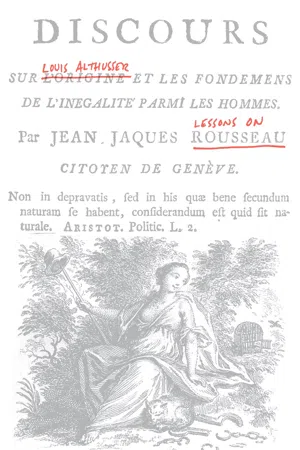
Lessons on Rousseau
About this book
Althusser delivered these lectures on Rousseau's Discourse on the Origins of Inequality at the ?cole normale sup?rieure in Paris in 1972. They are fascinating for two reasons. First, they gave rise to a new generation of Rousseau scholars, attentive not just to Rousseau's ideas, but also to those of his concepts that were buried beneath metaphors or fictional situations and characters. Second, we are now discovering that the "late Althusser's" theses about aleatory materialism and the need to break with the strict determinism of theories of history in order to devise a new philosophy "for Marx" were being worked out well before 1985 in this reading of Rousseau dating from twelve years earlier, which introduces into Rousseau's text the ideas of the void, the accident, the take, and the necessity of contingency.
Information
Topic
PhilosophySubtopic
Critical TheoryLECTURE THREE
17 March 1972
I SHALL GIVE YOU ONE final lecture today, and stop after this lecture. In this final lecture, I would like to talk to you about Rousseau once again and about the second Discourse once again. I would like to do something somewhat detailed on Part I of the second Discourse.
Last time, we saw the theoretical effects produced in Rousseau by the completely unprecedented dispositive of his genesis, a discontinuous genesis. We saw that these theoretical effects concern a certain number of possible concepts, ideas, and notions that are not made explicit, that are not thematized and, a fortiori, not systematized by Rousseau: hence possible concepts in the free state, in a state of theoretical divagation. We saw that these concepts – they can be so described – designate something which, vis-à-vis the old object of natural law theory, is very plainly a new object: it is what can be called the ‘object history’, with, of course, all the scare quotes one likes.
We saw, you will recall, the theoretical premises thanks to which this unprecedented dispositive of the genesis was literally imposed on Rousseau. It was imposed on him thanks to his radical critique of the false origin as circular and, correlatively, thanks to the fact that the true origin was posited as separate from the false origin, as pure, since this true origin is the pure state of nature. The simple critical redoubling of the origin, its division, thus had two effects, one triggering the other: first, the discontinuous dispositive of the genesis, of the process of denaturation and socialization; and, second, what I am calling the possible concepts implied by the provocation of the novelty of this dispositive.
However, these concepts, which I would group around the object history – these concepts are merely practised by Rousseau, rather than thought by him. To take just one example: the concept of accident observable between the state of pure nature and the state of peace, or between the state of peace and the state of war – in other words, the cosmic accidents, to begin with, followed by the accidental discovery of metallurgy, which Rousseau calls ‘this fatal [funeste] accident’.1 Rousseau practices the concept of accident, inasmuch as he writes the word ‘accident’, but he does not think the concept that he practices; he brings it into play, but does not reflect on it, on its theoretical meaning. He does not bring it into relation with his other concepts. That is what reflecting a concept would mean.
The consequence is that the concepts that we have brought out around the object history are visible for us, as a result of the analysis we have brought to bear on the structure of the dispositive and of the process of socialization/denaturation, and as a result of our comparative analysis of this dispositive, which we opposed to the classical dispositive of natural law philosophy – and only on that condition. It is only because we have analysed the implications of the dispositive of this process that these concepts are visible for us, but these effects are not visible in the same way [au même titre] for Rousseau in his text. It is not that these concepts or effects are invisible in and of themselves; it is not that they do not figure in Rousseau’s text, for they do figure in the logic of his text. Rousseau, however, fails to see them, and fails to see them for a simple reason: he directs his gaze elsewhere. We may say that these effects escape him, in both senses of the word: objectively, because he produces them without explicitly wanting to; and subjectively, because he does not pay enough attention to their existence to reflect it theoretically.2
The fact is that Rousseau trains his attention on completely different concepts, which he has forged to make his system function. Indeed, we can say that the concepts that make Rousseau’s system function are one thing, and the concepts that the system necessarily produces thanks to its very special sort of theoretical distraction (which we analysed last time) are quite another. Put differently, in order to bring out what is unprecedented in Rousseau, we have so far analysed, above all, the principle of the redoubling of the origin and the effect of that redoubling, the discontinuous structure of the process, and the effects of this effect, namely, the concepts induced by this structure.
We must, however, go on to see how Rousseau makes his system function with his explicit concepts. Since I cannot, in this final lecture, analyse the whole of the process depicted in the second Discourse, I shall take one precise example, the example of the first moment, the example of the pure state of nature, and ask the following question: How does Rousseau manage to produce a representation of this state? What determinations does he attach to it? What is their inner logic? What is the logic of this discourse, and what is the discourse of this logic? I am going to follow Rousseau’s text very closely in certain passages; however, to follow it closely, one does well to observe it from a certain distance. I shall therefore remind you that the state of pure nature has to meet – after all that we know, all that has been said about the origin – two requirements.
The first requirement is that the state of pure nature has to escape from the circle of the result projected onto the origin; that is, from the circle of the social result projected onto the pre-social, the non-social, from the circle of society projected onto the state of nature. For this reason, the state of pure nature must be a radical absence [néant] of society. It must be the absolute degree zero of society. Thus it must be separated, in the strong sense, from everything involving society, from every existing social result. In other words, between society and this radical absence of society, which will be a state, a nil [néant] state, of society, there must be a radical separation: not a de facto separation – this is the important point – but a de jure separation, such that the state of nature contains in itself, de jure, this separation itself. The first requirement is that separation not be imposed on it from outside, but result from its inner essence. It is not all that easy to meet this requirement in the representation of a real state.
The second requirement might be stated as follows. The state of nature must be the true origin, must, that is, be an origin in a mode altogether different from that of the false origin; hence it must be an origin in a mode external to the circle. The state of pure nature as origin must therefore contain, in a form to be defined, non-social determinations corresponding to the radical absence of society, determinations which, albeit radically separate in the sense just mentioned, are nevertheless originary, are the origin without being the cause of the contradictory process of socialization and denaturation; and are also the origin, while being, this time, the cause of the denaturation of the denaturation, of the negation of the negation, in short, of the restoration of the state of nature on new foundations at the moment of the social contract. There we have the two requirements.
We shall now see, in detail, how these two requirements are staged [mises en scène] by Rousseau; in other words, how the origin is realized, a term that must be understood in the strong sense. That is, we shall see how Rousseau confers reality, or something that has the appearance of being a reality, or the signification of being a reality, on the origin, in a concrete theoretical figure, in something anticipating what Hegel will call a Gestaltung, that is, a concrete figuration. I say ‘in a concrete theoretical figure’. Why theoretical? Because these are concepts that are realized in what Rousseau narrates; that is, concepts embodied in the dispositive of a figure. Why a concrete figure or figuration or mise en scène?. Why concrete? Because the existence of the concepts has to take on the form of empirical existence so that the origin is truly an origin, existence of the essence; so that space, trees, springs, animals, human individuals, hunger, sleep, death, and so on wind their way through the text. Why a figuration or figure? Because the natural empirical elements figuring concepts have to maintain relations among themselves such that they can ensure the efficacity, hence the theoretical effects, of the system of concepts. Why figures? In order to figure a theoretical system, a system of concepts that command one another.
I believe that this is how we have to read the text of Rousseau’s second Discourse. We have to read it not as a naive history, like the stories reported by travellers who have seen savages somewhere in the world and recount the lives of men dispersed in the big forest, with the dispersion of this story’s details; rather, we have to read it as a systematic conceptual figure in which the dispersion that is narrated, and its details, are simply the ultimate effect of the system.
This is how I would like to try to read this text. To begin, I shall set out from Rousseau’s general thesis, expounded in the state of pure nature. In the state of pure nature, men are free and equal. I take that as my starting point in order to ask the question of the forms of existence of these two concepts. The answer is as follows: men are free and equal in the state of nature on two conditions, to which the division of my study into two parts corresponds. First condition: men are free and equal in the state of nature on the following condition: that man’s relationship to nature is immediate, that is, without distance or negativity. Second condition: that man’s relationship to man is nil in the state of nature.
Two parts, then. Part I of this exposition: man’s relationship to nature is one of immediate, constant adequation.
Rousseau’s general thesis may be put this way: between natural man and the physical nature in which he lives, there exists immediate, constant harmony, an instantaneous harmony excluding all distance and all negativity, a constant adequation excluding all variation. His thesis is obviously opposed to the grand classical thesis that depicts man, deprived of everything, confronting a hostile nature. You remember the myth of Protagoras, which has it that Prometheus saw that man was naked and exposed to the cold, whereas the animals were covered with fur.3 Well, Rousseau’s man is naked too, and the animals in the world around him are also covered with fur, yet Rousseau’s man does not shiver and is not cold; he is not cold because it is not cold outside. We shall see why it is not cold outside later, but we may say that, for man, nature takes the place of fur.
It is only in the next part of the second Discourse, after the big cosmic accidents that will bring the state of pure nature out of its endless circle, when seasons appear, when trees start to grow – it is then that nature becomes distant and hostile, and that man has to ‘wrest’ (the word is Rousseau’s)4 his subsistence from it at the price of hardships and labour. At this point, man, in his relation to nature, enters into distance and, through distance, into negativity, into mediations, and thence into language, reason, civilization, and progress. In the state of pure nature, however, man exists in direct proximity to nature, in non-distance, in adequation. If we admit, as a definition of freedom, a thesis of the kind Hegel defends – ‘to be free is to be at home’, bei sich – we may say that this definition accords rather well with the state of pure nature described by Rousseau. Man in nature is at home like a fish in water, we shall say, like an animal in its natural habitat, in its element, at home. Man, who is nature, is in nature, is naturally at home, and is therefore free.
The whole opening section of the second Discourse tends to confer a concrete figuration on this thesis, as we shall see in the detail of the text as we discover the successive characteristics of man as animal, of man’s body, and of man’s needs. ‘I shall suppose [man]’, says Rousseau, ‘to have been at all times formed as I see him today’, stripped, however, of ‘the supernatural endowments he may have received and all the artificial faculties that he was able to acquire only through a long process [progrès]’.5 This man, shorn of, stripped of, the results of the progress of history, is no longer anything but animality. Man is, therefore, an animal, but an animal of a special sort. He is the generic animal, rather than a determinate animal; for what distinguishes him from a particular animal is that he is the animal ‘the most advantageously constituted of all’.6 We shall soon see how this constitution that is the most advantageous of all is defined.
What does ‘being an animal’ mean for Rousseau? To be an animal is to be a machine that renovates itself by itself, thanks to the information it receives from the external world through its sensory organs. To be an animal is to ensure the life of one’s machine by satisfying its needs; to be an animal is therefore to have needs, and an animal’s needs are physical needs. This term is crucial, for an entire segment of Rousseau’s thought is based on the distinction between physical and moral needs. Physical needs are simple needs: hunger, thirst, the need for sleep or a female: such are the sole needs that Rousseau grants to animals. They are called simple because they can be satisfied immediately; we shall see why in a moment. Man so defined, as an animal, a subject of simple needs that can be satisfied immediately, is distinct from the animal as such in that the animal has specific instincts, whereas man may well, says Rousseau, have none at all.
This makes man an animal of a very special kind, an animal that is not an animal, but what might be called the realization of animality in general, when its particular determinations are left out of account. Each species has only its characteristic instinct, Rousseau says, and ‘man, who perhaps has none peculiar to himself, arrogates them all’.7 Thus man is not defined as an animal by a specific instinct and by specific objects corresponding to this specific instinct, but by the absence of instinct, which is not a pure void, but, on the contrary, a positive capacity to appropriate all the instincts of all the animals.
What is the significance of this specific difference? We may say right away that man is no longer limited to a single instinct, as is every animal species; that is, man is not limited to a single object to satisfy his needs. With all the instincts at his disposal, man is all the more independent of nature. For example, an animal is so constituted that its instinct leads it to look for a particular kind of shelter; man can make do with shelters of all kinds. An animal’s instinct leads it to look for certain kinds of food; man can make do with food of all kinds. As Rousseau puts it, man therefore ‘finds his sustenance more easily than do any of the rest’ of the animals.8 The multiplication of instincts in man thus multiplies the answers to man’s needs in nature and augments man’s adequation to nature; in the same measure, it diminishes the negative character of the nature confronting man. Once man appropriates the universality of the animals’ instincts, he appropriates the universality of their objects and will at all times find in nature what he needs to satisfy his own instincts.
So much, then, for man’s general nature, which is animality.
Let us now see how this becomes more precise when we consider man’s body, the first form of naturalness and animality. What characterizes man’s body in the state of pure nature is its physical independence, the fact that it needs no external help, no physical help from outside. The whole man is in his body. There is no distance between man and nature, there is no distance between man’s body and nature, with the result that man possesses a body that needs no supplement or tools, but directly satisfies itself. ‘A savage’s body is the only tool he knows’,9 Rousseau says; his tools are its members. All the stronger by necessity, since it does not have tools as modern man does, man’s body consequently develops all the more in that it alone provides for his needs. Natural man has the advantage of ‘always carrying, so to speak, [his] whole self with [him]’;10 and nature reinforces this form of physical independence. Natural man as Rousseau depicts him for us is strong, and all the stronger in that he must do without any supplement. He therefore concentrates all his strength in his body; his faculties are multiplied, his vision is more acute than civilized man’s, as are his hearing, his sense of smell, and so on. In contrast, his sense of taste and his sense of touch are much coarser. You know all these passages; I shall not labour the point.
Man’s relation to the body, which, as we see here, implies direct contact with nature, is manifested in another form as well, in the form of illness and death. However, the presence of illness and death does not come between man and his body, as it does in social life. Rousseau gives us two reasons for this. First, illnesses, in a conception modelled after the one Plato develops in The Republic11 – illnesses appear as social institutions, as so many results of the evolution of society. Rousseau complacently develops this thesis. ‘The history of human ailments could be written by tracing that of civilized societies.’12 In the state of pure nature, consequently, since society does not exist, since refined foods do not exist, since fatigue, griefs, alcoholic beverages, and the passions do not exist, the man of the state of nature is never sick. Savages know no ailments other than injury and ...
Table of contents
- Cover Page
- Halftitle Page
- Title Page
- Copyright Page
- Contents
- Editor’s Note on the Text
- Editor’s Introduction
- Lecture One: 25 February 1972
- Lecture Two: 3 March 1972
- Lecture Three: 17 March 1972
- Notes
- Index
Trusted by 375,005 students
Access to over 1.5 million titles for a fair monthly price.
Study more efficiently using our study tools.
Frequently asked questions
Yes, you can cancel anytime from the Subscription tab in your account settings on the Perlego website. Your subscription will stay active until the end of your current billing period. Learn how to cancel your subscription
No, books cannot be downloaded as external files, such as PDFs, for use outside of Perlego. However, you can download books within the Perlego app for offline reading on mobile or tablet. Learn how to download books offline
Perlego offers two plans: Essential and Complete
- Essential is ideal for learners and professionals who enjoy exploring a wide range of subjects. Access the Essential Library with 800,000+ trusted titles and best-sellers across business, personal growth, and the humanities. Includes unlimited reading time and Standard Read Aloud voice.
- Complete: Perfect for advanced learners and researchers needing full, unrestricted access. Unlock 1.5M+ books across hundreds of subjects, including academic and specialized titles. The Complete Plan also includes advanced features like Premium Read Aloud and Research Assistant.
We are an online textbook subscription service, where you can get access to an entire online library for less than the price of a single book per month. With over 1.5 million books across 990+ topics, we’ve got you covered! Learn about our mission
Look out for the read-aloud symbol on your next book to see if you can listen to it. The read-aloud tool reads text aloud for you, highlighting the text as it is being read. You can pause it, speed it up and slow it down. Learn more about Read Aloud
Yes! You can use the Perlego app on both iOS and Android devices to read anytime, anywhere — even offline. Perfect for commutes or when you’re on the go.
Please note we cannot support devices running on iOS 13 and Android 7 or earlier. Learn more about using the app
Please note we cannot support devices running on iOS 13 and Android 7 or earlier. Learn more about using the app
Yes, you can access Lessons on Rousseau by Louis Althusser in PDF and/or ePUB format, as well as other popular books in Philosophy & Critical Theory. We have over 1.5 million books available in our catalogue for you to explore.