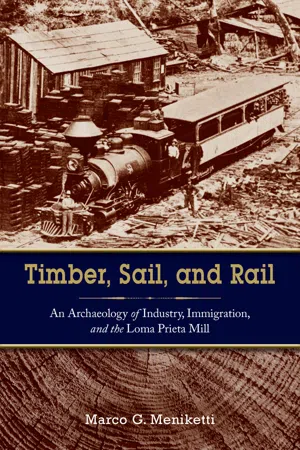
While taking a critical look at the labor and social issues related to timber, the story of labor, immigration, and development around the San Francisco Bay region is told through the lens of an archaeological case study of a major player of the timber industry between 1885 and 1920. Timber, Sail, and Rail recounts the mill operations and broadly examines its intersections with other industries, such as shipping, brick manufacture, rail companies, lime production, and other lesser enterprises. Three seasons of archaeological fieldwork, as well as ethnography and regional archival work, are examined to emphasize technological and labor components at the historic Loma Prieta mill.
eBook - ePub
Timber, Sail, and Rail
An Archaeology of Industry, Immigration, and the Loma Prieta Mill
- 220 pages
- English
- ePUB (mobile friendly)
- Available on iOS & Android
eBook - ePub
Timber, Sail, and Rail
An Archaeology of Industry, Immigration, and the Loma Prieta Mill
About this book
Trusted by 375,005 students
Access to over 1.5 million titles for a fair monthly price.
Study more efficiently using our study tools.
Information
CHAPTER 1
Logging History in the San Francisco Bay Area
A skilled axeman could plant a stake 30 to 50 feet from the trunk of a tree being felled and hit it every time with the falling tree once the final cut had been chopped through. Until the 1860s or early 1870s the crosscut saw was rarely used to fell the largest trees in California, the feller’s axe being employed instead.
—Brian Dillon, “Archaeological and Historical Survey of Soquel Demonstration State Forest, Santa Cruz County,” 1992
The grit and dangers faced by men working in the forests and mills, the tensions of labor, and the life of timber milling are conveyed in a poem titled “The Filer,” by Charles Olaf Olsen (Andrews 1957, 156). Olsen was a blacksmith in Oregon who penned several milling-related poems that were published in Ralph Andrews’s book Timber. We find in his words the tensions of labor, the pain of the body, and a testament to workers’ character. The saws, the poem says, like men, sometimes fly to pieces in sudden rage. Three seasons of fieldwork uncovered tangible evidence substantiating Olsen’s words—broken saw teeth, worn engine parts, and coarse laborers’ housing. The tools as well as the men can lose their tempers. The approach applied to interpreting the context of mining labor in song by Young (2014) can be used to deconstruct the poem. Each of the occupations in the camps carried its risks and minor rewards. Throughout the poem are references to the class of skilled workers. Filers were considered the aristocracy in the lumber camps and could earn upwards of $100 a month (Hutchinson 1959, 22). The immigrant laborers in the forest were the first to see some of the great trees since the native peoples, and also the last to see them as they exploited the timber.
Humans in the Forest
The greater San Francisco Bay Area has been home to myriad cultures for millennia. Stretching from the Santa Cruz Mountains in the south to the hills of Marin and Sonoma Counties in the north, and as far east as the Livermore Valley, tribes of Coast and Bay Miwok and Ohlone peoples exploited the rich resources of estuarine habitats and oak forest ecozones. The tribes organized themselves politically around paramount chiefs and subordinate chiefs who pay tribute.1 Captain Commander Fages (governor of Alta California, Monterey) in 1775 wrote firsthand descriptive accounts about aspects of aboriginal contact period political authority, social structure, and redistributive economy among the Costanoan-Esselen groups in the Monterey Bay Region: “Besides their chiefs of villages, they have in every district another one who commands four or five villages together, the village chiefs being his subordinates . . . Each of them collects every day in his village the tributes which the Indians pay him in seeds, fruits, game, and fish” (Fages 1937 [1775], 73).
The various Ohlone tribes occupied the highly variable terrain of the eastern and southern San Francisco Bay Area, stretching as far south as Monterey Bay, and lived throughout the forests and coastal zones encompassed by this study (Margolin 1978). Through interaction with local ecosystems, the first inhabitants of the San Francisco Bay Area and Monterey Bay region left their mark on the landscape in subtle yet significant ways that impacted local ecology, ranging from selective resource extraction to indigenous environmental management through controlled fires that aided propagation of preferred vegetation (Clar 1957; Lightfoot and Valentin 2013; Margolin 1978; Milliken 1995; Parker 2002). The practice modified the landscape and reduced the intensity of natural fires. Zayante, Aptos, and Soquel are all indigenous place names. The tribes of the region are part of the Ohlone culture group who continue to have a presence in the region. Forests provided materials for constructing shelters and sources of food. Oak woodlands were a source of highly prized and nutritious acorns, deer, rabbits, and birds. The bay was a source of fish and sea birds, as well as shellfish, mussels, and marine mammals. The local tribes were collectively called Coastanoans by the Spanish who ignored distinct linguistic differences and actual tribal affiliations (Beebe and Senkewicz 2001; Jackson and Castillo 1995). Kroeber compounded the errors by ignoring firsthand accounts of tribal organization and lumping all the tribes into a single polity, creating a problem that plagues the Ohlone to this day.2
Milliken (1995) depressingly detailed the disintegration of cultures in California due to the onslaught of missionization. As missions were established, local populations were thrown together in servitude, while their native customs, language, and diet were forbidden. Indigenous cultures have at least eight thousand years of occupation history in the San Francisco Bay Area. Aptos village is thought to have been the last recorded Native American village in the Santa Cruz Area. The rim of the San Francisco Bay was once dotted with shell middens of considerable size, reflecting generations of wetland resource exploitation as well as sites of habitation. Some middens were so large they appear as navigation landmarks on early maps of the bay. One such mound was topped in the 1920s and a dance hall built on it. This mound has since been leveled and has disappeared under a parking lot for a shopping mall on Shellmound Drive in Emeryville.
The missions worked their way up California one by one, first under Jesuit and then Franciscan management. With the arrival of Spanish colonists and the intrusion of the mission system in the region after 1775, new landscapes emerged, which defined and proscribed new social relations, concepts of space, and conflicting ideologies of productive environments. Each mission served as a central place for Spanish settlement and was charged with being self-sufficient. Conflicts arose between populations engaging in indigenous ecosystem management and the settlement patterns of the new arrivals with their nonnative animal herds. Ancient patterns of mobility and transport were modified or disrupted—replaced by models stemming from foreign lands and foreign practices (Beebe and Senkewicz 2001).
European settlement was sparse at first, and exploitation of timber restricted, since the resource was largely ignored (Clar 1957, 13; Wendling 1915). In 1804 Russian traders established a commercial outpost at Fort Ross north of the opening to the San Francisco Bay (known later as the Golden Gate) in the Sonoma coast. The Russian enterprise concentrated on furs, and timber served mainly as construction materials for the fort, and, by 1815, for boat construction. The presence of the Russians, nonetheless, may have spurred Spanish authorities to continue expanding the mission system as far north as Sonoma in a gesture of asserting some sovereignty in what they believed was their frontier (Lightfoot, Martinez, and Schiff 1998).
Independence from Spain came to Mexico in 1821, which ended the northward expansion of missions begun in Alta California in 1791, but even earlier in Baja California. The Mexican war for independence from Spain saw only peripheral and anecdotal action in California, yet set off a series of land disputes and opened the door for resource extraction to outsiders. Several factors contributed to slow development or exploitation of known timber resources, not the least of which was that Spanish Californians were mainly cattlemen and had “little reason to roam the forest” (Clar 1957, 2). The assessment seems fair, taking into account that gentlemen-ranchers considered lumbering beneath them; because they lacked skilled cutters or mills from which timber could be acquired, they did without. The nonexploitive approach to timber resources can be viewed as cultural rather than a result of a lack of enterprise, as later Anglo commentators often asserted. The forests were viewed through a different lens. Other colonists living in the vicinity of missions lacked the capacity for anything but small-scale lumbering. It should also be noted that many of the settlements were at considerable distance from the great stands of timber. When this fact is combined with the nonavailability of necessary milling equipment on the coast, it is not a surprise that, although some colonists wanted timber, lumbering was limited and difficult. Construction of homes and missions was mainly from adobe. Timber was mainly used by the missions for structural posts and roof beams (Allen 2010).
Richard Henry Dana sailed to California aboard the Boston clipper Pilgrim during the Mexican period in 1837. In his classic narrative of sailing to California, Two Years Before the Mast, Dana described the astonishing abundance of timber he saw, speculating that an enterprising person could do well to exploit the resources (Dana 1948). He also mentions how little capacity local authorities have for doing so on their own. In one account corroborating Dana’s observations, soldiers at the Mexican Presidio in Yerba Buena (now San Francisco) were sent to the nearby forests to get wood for construction. Equipped with hand axes and ox carts to pull the timber, the “journey for timber,” as recorded by a diarist, took more than a week of labor and transport (Brown 1966, 16). The principal product of the missions was hides, which were traded illegally to American ships. This illegal trade was caused in part from official neglect of California by Mexican authorities, and limited enforcement of laws forbidding the commerce. Dana thought Californians “an idle, thriftless people . . . who make nothing for themselves” (Dana 1948, 62). What Dana did not recognize were the political constraints preventing the Californians from trading or the extended supply train. Dana explicitly suggests that anyone who arrived on the scene with the requisite skills could immediately find a place and purpose in “Californio” society. As history makes clear, an adventurous few did just that.
Most of the earliest lumbering carried out in California was conducted at the missions, with neophyte Indians specifically designated as laborers. Documentary evidence for Indian labor from as early as the 1790s describes cutting in the arduous and dangerous whipsaw style (Brown 1966). As late as 1836, Indians were still employed to use this method (Clar 1957, 19). Whipsaw operations involved two men cutting timber. A timber framework was erected to support the log horizontally and a trench about the height of a man’s shoulders was dug beneath. The topman was usually a senior logger who stood on the log above and pulled a sash-saw upward, while the pitman, junior in rank, stood in the trench below and pulled downward, earning a face full of sawdust for his labors. If an accident were to occur, it usually befell the pitman. The timber produced was used for roof beams and supports in the churches and accommodations for mission authorities, with adobe serving the needs of the neophytes, as Native converts were called (Allen 2010). Only a few boards or beams could be cut per day by this slow and tedious method.
The California gold rush has deservedly received critical attention from historians and archaeologists alike, but the timber industry of California has garnered far less study, although it had an equal impact on the environmental and cultural landscape and is filled with just as many colorful and dynamic personalities. To some degree idiosyncratic and anecdotal in scope, a review of some of these individuals reveals an underlying pattern relevant to the study of timber production and highlights the cosmopolitan nature of California enterprises.
Of the many interesting characters to arrive in California who played a role in early timber production, was Joseph Chapman, a naval officer among Buenos Aires privateers engaged in the revolt against Spain. Prior to his adventurous maritime life, he had been a logger and carpenter in Maine, his place of origin. Chapman arrived in California to attack Monterey in 1818. Subsequently captured during a skirmish, he was brought to Los Angeles as a prisoner for trial. Realizing that there was a desperate need for timber cutting in the region, Chapman audaciously offered his services to administrators. The local magistrate, an obvious pragmatist, put Chapman to work felling trees, and soon afterward Chapman established a mill. Having equal hutzpah was John Cooper, who came to California from the East and married into the family of Governor General Mariano Vallejo in 1823. Cooper built the first mill on the Russian River in 1834 at a cost of $10,000 (Clar 1957, 20; 1959, 4). This water-wheel-driven mill had a short life when it was washed out by flooding in 1835. Cooper would persevere and build additional mills.
The first known sawmill in the immediate San Francisco Bay Area was built by a John Reed in 1834 in the town of Corte Madera—meaning place where wood is cut—on the San Francisco Bay. Reed was born in Dublin, Ireland, in 1805 and left aboard a ship at age fifteen. He made his way to Mexico and later Alta California at the age of twenty-one. There he married Hilaria Sanchez in 1836, daughter of the commandant of the Presidio in Yerba Buena (later San Francisco) and began work on a land grant at Rancho Corte Madera del Presidio (Boussy and Sliney 2018). This mill was driven by an undershot waterwheel (Clar 1957, 39). This mill most likely had a reciprocating sash saw. It was not until 1844, however, that the earliest sawmill appeared in Santa Cruz. Credit is given to Pierre “Pedro” Sainsevain. Born in France in 1818, he came to California in 1839 and constructed the first mill in San Bernardino, before moving north to Santa Cruz. Sainsevain had big plans. In addition to constructing a mill, he also built a 150-ton schooner for transporting lumber and milled grain (Evening Sentinel 1904b).
Another individual with important skills was shingle maker George Yount, who was given a land grant by General Vallejo for his services in 1843 (Clar 1957, 19; 1959). Yountville is today a modest-sized town in Northern California, still very much integrated with timbering. Shortly following the Bear Flag Revolt in 1848—a brief war engineered by a few Anglo residents of California supported by the U.S. government—Mexican California was annexed to the United States. A sawmill in Monterey from 1847 that was powered by four mules may represent the earliest use of a circular saw (Monterey Californian 1847). This saw was brought ashore by the U.S. occupation forces that captured the town 1847. It is an interesting historical footnote that the circular saw was invented in 1810 by a Shaker woman of the utopian community of Harvard Massachusetts (Dillon 1992, 112). Her intent was to create a device that would save labor and time, thus allowing more time for prayer.
Yet another mariner turned timberman was Captain Stephen Smith, who built California’s first steam-powered mill in 1843. Captain Smith, whose mother was Spanish, hailed from Baltimore. Reports sent to the East informed would-be lumbermen that prices for cut timber in California were “outrageous,” and there were reports of men making $16.00 a day, several times greater than normal on the East Coast, with timber selling at ten times East Coast prices. Export of the resource drove prices high. John Dolbeer of New Hampshire sold his fields in 1850 and went into lumbering in California. His inventive and enterprising spirit led to a patent in 1863 for a mechanical device for calculating the footage of cut board as it was processed (Carranco and Labbe 1979; see also Humboldt Times 16 May 1863). More significantly, Dolbeer’s invention of the donkey engine, patented in 1882, dramatically increased efficiency of timber transport to the mills by replacing the need for teams of oxen for hauling cut trees (Carranco and Labbe 1979, 49; Hutchinson 1959, 22). The Dolbeer donkey engines were steam-driven winches with sufficient power to draw logs hitched to a cable. These engines pulled themselves into position through a combination of pulleys and steel cable; once positioned and anchored they could pull as much timber in an hour that a team of oxen required half a day to achieve. The machine also reduced the need for bull masters and teamsters, thereby reducing the payroll. One pattern to emerge from these episodes of development is that immigrants found opportunities to insert themselves into the fabric of California society prior to the American period, which fundamentally reordered society politically and socially along strict ethnic lines.
With the announcement of the gold discovery a year later at Sutter’s timber mill, throngs of people began arriving from international ports to seek their fortunes. During the gold rush, landscapes were altered dramatically—not simply by sheer numbers of the growing population, but also through such dynamic process as hydraulic mining, farming, ranching, town development, fencing, timber cutting, salt manufacture, lime production, brick manufacture, shipping, railroad development, and dozens of other intersecting industries (McCrary 1981; Payne 1978). With the gold rush came a forceful demand for timber. An advertisement for a portable forty-eight-inch circular saw to be powered by horses appeared in 1851 (Sacramento Transcript 1851). The need for timber increased not merely incrementally, but profoundly, particularly since the newcomers were unfamiliar with adobe architecture.
The mosaic of industries springing up in California was mirrored in the ethnic and national diversity of laborers in the industries. Seeing that miners were in need of timber and drink, one clever entrepreneur constructed a combined sawmill and distillery in the Sierra foothills. After an initial period of success, the operation was converted to a grist mill.
Milling in Santa Cruz before Loma Prieta
The Santa Cruz region had an active history of logging since the Mexican period and saw milling as early as 1834 at the townsite of Zayante. A few mills continue in operation to this day, such as the Big Creek Lumber Company. The land that would eventually become a state park was once part of a large Mexican rancho belonging to Rafael Castro, a retired soldier of the Mexican army who, in 1833, petitioned and was awarded the land grant for services to the Mexican government. The six-thousand-acre Aptos Rancho became his major holding. Rafael was a resident of Villa de Branciforte, settled in 1798, on the San Lorenzo creek.3 This pueblo was located near Mission Santa Cruz. Rafael was a cattle rancher and did little to disturb the stands of redwoods. Rafael’s sister Martina, a widow, married Michael Lodge, an Irish sailor and ship’s carpenter. Lodge had come to California on a Boston whaling ship that shipwrecked in Monterey. Finding that his carpentry skills were in high demand, Lodge decided to stay. Anglo Americans were allowed to settle as long as they converted to Catholicism and became Mexican citizens. Lodge was an Irish Catholic. Settling in Catholic California presented no issue for Lodge, and he soon married a young Mexican woman. They moved to Villa de Branciforte in 1828, where tragically she and their infant died in 1829. Lodge thereafter married Martina around the year 1831 (Dillon 1992, 71).
Together Michael and Martina lobbied the Mexican government for an augmentation to the original grant (Rowland 1980). The Soquel Augmentation added 1,600 additional acres to the original grant in 1840. Since he was not exploiting the timber resources himself, Lodge prudently leased his land to millwrights, farmers, and woodcutters, keeping the rancho intact (Amended General Plan 2005, 35; Dillon 1992). These land grants were not actual transmission of land but were more akin to use-permits for development. During the Spanish period such grants might be given for services to the Crown, but the Crown maintained ownership. After Mexican independence the character of the grant shifted, yet remained an instrument of the government. What eventually came of Lodge...
Table of contents
- Cover
- Title Page
- Copyright Page
- Contents
- Illustrations, Figures, and Tables
- Acknowledgments
- Preface
- Introduction. The Industrial Landscape of Timber
- Chapter 1. Logging History in the San Francisco Bay Area
- Chapter 2. The Immigration Mosaic of the West
- Chapter 3. Laboring at Loma Prieta
- Chapter 4. Archaeology at Loma Prieta Mill
- Chapter 5. Artifacts: A Window to Life at the Mill
- Conclusion. Reading Ethnicity and Class
- Glossary
- References
- Index
Frequently asked questions
Yes, you can cancel anytime from the Subscription tab in your account settings on the Perlego website. Your subscription will stay active until the end of your current billing period. Learn how to cancel your subscription
No, books cannot be downloaded as external files, such as PDFs, for use outside of Perlego. However, you can download books within the Perlego app for offline reading on mobile or tablet. Learn how to download books offline
Perlego offers two plans: Essential and Complete
- Essential is ideal for learners and professionals who enjoy exploring a wide range of subjects. Access the Essential Library with 800,000+ trusted titles and best-sellers across business, personal growth, and the humanities. Includes unlimited reading time and Standard Read Aloud voice.
- Complete: Perfect for advanced learners and researchers needing full, unrestricted access. Unlock 1.5M+ books across hundreds of subjects, including academic and specialized titles. The Complete Plan also includes advanced features like Premium Read Aloud and Research Assistant.
We are an online textbook subscription service, where you can get access to an entire online library for less than the price of a single book per month. With over 1.5 million books across 990+ topics, we’ve got you covered! Learn about our mission
Look out for the read-aloud symbol on your next book to see if you can listen to it. The read-aloud tool reads text aloud for you, highlighting the text as it is being read. You can pause it, speed it up and slow it down. Learn more about Read Aloud
Yes! You can use the Perlego app on both iOS and Android devices to read anytime, anywhere — even offline. Perfect for commutes or when you’re on the go.
Please note we cannot support devices running on iOS 13 and Android 7 or earlier. Learn more about using the app
Please note we cannot support devices running on iOS 13 and Android 7 or earlier. Learn more about using the app
Yes, you can access Timber, Sail, and Rail by Marco Meniketti in PDF and/or ePUB format, as well as other popular books in Social Sciences & World History. We have over 1.5 million books available in our catalogue for you to explore.