Contributions by Jacob Agner, Susan V. Donaldson, Sarah Gilbreath Ford, Stephen M. Fuller, Jean C. Griffith, Ebony Lumumba, Rebecca Mark, Donnie McMahand, Kevin Murphy, Harriet Pollack, Christin Marie Taylor, Annette Trefzer, and Adrienne Akins Warfield
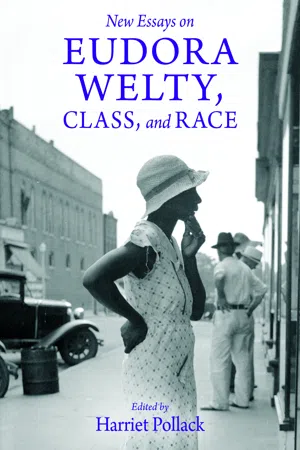
The year 2013 saw the publication of Eudora Welty, Whiteness, and Race, a collection in which twelve critics changed the conversation on Welty's fiction and photography by mining and deciphering the complexity of her responses to the Jim Crow South. The thirteen diverse voices in New Essays on Eudora Welty, Class, and Race deepen, reflect on, and respond to those seminal discussions. These essays freshly consider such topics as Welty's uses of African American signifying in her short stories and her attention to public street performances interacting with Jim Crow rules in her unpublished photographs. Contributors discuss her adaptations of gothic plots, haunted houses, Civil War stories, and film noir. And they frame Welty's work with such subjects as Bob Dylan's songwriting, the idea and history of the orphan in America, and standup comedy. They compare her handling of whiteness and race to other works by such contemporary writers as William Faulkner, Richard Wright, Toni Morrison, Chester Himes, and Alice Walker. Discussions of race and class here also bring her masterwork The Golden Apples and her novel Losing Battles, underrepresented in earlier conversations, into new focus.
Moreover, as a group these essays provide insight into Welty as an innovative craftswoman and modernist technician, busily altering literary form with her frequent, pointed makeovers of familiar story patterns, plots, and genres.
- 246 pages
- English
- ePUB (mobile friendly)
- Available on iOS & Android
eBook - ePub
New Essays on Eudora Welty, Class, and Race
About this book
Information
Publisher
University Press of MississippiYear
2019Print ISBN
9781496826152
9781496826145
eBook ISBN
9781496826169
WELTY’S MOONLIGHTING DETECTIVE
Whiteness and Eudora Welty’s Subversion of the American Noir Tradition in “The Demonstrators”

In her essay in Harriet Pollack’s volume Eudora Welty, Whiteness, and Race (2013), Rebecca Mark argues that Eudora Welty’s 1966 civil rights story, “The Demonstrators,” has been misread by critics. Mark suggests that Welty’s story about a white doctor in Mississippi failing to mend an African American couple’s wounds one night should be read not just as a civil rights narrative, but also as “a detective story.”1 In a story in which Welty includes a newspaper article riddled with mistakes and questionable editorial decisions, it is imperative to read every line, Mark argues, between the lines. There are “intertextual clues” laced throughout “The Demonstrators” that suggest that everything is not what it seems in Holden, Mississippi, particularly within its African American community (199). To that effect, Mark follows up with a quite remarkable reading. Once we follow the “mysterious dark quilt” of clues, Welty’s intertextual detective story should point us to “an elaborately choreographed political drama”—a demonstration—performed by members of the black community working to show the doctor the racism that is killing them (211, 199).
Then, in Eudora Welty’s Fiction and Photography: The Body of the Other Woman (2016), Harriet Pollack again emphasizes that “The Demonstrators” should be read as a “murder mystery” —as a medical crime story finally offering a “visible solution to [its] murder mystery at hand.”2 Pollack scrutinizes Dr. Strickland’s Jim Crow–era medical treatment of Ruby and judges him alarmingly quick to administer a final sedative to Ruby in a story circling “negligence and malpractice toward black bodies” (216–17). Seen in this light, “The Demonstrators” is a crime story whose seeming hero—its “moonlighting detective,” we could call Strickland—turns out to be its culprit. Pollack frames her reading with consideration of Welty’s admiration of Ross Macdonald’s (a.k.a. Kenneth Millar’s) crime fiction, admiration that in the 1970s would become personal as well as literary as the two writers developed a significant attachment while writing to one another.
So, while following these crime story readings, my essay will cast another light on the investigation. Although largely in agreement with Pollack and Mark, I think it’s not yet enough to suggest that “The Demonstrators” is a detective story or a complex crime story. The story could also read more specifically as a special kind of detective story, the one called noir. During the same period in which Welty produced most of her fiction, the genre of noir fiction and film developed in America. Broadly associated with the big cities, noir became increasingly known for capturing a modern milieu run rampant—with shadowy “mean streets,” urban labyrinths, hard-boiled criminal toughs, and murder wholesale. This urban genre, however, was not always exclusive to the cities. Indeed, as this essay will show, dark noir stories can also be found in places like Welty’s Mississippi. Throughout “The Demonstrators,” I argue, Welty adapts several of the common motifs—such as the ambiguous figure of the hard-boiled detective, the murder mystery scenario, high-contrast chiaroscuro (i.e., extreme black-and-white) lighting, and an unresolved ending—and Welty spins them in a way to comment on certain civil rights “crimes.” In so doing, Welty strategically co-opts noir’s shadowy dynamics in order to shine a light, paradoxically, on the darkness of whiteness.
EUDORA WELTY: NOIR ARTIST?
To begin, Eudora Welty was more informed in her time by the noir tradition than most think. Her most productive period (1941–55) paralleled the period in American cinema that film scholars have deemed as film noir’s “classic” phase (1941–1958), and her personal knowledge of the mystery genre was enthusiastic, informed, and generational.3 As many letters from her personal correspondence suggest, Welty often indulged in and reread all kinds of mystery and detective stories. Welty read English country house mysteries like E. C. Bentley’s Trent’s Last Case (1913), as well as more violent and morally ambivalent crime novels from the interwar decades.4 In 1946, Graham Greene’s Brighton Rock (1938) “chilled [her] to the bone,” she wrote; “It took me days to get over it.”5 She also casually mentioned to friends Frank Lyell and John Robinson popular films noir such as Stuart Heisler’s adaptation of Dashiell Hammett’s The Glass Key (1942) and Otto Preminger’s Laura (1944), one of her favorites, as well as many of Alfred Hitchcock’s renowned thrillers.6 In the 1970s, crime writer Kenneth Millar wrote to Welty about his seeing Roman Polanski’s Chinatown (1974) twice. Welty responded, “I read The Postman Always Rings Twice and Double Indemnity—both of which I thoroughly enjoyed. I can remember, in the 30s I guess, my mother, a great mystery reader, saying ‘That old James M. Cain!”7 Despite the public persona of “Miss Welty”—presumably a delicate southern woman writer, Welty all along followed noir’s broad cultural formations, which had been both evolving around—as well as in—her imagination.8
Elements of her own stories, in fact—bursts of extravagant violence, assortments of drifters and tramps, and settings unsettled by a sense of modern restlessness—have noirish trappings to them, yet critics have perhaps seen these characteristics through a gothic lens, an approach more frequently applied to southern writers. Welty’s sensitivity to diverse genres and mediums, including those of her contemporary popular culture, positions her as so much more than a mere practitioner of traditional southern fiction.9 Both as a writer and as a photographer, Welty’s skillful use of chiaroscuro lighting in her compositions, her attention to moments of high-contrast lighting between light and dark, dramatically ink and illuminate scenes quite like those in film noir. Welty’s photograph, Camellia house, shot in the late 1930s (precisely when film noir began to take off), takes light and shade to a hallucinatory level.
Pearl McHaney, a sensitive critic of Welty’s eye for composition, identifies in this photograph “Welty’s aesthetic awareness of the capabilities of the camera to transform light.”10 With something as simple as light filtering through wooden boards, Welty frames a hypnotizing sunburst effect with common materials and creates something like a prenoir, Depression Era expressionism that transforms the dilapidated into the dreamlike. And this same attention to chiaroscuro can also be found in Welty’s fiction.11 In the first sentences of her story “The Whistle,” Welty draws on this effect: “Night fell. The darkness was thin, like some sleazy dress that has been worn and worn for many winters and always lets the cold through the bones. Then the moon rose. A farm lay quite visible, like a white stone in water.”12 Welty’s use of chiaroscuro here is no doubt evocative and showy, but what’s most important about it is its politics. In the contexts of Jason and Sara Morton’s bone-chilling poverty in the story, Welty’s opening imagery bathed in the “bone”-white light of the wintry moon and the “thin” darkness of the night throws into relief the sharecroppers’ stark economic situation.
In another photograph from this period, Welty can again be seen experimenting with this shadowy effect. The African American woman in Welty’s Woman with Ice Pick (Hinds County, 1930s), who sits in a wicker chair and points an ice pick at Welty’s camera from her porch, is almost cut in two by a diagonal framing of light. The image of assault, directed at the white photographer presuming to take her image, is disarmed by the woman’s mischievous smirk, but her pose also bespeaks the underlying racial tensions of the time. Throughout the 1930s and the severe economic crisis of the Great Depression, the lines between black and white could be as stark as the shadows captured in Welty’s image. Although many of Welty’s photographs from this period feature African American women in candid poses, Woman with Ice Pick is special for the way it allows one of those women to confidently hijack Welty’s photographic gaze. Noting the “wacky, roguish melodrama” of the image, Pollack describes the image as making “a comedy of, while acknowledging, the tensions understood” in the relationship between white photographer and black subject (95).

Eudora Welty, “Camellia house” (Jackson, Mississippi, post-1936). Copyright © Eudora Welty, LLC.

Eudora Welty, “Woman with Ice Pick” (Hinds County, 1930s). Copyright © Eudora Welty, LLC.
Woman with Ice Pick also reflects Welty’s knowledge of other noir motifs. Photographed in the decade of the hard-boiled 1930s, which saw the rise of “tough-guy” fiction and the gangster movie, the black woman’s ice pick held above her cocked fedora draws attention to, at the same time it “pokes” fun at, the over-the-top violence and masculinity of American noir. Ice picks, in fact, are a favorite among the killers and criminals in noir. In Dashiell Hammett’s Red Harvest (1929), published a few years before Welty shot her photograph, Hammett’s iconic detective, the Continental Op, wakes up one morning to find his hand upon the makeshift weapon driven into a woman’s body. Hammett’s detective has been framed, of course, but the ice pick’s sudden and violent intrusion makes such an impression in the novel that the weapon would continue to pierce through several later works, such as Fritz Lang’s Scarlet Street in 1945, Raymond Chandler’s The Little Sister in 1949, and Welty’s “The Demonstrators” thirty-some years later.
Despite the fact that Welty’s photography has been appreciated for its “alternative visionings” for African Americans, Welty still runs the risk of evoking traditionally problematic ones (Pollack 76). If one were to view Woman with Ice Pick, for example, without the knowledge of Welty’s pleasure in parody, a black woman framed with a weapon above her head may not come across much better than any “black mammy” or nostalgic black stereotype. Noir, in other words, is also a deeply problematic racial category in its own particular ways. As several critical race scholars have noted, noir’s entire lineage of dark, shadowy stories and its nominal derivation from the French word for “black” are a case in point regarding the fundamental problem Toni Morrison notes in Playing in the Dark (1992). The moral and criminal “darkness” of noir is a textbook example of the rampantly specious “Africanisms” at work in Western discourse, which cast blackness of any shade as an essentially negative, threatening, or othered entity.13 By the same token, Eric Lott argues that the “black film” of “film noir” paradoxically serves as both an unconscious expression and a “refuge of whiteness”—a Hollywood metaphor for white pathology that relied heavily “on race to convey that pathology.”14 Critic Paula Rabinowitz also notes that black women in noir’s dark world are often called upon.15 Indeed, consider Dashiell Hammett’s next novel after Red Harvest, The Dain Curse, (1929), in which Hammett’s hardboiled hero badgers a young white woman’s “mulatto” servant whenever he can’t get hold of the white femme fatale herself, who, of course, is always more protected than her darker-skinned maid. “She sent you out to get dope?” the detective questions the maid with calculated force, “tightening [his] grip on her wrist.”16 This, then, is the rub: black women in the genre—or, as Rabinowitz calls them “literal femme noir”—are often as important in the narratives as they are expendable.17
Did Welty intuitively know this? Woman with Ice Pick positions itself against the problems inherent in noir. Whereas, for example, black women are often relegated to the side in the genre, Welty’s “femme noir” is front and center. Unlike the maid in Hammett’s story, Welty’s femme noir signals she is not one to mess with, not one to be readily roughed up by any hard-boiled detective or, for that matter, any demanding femme fatale or white woman hovering outside of her own image’s frame. By contrast, Welty’s Woman with Ice Pick does not, like early noir, come off as an unconscious expression of white pathology, but rather as a highly aware expression of it. In the black woman’s playful smirk and the point of her raised ice pick, the image seems to allow proper room for the black woman to draw attention to the white woman behind the camera. As Welty points her camera, in other words, the bootlegger points right back.
WHITENESS VISIBLE IN “THE DEMONSTRATORS”
This relationship between white and black can be found throughout Welty’s “The Demonstrators” thirty-some years later. As in the earlier portrait, “The Demonstrators” will begin with a violent racial scenario involving an ice pick. But clues throughout the story will invite the reader to look beyond the black “red herring” at the center of the crime story, to pay attention instead to the “smoking guns” on the story’s white margins. Welty moves beyond the racial chiaroscuro suggested by her story’s initial crime, to highlight shadows that throw whiteness into relief and draw it from its position just outside the story’s frame. This process, I hope to show here, begins early on in Welty’s story.
In its opening sentences, Dr. Strickland is introduced in a way that suggests he is the story’s protagonist. “Near eleven o’clock that Saturday night,” in front of his office, Strickland is first seen dutifully doing his job (733). While it’s late on a weekend night, and his job has already interrupted his “weekly bridge game at the club,” Strickland is the only one in town—“the son of a doctor,” we learn later on, “practicing in his father’s office”—capable of attending to the sick and infirm (733, 743). Paying such a visit to senile Miss Marcia Pope, the schoolteacher who “taught three generations of Holden, Mississippi, its Latin, civics, and English,” Dr. Strickland has become responsible for presiding over those who once presided over him (733). Fortunate enough to go to “university and then at medical school” decide to carry on his family’s legacy in Holden, Strickland has become as one with his town as his father before him. His family name stands blazoned on the town square: above “the bank, with its doorway onto the stairs to Drs. Strickland & Strickland, their names [appear] in black and gilt on three windows” (745). In a way, Holden’s Strickland is Welty’s version of Atticus Finch or Andy Taylor—the small-town white paternal hero.
This impression, however, does not last very long. As Strickland quietly tends to his former school teacher, the woman reveals something personal about him: “Richard Strickland?” she says in confusion, “I have it on my report that Irene Roberts is not where she belongs” (733). Here we learn that Dr. Strickland, like Andy and Atticus before him, is without a wife. But this time around, there’s a crucial difference to that story. Dr. Strickland is not a widower; his wife has left him. Although “Richard had grown up in Holden” and had “married ‘the prettiest girl in the Delta,’” his wife had separated from him “by her wish” (743). Th...
Table of contents
- Cover
- Title Page
- Copyright
- Contents
- Acknowledgments
- Eudora Welty, Whiteness, and Race Reconsidered: An Introduction
- Transformative Performances: Eudora Welty’s “Negro State Fair Parade” Photographs
- The Lynched Earth: Trees, Trespass, and Political Intelligence in Welty’s “A Worn Path” and Morrison’s Home
- Specters On Staircases: Race, Property, and the Gothic in William Faulkner’s Absalom, Absalom!, Eudora Welty’s Delta Wedding, and Toni Morrison’s Song of Solomon
- Moon Lake’s Orphans and “the Other Way to Live”
- The Boogie in the Bush: The Boundaries of Race, Nature, and Desire in Eudora Welty’s The Golden Apples
- For Crying Out Loud, Or “the Truth is Something Worse, I Ain’t Said What Yet”: African American Howls and Cries as Radical Punctuation/Puncture in Eudora Welty’s Fiction
- Faltering Narrative: Eudora Welty’s “The Burning,” Slavery’s Ghosts, and the Politics of Grief
- Insiders, Outsiders, and Class Anxiety: Eudora Welty and Bob Dylan on the Medgar Evers Murder
- Demonstration of Life: Signifying for Social Justice in Eudora Welty’s “The Demonstrators”
- Welty’s Moonlighting Detective: Whiteness and Welty’s Subversion of the American Noir Tradition in “The Demonstrators”
- Ideology, Ethnicity, and Performativity in Eudora Welty’s Losing Battles
- About the Contributors
Trusted by 375,005 students
Access to over 1.5 million titles for a fair monthly price.
Study more efficiently using our study tools.
Frequently asked questions
Yes, you can cancel anytime from the Subscription tab in your account settings on the Perlego website. Your subscription will stay active until the end of your current billing period. Learn how to cancel your subscription
No, books cannot be downloaded as external files, such as PDFs, for use outside of Perlego. However, you can download books within the Perlego app for offline reading on mobile or tablet. Learn how to download books offline
Perlego offers two plans: Essential and Complete
- Essential is ideal for learners and professionals who enjoy exploring a wide range of subjects. Access the Essential Library with 800,000+ trusted titles and best-sellers across business, personal growth, and the humanities. Includes unlimited reading time and Standard Read Aloud voice.
- Complete: Perfect for advanced learners and researchers needing full, unrestricted access. Unlock 1.5M+ books across hundreds of subjects, including academic and specialized titles. The Complete Plan also includes advanced features like Premium Read Aloud and Research Assistant.
We are an online textbook subscription service, where you can get access to an entire online library for less than the price of a single book per month. With over 1.5 million books across 990+ topics, we’ve got you covered! Learn about our mission
Look out for the read-aloud symbol on your next book to see if you can listen to it. The read-aloud tool reads text aloud for you, highlighting the text as it is being read. You can pause it, speed it up and slow it down. Learn more about Read Aloud
Yes! You can use the Perlego app on both iOS and Android devices to read anytime, anywhere — even offline. Perfect for commutes or when you’re on the go.
Please note we cannot support devices running on iOS 13 and Android 7 or earlier. Learn more about using the app
Please note we cannot support devices running on iOS 13 and Android 7 or earlier. Learn more about using the app
Yes, you can access New Essays on Eudora Welty, Class, and Race by Harriet Pollack in PDF and/or ePUB format, as well as other popular books in Literature & Literary Criticism for Comparative Literature. We have over 1.5 million books available in our catalogue for you to explore.