In classical antiquity, there was much interest in necromancy--the consultation of the dead for divination. People could seek knowledge from the dead by sleeping on tombs, visiting oracles, and attempting to reanimate corpses and skulls. Ranging over many of the lands in which Greek and Roman civilizations flourished, including Egypt, from the Greek archaic period through the late Roman empire, this book is the first comprehensive survey of the subject ever published in any language.
Daniel Ogden surveys the places, performers, and techniques of necromancy as well as the reasons for turning to it. He investigates the cave-based sites of oracles of the dead at Heracleia Pontica and Tainaron, as well as the oracles at the Acheron and Avernus, which probably consisted of lakeside precincts. He argues that the Acheron oracle has been long misidentified, and considers in detail the traditions attached to each site. Readers meet the personnel--real or imagined--of ancient necromancy: ghosts, zombies, the earliest vampires, evocators, sorcerers, shamans, Persian magi, Chaldaeans, Egyptians, Roman emperors, and witches from Circe to Medea. Ogden explains the technologies used to evocate or reanimate the dead and to compel them to disgorge their secrets. He concludes by examining ancient beliefs about ghosts and their wisdom--beliefs that underpinned and justified the practice of necromancy.
The first of its kind and filled with information, this volume will be of central importance to those interested in the rapidly expanding, inherently fascinating, and intellectually exciting subjects of ghosts and magic in antiquity.
- English
- ePUB (mobile friendly)
- Available on iOS & Android
eBook - ePub
Greek and Roman Necromancy
About this book
Information
Publisher
Princeton University PressYear
2019Print ISBN
9780691119687
9780691009049
eBook ISBN
9780691207063
PART I
PLACES
CHAPTER 1
TOMBS AND BATTLEFIELDS
THE prime site for necromancy and its conceptual home in the Greek and Roman worlds was the tomb, which served the living as the home of the ghost. A ghost was often believed to hover in the vicinity of its corpse’s place of burial.1 The importance of tombs as sites for the exercise of control over ghosts is demonstrated by the many curse tablets (in Greek katadesmoi; in Latin defixiones) and voodoo dolls (in Greek kolossoi) deposited in them. The tablets were addressed to the ghosts within, who were required to achieve, by means direct or indirect, the curse described.2
Our first fully extant literary instance of necromancy at the tomb is found in Aeschylus’s Persians (472 B.C.). Here the queen mother Atossa and the chorus of Persian elders make the ghost of her husband Darius, the old king, rise up at his tomb so that she can tell him of the disaster of the new king, their son Xerxes. The staging of this, one of Greek tragedy’s most striking scenes, may have required the construction of a passage underneath the stage area or of an artificial barrow above it.3 Tragic audiences were probably already familiar with the ghost of Achilles similarly rising above his Trojan barrow in his golden armor to demand the sacrifice of Polyxena. This commonplace episode of the cyclic epics is likely to have entered tragic tradition at an early stage. At any rate, it was subsequently to be found in Sophocles’s lost Polyxena and, offstage, in Euripides’ Hecabe. An Attic fifth-century askos lid helps us to imagine the scene (fig. 1). It portrays a warrior armed with helmet, cuirass, shield, and spear, rising from his barrow with an alert gesture. The warrior could have been the youthful Achilles himself, had he not been portrayed with a beard. Later on again, in the first century A.D., Achilles’ tomb provided the Neo-Pythagorean Apollonius of Tyana with an opportunity to inquire into Homer’s account of the Trojan War. He called up the ghost, not by the usual method involving the sacrifice of a sheep (as a Pythagorean he eschewed animal sacrifice), but with an Indian prayer. The ghost grew to a height of twelve cubits, and affably permitted Apollonius five questions.4
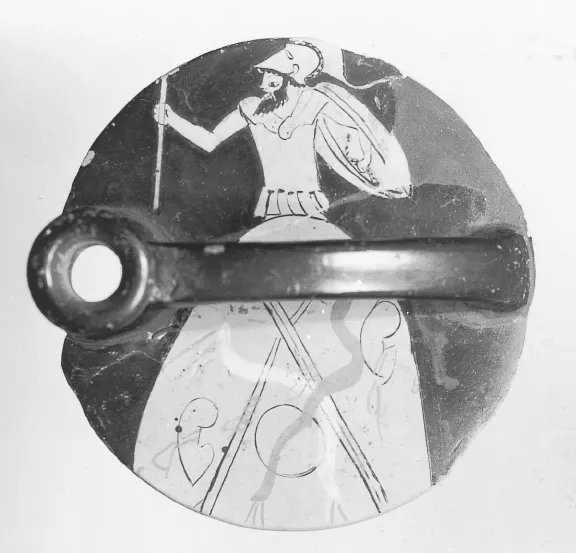
1. A hero rises from his tomb. Red-figure Attic askos, 500–490 B.C. Boston, Museum of Fine Arts, 13.169. Gift of E. P. Warren. Courtesy, Museum of Fine Arts, Boston. © Museum of Fine Arts, Boston.
Pythagoreans may have been particularly keen on necromancy at the tomb. Plutarch (first to second century A.D.) tells that Lysis, a member of a sect based in Thebes, died and was buried away from home. His friends were concerned that his burial may not have accorded with their customs, so one of them, Theanor, visited the tomb. By night he poured libations and called on the soul of Lysis to come and prophesy to him, “just as one must do these things.” As night went on he saw nothing, but he seemed to hear a voice telling him not to disturb the unalterable, since the body of Lysis had been buried with due piety, and his soul, already judged, had departed for another incarnation. The readiness of Pythagorean ghosts to give voice at their tombs is advertised also in Iamblichus’s tale of a shepherd who heard the Pythagorean Philolaus singing from his tomb. Philolaus’s pupil Eurytus, when told, nonchalantly asked what tune it was.5
Tomb necromancy is found also in Roman culture. A summary of the powers of the sorcerer Moeris in Virgil’s Eclogues (37 B.C.) includes the ability to call up souls from the bottoms of graves. A complex magical episode is described through the witnessing eyes of a statue of Priapus in Horace’s Satires (ca. 30 B.C.). The scene, in which the witches Canidia and Sagana appear to conflate necromantic evocation and a spell of erotic attraction, takes place in the garden of Maecenas on the Esquiline, which had been built over a disused cemetery. The grand, tall, white tombs remained; the common trenches for the slaves and the poor had been plowed over, and until recently bleached bones had lain exposed. One could bring forth voices even from burnt ashes: in Horace’s Epodes, Canidia explicitly boasts the ability to raise the cremated dead (ca. 30 B.C.), and, according to Lucan (A.D. 65), urns had groaned spontaneously as an omen of the disastrous civil war between Caesar and Pompey.6 The imperial period offers further examples of tomb necromancy.7
At least some of the dead could welcome consultation in the tomb. Epitaphs occasionally invite the passerby to consult their dead for prophecy. Ammias, priestess of a mystery cult at Thyateira in Asia Minor, was buried there in the second century A.D. Her funerary altar offers: “If anyone wishes to learn the truth from me, let him put what he wants in a prayer at the altar and he will obtain it by means of a vision during the night or the day.” Ammias’s priesthood may have given her an exceptional heroic status in death, upon which her powers may have been consequent. Her cult, if not one of Artemis, who was known to have had mysteries at Thyateira, may have been one of Asclepius, in which case her prophecies will have been healing ones.8 Athanatos Epitynchanos, a prophet from Akmonia in Phrygia, died in the early fourth century A.D. His epitaph advertises his eagerness to continue prophesying after death in the following terms: “This gift I have from the immortal … Athanatos Epitynchanos, the one that chatters out everything.” In another Phrygian epitaph, a son appears to describe the parents he buries as “uttering useful things from an oracular crypt.” Finally, an undated epitaph from the city of Rome invites the passerby, if he doubts the existence of ghosts, to invoke the dead person with a call, so that he will understand. Evidently the epitaph played a joke with a local echo, but even so it serves to show how a nondoubter might have communicated with a tomb’s occupant.9
As we shall see (especially in chapter 15), necromancy was heavily associated with the laying of restless ghosts, a process that often entailed, paradoxically, an initial evocation. If the ghost’s body was already buried, albeit unsatisfactorily, then the act of laying would take place at the site of this burial. Thus in a fictitious narrative of Ps.-Quintilian, a father hires a sorcerer to lay the ghost of his dead son, much to the mother’s annoyance. The sorcerer binds his urn and his entire tomb with spells, and the latter also with stones and chains of iron (a metal superior to ghosts). As we shall see, evocators or psuchagōgoi could lay restless ghosts by locating the site at which their body lay with the help of a black sheep, and then calling the ghost up and asking it the reason for its restlessness.10
. . . . .
The rites traditionally used to summon up ghosts were identical to the normal rites of pious observance made at tombs in the Greek world, with the possible exception of the utterance of “spells.”11 This, too, suggests that tombs constituted the conceptual home of necromancy. Observances at tombs can be distinguished into several types, but the archeological literature on these types is chaotic for want of an agreed terminology. One seldom finds two archeologists meaning the same thing by “tomb cult.” As an example of the distinctions that can be made, here are the recent classifications of Antonaccio: observances at the occasion of the burial itself; observances on regular or irregular visits to a relative’s tomb thereafter—“tomb attendance” or “tomb visits” or “cult of the dead”; offerings made on a single occasion at or into a Mycenean tomb—“tomb cult”; and offerings made at a hero’s shrine, with which no actual burial is associated—“hero cult.” Visits to tombs for necromantic purposes are ostensibly most akin to the categories of “tomb attendance” and “tomb cult” here. Literary and archeological evidence combines to show that despite differences in emphasis and variations in practice across place and time, all of these four categories of observance employed the ritual elements traditional in accounts of necromancy: the digging of a pit; libations of milk, honey, wine, water, and oil, and offerings of grain and flowers; offerings of blood (known as haimakouria, literally “blood-sating”), together with an associated holocaust animal sacrifice; and prayers.
Blood offering was perhaps less common in the two most necromantically relevant categories, although there were no hard and fast distinctions.12 It is often contended that it was only used in tomb attendance when the dead in question were conceived of as in some way heroized.13 Blood offering is, however, a usual feature of literary accounts of necromancy, albeit not a universal one (none is made to Aeschylus’s ghost of Darius, for example). It may be that blood offering is a commonplace in the literary tradition of necromantic consultations because most of these consultations are in any case of ghosts of heroic status. Or it may be that actual necromancy either favored the heroized dead as subjects for consultation or, ipso facto, conferred a heroized status upon the dead it chose to exploit (the status of Ammias is curiously ambiguous). Curse tablets at any rate sometimes address as heroes the ordinary dead, perhaps warriors in particular, to whom they are entrusted. The mid-fifth-century sacred law from Selinus prescribes on one side the sacrifice of a sheep and the pouring of its blood into the ground to lay unquiet ghosts. On the other, it prescribes the sacrifice of a sheep to the Tritopatores for the purpose of general purification, alongside offerings of wine, melikraton (honey and milk), and barley-cakes, and these offerings are explicitly compared to those made to heroes.14
The easy glide between tomb attendance and evocation is illustrated by Aeschylus’s Persians and his Choephoroi. When, in the Persians, Atossa first arrives with her offerings of honey, water, wine, oil, and flowers for Darius, we do not realize that she intends anything other than ordinary attendance at the tomb of a relative, much as Euripides’ Iphigenia contemplates making uneventful offerings of milk, wine, and honey at the tomb of her brother Orestes.15 In the Choephoroi (458 B.C.), Electra brings libations to the tomb of her father Agamemnon and pr...
Table of contents
- Cover Page
- Title Page
- Copyright Page
- Contents
- List of Figures
- Preface
- Abbreviations
- Introduction
- Part I: Places
- Part II: People
- Part III: Technology
- Part IV: Theory
- Conclusion: Attitudes toward Necromancy
- Bibliography
- Index
Trusted by 375,005 students
Access to over 1.5 million titles for a fair monthly price.
Study more efficiently using our study tools.
Frequently asked questions
Yes, you can cancel anytime from the Subscription tab in your account settings on the Perlego website. Your subscription will stay active until the end of your current billing period. Learn how to cancel your subscription
No, books cannot be downloaded as external files, such as PDFs, for use outside of Perlego. However, you can download books within the Perlego app for offline reading on mobile or tablet. Learn how to download books offline
Perlego offers two plans: Essential and Complete
- Essential is ideal for learners and professionals who enjoy exploring a wide range of subjects. Access the Essential Library with 800,000+ trusted titles and best-sellers across business, personal growth, and the humanities. Includes unlimited reading time and Standard Read Aloud voice.
- Complete: Perfect for advanced learners and researchers needing full, unrestricted access. Unlock 1.5M+ books across hundreds of subjects, including academic and specialized titles. The Complete Plan also includes advanced features like Premium Read Aloud and Research Assistant.
We are an online textbook subscription service, where you can get access to an entire online library for less than the price of a single book per month. With over 1.5 million books across 990+ topics, we’ve got you covered! Learn about our mission
Look out for the read-aloud symbol on your next book to see if you can listen to it. The read-aloud tool reads text aloud for you, highlighting the text as it is being read. You can pause it, speed it up and slow it down. Learn more about Read Aloud
Yes! You can use the Perlego app on both iOS and Android devices to read anytime, anywhere — even offline. Perfect for commutes or when you’re on the go.
Please note we cannot support devices running on iOS 13 and Android 7 or earlier. Learn more about using the app
Please note we cannot support devices running on iOS 13 and Android 7 or earlier. Learn more about using the app
Yes, you can access Greek and Roman Necromancy by Daniel Ogden in PDF and/or ePUB format, as well as other popular books in History & Ancient History. We have over 1.5 million books available in our catalogue for you to explore.