- 288 pages
- English
- ePUB (mobile friendly)
- Available on iOS & Android
eBook - ePub
About this book
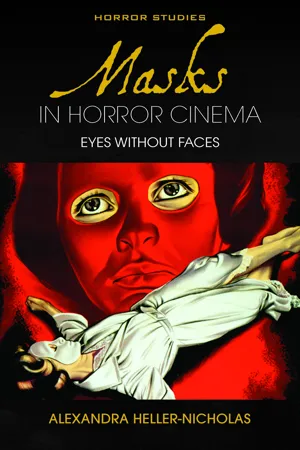
Why has the mask been such an enduring generic motif in horror cinema? This book explores its transformative potential historically across myriad cultures, particularly in relation to its ritual and mythmaking capacities, and its intersection with power, ideology and identity. All of these factors have a direct impact on mask-centric horror cinema: meanings, values and rituals associated with masks evolve and are updated in horror cinema to reflect new contexts, rendering the mask a persistent, meaningful and dynamic aspect of the genre's iconography. This study debates horror cinema's durability as a site for the potency of the mask's broader symbolic power to be constantly re-explored, re-imagined and re-invented as an object of cross-cultural and ritual significance that existed long before the moving image culture of cinema.
Information
1

Situating Masks and Horror Cinema
THIS CHAPTER considers the endurance of horror film masks as a key aspect of the genre’s iconography, including considerations of myth and its relation to genre studies more broadly, shamanism and tricksters. Shamanism is central here for its role in what I like to think of as the ‘shamanic imagination’, a broader cross-cultural sensibility removed from the specificities of how the term is understood from orthodox anthropological perspectives and rather understood in a looser, more elastic way that accounts for how the power of masks are broadly conceived.
First and foremost, however, masks are ‘things’ – material objects that can be felt, worn and touched. It is therefore worth considering horror film masks and their material histories when approaching them as an enduring aspect of horror’s mise en scène. As the study of objects and how they pertain to human culture, for Ian Woodward material culture concerns ‘how apparently inanimate things within the environment act on people and are acted upon by people, for the purposes of carrying out social functions, regulating social relations and giving symbolic meaning to human activity’.1 Objects unite economic and social structures with individuals,2 and as such there is a tension when considering an object like masks and their place in horror film history: between how they function in diegetic terms and how they are understood by the spectator at any given moment, across a range of exhibition and reception possibilities. For example, the experience of watching John Carpenter’s Halloween at a British drive-in in 1978, on VHS in Australia in 1988, on television in Japan in 1998, on DVD in France in 2008 or its fortieth anniversary US cinema screenings in 2018, would all be different, even though the text remained the same. This pertains not only to reception and exhibition, but how intertextual reference points may alter in meaning and significance across time and space.
Approaching horror film masks from a material culture perspective offer allows a consideration of both ideological and aesthetic aspects of the object across different contexts. Materiality is significant here, the aesthetic qualities (shape, texture, colour, etc.) we see on screen might be communicated visually, but recalling Vivian Sobchack’s essay ‘What My Fingers Knew: The Cinesthetic Subject, or Vision in the Flesh’, there is far more at stake here than mere ‘objective symbolic representation’, because ‘vision [is] always in cooperation and significant exchange with other sensorial means of access to the world’.3 Many horror films go to remarkable lengths to provoke multi-sensory responses that imply what the masks might feel like: the stretchy peel of the rubber mask off Ann’s face in Happy Birthday to Me discussed in chapter 4 evokes a clammy stickiness; the heavy breathing that often accompanies Michael Myers’s first person point-of-view shots in the Halloween franchise arouse a suffocating intimacy. The appearance of these masks is an entry point to other sensorial experiences: they provoke a ‘sensual and sense-making experience’ across our senses, even if the data is visually encoded.4 Seen from the perspective of material culture, the significance of these factors is heightened when considering the history of horror film masks.
Genre, Myth and Masks
As a film genre, taxonomical factors unite horror with myth and ritual. In his foundational work on the western, John G. Cawelti identified that genre as a ‘social and cultural ritual’ and ‘a means of affirming certain basic cultural values, resolving tension and establishing a sense of continuity between the present and the past’.5 Christian Metz (1974) and Umberto Eco (1976) were crucial in linking semiotics and structuralist approaches with film studies, but earlier work influenced film and genre studies also. Lévi-Strauss’s essay ‘The Structural Study of Myth’ (originally published in 1955) strongly influenced structuralism and his book The Way of the Masks (originally published in 1972) is centred around a mask used amongst tribes on the coast of British Columbia. Lévi-Strauss argues that myths and their representations are not singular, one-off phenomena, and he looks for patterns that demonstrate a historical form of communication between the tribe and those around it. Focusing on patterns in myths spawned from masks, his geographical area of focus expands both spatially and temporally. These patterns are crucial to him, ‘as is the case with myths, masks, too, cannot be interpreted in and by themselves as separate objects’.6 Lévi-Strauss claimed that ‘we can perceive, between the origin myths for each type of mask, transformational relations homologous to those that, from a purely plastic point of view, prevail among the masks themselves’.7 He insisted that ‘we must reassemble the data available’ for study and that ‘it is only after this all-inclusive documentation has been gathered that we may be able to compare it with other records’.8 In short, he called for intensive close material analysis looking for structural patterns.
Much has been gained by approaching genre in a similar manner. Jim Kitses’s (1969) and Will Wright’s (1975) work on the western was crucial in the development of genre studies, informed by Lévi-Strauss’s structuralist approach to myth. Lévi-Strauss’s observation that ‘a myth remains the same as long as it is felt as such’ was echoed by Andrew Tudor: discussing the ‘empiricist’s dilemma’, he noted a tendency to define genres through what were already broadly assumed to be ‘principle characteristics’ in the first place, resulting in his famous observation that ‘genre is what we collectively believe it to be’.9 This logic dictates that we need to know the generic characteristics that we are looking for to be able to identify them in the first place. As Mark Jancovich noted, assumptions about horror’s formulaic nature are so widespread that they underpin ‘meta’ horror movies like Wes Craven’s Scream (1996), a film that for Jancovich ‘both draws upon and reproduces in its supposed self-referential play with the “rules” of the horror film’.10 Thomas Schatz noted that ‘in its ritualistic capacity, a film genre transforms certain fundamental cultural contradictions and conflicts into a unique conceptual structure that is familiar and accessible to the mass audience’.11 While acknowledging this ‘genre as myth model is widely influential’, as Rick Altman suggested – amongst other issues – Lévi-Strauss’s notion of ritual does not fully account for the ‘why’ of film genre production.12
The influence of Lévi-Strauss on genre studies in terms of myth and ritual and his interest in masks position him as an important reference point in this book. However, this risks missing the significance of the mask’s materiality, discussed previously: for Angela Ndalianis, while ‘a structuralist like Lévi-Strauss may insist that to get to the core of myths it’s necessary to strip away the surface’ in order to look for these deep structures and patterns, ‘horror … is as much about the surface as it is about the underlying structure’.13 Echoing Sobchack, Ndalianis’s focus on the sensory aspects of horror is crucial when considering horror film masks, as it is precisely their material qualities in many cases that grant them their potency.
More urgently, the utility of Neale’s tension between repetition and variation is also lost when it is only the former that is privileged. In his discussion of Carnival masks, Bakhtin noted that it is all but ‘impossible to exhaust the intricate multiform symbolism of the mask’ and this is true too of horror film masks.14 Their very ubiquity makes any attempt to include every mask in the genre practically impossible, so my examples underscore Neale’s suggestion that genre is less a rigid system of mimicry as it is a constantly evolving process driven by tensions between repetition and difference. In Genre and Hollywood (2000), Neale challenged Thomas Schatz’s (1981) privileging of repetition alone as key to generic mechanics, seeking to ‘temper the emphasis he places on repetition and sameness as opposed to variation and change’.15 The endurance of horror film masks reflects this: ‘these processes may, for sure, be dominated by repetition, but they are also marked fundamentally by difference, variation and change’.16 Similarity and difference are crucial when thinking about genres like horror as they maintain their freshness and interest for audiences by experimenting with the tension between originality and mimicry.17 As the later case studies in this book will indicate, while sharing mask motif, they deploy it in diverse and often sophisticated ways.
We can therefore look towards both intersecting threads and points of diversity as we consider the endurance of horror film masks. It would be difficult to talk about horror film masks and not discuss The Phantom of the Opera (1925), for instance, but we might also consider the value of looking towards lesser known films that show how broadly masks have been deployed in horror. As Crocker noted, ‘there are … many varieties of masking, and it would be very misleading to reduce them to some kind of ur-mask both in form and in social function’.18 This is true of horror film masks also. Accordingly, while not ignoring trends or disregarding the influence of more well-known horror films that diegetically utilise masks, my case studies include both ‘masterpieces’ and forgotten television movies. Through horror film masks, we can explore the multifaceted and often complex terrain of their transformative capacities and how they pertain to power and ritual. The shamanic imagination and the associated role of the trickster play a central part in how I suggest we can approach this question.
Masks and the Shamanic Imagination
Central to the enduring symbolic potency of horror film masks, shamanic traditions and practices and rituals of transformation offer a starting place to consider the mask in performance contexts because of widespread historical beliefs in the mask as an object with the capacity to transform, literally or symbolically. Doug Bradley argued that, historically, they had a crucial social function: ‘shamans were actors, dancers, singers, poets and storytellers, healers, weathermen, fortune tellers and mystics’.19 Shamanic ritual for Bradley – like horror film – ‘is symbolic theatre of the most powerful, primal kind’.20 In horror, masked transformations often relate directly to the power of its wearer, be they one of horror’s many masked antagonists or – less commonly – those who lack power or who have been victimised, such as in films Dark Night of the Scarecrow (Frank De Felitta, 1981), Black Sunday (Mario Bava, 1960) and Eyes without a Face (both discussed in chapter 3) and Halloween III and The Poughkeepsie Tapes (both discussed in chapter 8). But even these categories can be complicated: in Jonathan Demme’s Silence of the Lambs (1991), the mask protects the world from its wearer, its iconic design featuring bars across the mouth, literally imprisoning the offending body part of cannibal Hannibal Lecter (Anthony Hopkins) in a kind of ‘mini-jail’. While masks predominantly empower horror antagonists, this is not absolute.
For reasons expanded upon further shortly, I resist positioning horror film masks on a linear continuum from earlier shamanic rituals and traditions as such and rather suggest it is part of a much looser shamanic imagination. This relies less on specific shamanic practices as identified from an orthodox anthropological perspective and on a broader cultural sensibility that frames widespread beliefs that masks – as cultural artefacts – can bestow certain kinds of power (particularly to transform) in cultural arenas such as horror. The shamanic imagination contains residual traces of traditional anthropological considerations of shamanism, but is more elastic, adaptable to contemporary rituals which, in horror, exist both within the films themselves and in rituals that surround cinema spectatorship as previously discussed.
There is of course some overlap between definitions of shamanism from anthropological and/or religious studies perspectives and the shamanic imagination. In 1970, Robin and Tonia Ridington noted that while ‘shamanism is usually described as a magical flight into a supernatural realm’, it has an integral symbolic aspect: ‘The shaman does not really fly up or down, but inside to the meaning of things.’21 They step away from traditional understandings of shamanism as an institutionalised religious/spiritual practice and argued instead that it is ‘a universal human experience’.22 The shamanic imagination grants a comprehension of new dimensions of movement across symbolic (and in horror, sometimes literal) planes, movement with historically entrenched associations with masks and the supernatural. As discussed later in this chapter, not all horror cinema is supernatural and the shamanic imagination therefore encompasses a range of liminal spaces, natural and/or supernatural, literal and/or symbolic. This logic underscores horror movie masks, rendering them an enduring iconographic feature.
While masks play an important role in shamanic ritual and performance, as Bradley noted they are used in diverse ways across different cultures.23 For Michael Ripinsky-Naxon, mask-wearing shamans can be traced to the Palaeolithic period in south-western Europe, where animal and bird masks were used into the Neolithic period. For Ripinsky-Naxon, ‘when a man puts on a mask, his symbolic position is enhanced, for he assumes the significance of something other than himself’.24 There are, too, parallels here with horror film masks and their relationship to ritual, power and transformation. I have until now avoided a definition of shamanism as the term risks being misunderstood. From the outset, the ideological volatility ...
Table of contents
- Cover
- Title Page
- Copyright Page
- Dedication
- Contents
- Acknowledgements
- Introduction
- 1. Situating Masks and Horror Cinema
- Part One: Masks, Horror and Cinema – Towards Codification
- Part Two: Horror Film Masks from 1970 – Case Studies
- Part Three: Masks as Transformational Technologies – Moving Forward by Looking Back
- Conclusion
- Endnotes
- Bibliography
- Back Cover
Trusted by 375,005 students
Access to over 1.5 million titles for a fair monthly price.
Study more efficiently using our study tools.
Frequently asked questions
Yes, you can cancel anytime from the Subscription tab in your account settings on the Perlego website. Your subscription will stay active until the end of your current billing period. Learn how to cancel your subscription
No, books cannot be downloaded as external files, such as PDFs, for use outside of Perlego. However, you can download books within the Perlego app for offline reading on mobile or tablet. Learn how to download books offline
Perlego offers two plans: Essential and Complete
- Essential is ideal for learners and professionals who enjoy exploring a wide range of subjects. Access the Essential Library with 800,000+ trusted titles and best-sellers across business, personal growth, and the humanities. Includes unlimited reading time and Standard Read Aloud voice.
- Complete: Perfect for advanced learners and researchers needing full, unrestricted access. Unlock 1.5M+ books across hundreds of subjects, including academic and specialized titles. The Complete Plan also includes advanced features like Premium Read Aloud and Research Assistant.
We are an online textbook subscription service, where you can get access to an entire online library for less than the price of a single book per month. With over 1.5 million books across 990+ topics, we’ve got you covered! Learn about our mission
Look out for the read-aloud symbol on your next book to see if you can listen to it. The read-aloud tool reads text aloud for you, highlighting the text as it is being read. You can pause it, speed it up and slow it down. Learn more about Read Aloud
Yes! You can use the Perlego app on both iOS and Android devices to read anytime, anywhere — even offline. Perfect for commutes or when you’re on the go.
Please note we cannot support devices running on iOS 13 and Android 7 or earlier. Learn more about using the app
Please note we cannot support devices running on iOS 13 and Android 7 or earlier. Learn more about using the app
Yes, you can access Masks in Horror Cinema by Alexandra Heller-Nicholas in PDF and/or ePUB format, as well as other popular books in Mezzi di comunicazione e arti performative & Storia e critica del cinema. We have over 1.5 million books available in our catalogue for you to explore.