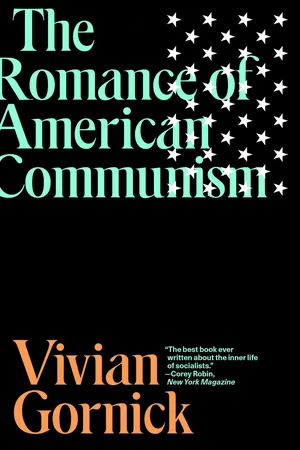
"Before I knew that I was Jewish or a girl I knew that I was a member of the working class." So begins Vivian Gornick's exploration of how the world of socialists, communists, and progressives in the 1940s and 1950s created a rich, diverse world where ordinary men and women felt their lives connected to a larger human project.
Now back in print after its initial publication in 1977 and with a new introduction by the author, The Romance of American Communism is a landmark work of new journalism, profiling American Communist Party members and fellow travelers as they joined the Party, lived within its orbit, and left in disillusionment and disappointment as Stalin's crimes became public.
From the immigrant Jewish enclaves of the Bronx and Brooklyn and the docks of Puget Sound to the mining towns of Kentucky and the suburbs of Cleveland, over a million Americans found a sense of belonging and an expanded sense of self through collective struggle. They also found social isolation, blacklisting, imprisonment, and shattered hopes. This is their story--an indisputably American story.
- 288 pages
- English
- ePUB (mobile friendly)
- Available on iOS & Android
eBook - ePub
The Romance of American Communism
About this book
Information
CHAPTER ONE
To Begin With
BEFORE I KNEW that I was Jewish or a girl I knew that I was a member of the working class. At a time when I had not yet grasped the significance of the fact that in my house English was a second language, or that I wore dresses while my brother wore pants, I knew—and I knew it was important to know—that Papa worked hard all day long. One of my strongest memories of early childhood is that no matter what we were doing, my mother and I, everything in our Bronx apartment stopped dead at four-thirty in the afternoon and she began cooking supper. If ever I questioned this practice, or complained, or demanded that we continue what we were doing, my mother—whose manner was generally frantic and uncontrolled—would answer with a sudden dignity that stopped me cold: “Papa works hard all day long. When he comes home his supper must be on the table.”
Papa works hard all day long. Those words, in my mother’s mouth, spoke volumes, and from the age of reason on I absorbed their complex message. The words stirred in me, almost from the first time I heard them, an extraordinary resonance, one whose range was wide enough to compel my emotional attention throughout my subsequent life. To begin with, the words communicated pain and difficulty; my childish heart ached for my gentle father. The pain was frightening, and even as it began to flow inside me, like a liquid turning to a solid, I felt myself go numb. This emotion was awesome; it induced in me the sense of some mysterious force working on our lives, some force in which we were all caught: suspended, puzzled, moving blind. At the very same time, the mere articulation of the words in my mother’s mouth produced a peculiar and relieving focus against the murkiness of that mysterious force, a focus which told me where and who I was: I was the daughter of Papa who worked hard all day long. Finally, the words said: We are all of us, here in this house, vitally connected to the fact that Papa works hard all day long. We pay attention to and respect that fact; we make common cause with it. This last, this oneness, this solidarity, produced in me pride and excitement; it dissolved the numbness and transformed the pain back into a moving, stirring, agitating element: something to be understood and responded to, something to be dealt with and struggled against.
My father stood upright on the floor of a dress factory on West 35th Street in New York City with a steam iron in his hand for thirty years. My uncles owned the factory. My father was Labor, my uncles were Capital. My father was a Socialist, my uncles were Zionists. Therefore, Labor was Socialism and Capital was Nationalism. These equations were mother’s milk to me, absorbed through flesh and bone almost before consciousness. Concomitantly, I knew also—and again, as though osmotically—who in this world were friends, who enemies, who neutrals. Friends were all those who thought like us: working-class socialists, the people whom my parents called “progressives.” All others were “them”; and “them” were either engaged enemies like my uncles or passive neutrals like some of our neighbors. Years later, the “us” and “them” of my life would become Jews and Gentiles, and still later women and men, but for all of my growing-up years “us” and “them” were socialists and non-socialists; the “politically enlightened” and the politically unenlightened; those who were “struggling for a better world” and those who, like moral slugs, moved blind and unresponsive through this vast inequity that was our life under capitalism. Those, in short, who had class consciousness and those lumpen or bourgeois who did not.
This world of “us” was, of course, a many-layered one. I was thirteen or fourteen years old before I consciously understood the complex sociology of the progressive planet; understood that at the center of the globe stood those who were full-time organizing members of the Communist Party, at the outermost periphery stood those who were called “sympathizers,” and at various points in between stood those who held Communist Party membership cards and those who were called “fellow travelers.” In those early childhood years these distinctions did not exist for me; much less did I grasp that within this sociology my parents were merely “fellow travelers.” The people who came to our house with the Daily Worker or the Yiddish newspaper Der Freiheit under their arms, the people at the “affairs” we attended, the people at the shule (the Yiddish school I was sent to after my public-school day was over), the people at the rallies we went to and the May Day parades we marched in, the people who belonged to the various “clubs” and were interminably collecting money for the latest cause or defense fund—they were all as one to me; they were simply “our people.” Of a Saturday morning, the doorbell in our Bronx apartment would ring, my father would open the door, and standing there would be Hymie, a cutter in my father’s shop, a small, thin man with gnarled hands and the face of an anxious bulldog. “Nu, Louie?” Hymie would say to my father. “Did you see the papers this morning? Did you see—a black year on all of them!—what they’re saying about the Soviet Union this morning?” “Come in, Hymie, come in,” my father would reply. “Have a cup of coffee, we’ll discuss it.” I did not know that there was a difference between Hymie, who was also only a “fellow traveler,” and my cousins David and Selena, who were YCLers, or my uncle Sam, who was always off at “a meeting,” or Bennie Grossman from across the street who had suddenly disappeared from the neighborhood (“unavailable” was the word for what Bennie had become, but it would be twenty years before I realized that was the word). It was, to begin with, all one country to me, one world, and the major characteristic of that world as I perceived it was this:
At the wooden table in our kitchen there were always gathered men named Max and Hymie, and women named Masha and Goldie. Their hands were work-blackened, their eyes intelligent and anxious, their voices loud and insistent. They drank tea, ate black bread and herring, and talked “issues.” Endlessly, they talked issues. I sat on the kitchen bench beside my father, nestled in the crook of his arm, and I listened, wide-eyed, to the talk. Oh, that talk! That passionate, transforming talk! I understood nothing of what they were saying, but I was excited beyond words by the richness of their rhetoric, the intensity of their arguments, the urgency and longing behind that hot river of words that came ceaselessly pouring out of all of them. Something important was happening here, I always felt, something that had to do with understanding things. And “to understand things,” I already knew, was the most exciting, the most important thing in life.
It was characteristic of that world that during those hours at the kitchen table with my father and his socialist friends I didn’t know we were poor. I didn’t know that in those places beyond the streets of my neighborhood we were without power, position, material or social existence. I only knew that tea and black bread were the most delicious food and drink in the world, that political talk filled the room with a terrible excitement and a richness of expectation, that here in the kitchen I felt the same electric thrill I felt when Rouben, my Yiddish teacher, pressed my upper arm between two bony fingers and, his eyes shining behind thick glasses, said to me: “Ideas, dolly, ideas. Without them, life is nothing. With them, life is everything.”
Sometimes I would slip off the bench and catch my mother somewhere between the stove and the table (she was forever bringing something to the table). I would point to one or another at the table and whisper to her: Who is this one? Who is that one? My mother would reply in Yiddish: “He is a writer. She is a poet. He is a thinker.” Oh, I would nod, perfectly satisfied with these identifications, and return to my place on the bench. He, of course, drove a bakery truck. She was a sewing-machine operator. That other one over there was a plumber, and the one next to him stood pressing dresses all day long beside my father.
But Rouben was right. Ideas were everything. So powerful was the life inside their minds that sitting there, drinking tea and talking issues, these people ceased to be what they objectively were—immigrant Jews, disenfranchised workers—and, indeed, they became thinkers, writers, poets.
Every one of them read the Daily Worker, the Freiheit, and the New York Times religiously each morning. Every one of them had an opinion on everything he or she read. Every one of them was forever pushing, pulling, yanking, mauling those opinions into shape within the framework of a single question. The question was: Is it good for the workers? That river of words was continually flowing toward an ocean called farshtand, within whose elusive depths lay the answer to this question.
They were voyagers on that river, these plumbers, pressers, and sewing-machine operators. Disciplined voyagers with a course to steer, a destination to arrive at. When one of them yelled at another (as one of them regularly did) “Id-yot! What has that to do with anything? Use your brains! God gave you brains, yes or no? Well, use them!” he was, in effect, saying: Where will that question take us? Nowhere. Get back on course. We’re going somewhere, aren’t we? Well, then, let’s go there.
They took with them on this journey not only their own narrow, impoverished experience but a set of abstractions as well, abstractions with the power to transform. When these people sat down at the kitchen table to talk, Politics sat down with them, Ideas sat down with them, above all, History sat down with them. They spoke and thought within a context that had world-making properties. This context lifted them out of the nameless, faceless obscurity of the soul into which they had been born and gave them, for the first time in their lives, a sense of rights as well as of obligations. They had rights because they now knew who and what they were. They were not simply the disinherited of the earth, they were proletarians. They were not a people without a history, they had the Russian Revolution. They were not without a civilizing world view, they had Marxism.
Within such a context the people at my father’s kitchen table could place themselves; and if they could place themselves—compelling insight!—they could become themselves. For, in order to become one must first have some civilizing referent, some social boundary, some idea of nationhood. These people had no external nationhood; nothing in the cultures they had left, or the one to which they had come, had given them anything but a humiliating sense of outsidedness. The only nationhood to which they had attained was the nationhood inside their minds: the nationhood of the international working class. And indeed, a nation it was—complete with a sense of family, culture, religion, social mores, political institutions. The people in that kitchen had remade the family in the image of workers all over the world, political institutions in the image of the Communist Party, social mores in the image of Marxist allegiance, religion in the image of the new socialized man, Utopia in the image of the Soviet Union. They sat at the kitchen table and they felt themselves linked up to America, Russia, Europe, the world. Their people were everywhere, their power was the revolution around the corner, their empire “a better world.”
To see themselves as part of an identifiable mass of human beings with a place and a destiny in the scheme of civilized life—when until now they had felt only the dread isolation that is the inevitable legacy of powerlessness—was suddenly to “see” themselves. Thus, paradoxically, the more each one identified himself or herself with the working-class movement, the more each one came individually alive. The more each one acknowledged his or her condition as one of binding connectedness, the more each one pushed back the darkness and experienced the life within. In this sense, that kitchen ceased to be a room in a shabby tenement apartment in the Bronx and became, for all intents and purposes, the center of the world as that center has ever been described since the time of the ancient Greeks. For, here in the turmoil and excitation of their urgent talk, the men and women at the kitchen table were involved in nothing less than an act of self-creation: the creation of the self through increased consciousness. The instrument of consciousness for them was Marx. Marx and the Communist Party and world socialism. Marx was their Socrates, the Party was their Plato, world socialism their Athens.
There are few things in life to equal the power and joy of experiencing oneself. Rousseau said there is nothing in life but the experiencing of oneself. Gorky said he loved his friends because in their presence he felt himself. “How important it is,” he wrote, “how glorious it is—to feel oneself!” Indeed, how impossible it is not to love ardently those people, that atmosphere, those events and ideas in whose presence one feels the life within oneself stirring. How impossible, in fact, not to feel passionately in the presence of such stirrings. For the people among whom I grew this intensity of feeling was transmitted through Marxism as interpreted by the Communist Party.
At the indisputable center of the progressive world stood the Communist Party. It was the Party whose awesome structure harnessed that inchoate emotion which, with the force of a tidal wave, drove millions of people around the globe toward Marxism. It was the Party whose moral authority gave shape and substance to an abstraction, thereby making of it a powerful human experience. It was the Party that brought to astonishing life the kind of comradeship that makes swell in men and women the deepest sense of their own humanness, allowing them to love themselves through the act of loving each other. For, of this party it could rightly be said, as Richard Wright in his bitterest moment did, nonetheless, say: “There was no agency in the world so capable of making men feel the earth and the people upon it as the Communist Party.”
Who, who came out of that world could fail to remember the extraordinary quality these experiences embodied for all those living through them? You were, if you were there, in the presence of one of the most amazing of humanizing processes: that process whereby one emerges by merging; whereby one experiences oneself through an idea of the self beyond the self and one becomes free, whole, and separate through the mysterious agency of a disciplining context. In short, you were in the presence of the socializing emotion, that emotion whose operating force is such that men and women feel themselves not through that which composes their own unique, individual selves but rather through that which composes the shared, irreducible self.
To all this the Communist Party spoke. From all this it drew its formidable strength.
I was twenty years old in April of 1956 when Khrushchev addressed the 20th Congress of the Soviet Union and “revealed” to the world the incalculable despair of Stalin’s rule. I say “revealed” because Khrushchev’s report compelled millions of people to know consciously that which many of them had known subconsciously for a very long time. The 20th Congress Report brought with it political devastation for the organized Left-wing. Coming as it did in the midst of one of the most repressive periods in American history—a period when Communists were hunted like criminals, suffered trial and imprisonment, endured social isolation and loss of work, had their professional lives destroyed and, in the case of the Rosenbergs, were put to death—the Khrushchev Report was the final instrument of annihilation for the American Left. Thousands of men and women in the Left walked about feeling as lgnazio Silone twenty-five years before them had felt: “Like someone who has had a tremendous blow on the head and keeps on his feet, walking, talking, gesticulating, but without fully realizing what has happened.” And like Silone they, too, said to themselves: “For this? Have we sunk to this? Those who are dead, those who are dying in prison, have sacrificed themselves for this? The vagabond, lonely, perilous lives that we ourselves are leading, strangers in our own countries—is it all for this?” Overnight, the affective life of the Communist Party in this country came to an end. Within weeks of the Report’s publication, 30,000 people left the Party. Within a year the Party was as it had been in its 1919 beginnings: a small sect, off the American political map.
For me, at twenty, the Khrushchev Report snapped the last thread in a fabric of belief that was already worn to near disintegration. In the previous three or four years I had often been in a state of dismay as I felt the weight of simplistic socialist explanation pressing upon my growing inner life. At fifteen I had been a member of the Labor Youth League (the Party’s last incarnation of the Young Communist League), attending meetings in a loft on New York’s Prince Street where the walls were covered with huge poster pictures of Lenin, Stalin, and (who could now believe it?) Mao, and where the Party organizer came weekly to deliver exhortations and assignments in a language that, increasingly, began to sound foreign to my ears: remote, very remote from the language of the kitchen which, itself, was beginning to be replaced by the language of Melville, Mann, Wolfe and Dostoevsky now sounding within me. As my interior language altered, and new kinds of thought challenged the once unquestioned, now vulnerable socialist ideology, shadows and confusions filled my mind. I began to feel a dreadful nagging pain developing at the edge of thought—sometimes like toothache, sometimes a sudden stab of fear, sometimes a quick wash of panic—about the “progressive” world. Its logic began to break down; injustices began to loom; discrepancies in behavior nagged at me; questions arose for which there were no longer ready answers. I found myself arguing with my relatives and my father’s friends; the arguments produced anger and divisions instead of explanations and unity. It was no longer sufficient to be told “The Party knows what it’s doing” or “Do you know better than the Soviet Union what is good for the workers?” or “They know better than we do what’s going on. If they do thus-and-so there’s a very good reason for it. Who are you to question those in a position to know what’s going on?”
Now, in 1956, we sat in the kitchen: my mother, my aunt, and I. My brother was married and long gone from the house (not to mention the progressive world). My father was dead, and so was my uncle Sam. We alone remained—we three women—in this crumbling house to face the crumbling world outside the kitchen. Our men, our race, our politics: dead and dying, lost and gone, smashed and murdered. Hitler had destroyed half of our world, now Stalin had destroyed the other half. I was beside myself with youthful rage. My mother was desperately confused. My aunt remained adamantly Stalinist. Night after night we quarreled violently.
“Lies!” I screamed at my aunt. “Lies and treachery and murder. A maniac has been sitting there in Moscow! A maniac has been sitting there in the name of socialism. In the name of socialism! And all of you—all these years—have undone yourselves over and over again in the service of this maniac. Millions of Russians have been destroyed! Millions of Communists have betrayed themselves and each other!”
“A Red-baiter!” my aunt yelled back. “A lousy little Red-baiter you’ve become! Louie Gornick must be turning over in his grave, that his daughter has become a Red-baiter!”
And we stared at each other, each of us trapped in her own anguish. I, in the grip of that pain and fury that I can feel to this day (waking suddenly in the night now, twenty years later, having just read or heard some new report of inhumanity from the Soviet Union, I often find myself very nearly saying out loud: “All this done in the name of socialism. In the name of socialism”), and she, my aunt, her strong peasant face ashen with grief and survival, the world inside her and all around her dissolving in a horror of confusion too great to bear, too annihilating to take in.
And all the while, in the back of my head—even as my aunt and I were turning and turning, locked together inside this waking nightmare of human disintegration—I was hearing the felt sound of Ignazio Silone’s voice saying: “The truth is this: the day I left the Communist Party was a very sad one for me, it was like a day of deep mourning, the mourning I felt fo...
Table of contents
- Cover Page
- Halftitle Page
- Title Page
- Copyright Page
- Dedication
- Contents
- Acknowledgments
- Introduction
- Chapter One: To Begin With
- Chapter Two: They Came from Everywhere: All Kinds of Beginnings
- Chapter Three: Living It Out: From Vision to Dogma and Halfway Back
- Chapter Four: They Went Back into Everywhere: Varieties of Aftermath
- Chapter Five: To End With
Trusted by 375,005 students
Access to over 1.5 million titles for a fair monthly price.
Study more efficiently using our study tools.
Frequently asked questions
Yes, you can cancel anytime from the Subscription tab in your account settings on the Perlego website. Your subscription will stay active until the end of your current billing period. Learn how to cancel your subscription
No, books cannot be downloaded as external files, such as PDFs, for use outside of Perlego. However, you can download books within the Perlego app for offline reading on mobile or tablet. Learn how to download books offline
Perlego offers two plans: Essential and Complete
- Essential is ideal for learners and professionals who enjoy exploring a wide range of subjects. Access the Essential Library with 800,000+ trusted titles and best-sellers across business, personal growth, and the humanities. Includes unlimited reading time and Standard Read Aloud voice.
- Complete: Perfect for advanced learners and researchers needing full, unrestricted access. Unlock 1.5M+ books across hundreds of subjects, including academic and specialized titles. The Complete Plan also includes advanced features like Premium Read Aloud and Research Assistant.
We are an online textbook subscription service, where you can get access to an entire online library for less than the price of a single book per month. With over 1.5 million books across 990+ topics, we’ve got you covered! Learn about our mission
Look out for the read-aloud symbol on your next book to see if you can listen to it. The read-aloud tool reads text aloud for you, highlighting the text as it is being read. You can pause it, speed it up and slow it down. Learn more about Read Aloud
Yes! You can use the Perlego app on both iOS and Android devices to read anytime, anywhere — even offline. Perfect for commutes or when you’re on the go.
Please note we cannot support devices running on iOS 13 and Android 7 or earlier. Learn more about using the app
Please note we cannot support devices running on iOS 13 and Android 7 or earlier. Learn more about using the app
Yes, you can access The Romance of American Communism by Vivian Gornick in PDF and/or ePUB format, as well as other popular books in Literature & Literary Biographies. We have over 1.5 million books available in our catalogue for you to explore.