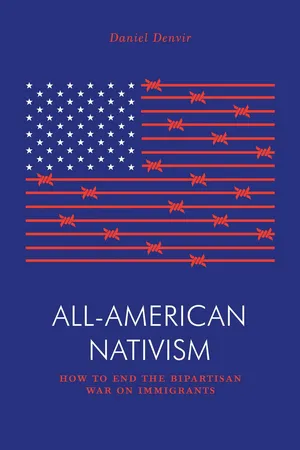
It is often said that with the election of Donald Trump nativism was raised from the dead. After all, here was a president who organized his campaign around a rhetoric of unvarnished racism and xenophobia. Among his first acts on taking office was to issue an executive order blocking Muslim immigrants from entering the United States. But although his actions may often seem unprecedented, they are not as unusual as many people believe. This story doesn't begin with Trump. For decades, Republicans and Democrats alike have employed xenophobic ideas and policies, declaring time and again that "illegal immigration" is a threat to the nation's security, wellbeing, and future.
The profound forces of all-American nativism have, in fact, been pushing politics so far to the right over the last forty years that, for many people, Trump began to look reasonable. As Daniel Denvir argues, issues as diverse as austerity economics, free trade, mass incarceration, the drug war, the contours of the post 9/11 security state, and, yes, Donald Trump and the Alt-Right movement are united by the ideology of nativism, which binds together assorted anxieties and concerns into a ruthless political project.
All-American Nativism provides a powerful and impressively researched account of the long but often forgotten history that gave us Donald Trump.
eBook - ePub
All-American Nativism
How the Bipartisan War on Immigrants Explains Politics as We Know It
- 352 pages
- English
- ePUB (mobile friendly)
- Available on iOS & Android
eBook - ePub
All-American Nativism
How the Bipartisan War on Immigrants Explains Politics as We Know It
About this book
Information
1
SCARCITY
Failing to reduce the current rate of immigration, legal and illegal, clearly means that our children and our grandchildren cannot possibly have the quality of life that we ourselves have been fortunate to have enjoyed.
—Representative Anthony C. Beilenson (D-CA), 19961
In 1964, President Lyndon B. Johnson called on Americans to build a Great Society, where “an order of plenty for all of our people” would be directed to “elevate our national life, and to advance the quality of our American civilization.”
The optimism soon curdled. Americans lost their sense of place in the world and found themselves in long lines at gasoline stations. The horn of plenty dried up as stagflation, a schema-shattering combination of high unemployment and inflation, took hold—setting the stage for a business reaction against organized labor and the New Deal order that had protected it. A slow, bloody, and expensive war on Vietnam not only defeated the US military but also, alongside Richard Nixon’s hack criminality, discredited government. Even prosperity’s most taken-for-granted foundation appeared at risk: suddenly, our way of life appeared to push the earth beyond carrying capacity. In short, a future that had once seemed to offer limitless promise was abruptly and drastically circumscribed; the boundless Great Society devolved into a zero-sum game, with hostile camps competing over dwindling resources. A new era of immigration—mass, diverse and, in the case of Mexicans, criminalized—had the bad fortune of accompanying this proliferating uncertainty, conflict, and pessimism.
For decades, the debate over immigration has centered on empirical questions over whether immigrants put downward pressure on wages for native-born workers (by and large they do not) or are a strain on public spending (it depends on what level of government).* But the dynamics of American immigration politics can’t be explained by seeking to answer these questions. What’s revelatory is why and how these debates began to shape American politics in the first place.
The politics of immigration need to be understood in relation to the rise of mass incarceration, the crisis of empire, and white reaction against demographic change. But for the purposes of this chapter, I untangle the pervasive sense of economic scarcity that formed the core of contemporary immigration politics as it took shape in the 1970s. My concern here is not only economics narrowly construed but also the fundamental resources provided by non-human nature—the fragility of which had come into view and become the object of widespread anxiety. But making sense of this recent history first requires explaining how Americans became primed to blame racialized others for economic problems in the first place.
Workers of the world divided
The Naturalization Act of 1790 opened citizenship to most “any alien” who was a “free white person” and barred all those who were not—forging a deep and permanent link between citizenship, race, and the status of labor. “Free white” workers would consistently scapegoat immigrants and others for an unequal system; it was that system, in turn, that made those others other, as the invention of racial difference came to explain the status of the labor they performed. W.E.B. Du Bois described this dynamic in Black Reconstruction in America, writing that slavery caused poor whites to hate enslaved black workers and their work. Instead of identifying as workers, they dreamed of emulating planters and owning an enslaved workforce of their own. “To these Negroes [the poor white] transferred all the dislike and hatred which he had for the whole slave system,” wrote Du Bois. “The result was that the system was held stable and intact by the poor white.”2 White-supremacist naturalization law and slavery alike established who counted as a true American.
The white man’s republic celebrated a “free labor” ideal that depended upon but also rejected menial labor, performed first by black people and then later by racialized immigrants. Assignment to menial labor became an inherited, racial trait, appearing in the false guise of a feature of biology. This also meant that sex and gender were central to white supremacy and capitalism, because it was through reproduction that race—and thus the division of labor—became a social reality.
Racism on the basis of the free labor ideology became a ground for racist nativism. In 1850, California imposed a special tax on foreign miners and then, briefly, five years later, imposed it specifically on those ineligible for citizenship: Asians. Approximately 250,000 Chinese workers arrived between 1850 and 1882, many to mine gold in California or to labor on the transcontinental railroad, the economic backbone of an American empire stretching to the Pacific.3 After the Civil War and amid the counterrevolution against Radical Reconstruction, a recession took hold in the 1870s as the United States expanded its genocidal frontier. Anti-Chinese sentiment grew across the West, particularly in California.
Industrial capitalism squeezed farmers and labor alike, a dilemma to which free and cheap land on an expanding frontier no longer provided an exit. So many genocidal wars against Native people had been won and yet the new system made the economic independence promised by the frontier myth plainly untenable. Westward migration no longer offered an escape valve for the masses of people lacking wealth or land.4 Xenophobia offered a temporary fix. Many businesses no doubt wanted immigrant labor.5 But anti-immigrant politics was a compromise that facilitated industrial capitalism’s ascent in the face of the increasingly militant movements of the 1870s and 1880s. One such movement, the Populist alliance of workers and farmers, posed a truly radical threat. The movement drew strength from its rejection of the racist divisions at home and abroad that fundamentally shape American capitalism. It was undermined in part by its failure to fully move beyond those divisions: the Knights of Labor voted to back Chinese exclusion, and members of the white Farmer’s Alliance failed to support Colored Farmers’ Alliance boycotts and strikes, which were met with lethal violence in the South.6 Populism’s defeat, in turn, only helped consolidate racism’s hold.7 Although elite strategies of racial division and stratification can prove to be explosive and unpredictable, it has for American capitalism been an indispensable feature.
Cultural theorist Stuart Hall wrote that “race is the modality in which class is lived.” Whites blaming Chinese workers’ racial “servility” for the economic system that subjugated them all was a case in point. The first restrictive federal immigration law, the Page Law of 1875, targeted Chinese people precisely as a racialized labor threat, increasing criminal sanctions for transporting and contracting “coolie” workers and barring the entry of Asians suspected of being prostitutes.8
In 1882, a ten-year ban on Chinese workers became law.9 The Chinese Exclusion Act was repeatedly renewed, and finally made permanent in 1904.10 Nativists were adamant that no other Asian laborers fill the void. In 1907, the US government succeeded in obtaining the Japanese government’s agreement not to issue passports to laborers, which prevented the immigration of Japanese workers to the United States. In 1917, an entry ban was enacted to cover people from across an expansive “Asiatic Barred Zone,” which did not include Japan or the Philippines, a colonial possession. The exclusion was cemented and expanded to Japan by the 1920s national origins quota laws, which also sharply restricted immigration from southern and eastern Europe. Racial bars to naturalization were not fully abolished until 1952 and Asian immigration was severely limited until 1965, when President Johnson signed the Hart-Celler Act, repealing the quota system.
The labor movement of the late nineteenth and early twentieth century was divided over mass immigration. The Knights of Labor’s model of industrial unionism extended to many immigrants but not to European contract laborers or, after internal debate, to Chinese workers. The American Federation of Labor (AFL) embraced a craft-based model, an exclusionary approach that also manifested in its support for excluding newcomers. The radical Industrial Workers of the World organized not only people from every nation but even across the US-Mexico border alongside the radical Partido Liberal Mexicano, with whom they mounted an insurrection in Baja California.11 The Socialist Party, radical labor’s most important electoral force, was riven by debates over immigration. But the SPUSA ultimately embraced restriction to the consternation of its tribune, Eugene Debs.12 The labor movement won spectacular victories when it organized the entire working class. But business retained the upper hand as workers from the world over remained divided.
Less desirable as a citizen than as a laborer
With Asian workers banned and European workers heavily restricted, industries in the Southwest, especially agriculture, and others as far away as Chicago demanded Mexican labor. In the early twentieth century, recruiters traveled into Mexico’s west-central states, enticing workers into a system of indentured servitude known as el enganche, or “the hook.” Those recruited to work in the United States fled the privatization and consolidation of rural land, falling wages in the cities and, eventually, a country battered by the chaos of the Mexican Revolution.13
Mexicans—those who migrated and those who simply found themselves on the wrong side of the border after the Mexican-American War—were tolerated as workers but disdained as neighbors. They were subjected not only to exploitation on the job but to segregation and discrimination in housing and public accommodations, and to rampant state and vigilante violence.14 As the congressional Dillingham Commission, which laid the groundwork for the massive restriction of the 1920s, put it: Mexican workers were “providing a fairly adequate supply of labor … While not easily assimilated, this is of no great importance as long as most of them return to their native land. In the case of the Mexican, he is less desirable as a citizen than as a laborer.”15
A Los Angeles Chamber of Commerce official declared that agricultural work was best done by “the oriental and Mexican due to their crouching and bending habits [to which they] are fully adapted, while the white is physically unable to adapt himself to them.”16 Race was defined by the sort of work someone did, and then work was organized by those racial categories. This created the problem of what to do with racialized others. Mexicans, portrayed as deportable and impermanent laborers, were not excluded alongside Asians or restricted together with Europeans. Instead, a compromise between nativists and agricultural interests was struck in 1929 that made crossing the border without authorization a misdemeanor—the law that would one day make Trump’s family separations possible.17 It also made illegally reentering after having been deported a felony.18
During the Great Depression, federal, state, and local government drove hundreds of thousands of Mexicans from their jobs, the relief rolls, and ultimately the country as part of a massive “repatriation” campaign that combined coerced deportations and voluntary departures, including of US citizens.19 But World War II soon increased demand for low-wage labor. In response, the United States and Mexico established the Bracero program, through which guest workers could work temporarily north of the border. Much of the wages were deposited in a Mexican bank to induce them to return (though some funds never were returned to workers).20 The program issued 4.6 million temporary visas between 1942 and 1964.21 Many others entered without authorization.22 The program laid the groundwork for large-scale Mexican migration—what scholars have called “the largest sustained flow of migrant workers in the contemporary world”—that would last until the Great Recession of 2008.23
Business demanded immigrant workers; indeed, growers in the Southwest adamantly resisted enforcement targeting their employment of undocumented Mexican workers. But politicians would feel compelled to expel, repress, or exclude those same workers in order to placate public sentiment. In these early years, much opposition to both unauthorized Mexican immigration and the Bracero program came from labor: the restrictionist AFL; the Congress of Industrial Organizations (CIO), formed in the 1930s to organize the ethnically diverse masses of mass production workers neglected by the AFL, and which did staunchly oppose racist national origins quotas; and Mexican-American organized labor. In 1949, the National Agricultural Workers Union (NAWU) mobilized six thousand people at the border in California’s Imperial Valley to protest imported Mexican labor. “Braceros and ‘wets’ are the two sides of the same phony coin,” said NAWU organizer Ernesto Galarza. Their purpose was to “cut down the wages of farm labor, to break strikes and to prevent [union] organization; to run American citizens off farm jobs, especially on the corporation ranches.”24
Mexican labor migration was for decades protected from union and nativist critics by an “iron triangle” comprising Southwestern agricultural interests, Southern and Western conservatives in Congress, and the Federal Immigration Bureau.25 The 1952 Immigration and Nationality Act made “harboring” undocumented immigrants a felony, but included a measure known as the Texas Proviso that exempted employers. Enforcement often targeted braceros who attempted to organize.26
In 1954, President Eisenhower appointed Lieutenant General Joseph M. Swing to run the Immigration and Naturalization Service (INS). ...
Table of contents
- Cover Page
- Halftitle Page
- Title Page
- Copyright Page
- Contents
- Introduction
- 1. Scarcity
- 2. Security
- 4. Reaction
Trusted by 375,005 students
Access to over 1.5 million titles for a fair monthly price.
Study more efficiently using our study tools.
Frequently asked questions
Yes, you can cancel anytime from the Subscription tab in your account settings on the Perlego website. Your subscription will stay active until the end of your current billing period. Learn how to cancel your subscription
No, books cannot be downloaded as external files, such as PDFs, for use outside of Perlego. However, you can download books within the Perlego app for offline reading on mobile or tablet. Learn how to download books offline
Perlego offers two plans: Essential and Complete
- Essential is ideal for learners and professionals who enjoy exploring a wide range of subjects. Access the Essential Library with 800,000+ trusted titles and best-sellers across business, personal growth, and the humanities. Includes unlimited reading time and Standard Read Aloud voice.
- Complete: Perfect for advanced learners and researchers needing full, unrestricted access. Unlock 1.5M+ books across hundreds of subjects, including academic and specialized titles. The Complete Plan also includes advanced features like Premium Read Aloud and Research Assistant.
We are an online textbook subscription service, where you can get access to an entire online library for less than the price of a single book per month. With over 1.5 million books across 990+ topics, we’ve got you covered! Learn about our mission
Look out for the read-aloud symbol on your next book to see if you can listen to it. The read-aloud tool reads text aloud for you, highlighting the text as it is being read. You can pause it, speed it up and slow it down. Learn more about Read Aloud
Yes! You can use the Perlego app on both iOS and Android devices to read anytime, anywhere — even offline. Perfect for commutes or when you’re on the go.
Please note we cannot support devices running on iOS 13 and Android 7 or earlier. Learn more about using the app
Please note we cannot support devices running on iOS 13 and Android 7 or earlier. Learn more about using the app
Yes, you can access All-American Nativism by Daniel Denvir in PDF and/or ePUB format, as well as other popular books in Politics & International Relations & Communism, Post-Communism & Socialism. We have over 1.5 million books available in our catalogue for you to explore.