- 560 pages
- English
- ePUB (mobile friendly)
- Available on iOS & Android
eBook - ePub
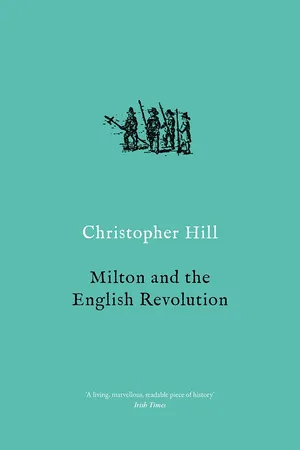
Milton and the English Revolution
About this book
In this remarkable book Christopher Hill used the learning gathered in a lifetime's study of seventeenth-century England to carry out a major reassessment of Milton as man, politician, poet, and religious thinker. The result is a Milton very different from most popular representations: instead of a gloomy, sexless "Puritan", we have a dashingly thinker, branded with the contemporary reputation of a libertine.
Information
Chapter 1
Introduction
The civil war of the seventeenth century, in which Milton is a symbolic figure, has never been concluded. … Of no other poet is it so difficult to consider the poetry simply as poetry, without our theological and political dispositions, conscious and unconscious, inherited or acquired, making an unlawful entry.
T. S. Eliot, Milton (1947), p. 3
Milton is a more controversial figure than any other English poet. Many of the controversies relate to Milton’s participation in the seventeenth-century English Revolution, yet Milton is more controversial even than that Revolution itself. Those who dislike Milton dislike him very much indeed, on personal as well as political grounds. How could the American who proclaimed himself Royalist, Anglo-Catholic and classicist have any use for England’s greatest republican anti-Catholic? Blake, Shelley and Herzen were more attuned to Milton: so were Jefferson, Mirabeau and the Chartists.
Yet the controversies around Milton are not simple. He was, for instance, a propagandist of revolution, a defender of regicide and of the English republic. Dr. Johnson and many since have found it hard to forgive him for this, or to be fair to him. Yet Milton frequently expressed great contempt for the common people, and so cannot be whole-heartedly admired by modern democrats. He was a passionate anti-clerical, and in theology a very radical heretic. Since he was also a great Christian poet, ‘orthodox’ critics have frequently tried to explain away, or to deny, his heresies. We may feel that these attempts tell us more about the commentators than about Milton, but they have not been uninfluential. On the other hand, Milton’s radical theology is far from conforming to the sensibility of twentieth-century liberal Christians.
The popular image of Milton is of a sour Puritan, an arrogant and hypocritical male chauvinist who ill-treated his own wife and daughters. But his contemporaries denounced him as a libertine who encouraged the insubordination of women, as an advocate of ‘divorce at pleasure’ and polygamy. Milton has been criticized for approaching serious political and social problems from a totally personal angle – for writing about divorce only after his own marriage had broken down, about liberty of printing only after he had himself run into trouble with would-be censors; for attacking in an unbalanced way the leaders of the Long Parliament (in the ‘digression’ to his History of Britain) because he himself had had difficulties with some of that Parliament’s committees. A similar accusation of making political issues out of personal problems was made against the Leveller leader John Lilburne. Even if the charge is true, the ideas still remain to be judged on their merits.
Although Milton was a considerable scholar, and classicist enough to satisfy T. S. Eliot, he offends many readers by his apparent rejection of all human learning in Paradise Regained and the De Doctrina Christiana. Stylistically, he is accused of writing an old-fashioned prose, lacking in simplicity and directness; and verse in a style which (because of its alleged Latinisms and grandiloquence)1 proved a deplorable model and is to blame for the artificial eighteenth-century ‘poetic diction’. His great reputation was thus a disaster for English literature. Milton has been regarded as playing a big part in the ‘dissociation of sensibility’ which is said to have taken place in seventeenth-century England; critics have wagged fingers at him for not being Shakespeare or for not being a metaphysical poet.
For all these reasons – and no doubt for many more – a determined attempt was made not so long ago to demote Milton, to remove him from the canon. We forget to-day how near it came to success. ‘Milton’s dislodgment, in the past decade, after his two centuries of predominance, was effected with remarkably little fuss.’ So F. R. Leavis wrote, triumphantly if prematurely, in 1936.2 In 1956 the volume of the Penguin Guide to English Literature which succeeded The Age of Chaucer and The Age of Shakespeare was not called The Age of Milton but From Donne to Marvell. The chapter devoted to ‘Milton’s religious verse’ was not enthusiastic.
As late as 1968 W. R. Parker wrote ‘after having disliked Milton’s ideas for three centuries, while admiring his poetry, the English have finally decided … that the poetry too is bad’3 – a statement even more astonishing for what it says about the countrymen of Blake and Shelley, Wordsworth and the Chartists, than for its finality about the present. It is historically quite untrue, but indicative of the success of the propaganda of those whom William Empson calls the ‘neo-Christians’. Fortunately these were not united in their strategy. Over against those who tried to dismiss Milton were others, less politically shrewd perhaps, who with C. S. Lewis at their head believed that they could annex Milton for ‘orthodoxy’. In Lewis’s Preface to Paradise Lost (1942) the poet is represented as a traditional authoritarian who can be used to rebuke the sinful modern world. Eliot himself on second thoughts joined in the game of salvaging as much of Milton as possible for ‘orthodoxy’. It was part of a movement, now one hopes defunct, which saw Shakespeare as a propagandist of something called ‘Christian humanism’, defender of a hierarchical society, and Milton as the product of ‘the Christian tradition’.
It is, in my view, quite wrong to see Milton in relation to anything so vague and generalized as ‘the Christian tradition’. He was a radical Protestant heretic. He rejected Catholicism as anti-Christian: the papist was the only heretic excluded from his wide tolerance. Milton shed far more of mediaeval Catholicism than did the Church of England. His great theological system, the De Doctrina Christiana, arose by a divorcing command from the ambiguous chaos of traditional Christianity.1 Milton rejected the Trinity, infant baptism and most of the traditional ceremonies, including church marriage; he queried monogamy and believed that the soul died with the body. He cannot reasonably be claimed as ‘orthodox’.
Demotion is now impossible. Since Christopher Ricks’s Milton’s Grand Style (1963) routed the Leavisites, Milton’s poetical reputation stands to-day as high as ever. Yet Milton needs to be defended from his defenders almost more than from the declining band of his enemies. There is the immensely productive Milton industry, largely in the United States of America, a great part of whose vast output appears to be concerned less with what Milton wrote (still less with enjoyment of what Milton wrote) than with the views of Professor Blank on the views of Professor Schrank on the views of Professor Rank on what Milton may or may not have written. Milton has been described as ‘the poet of scholars and academic critics’ – no longer either a people’s poet or a poet’s poet.2 What a fate for the arch-enemy of academic pedantry: better dead than buried alive, surely!
Yet how far is Milton read with enjoyment by ordinary people? On the one hand there are those who would persuade us that we must swallow Milton’s theology whole if we are to appreciate his poetry; on the other are those who, in the hope of getting the young to read him, tell us that we must forget that he was a ‘Puritan’ and a classical scholar, things which no one can take seriously in the late twentieth century. We must somehow let the poetry speak to us directly, and then all will be well.1 I applaud the intention, but I doubt whether it will succeed, at any rate with the major poems. Milton was not just a fine writer. He is the greatest English revolutionary who is also a poet, the greatest English poet who is also a revolutionary. The poems will not speak for themselves unless we understand his ideas in their context. But the context is historical, and it is very difficult to grasp Milton’s ideas without placing them in relation to those of his contemporaries. That is what I try to do in this book.
It is not then a straightforward biography of Milton. I am arguing a case, and attempting to refute traditional interpretations and assumptions where they appear to conflict with this case. So I must begin by declaring my hand. I believe that Milton’s ideas were more directly influenced than is usually recognized by the events of the English Revolution in which he was an active participant: and that the influences brought to bear on him were much more radical than has been accepted. Some minimum understanding of the world in which Milton acted and wrote is, I think, necessary if we are to appreciate what his poetry is doing.
A long time ago Milton used to be the great ‘Puritan’ poet, with iron-grey homespun clothes and iron-grey homespun character. Critics nagged away at the problem of how a ‘Puritan’ could also be a humanist. Modern studies of Puritanism have abolished this problem by abolishing the killjoy concept of Puritanism: there was nothing abnormal in a seventeenth-century Puritan loving music, song, wine and plays, or defending, as Milton did, elegance, fine clothes, dancing, theatres, bagpipes and fiddles, ale-houses. Passions and pleasures, he declared in Areopagitica, if ‘rightly tempered, are the very ingredients of virtue’.2 Sexual austerity was at least as likely to be associated with Catholicism in seventeenth-century opinion: radical Protestants were thought to be more sexually indulgent.3 Milton was a ‘roundhead’ whose portraits show him with long hair. It was Archbishop Laud who insisted on undergraduates cutting their hair short: long hair luxuriated in Oxford after the victory of the ‘roundheads’. Milton was not unique in choosing as a symbol of strength and virtue the long flowing locks of Samson.1 The stereotype of the dour Puritan seemed applicable to Milton so long as it was believed that he wrote his first divorce pamphlet within a month of marrying Mary Powell. But historical research long ago disproved that myth.
I believe that other problems can be dissolved by a historical approach. Take the question of the sources of Milton’s ideas. Critics obsessed with the poet’s great reputation and great scholarship tend to look exclusively to literary sources for his ideas – to the Greek and Roman classics, to the early Christian Fathers. There are useful works on Milton and Plato, Milton and Origen, Milton and Lactantius. More to my point, there have been studies of Milton and Servetus, Milton and Ochino, Milton and Du Bartas, Milton and Boehme. My not very daring suggestion is that Milton got his ideas not only from books but also by talking to his contemporaries. As Saurat put it, ‘to take up a thread at the beginning of human culture and follow it up till it reaches Milton is a pure illusion, a mere abstract fabrication of the academic mind.’2 It is a prevalent donnish assumption that ideas are transmitted principally by books. But ‘Marxist’ and ‘Freudian’ ideas are held to-day by people who never opened a book by Marx or Freud. How many of those whom we call ‘Arminian’ in seventeenth-century England had read Arminius? Milton had; but his learning was exceptional. Ideas which scholars solemnly trace back to the fifth century B.C. or the third century A.D. were commonplaces to seventeenth-century Baptists, Levellers, Diggers, Seekers, Behmenists, Socinians, Ranters, Muggletonians, early Quakers and other radical groupings which took part in the free-for-all discussions of the English Revolution. The ideas had previously circulated only in the heretical underground: now they could suddenly be freely discussed. Milton celebrated this ferment in Areopagitica. I see him in permanent dialogue with the plebeian radical thinkers of the English Revolution and I see him drawing on the same traditions as they drew on-traditions which include Servetus, Ochino and Boehme, but which also include Hermeticism, whose rediscovery in the fifteenth century gave new life to many ideas from classical antiquity.3
Milton’s relation to this underworld of thought has not yet been properly investigated. Fifty years ago M. Saurat seized on Milton’s radical heresies but put us on the wrong track by attributing them to Jewish sources. We need more specific studies of Milton and his links with this radical background. The best to date is N. T. Burns’s Christian Mortalism from Tyndale to Milton, which sets the poet against a century and more of underground heretical thought in England. There is also Leo Miller’s Milton among the Polygamophiles, which relates some of Milton’s views on marriage to previous history; but a wider study of Milton and preceding ideas about the relation of the sexes is needed. There are general histories of Unitarianism and of Socinianism in which Milton’s name occurs; but no study of his ideas in the light of this tradition, also strong in the English underground. There is no work on Milton and contemporary millenarianism, antinomianism, materialism or Hermeticism. Despite Saurat’s pioneer work, quite recently very respectable scholars could assume that the Milton who read Cicero and Virgil could not possibly ‘have given his serious attention to the naive and superstitious Robert Fludd’, or to ‘the vulgar astrological flimflam of Dr. John Dee’.1 But John Selden was a great admirer of Fludd, and Sir Isaac Newton took very seriously thinkers who seem by twentieth-century standards to be no less irrational than Dee and Fludd. Our understanding of the seventeenth century has been greatly enriched of late by scholarly work which has restored Dee and Fludd to the predominance which contemporaries gave them.2 There is a book to be written on ‘Milton and Fludd’ which will be far more important than any studies of Milton’s classical or patristic sources. But whoever writes it will need both more courage and more Latin than I possess.
I believe that the historian’s approach can help by trying to explain how Milton came to hold the views he did at the time he held them; and perhaps to explain changes in his views over time. Milton was not an original thinker, in politics or theology. Almost every one of his ideas can be paralleled among his radical contemporaries. He is unique only in the way he combined their ideas and related them to the Bible. If we restore him to the seventeenth-century context we shall no longer see originality where none exists. For instance, Milton’s notorious ‘He for God only, she for God in him’ is one of the few of his statements which would have been totally acceptable to the orthodox among his contemporaries. Similarly, there is no need to make a pother about Milton’s climatic theories once we appreciate that the belief that northerners were stronger than but intellectually inferior to southerners was the stalest of chestnuts in the seventeenth century.1 Where commentators have supposed that Milton was strikingly original he is often only fusing with the orthodox Puritan tradition ideas from the Familist/Hermeticist tradition which I shall be investigating.2
Milton, wrote J. H. Hanford, ‘contemplated no activity as a poet which did not involve an intimate relation with the currents of life and thought in which he lived’.3 By replacing Milton in history we shall be able to catch in his writings echoes of discussions and controversies which meant much to him and to those for whom he wrote, but which lose this resonance when they are treated in isolation. Milton like many of us, combined traditional ideas unquestioningly accepted with others which were, by the standards of his day, highly unorthodox. That is why each critic can create his own Milton. C. S. Lewis, an old-fashioned authoritarian Christian surviving into the twentieth century, found some of the more traditional aspects of Milton’s thought congenial and expounded them very effectively for his time. Empson, a dashing modern atheist, has more sympathy for those aspects of Milton’s thought which were wildly heretical in the seventeenth century, though they were perhaps not quite so positively anti-Christian as Empson wished to think.
But Milton was neither a twentieth-century authoritarian Christian nor a twentieth-century atheist. He has more in common with a Ranter like Laurence Clarkson than with Lewis and the neo-Christians; but he also has more in common with Lodowick Muggleton, who believed he was one of the two Last Witnesses, than with Empson.4 Whilst keeping Milton in the seventeenth century we must recognize that in the sixteen-forties and -fifties there was an outburst of radical thinking in England which transcended the ort...
Table of contents
- Cover Page
- Halftitle Page
- Title Page
- Copyright Page
- Dedication
- Contents
- Preface
- Abbreviations
- Milton’s Principal Writings
- Chapter 1: Introduction
- Part I: Shipwreck Everywhere
- Part II: Teeming Freedom
- Part III: Milton and the Commonwealth
- Part IV: Defeat and After
- Part V: Milton’s Christian Doctrine
- Part VI: The Great Poems
- Part VII: Towards a Conclusion
- Appendices
- Notes
- Bibliography
- General Index
- Index of References to Milton’s Writings
Trusted by 375,005 students
Access to over 1.5 million titles for a fair monthly price.
Study more efficiently using our study tools.
Frequently asked questions
Yes, you can cancel anytime from the Subscription tab in your account settings on the Perlego website. Your subscription will stay active until the end of your current billing period. Learn how to cancel your subscription
No, books cannot be downloaded as external files, such as PDFs, for use outside of Perlego. However, you can download books within the Perlego app for offline reading on mobile or tablet. Learn how to download books offline
Perlego offers two plans: Essential and Complete
- Essential is ideal for learners and professionals who enjoy exploring a wide range of subjects. Access the Essential Library with 800,000+ trusted titles and best-sellers across business, personal growth, and the humanities. Includes unlimited reading time and Standard Read Aloud voice.
- Complete: Perfect for advanced learners and researchers needing full, unrestricted access. Unlock 1.5M+ books across hundreds of subjects, including academic and specialized titles. The Complete Plan also includes advanced features like Premium Read Aloud and Research Assistant.
We are an online textbook subscription service, where you can get access to an entire online library for less than the price of a single book per month. With over 1.5 million books across 990+ topics, we’ve got you covered! Learn about our mission
Look out for the read-aloud symbol on your next book to see if you can listen to it. The read-aloud tool reads text aloud for you, highlighting the text as it is being read. You can pause it, speed it up and slow it down. Learn more about Read Aloud
Yes! You can use the Perlego app on both iOS and Android devices to read anytime, anywhere — even offline. Perfect for commutes or when you’re on the go.
Please note we cannot support devices running on iOS 13 and Android 7 or earlier. Learn more about using the app
Please note we cannot support devices running on iOS 13 and Android 7 or earlier. Learn more about using the app
Yes, you can access Milton and the English Revolution by Christopher Hill in PDF and/or ePUB format, as well as other popular books in History & Literary Biographies. We have over 1.5 million books available in our catalogue for you to explore.