- 160 pages
- English
- ePUB (mobile friendly)
- Available on iOS & Android
eBook - ePub
Remembering the Crusades in Medieval Texts and Songs
About this book
Exploring Latin texts, as well as Old French, Castilian and Occitan songs and lyrics, Remembering the Crusades in Medieval Texts and Songs takes inspiration from the new ways scholars are looking to trace the dissemination and influence of the memories and narratives surrounding the crusading past in medieval Europe. It contributes to these new directions in crusade studies by offering a more nuanced understanding of the diverse ways in which medieval authors presented events, people and places central to the crusading movement. This volume investigates how the transmission of stories related to suffering, heroism, the miraculous and ideals of masculinity helped to shape ideas of crusading presented in narratives produced in both the Latin East and the West, as well as the importance of Jerusalem in the lyric cultures of southern France, and how the narrative arc of the First Crusade developed from the earliest written and oral responses to the venture.
Information
ISBN 978-1-78683-504-8
eISBN 978-1-78683-506-2
ISSN (Print) 2057-4517
ISSN (Online) 2057-4525
The Journal of Religious History, Literature and Culture
© University of Wales Press, 2019
Articles and reviews © The Contributors, 2019
Contributors to The Journal of Religious History, Literature and Culture should refer enquiries to the journal page at www.uwp.co.uk or e-mail [email protected] requesting notes for contributors.
Advertising enquiries should be sent to the Sales and Marketing Department at the University of Wales Press, at the address below.
Subscriptions: The Journal of Religious History, Literature and Culture is published twice a year in June and November. The annual subscription for institutions is £95 (print only), £85 (online only) or £140 (combined); and for individuals is £25 (print or online only) or £40 (combined). Subscription orders should be sent to University of Wales Press, University Registry, King Edward VII Avenue, Cardiff CF10 3NS. E-mail: [email protected].
Open Access information for journals is available on the University of Wales Press website at www.uwp.co.uk.
The publisher has no responsibility for the persistence or accuracy of URLs for any external or third-party internet websites referred to in this book, and does not guarantee that any content on such websites is, or will remain, accurate or appropriate.
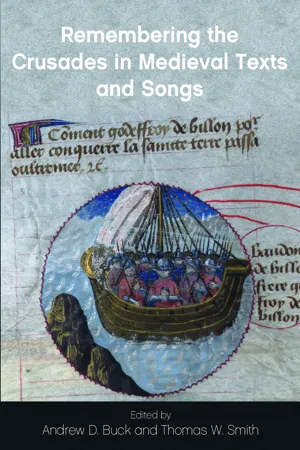
Cover image: Cover image: The contingent of Godfrey of Bouillon, travelling on the First Crusade. Miniature from historical roll (late fifteenth century), BC MS 100/28, reproduced by permission of Special Collections, Brotherton Library, University of Leeds.
Notes
‘Weighed by such a great calamity, they were cleansed for their sins’: Remembering the Siege and Capture of Antioch
1 For their invaluable insights on the ideas in this piece, I would like to thank conference audiences in Leeds and St Andrews, as well as Katy Mortimer, Beth Spacey, Stephen Spencer and Carol Sweetenham.
2 For this piece, the primary texts examined are: GF; PT; RA; FC; RM; BB; GN; AA; RC; GP. Events at Antioch were also immortalised in epic songs, wall paintings, and other forms of material culture, but these will be examined elsewhere.
3 N. Paul, To Follow in Their Footsteps: The Crusades and Family Memory in the High Middle Ages (Ithaca, NY, 2012); M. Cassidy-Welch (ed.), Remembering the Crusades and Crusading (Abingdon, 2016).
4 T. Asbridge, The First Crusade: A New History (London, 2004), pp. 153–240.
5 GF, pp. 28–84.
6 GF, pp. 62–3: ‘Istas et multas anxietates ac angustias quas nominare nequeo passi sumus pro Christi nomine et Sancti Sepulchri via.’
7 GF, pp. 34–7 (here p. 37): ‘in adiutorium Dei Sanctique Sepulchri’.
8 GF, pp. 38–41, 43–50, 56–65, 69–70, 72.
9 GF, p. 72: ‘quemadmodum hunc feliciter valerent conducere et regere populum, donec peragerent iter Sancti Sepulchri, pro quo hucusque multa erant passi pericula’.
10 PT, pp. 62–114; M. G. Bull, ‘The Relationship Between the Gesta Francorum and Peter Tudebode’s Historia de Hierosolymitano Itinere: The Evidence of a Hitherto Unexamined Manuscript (St. Catharine’s College, Cambridge, 3)’, Crusades, 11 (2012), 1–17; RA, pp. 46–84 (here pp. 51, 53): ‘flagitiorum adulterii et rapine mentes ad penitentiam concuti’, ‘equos suos diurna contabescere fame patiebantur.’
11 RA, pp. 55, 68: ‘divina clementia eis affuit, et que lascivientes filios correxerat, nimium tristes tali modo consolata est.’
12 FC, pp. 199–203, 215–66 (here pp. 199, 222): ‘De indigentia Christianorum’, ‘famem maximam sustinere’.
13 FC, pp. 222–6: ‘illi quasi aurum ter probatum igni septiesque purgatum iamdudum a Domino praeelecti … et in tanta calamitate examinati, a peccatis suis mundati sunt.’
14 FC, p. 243: ‘confestim cum feminis exlegibus commiscuerunt’; RA, pp. 53–4, 66 (quotation at p. 66): ‘dum nostri enumerando, et recognoscendo spolia, ab obpugnatione castri superioris desisterent, atque audiendo saltatrices paganorum splendide ac superbe epularentur, nullatenus Dei memores qui tantum beneficium eis contulerat’. See also A. Holt, ‘Feminine sexuality and the crusades: clerical opposition to women as a strategy for crusading success’, in A. Classen (ed.), Sexuality in the Middle Ages and Early Modern Times: New Approaches to a Fundamental Cultural-Historical and Literary-Anthropological Theme (Berlin, 2008), pp. 449–69.
15 FC, pp. 235–41, 251–6. Raymond’s stance, at least, may relate to Raymond of Toulouse’s singular failure to secure material rewards in northern Syria.
16 RM, pp. 33–90; BB, pp. 37–96; GN, pp. 168–251.
17 BB, p. 43: ‘Taliter autem Deus redarguebat eos misericorditer, ut ad eum toto corde conuerterentur; et si quid impenitudinis in eis latitabat, igne compunctionis et infortunio superuenientis necessitatis excocti purgarentur.’
18 BB, p. 85: ‘multas passus est calamitates ut sepulcrum domini Dei sui uidere promereatur’; GN, pp. 187–8: ‘assumpti huius intentionem tibi propone laboris … Iherosolimam deo redimere ac eius liberare Sepulchrum.’
19 GN, pp. 178, 180: ‘mentis reparent vigores’.
20 GN, p. 182: ‘ad dei solius subsidium, sub tanta miseria unice prestolandum, spei instinctu melioris appulsos … quo magis suas attenderent aut copias extenuari … eo amplius ad deum … docerentur debita humilitate subici.’
21 GN, p. 188: ‘tuam patienti Christo iam defer audaciam.’
22 RM, xlii–xlvii.
23 RM, p. 34: ‘ut Dominus ostenderet oculis mortalium, quia non e...
Table of contents
- Cover
- Title Page
- Contents
- The Contributors
- Editorial
- Abbreviations
- ‘Weighed by such a great calamity, they were cleansed for their sins’: Remembering the Siege and Capture of Antioch
- Framing the Narrative of the First Crusade: The Letter Given at Laodicea in September 1099
- Fear, Fortitude and Masculinity in William of Malmesbury’s Retelling of the First Crusade and the Establishment of the Latin East
- Refocusing the First Crusade: Authorial Self-Fashioning and the Miraculous in William of Tyre’s Historia Ierosolymitana
- Remembering Jerusalem: Lamenting the Holy City in Occitan Lyric, c. 1187–c. 1300
- ‘Li bons dus de Buillon’: Genre Conventions and the Depiction of Godfrey of Bouillon in the Chanson d’Antioche and the Chanson de Jérusalem
- The Gran conquista de Ultramar, its Precursors, and the Lords of Saint-Pol
- Copyright Page
Trusted by 375,005 students
Access to over 1.5 million titles for a fair monthly price.
Study more efficiently using our study tools.
Frequently asked questions
Yes, you can cancel anytime from the Subscription tab in your account settings on the Perlego website. Your subscription will stay active until the end of your current billing period. Learn how to cancel your subscription
No, books cannot be downloaded as external files, such as PDFs, for use outside of Perlego. However, you can download books within the Perlego app for offline reading on mobile or tablet. Learn how to download books offline
Perlego offers two plans: Essential and Complete
- Essential is ideal for learners and professionals who enjoy exploring a wide range of subjects. Access the Essential Library with 800,000+ trusted titles and best-sellers across business, personal growth, and the humanities. Includes unlimited reading time and Standard Read Aloud voice.
- Complete: Perfect for advanced learners and researchers needing full, unrestricted access. Unlock 1.5M+ books across hundreds of subjects, including academic and specialized titles. The Complete Plan also includes advanced features like Premium Read Aloud and Research Assistant.
We are an online textbook subscription service, where you can get access to an entire online library for less than the price of a single book per month. With over 1.5 million books across 990+ topics, we’ve got you covered! Learn about our mission
Look out for the read-aloud symbol on your next book to see if you can listen to it. The read-aloud tool reads text aloud for you, highlighting the text as it is being read. You can pause it, speed it up and slow it down. Learn more about Read Aloud
Yes! You can use the Perlego app on both iOS and Android devices to read anytime, anywhere — even offline. Perfect for commutes or when you’re on the go.
Please note we cannot support devices running on iOS 13 and Android 7 or earlier. Learn more about using the app
Please note we cannot support devices running on iOS 13 and Android 7 or earlier. Learn more about using the app
Yes, you can access Remembering the Crusades in Medieval Texts and Songs by Thomas W. Smith,Andrew D. Buck in PDF and/or ePUB format, as well as other popular books in History & European Medieval History. We have over 1.5 million books available in our catalogue for you to explore.