In the history of planning, the design of an entire community prior to its construction is among the oldest traditions. Iconic Planned Communities and the Challenge of Change explores the twenty-first-century fortunes of planned communities around the world. Drawing on interdisciplinary perspectives, the editors and contributors examine what happened to planned communities after their glory days had passed and they became vulnerable to pressures of growth, change, and even decline.
Beginning with Robert Owen's industrial village in Scotland and concluding with Robert Davis's neotraditional resort haven in Florida, this book documents the effort to translate optimal design into sustaining a common life that works for changing circumstances and new generations of residents. Basing their approach on historical research and practical, on-the-ground considerations, the essayists argue that preservation efforts succeed best when they build upon foundational planning principles, address landscape, architecture, and social engineering together, and respect the spirit of place.
Presenting twenty-three case studies located in six continents, each contributor considers how to preserve the spirit of the community and its key design elements, and the ways in which those elements can be adapted to contemporary circumstances and changing demographics. Iconic Planned Communities and the Challenge of Change espouses strategies to achieve critical resilience and emphasizes the vital connection between heritage preservation, equitable sharing of the benefits of living in these carefully designed places, and sustainable development.
Communities: Bat'ovany-Partizánske, Cité Frugès, Colonel Light Gardens, Den-en Chôfu, Garbatella, Greenbelt, Hampstead Garden Suburb, Jardim América, Letchworth Garden City, Menteng, New Lanark, Pacaembú, Radburn, Riverside, Römerstadt, Sabaudia, Seaside, Soweto, Sunnyside Gardens, Tapiola, The Uplands, Welwyn Garden City, Wythenshawe.
Contributors: Arnold R. Alanen, Carlos Roberto Monteiro de Andrade, Sandra Annunziata, Robert Freestone, Christine Garnaut, Isabelle Gournay, Michael Hebbert, Susan R. Henderson, James Hopkins, Steven W. Hurtt, Alena Kubova-Gauché, Jean-François Lejeune, Maria Cristina a Silva Leme, Larry McCann, Mervyn Miller, John Minnery, Angel David Nieves, John J. Pittari, Jr., Gilles Ragot, David Schuyler, Mary Corbin Sies, Christopher Silver, André Sorensen, R. Bruce Stephenson, Shun-ichi J. Watanabe.
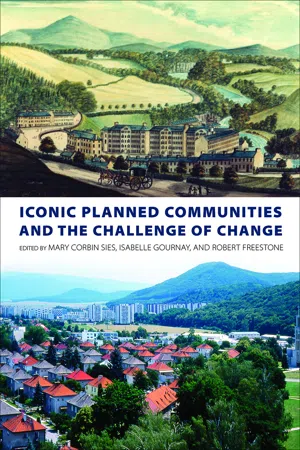
eBook - ePub
Iconic Planned Communities and the Challenge of Change
- 544 pages
- English
- ePUB (mobile friendly)
- Available on iOS & Android
eBook - ePub
Iconic Planned Communities and the Challenge of Change
About this book
Information
Publisher
University of Pennsylvania PressYear
2019Print ISBN
9780812251142
9780812251142
eBook ISBN
9780812295849
Topic
ArchitectureSubtopic
Urban Planning & LandscapingCHAPTER 1
NEW LANARK
Sustaining Robert Owen’s Legacy in Scotland
New Lanark is a small industrial settlement, physically isolated from the mainstream of urban history, yet it holds a special place in the narratives of urban planning, industrial innovation, and social reform. It is some forty kilometers (twenty-four miles) southeast of Glasgow in Scotland.
New Lanark was started in 1785 by David Dale, who was a Scottish textile merchant, banker, and entrepreneur, in a brief partnership with Richard Arkwright, an English inventor and businessman. The site was chosen in part because of the steady flow of the River Clyde just below the Falls of Clyde. Today, New Lanark is still a lively village where people live and work. It retains the essential elements of its early physical structure, but today’s activities are completely different to those of the town’s early years. Along the way many of the eighteenth-century advantages of its location created difficulties for its various later owners.
Iconic Status and Challenges
New Lanark has three sources of special historical significance. First, it is a classic early example of a planned industrial settlement where a manufacturer provided jobs but also convenient, good-quality housing and supporting services for his workers. Colin Bell and Rose Bell (1972, 241) emphasize this combination: “There is nothing in the history of town planning, or industrialization, which makes any one of New Lanark’s policies or artefacts stand out as unique, only their combination.” In fact, Gordon Cherry (1974, 17, 18) argues that it “set the scene” as a stimulus for the town planning movement. Graham U’ren (who held various important town planning positions in Clydesdale District Council, South Lanarkshire Council, and the Royal Town Planning Institute in Scotland between 1975 and 2007), in email correspondence (January 21, 2013), argues that even modern urban-design visitors to the town recognize its overall qualities as a livable place.
Its second claim to iconic status is from the cotton-spinning mills around which the town was built. These provide an outstanding example of early industrialized production methods, housing several newly invented machines and at a scale bigger than anything seen before. The New Lanark mills were at one stage the “largest and most successful” of the cotton manufacturing enterprises in Scotland (Donnachie and Hewitt 1993, 16). In G. D. H. Cole’s (1927 [1813–20], ix) estimation, they were “the largest and best equipped spinning mills in Scotland” in 1800. The mills in New Lanark were “amongst the most important of the Arkwright mills” as examples of industrial innovation (Pierson 1949, 11).
New Lanark’s third source of iconicity is its intimate association with the social and educational reformer Robert Owen. Owen was for a critical period the manager and part owner of the town and its mills; in the period from 1800 to 1825 he put into practice many of his theories while his experience at New Lanark became the basis for many of his later reformist ideas—or at least was used in his effective and widespread self-publicity about them (Donnachie 2000; Holloway 1966, 105). Owen’s social reforms resonate with the reforming utopianism that is one of the threads underpinning early British town planning (Cherry 1969, 49). Gerald Burke (1971, 136) even breathlessly claims that New Lanark “stimulated a long succession of schemes for the ideal community from a wide variety of sources including Quakers, Moravians, Unitarians, Anglicans, industrialists, social reformers and cranks.”
Rather than being known for its size or any grand designs, New Lanark became an icon due to these three threads: early town planning, industrial innovation, and Owenism. At the peak of its population in the early nineteenth century, it housed only about 2,300 people (Donnachie and Hewitt 1993, 94).
The features that lie at the heart of its iconicity are also the causes of the challenges it has had to face. First, because the town was based on a single manufacturing activity, it was vulnerable to the fluctuating fortunes of that industry. From the mid-nineteenth century until the 1960s, the Scottish (and world) cotton manufacturing industry gradually declined. The New Lanark mills managed to avoid for a time the problems facing the industry because they had ready access to cheap water power and offered low wages (compensated for by low rents), but they were not able to avoid the industry’s overall collapse. Second, although the location provided cheap power, it has poor road access. The town was started before working railways were invented but even today there is no direct rail line due to the inaccessibility of its river gorge location. Poor access created huge difficulties for later owners. The third great challenge was the single combined ownership of the mills and town. While for Dale and Owen the coupling was advantageous, to later manufacturers who bought the mills the management of the associated housing, school, and facilities was far outside their industrial expertise. Fourth, social and governance structures are radically different to those in the late eighteenth century. For example, today’s housing standards bear almost no resemblance to expectations in Dale and Owen’s time, and many of Owen’s radical innovations are now mainstreamed into social and educational policy. Today these challenges have been confronted and partially overcome but many of the problems remain. The continuing story of New Lanark has many lessons for other iconic planned settlements.
A Brief History
The reliable source of water power adjacent to a flat site below the Falls of Clyde was the principal attraction for Richard Arkwright when he was taken to see it by David Dale in 1784 (New Lanark Trust n.d.). Access from Glasgow to Lanark had also been recently improved with the building of road bridges over the Clyde. Dale and Arkwright formed a partnership that obtained the land “for a feu duty,” or for an annual rent, from Lord Justice Braxfield to build mills housing Arkwright’s recently invented water-powered cotton-spinning machinery (Donnachie and Hewitt 1993, 25). Building of the mills started in 1785. After the partnership was dissolved in 1786, Dale continued as sole proprietor (New Lanark Trust n.d., 4). Because of the relative isolation, and because there was no easy source of labor, Dale needed to “scavenge for labour, and to keep it there, had to provide a town” (Bell and Bell 1972, 242). The town’s physical shape was dictated by the limited building land available between the river and the steep-sided gorge (see Plates 1 and 2 for a modern and a historical perspective).
Some skilled labor was available in the nearby town of Lanark, including mechanics and watchmakers who were able to make and maintain the machinery in the mills. But the majority of the laboring workforce was made up of children, many of whom came from orphanages in Edinburgh and Glasgow. Dale also attracted reluctant adult workers who were forced by changes in agricultural methods and tenure to move from the land, including a group who were diverted from immigrating to America by Dale’s offer of immediate employment and low-rent housing. By 1796 Dale had “four mills in operation, employing 1,340 hands, 750 of them children and half of those under nine years old. By the standards of the time, Dale was a model master—but the standards were quite plainly appalling” (Bell and Bell 1972, 244). Dale provided schooling for the children, including a day-school for under sixes, so that mothers were free to work in the mills during the day (New Lanark Trust n.d., 8).
Robert Owen, with whom New Lanark is more famously associated, was a successful Welsh industrialist who married Dale’s eldest daughter, and set up a consortium from among his industrial associates in Manchester. The consortium bought the mills and town, and Owen took over as general manager in 1800. He had gained substantial experience in the textile industry while working in Lancashire. His extensive writings, dating mainly from his time at New Lanark and later in New Harmony in Indiana, give a self-aggrandizing view of the importance of his contribution, as well as setting out his philosophies on cooperation, education, and working conditions. Basically he held that a person’s character is shaped by their environment and that a fundamental component of that shaping was the education of the child. It followed that “the governing powers of all countries should establish rational plans for the education and general formation of the characters of their subjects” (Owen 1927 [1813]-a, 20). This education should “train children from their earliest infancy in good habits of every description. . . . They must afterwards be rationally educated, and their labour be usefully directed” (Owen 1927 [1813]-a, 20). Owen felt that children could not be trained in good habits if they were forced to work in factories, so he abolished child labor at New Lanark. His Second Essay claimed to show how this new way of forming character worked in practice in New Lanark (Owen 1927 [1813]-b, 33). In his Third Essay (Owen 1927 [1813]-c, 43) he also made a strong case for the provision of “rooms for innocent amusements and rational recreation.”
Owen used surplus profits voted by his various controlling boards to expand Dale’s original town, adding further housing as well as many other facilities. These included a new school, a bakery, a communal wash-house and a cooperative store, as well as an Institute for the Formation of Character (opened in 1816). Although he was a successful entrepreneur and manufacturer, he fell out with his financial backers over the degree of investment he proposed in community facilities, so New Lanark was run, over the years, by a number of successive boards; but each time that it was necessary to get new backers the purchase price increased—from £60,000 in 1799 to £114,100 in 1813, for example (Donnachie and Hewitt 1993). A forced auction in 1813, brought about by internal politicking within the board, saw Owen outwit his opponents to retain ownership with a new board (including the economist Jeremy Bentham) sympathetic to his reforming ideals. He also took care to publicize widely these ideas and to identify New Lanark as an exemplar of successful practice. Some fifteen thousand visitors flocked to New Lanark during Owen’s management: “they came not just to see an ideal community, but an efficient enterprise” (Bell and Bell 1972, 246). “For some time 2,000 visitors went annually to New Lanark, many of them eminent people, the Tsar of Russia included” (Cherry 1974, 18). In fact, “commercial success at New Lanark . . . was the vital ingredient in providing credibility for Owen’s principles” (New Lanark Trust n.d., 14). “His great achievement,” says William Ashworth (1954, 120), “was to transform the character of his village without injury to the business on which it depended. In the first thirteen years of his management the proprietors received over £50,000 in addition to 5 per cent on their capital . . . [and] . . . the output capacity was increased more than five-fold.”
But having “run through three boards, [Owen] finally sold out his share to the only director of the last board he found at all acceptable, John Walker” (Bell and Bell 1972, 248). Walker, a Quaker, and his family thus obtained a controlling interest in the town and mills in 1825. Owen then left for the United States, where with William MacLure, the geologist and educationalist, he bought the 121-square-kilometer (30,000-acre) site of Harmonie, Indiana, renamed New Harmony, from the founder of the Harmony Society, George Rapp. He maintained an interest in New Lanark, continuing to use the town to publicize his ideals. Owen’s aspirations for a new model community at New Harmony proved unattainable and after only three years he returned to the United Kingdom, having lost most of his personal fortune. He continued to proselytize on the national and international stage, but died in 1858.
By the 1830s the Scottish cotton industry faced fierce competition. Walker’s sons had taken over from their father and tried, unsuccessfully, to sell the mills and the houses in 1851. They modernized some of the machinery and maintained Owen’s innovations in the village, although obviously not with his fervor. By 1881, when New Lanark was sold to Henry Birkmyre and his brother-in-law, Robert Somerville, the town’s population had decreased to a mere 706 people (Donnachie and Hewitt 1993, 144). Birkmyre was the principal partner in the Gourock Ropework Company, which was expanding globally as a result of its successful association with the huge shipbuilding industry on the Lower Clyde. The Lanark Spinning Company continued to trade under that name until it merged with Gourock in 1903. Birkmyre and Gourock sought to maintain some of the social patterns that underpinned the town’s success. They also diversified the factory activities. As well as cotton being spun, it was also woven on site (UNESCO 2001, 41), and output now included ship sails and fishing nets manufactured with looms brought in from other company mills, as well as...
Table of contents
- Cover
- Half title
- Title
- Copyright
- Contents
- Introduction: Toward Critical Resilience in Iconic Planned Communities
- Chapter 1 New Lanark: Sustaining Robert Owen’s Legacy in Scotland
- Chapter 2 Riverside: The First Comprehensively Designed Suburban Community in the United States
- Chapter 3 English Garden Cities: Challenges of Conservation and Change
- Chapter 4 Uplands: A Residential Park in Victoria, British Columbia, Canada
- Chapter 5 Menteng: Heritage of a Planned Community in a Southeast Asian Megacity
- Chapter 6 Colonel Light Gardens: History, Heritage, and the Enduring Garden Suburb in Adelaide, South Australia
- Chapter 7 Den-En Chōfu: The First Japanese “Garden City”
- Chapter 8 The Jardim América and Pacaembu Garden Suburbs: Facing the Changes to the Metropolis of São Paulo
- Chapter 9 Garbatella: Heritage, Gentrification, and Public Policies in Rome, Italy
- Chapter 10 Sunnyside Gardens and Radburn: The Common Legacy and Divergent Experiences of Community Life
- Chapter 11 Citè Frugès: Le Corbusier’s Paradoxical Appropriation in Pessac, France
- Chapter 12 The Römerstadt Settlement: The “New Life” in Frankfurt am Main, Germany
- Chapter 13 Soweto: Planning for Apartheid and Preserving the Garden City Townships of Johannesburg, South Africa
- Chapter 14 Wythenshawe: Manchester’s Municipal Garden City
- Chapter 15 Sabaudia: Foundation, Growth, and Critical Memory in the Last Italian City
- Chapter 16 Greenbelt: Sustaining the New Deal Legacy
- Chapter 17 Baťovany-Partizánske: A Functionalist Company Town in Slovakia
- Chapter 18 Tapiola: From Garden City to National Landscape Icon in Finland
- Chapter 19 Seaside: Iconic Community of the New Urbanism
- Chapter 20 Iconicity in Planned Communities: The Power of Visual Representations
- Chapter 21 Afterword: Lessons of the Iconic Planned Community
- List of Contributors
- Index
- Acknowledgments
Trusted by 375,005 students
Access to over 1.5 million titles for a fair monthly price.
Study more efficiently using our study tools.
Frequently asked questions
Yes, you can cancel anytime from the Subscription tab in your account settings on the Perlego website. Your subscription will stay active until the end of your current billing period. Learn how to cancel your subscription
No, books cannot be downloaded as external files, such as PDFs, for use outside of Perlego. However, you can download books within the Perlego app for offline reading on mobile or tablet. Learn how to download books offline
Perlego offers two plans: Essential and Complete
- Essential is ideal for learners and professionals who enjoy exploring a wide range of subjects. Access the Essential Library with 800,000+ trusted titles and best-sellers across business, personal growth, and the humanities. Includes unlimited reading time and Standard Read Aloud voice.
- Complete: Perfect for advanced learners and researchers needing full, unrestricted access. Unlock 1.5M+ books across hundreds of subjects, including academic and specialized titles. The Complete Plan also includes advanced features like Premium Read Aloud and Research Assistant.
We are an online textbook subscription service, where you can get access to an entire online library for less than the price of a single book per month. With over 1.5 million books across 990+ topics, we’ve got you covered! Learn about our mission
Look out for the read-aloud symbol on your next book to see if you can listen to it. The read-aloud tool reads text aloud for you, highlighting the text as it is being read. You can pause it, speed it up and slow it down. Learn more about Read Aloud
Yes! You can use the Perlego app on both iOS and Android devices to read anytime, anywhere — even offline. Perfect for commutes or when you’re on the go.
Please note we cannot support devices running on iOS 13 and Android 7 or earlier. Learn more about using the app
Please note we cannot support devices running on iOS 13 and Android 7 or earlier. Learn more about using the app
Yes, you can access Iconic Planned Communities and the Challenge of Change by Mary Corbin Sies, Isabelle Gournay, Robert Freestone, Mary Corbin Sies,Isabelle Gournay,Robert Freestone in PDF and/or ePUB format, as well as other popular books in Architecture & Urban Planning & Landscaping. We have over 1.5 million books available in our catalogue for you to explore.